
Organizations spend significant time and money on leadership training that never quite sticks. Workshops get scheduled, content gets delivered, and then leaders return to their desks and revert to old behaviors within weeks. The problem is rarely the content itself. It’s the absence of a structured, intentional process to build leadership development curriculum steps that connect learning to real behavior change. This article walks you through a clear, practical framework for designing and implementing a leadership training program that actually moves the needle, from needs assessment through measurement and continuous improvement.
Table of Contents
Key takeaways
| Point | Details |
|---|---|
| Start with a needs assessment | Identify specific capability gaps tied to business goals before designing any curriculum content. |
| Build a competency framework first | Define the leadership behaviors you want to develop before selecting learning methods or content. |
| Use the 70-20-10 learning model | Blend experiential, social, and formal learning to maximize behavior transfer and retention. |
| Measure behavior change, not completion | Track observable behavioral shifts and business metrics rather than attendance or course completion rates. |
| Treat curriculum as an ongoing process | Effective curriculum development is a cycle of delivery, feedback, and refinement, not a one-time build. |
Steps to build a leadership development curriculum
The most common mistake organizations make is treating leadership development as a content problem. They add more workshops, license more e-learning modules, and wonder why nothing changes. Effective curriculum development is a systems problem. It requires you to understand what capabilities are actually missing, design a learning experience that develops those capabilities over time, and then track whether those changes show up in real behavior.
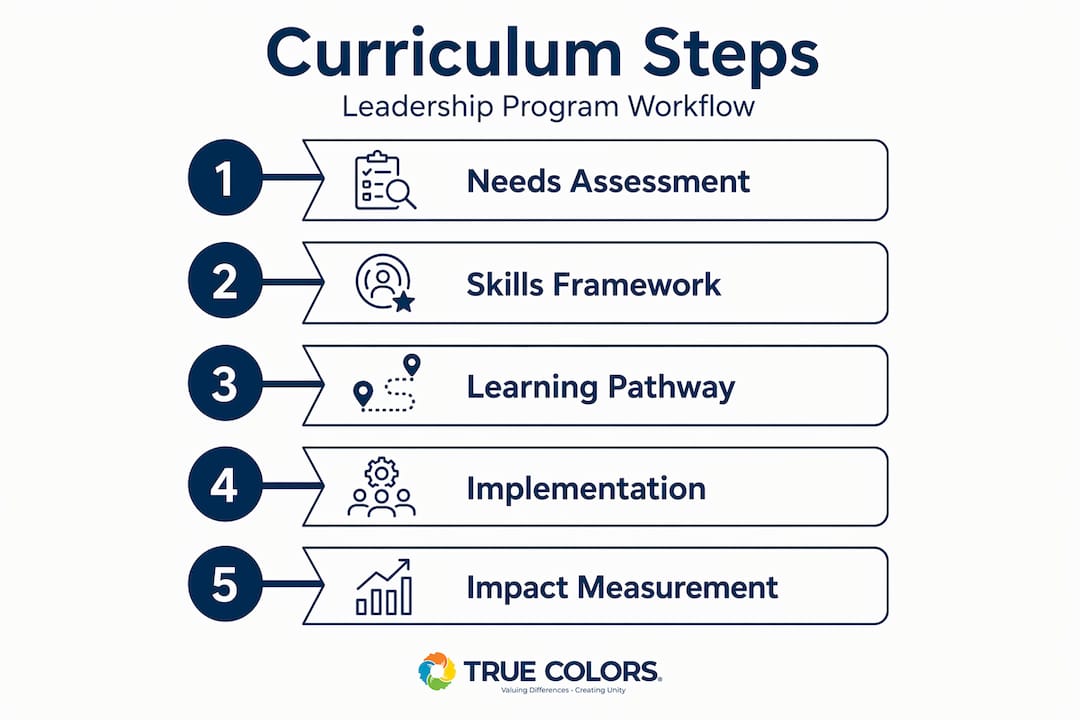
A structured 6-step process has emerged as the benchmark for building effective leadership curricula. That structure covers needs identification, skills definition, pathway design, blended delivery, impact measurement, and program scaling. Each step builds on the previous one. Skip a step, and you are likely to end up with a curriculum that looks good on paper but underdelivers in practice.
Assessing leadership needs and defining capability gaps
Before you write a single learning objective, you need a clear picture of what your leaders currently do well and where observable gaps exist. This is where most programs go wrong. HR teams inherit a wish list from senior executives or default to generic frameworks instead of diagnosing what is actually limiting performance.
Effective needs assessment draws from multiple sources simultaneously:
-
Surveys and self-assessments from current leaders to capture perceived gaps
-
Manager and stakeholder interviews to surface performance patterns not visible in surveys
-
360-degree feedback data to reveal behavioral blind spots
-
Business performance indicators such as team engagement scores, retention rates, and project delivery quality
-
Succession planning data to identify gaps at each leadership level
The output of this step should not be a general wish list. It should be a prioritized list of capabilities that, if developed, would directly improve outcomes your organization cares about. Differentiate needs by leadership level too. A frontline team leader needs different capabilities than a senior director. Conflating those needs produces a curriculum that is too broad to be useful for either group.
Pro Tip: Ask your highest-performing leaders what capabilities they wish they had developed earlier. That answer often reveals the most critical gaps and makes for compelling content to anchor the curriculum.
Leadership development programs fail most often when the design phase begins without this diagnostic step. Do not skip it.
Defining your leadership skills framework
Once you know which capabilities need to be developed, the next step is to organize them into a clear leadership skills framework. This framework defines what good leadership looks like in your organization specifically, not generically. It gives the curriculum a spine.
A competency model typically groups skills into three to five domains. Common examples include:
-
Communication and influence: Active listening, delivering feedback, aligning teams around shared goals
-
Decision-making: Analyzing ambiguous situations, balancing short and long-term tradeoffs, exercising sound judgment
-
Coaching and developing others: Identifying potential, holding performance conversations, enabling growth
-
Adaptability and resilience: Managing change, staying effective under pressure, modeling composure
-
Strategic thinking: Connecting teamwork to organizational priorities, anticipating challenges, planning with longer time horizons
For each competency, define behavioral indicators at different leadership levels. A competency like “coaching others” looks very different at the manager level versus the VP level. Spelling out those differences prevents curriculum content from feeling irrelevant to participants.
Validate the framework by reviewing it with senior leaders and a sample of your highest performers. Their input surfaces nuances that HR teams cannot see from the outside. As Truecolorsintl has observed repeatedly across organizations:
Culture is not what is said. It’s what is repeated.
Your competency framework should describe the behaviors leaders will repeat, not the values they will aspire to. That distinction determines whether the framework becomes a living tool or a forgotten document.
Designing a structured learning pathway
With your framework in place, you can now design the actual curriculum. This is the step where most organizations collapse a thoughtful assessment into a collection of unrelated courses. Resist that pull. What you need is a structured learning pathway that sequences development over time and blends different types of learning.
The 70-20-10 model provides a reliable allocation framework:
| Learning type | Percentage | Examples |
|---|---|---|
| Experiential | 70% | Stretch assignments, real projects, job rotations |
| Social | 20% | Mentoring, peer cohorts, coaching conversations |
| Formal | 10% | Workshops, e-learning courses, seminars |
Most organizations invert this ratio. They spend 70% of their budget on formal training and expect the 10% experiential slice to carry the behavioral change. It never does. Spaced learning over weeks or months with active practice between sessions is far more effective than intensive workshops delivered in isolation.
Pro Tip: Design your curriculum in stages rather than modules. Stage 1 might cover foundational self-awareness. Stage 2 might focus on team dynamics. Stage 3 might address strategic influence. Each stage has clear outcomes that build toward the full competency picture.
When sequencing content, define milestones at each stage and state clear observable outcomes. What should a participant be doing differently at the end of Stage 1? What decisions should they be making differently by Stage 3? Clarity at this level keeps the curriculum honest and gives your measurement strategy something concrete to track.
Avoid content piling, which is the tendency to keep adding resources, readings, and supplementary materials until the curriculum becomes a burden rather than a guide. More content does not lead to greater development. Anchor each stage in a small number of high-quality experiences and then let the application do the teaching.
Delivering and implementing the curriculum
Even the best-designed curriculum fails without deliberate implementation. Delivery is where the learning either takes hold or evaporates. A few principles distinguish organizations that achieve genuine behavior change from those that achieve only completion certificates.

Start by integrating mentors and sponsors with clear, defined roles. Unclear mentor expectations consistently produce inconsistent results. Brief your mentors on what they are there to do, what the curriculum is building toward, and how to conduct effective development conversations.
A practical delivery sequence looks like this:
-
Orientation session to set expectations, introduce cohort members, and establish psychological safety for honest learning
-
Formal learning inputs delivered in short, focused blocks rather than full-day events
-
Stretch assignments deployed between formal sessions so participants apply concepts to real work immediately
-
Peer cohort conversations to process experiences and build shared accountability
-
Coaching touchpoints at regular intervals to surface blockers and reinforce progress
-
Debrief sessions after major assignments where stretch experiences combined with structured reflection accelerate skill development
-
Post-program reinforcement that keeps development moving after the formal curriculum ends
Technology can significantly reduce the administrative friction in managing these steps. Automated governance platforms that centralize cohort tracking, communication, and visibility into progress increase accountability for both participants and program managers. Many organizations running cohorts of 25 to 30 participants find that without centralized tracking, follow-through falls apart within the first few weeks.
Continued development after the formal program is not optional. Culture is built through repetition, and a curriculum that ends abruptly at program completion has already lost half its value.
Measuring impact and iterating the program
You cannot improve what you cannot see, and most organizations are measuring the wrong things. Attendance data, completion rates, and satisfaction scores tell you whether people showed up and whether they liked it. They do not tell you whether behavior changed.
Effective measurement focuses on observable behavioral shifts over time. Useful metrics include:
| Metric type | What it measures | Example |
|---|---|---|
| 360-degree feedback | Behavioral change pre/post program | Direct reports rating manager coaching behavior |
| Team engagement scores | Leadership impact on team climate | Quarterly engagement pulse results |
| Retention rates | Whether leaders are retaining top performers | Year-over-year team retention data |
| Performance outcomes | Business results linked to leadership quality | Project delivery rates, revenue targets |
Most programs fail to measure behavior change at all, which creates a significant accountability gap. If your stakeholders are asking whether the leadership training program is working and your only answer is “participants rated it 4.2 out of 5,” that is a problem worth solving before it erodes the program's budget support.
Curriculum development is a continuous cycle of planning, delivery, reflection, and adjustment. Build a feedback loop into each cohort cycle. After each program delivery, review what worked, what did not land, and what gaps remain. Use that data to sharpen the curriculum before the next cohort begins.
Pro Tip: Conduct a 90-day follow-up with graduates. Ask them which curriculum elements they are still using and which they have abandoned. That data is more honest than any end-of-program survey and far more useful for iteration.
One emerging priority worth noting: AI literacy as a leadership competency is becoming an expectation rather than a differentiator. Designing for it now keeps your curriculum current, and your leaders prepared for the decisions they will actually face.
My honest take on what makes or breaks this process
I’ve seen organizations build genuinely sophisticated leadership curricula, and I’ve seen those same curricula fail to produce any measurable change. The pattern is almost always the same. The curriculum is designed well, but no one is accountable for what happens after participants leave the room.
What I’ve found is that the governing structure around a curriculum matters as much as the content itself. Who reviews the data? Who decides when a module needs to be replaced? Who ensures mentors are actually mentoring? Without that governance, even a well-designed program drifts toward irrelevance within two to three cycles.
The other pitfall I’ve seen repeatedly is what I’d call the expertise trap. Subject matter experts get involved in curriculum design and interpret their role as adding content. Every expert adds their own favorite frameworks, models, and articles. The curriculum becomes dense, overwhelming, and ultimately ignored. Designing leadership courses well requires the discipline to remove things, not just add them.
My most consistent advice: design for behavior first, and let content serve the behavior. If a piece of content cannot be directly connected to something a leader will do differently, it does not belong in the curriculum. That standard alone would cut the average leadership program by about a third, and the remaining two-thirds would be twice as effective. For a deeper look at personalized development strategy, the principles apply directly here.
— Theresa Stairs
How Truecolorsintl supports leadership curriculum development
Building a leadership curriculum from scratch is one of the most complex investments an organization can make, and getting the architecture right from the start determines whether it delivers lasting change or adds to the pile of initiatives that faded quietly.

Truecolorsintl brings a practical, behavior-centered approach to leadership development programs, turning the steps outlined in this article into real organizational capability. The Connected Leadership Program integrates communication training, behavioral awareness, and structured reinforcement to develop leaders who consistently influence, not just when it is convenient. Truecolorsintl’s corporate consulting solutions are designed for organizations that need support with curriculum architecture and delivery, whether you are building from the ground up or refining a program that has stalled. Solutions are adapted across corporate, government, and military environments, making the framework flexible without sacrificing the core behavioral focus that drives real results.
FAQ
What are the first steps to build a leadership development curriculum?
Start with a structured needs assessment that identifies specific capability gaps tied to organizational goals. Map those gaps to leadership levels before designing any content or selecting learning methods.
How long should a leadership development program run?
Research on effective programs points to practice-led journeys of 10 months or longer for mid-career leaders, with small cohorts and a blend of online and in-person learning that prioritizes application over credential completion.
What is the 70-20-10 model in leadership training?
The 70-20-10 model allocates 70% of learning to experiential activities, 20% to social and peer learning, and 10% to formal instruction. This allocation reflects how leadership behavior actually develops, through doing and reflecting rather than listening and reading.
How do you measure whether a leadership program is working?
Measure behavioral change using 360-degree feedback collected before and after the program, alongside team engagement scores, retention data, and relevant performance metrics. Completion rates and satisfaction scores do not indicate whether leadership behavior has actually changed.
What causes leadership development curricula to fail?
The most common causes are a lack of accountability for governance after delivery, content overload that overwhelms participants, and measurement strategies focused on activity rather than behavior change. Connecting every learning element back to observable behaviors that leaders will practice reduces all three failure modes simultaneously.