
Psychological safety is the shared belief that team members can ask questions, admit mistakes, and disagree without fear of humiliation or retaliation. To build psychological safety, start today by inviting one honest question in your next meeting and responding to whatever answer you get with curiosity instead of correction. The practical steps, measurement tools, and 30 to 120 day roadmap that follow show you how to make that first move stick.
TL;DR:
- Building psychological safety requires explicit norms and written commitments to ensure behaviors are reinforced consistently over time.
- Leaders should prioritize designing meetings that distribute voice and normalize speaking up, not just aim for team harmony or comfort.
- Repeated, specific behaviors, such as thanking candor and modeling vulnerability, are more effective than one-time activities or posters.
- Measuring team perceptions through short, frequent surveys and observing in-meeting behavior helps track progress reliably.
- Remote teams must deliberately incorporate structured practices like virtual check-ins and written feedback to foster trust and openness.
Table of Contents
- Why Does Psychological Safety Matter to Performance?
- What Leader Behaviors Actually Build Psychological Safety?
- How Do You Roll Out Psychological Safety in 120 Days?
- How Do You Measure Psychological Safety on a Team?
- What Should Managers Say in Meetings and One-on-Ones?
- What Undermines Psychological Safety Fastest?
- How Does True Colors Turn This Into an Operating System?
- Does Remote Work Change How Psychological Safety Gets Built?
- How Do Teams Build Peer-to-Peer Psychological Safety?
- An Editorial Take on Making Psychological Safety Stick
- Ready to Turn This Roadmap Into a Program?
- Where to Go for More on Psychological Safety
- Sources
Why Does Psychological Safety Matter to Performance?
Psychological safety is not a soft perk. It is a measurable driver of how fast teams learn, how well they perform under pressure, and how long good people stay.
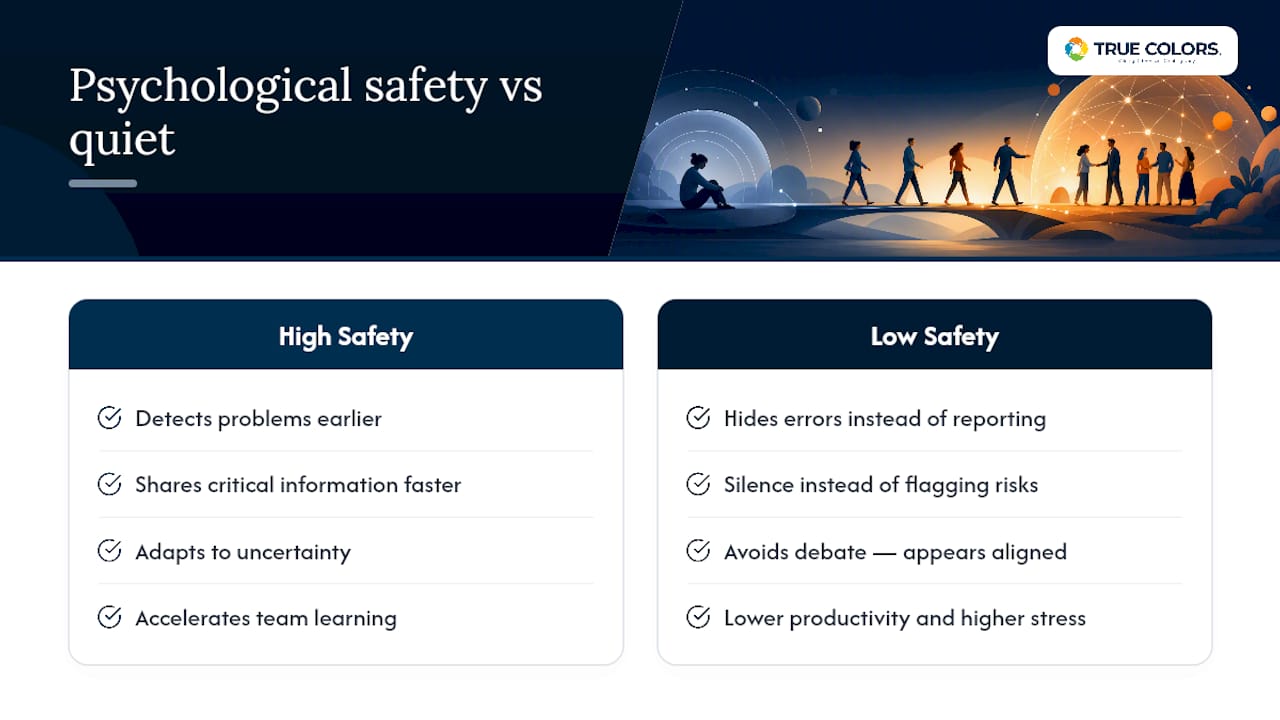
Amy Edmondson's research, synthesized by Harvard Business School, found that teams with high psychological safety detect problems earlier, share critical information faster, and adapt to uncertainty more effectively than teams operating under fear. Peer-reviewed research confirms the mechanism: safety accelerates team learning because people stop hiding errors and start reporting them while they are still fixable.
The trust dividend: A widely cited Harvard Business Review survey referenced in Forbes found people in high-trust workplaces reported significantly greater work energy, markedly better productivity, and substantially lower stress than people in low-trust environments.
Those numbers should reframe how leaders prioritize culture work. Retention, innovation, and speed to market are not separate initiatives from psychological safety. They are downstream of it.
Here is where most leaders trip: they confuse safety with comfort. A team that never disagrees, never challenges a bad decision, and never pushes back on a flawed plan is not psychologically safe. It is quiet. HBR's research on the topic makes the distinction explicit: true safety produces more robust debate, not less, because people can voice a dissenting view without expecting to get punished for it.
Think about the last time someone on your team stayed silent instead of flagging a risk. That silence was not agreement. It was a signal that the cost of speaking up felt higher than the cost of staying quiet. Leaders who chase harmony instead of honesty end up managing a team that looks aligned on paper and is quietly disengaged in practice.
The fix is holding two things at once: high standards and high safety. Expectations stay clear and rigorous. What changes is what happens when someone falls short of them, admits confusion, or raises an uncomfortable question. If your team's best people are leaving, or your best ideas are dying in silence before a meeting, weak psychological safety is worth investigating before you look anywhere else.
What Leader Behaviors Actually Build Psychological Safety?
Most psychological safety advice stops at "be more open." That is not a behavior. It is a wish. The practices below are specific enough to try this week and repeat until they become habits your team recognizes.
-
Make it explicit, then write it down. Psychological safety rarely survives on good intentions alone. Draft a short team charter, three to five lines, that names the behaviors you are committing to: how the team handles disagreement, how mistakes get discussed, who speaks first in meetings. A written norm gives people something to point back to when the pressure is on.
-
Ask more than you answer. Leaders who default to giving direction train their teams to wait for direction. Flip the ratio. Use curiosity prompts like "What am I missing here?" or "What would make this fail?" instead of stating your conclusion and asking for agreement. Practitioner research compiled by HBS consistently ranks this among the highest-leverage moves a manager can make, largely because it shifts the team's mental model of what your meetings are for.
-
Respond to candor like it is valuable, because it is. When someone flags a problem, admits an error, or challenges your idea, the next ten seconds matter more than anything you say for the rest of the meeting. Thank them. Ask a follow-up question. Resist the urge to defend, explain, or minimize. One punitive reaction, even a mild one, teaches everyone watching that honesty has a cost.
-
Model vulnerability yourself, out loud. You cannot ask a team to admit mistakes if you have never visibly admitted one. Naming a call you got wrong, and what you learned from it, does more to establish safety than any policy memo. HBS's research on operationalizing safety points to short behavioral anchors as effective here, phrases like "we treat mistakes as information" that get repeated often enough to become shorthand.
-
Redesign meeting mechanics so voice is distributed, not claimed. Round-robin check-ins, where every person speaks briefly before open discussion starts, prevent the loudest voice from setting the frame. Silent brainstorming, where people write ideas before anyone speaks, protects junior team members and introverts from being drowned out by whoever talks fastest. Structured feedback rounds, where each person gives one comment before rebuttal is allowed, slow down the instinct to shut down a new idea before it is fully understood.
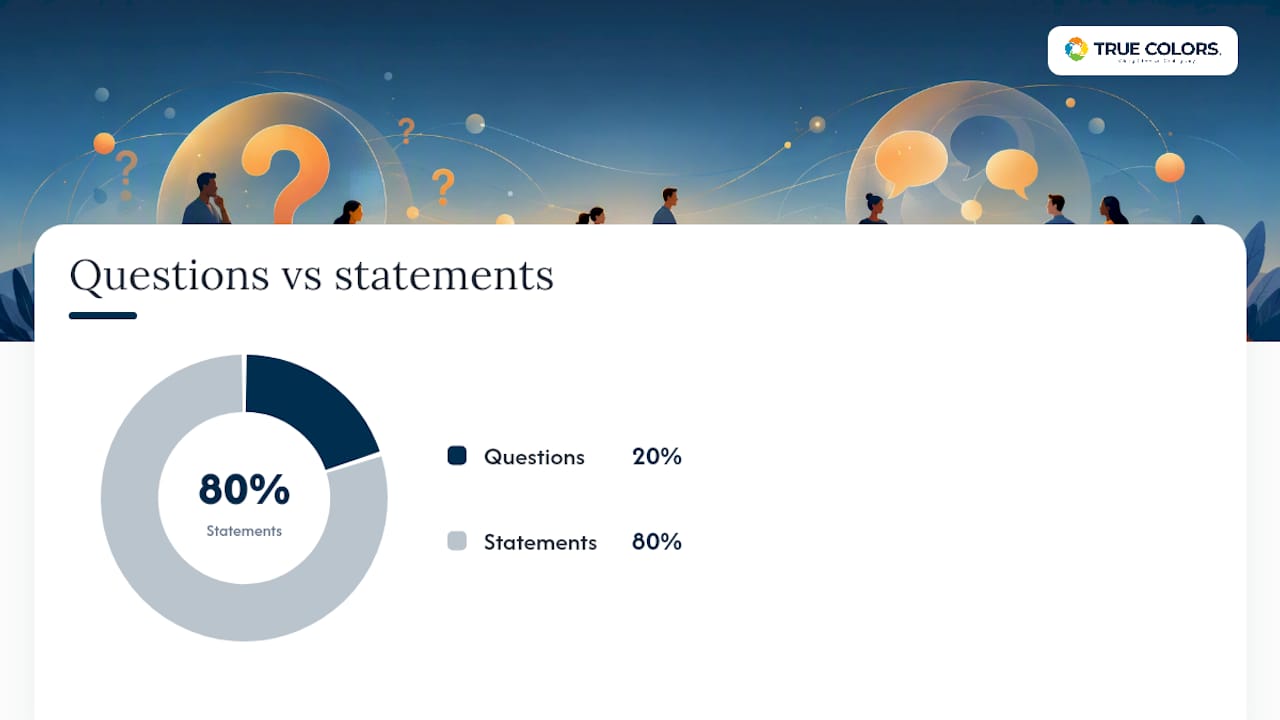
Pro Tip: Track how many questions you ask versus statements you make in your next three team meetings. Most managers are shocked to find the ratio is 4-to-1 in favor of telling. Flipping that ratio, even partially, changes how safe people feel raising a half-formed idea.
One nuance worth naming: psychological safety is a group-level climate, not a collection of individual friendships. A PMC research review draws this distinction clearly. You can have strong one-on-one trust with every person on your team and still run meetings where nobody speaks up, because the group ritual, not the individual relationship, sets the norm. That is why the practices above focus on meeting design and public behavior patterns rather than private rapport. If you want a deeper walkthrough of the emotional-safety exercises behind this, Truecolorsintl's guide to fostering emotional safety breaks down specific team exercises leaders can run in under 30 minutes.
How Do You Roll Out Psychological Safety in 120 Days?
Psychological safety does not happen because a leader decides it should. It happens because specific actions get taken in a specific order, repeated long enough to become the way your team actually works. Here is a sequence that holds up in practice.
Days 1 to 30: Establish the baseline and make the first move.
- Run a short diagnostic, either an informal pulse check or a structured survey, to understand where your team stands today before you change anything.
- Invite one honest question in your next team meeting and respond to it visibly well. This single act sets the tone for everything that follows.
- Adjust one meeting norm immediately, such as adding a round-robin check-in or a two-minute silent write-up before group discussion.
- Draft a team charter with input from at least two team members, not just yourself, and post it somewhere visible.
Days 30 to 90: Build the habit and coach the behavior.
- Run a short training session on psychological safety fundamentals for the full team, framed around behaviors rather than theory.
- Coach frontline managers on the specific response patterns from the section above: thank, probe, avoid punishing candor.
- Pilot one behavioral experiment, like a "no interruptions" rule in status meetings, and ask the team to evaluate it after two weeks.
- Collect a second pulse reading and compare it against your baseline.
Days 90 to 120: Harden the habit into how the organization operates.
- Integrate psychological safety behaviors into performance conversations, specifically how managers are evaluated on team climate, not just output.
- Scale the training and coaching that worked in the pilot group to additional teams.
- Publish a short summary of results to the people who participated. Transparency about what changed, and what did not, builds more credibility than a polished announcement ever will.
A sample charter can be as short as this:
- We ask before we assume.
- We treat mistakes as information, not evidence against a person.
- Anyone can name a risk without needing permission first.
- Disagreement is expected in this room, not tolerated.
And a sample agenda addition for weekly team meetings: open with a 90 second round-robin ("one word for how this week is going"), close with a standing item labeled "what didn't work," and rotate who facilitates that closing item each week so it does not become the manager's job by default. For a deeper set of trust-building exercises to slot into this phase, Truecolorsintl's leadership trust-building practices offers additional structured techniques worth testing during the 30 to 90 day window.
How Do You Measure Psychological Safety on a Team?
You cannot manage what you never measure, and psychological safety is no exception. The good news: measuring it does not require a massive survey initiative.
Amy Edmondson's original scale uses seven statements team members rate on agreement, and a handful translate directly into a working pulse survey:
- "If I make a mistake on this team, it is often held against me." (reverse scored)
- "Members of this team are able to bring up problems and tough issues."
- "It is safe to take a risk on this team."
- "It is difficult to ask other members of this team for help." (reverse scored)
- "People on this team value and respect each other's contributions."
For an ongoing pulse, five items measured quarterly beats twenty items measured once a year. AHRQ's guidance on repeated, lightweight measurement holds up well here: shorter, more frequent checks avoid survey fatigue and let you catch a dip before it becomes a pattern. Aim for a sample large enough to protect anonymity, generally at least eight to ten respondents per team, and track trends over time rather than obsessing over a single score.
Numbers only tell part of the story. Watch what happens in the room itself:
- Who speaks first, and does the same person always speak first?
- Does anyone get interrupted mid-sentence more often than others?
- Do you see eye-rolls, sighs, or glances at the clock when someone raises a concern?
- Does silence follow a hard question, or does someone usually fill it too fast?
When you present results to executives, resist the instinct to round the story up. Show the trend, name the specific behavior changes tied to any movement, and set a concrete target for the next quarter rather than a vague aspiration. A five point increase in one survey item tied to a specific meeting change is more persuasive to a skeptical executive than a general claim that "culture is improving."
What Should Managers Say in Meetings and One-on-Ones?
The gap between knowing psychological safety matters and actually practicing it in a live meeting is where most good intentions die. Specific language closes that gap faster than any framework.
Curiosity starters that work in the moment:
- "What's the part of this you're least sure about?"
- "What would you do differently if there were no wrong answer here?"
- "What am I not seeing?"
- "Walk me through what almost went wrong, not just what went right."
Meeting designs that distribute voice instead of concentrating it around whoever is most senior or most vocal: a two minute silent write-up before any group brainstorm, a structured round where every person shares one thought before open discussion, and a standing "what didn't work" segment that normalizes surfacing problems as routine business, not confession.
When someone does speak up, your response in the next few seconds sets the tone for the next six months. Thank them specifically for raising it. Ask one genuine follow-up question. Enlist them in solving it rather than taking over. That sequence, thank, ask, enlist, is simple enough to remember under pressure, which matters because psychological safety is usually tested in exactly the moments when a manager is stressed and least likely to think clearly.
Pro Tip: In one-on-ones, end with a version of "what's something you didn't feel comfortable raising in the team meeting?" Ask it consistently, even when the answer is "nothing," and eventually people will start testing whether you actually mean it.
For managers building this into ongoing coaching rhythms, Truecolorsintl's guide to building team confidence and competence offers additional coaching prompts suited to one-on-one settings specifically.
What Undermines Psychological Safety Fastest?
Psychological safety is easier to break than to build, and most damage comes from a handful of repeatable mistakes.
- Token activities. A single off-site exercise or a poster about "speaking up" does nothing if the next real disagreement gets shut down in a meeting two days later.
- Ignoring microaggressions. Small dismissive comments left unaddressed teach the whole room what is actually tolerated, regardless of what the team charter says.
- Punitive responses to honesty. Even one instance of someone getting blamed for surfacing a problem can undo months of trust-building.
- Vague accountability. Without a clear escalation path for when norms get violated, "we value psychological safety" becomes a slogan nobody trusts.
Repair is possible, but it has to be visible. Acknowledge the specific incident rather than issuing a general reminder. Investigate what actually happened before assuming intent. Then take a concrete, observable step to restore trust, whether that is a policy change, a direct apology, or a public correction of the behavior. Skipping straight to "let's move forward" without naming what went wrong rarely convinces anyone that it will not happen again.
How Does True Colors Turn This Into an Operating System?
Most psychological safety advice stops at behavior tips. Behavior tips do not stick without a system behind them.
A practical, behavior-based assessment can give leaders and teams a shared vocabulary for how people actually work, communicate, and respond under pressure. That shared vocabulary is what turns a one-time workshop into a lasting operating rhythm, because it gives teams language for naming friction before it becomes conflict.
The roadmap outlined above maps directly onto how True Colors structures an engagement:
- The 30 day assessment phase pairs with True Colors' employee experience surveys, which establish the baseline before any training begins.
- The 30 to 90 day coaching phase pairs with team training and leadership workshops that translate the behavior-based assessment into daily habits, not a one-time event.
- The 90 to 120 day scaling phase pairs with ongoing reinforcement support, so the new norms survive past the initial excitement of a launch.
Culture is not what is said. It's what is repeated. A team charter posted on a wall changes nothing on its own. What changes behavior is a leader who asks the same curiosity question in the same way, week after week, until the team stops waiting to see if it was a one-time act.
Organizations typically pilot this work with a single team or department before scaling company-wide, using the pilot's measured results, pulse survey movement, meeting observation notes, retention signals, to make the business case for a broader rollout. That sequencing matters more than most leaders expect: a credible pilot with honest data beats an ambitious company-wide launch that nobody can point back to six months later.
Does Remote Work Change How Psychological Safety Gets Built?
Remote and hybrid teams face a specific version of this challenge: the informal signals that build trust in person, a hallway comment, a read of someone's body language, a quick check-in after a hard meeting, mostly disappear on a video call.
That means the deliberate practices matter more, not less, for distributed teams. Round-robin check-ins need to become explicit agenda items rather than something that happens naturally when people gather in a room. Silent brainstorming actually works better remotely, since shared documents let everyone contribute without waiting for a turn to unmute. What suffers most is the informal repair moment, the quick "hey, that came out wrong" after an awkward exchange, which requires a manager to deliberately follow up over direct message or a scheduled call rather than assuming it will resolve itself.
Camera-off cultures deserve specific attention. If half your team keeps cameras off by default, you are losing the nonverbal cues that tell you who is engaged and who is checking out. Rather than mandating cameras, which can backfire for people managing bandwidth or personal circumstances, build in more direct check-ins: a rotating "how are you actually doing" question at the start of team meetings, or a private one-on-one cadence that does not depend on catching someone's expression on a shared call.
Asynchronous tools also change what "speaking up" looks like. A written comment in a shared document, submitted without needing to interrupt a live meeting, can be a safer first step for someone hesitant to speak out loud. Building that option in deliberately, rather than treating video meetings as the only forum that counts, widens who actually contributes.
How Do Teams Build Peer-to-Peer Psychological Safety?
Leaders set the tone, but psychological safety that depends entirely on the manager being present is fragile. The strongest teams build safety peer to peer, so it survives a manager's day off, a reorganization, or a new hire's first week.
Peer accountability starts with naming it explicitly: ask the team, not just leadership, to agree on how they want to handle disagreement with each other, not just with their manager. A team charter built collaboratively, rather than handed down, creates more peer ownership than one written solely by a manager.
Peer recognition matters here too. When a teammate thanks a colleague for flagging a risk or asking an uncomfortable question, in the moment, in front of the group, it reinforces the norm more durably than the same message coming from a manager, because it signals the whole team values it, not just the person in charge.
Structured peer feedback rounds, where colleagues give each other input on a shared project before a manager weighs in, build the muscle of receiving hard feedback without waiting for permission or protection from above. Rotating who leads that feedback round, rather than always defaulting to the most senior person, spreads both the practice and the trust more evenly across the team.
An Editorial Take on Making Psychological Safety Stick
Most psychological safety content stops at inspiration: research citations, a definition, a call to "be more open." The research actually supports something narrower and more useful, that safety is built through repeated, specific behaviors inside meetings and one-on-ones, not through a single training or a poster campaign.
The conventional advice underestimates how much psychological safety depends on group ritual rather than individual goodwill. A well-liked manager who never redesigns a meeting agenda, and a strict manager who runs disciplined round-robins and thanks people for hard questions, will produce very different team climates, regardless of who is more personally approachable.
If you take one thing from this guide, prioritize the meeting mechanics before the mission statement. A charter without a changed meeting is decoration. A changed meeting, repeated consistently, becomes a culture whether or not anyone ever writes it down.
— Theresa
Ready to Turn This Roadmap Into a Program?
Reading a roadmap and running one inside a real organization, across multiple teams, with actual resistance and actual time constraints, are different problems. A behavior-based system gives leaders a shared language for culture and a reinforcement structure that keeps the work moving after the initial training ends.

The phases in this guide map directly onto how we structure engagements. Teams ready to establish a baseline typically start with our employee experience survey to measure where trust and communication actually stand today. Teams ready to build manager-level habits move into our Connected Leadership training program, which translates the behaviors covered above into a structured coaching cadence rather than a single workshop.
If you are an HR leader or organizational leader weighing where to start, visit Truecolorsintl to request a consultation and talk through which phase your team is actually in right now.
Where to Go for More on Psychological Safety
- HBS Online's guide to psychological safety for Edmondson's foundational research and diagnostic scale.
- AHRQ's psychological safety handout for meeting-level facilitation tips and governance worksheets.
- OSHA's step-by-step safety program guide for a worksheet model on worker participation and management leadership.
- The PMC review of psychological safety and team learning for the peer-reviewed evidence base behind the practices in this guide.
Sources
- How to Build Psychological Safety in the Workplace — HBS Online
- Creating Psychological Safety in Teams: Handout — AHRQ
- Step-by-step guide — OSHA recommended practices for safety and health programs
- Peer-reviewed article on psychological safety and team learning — PMC
Recommended
- Building a Fortress of Trust: Fostering Emotional Safety in Your Workplace
- How Do I Build Team Confidence and Competence? A Practical Strategy for People Leaders
- Leadership Team Trust Building Practices That Work
- What Are the Warning Signs of Toxic Leadership, And How Do You Repair the Culture They Leave Behind?