
A focused team effectiveness workshop should leave every participant with three concrete deliverables: a written Team Agreement, at least three time-bound behavior commitments with named owners, and a scheduled 30-day follow-up date. To produce those outcomes, your design needs six essential elements working together.
What you need to produce before the session:
- Measurable objectives tied to behavioral and business outcomes
- A confirmed participant list with roles and power dynamics mapped
- A timed agenda template matched to your available window
- A curated activity bank with debrief prompts for each exercise
- A facilitator moves plan covering openings, conflict, and synthesis
- A materials and tech checklist plus a measurement approach
The diagnostic backbone for this guide is the Six Conditions of Team Effectiveness (real team, compelling purpose, right people, sound structure, supportive context, and team coaching), a validated model that tells you where to focus before you pick a single activity. Truecolorsintl's behavior-to-action system then converts that awareness into reinforced habits. Evidence from CIPD's review of high-performing teams confirms that team-focused interventions targeting group processes and goal clarity produce moderate-to-large effects on performance outcomes. This guide gives you the planning checklist, agenda templates, activity bank, facilitation scripts, and measurement cadence to get there.
Table of Contents
- How do you plan a team effectiveness workshop step by step?
- Ready-to-use agenda templates and timing
- Which activities build real team effectiveness?
- What does a skilled facilitator actually do in the room?
- What materials and tech do you need for in-person and hybrid sessions?
- How do you measure whether a workshop actually changed anything?
- What diagnostic framework should back your workshop design?
- Key Takeaways
- Why the workshop is the beginning, not the event
- How Truecolorsintl supports workshop design and long-term reinforcement
- Useful sources and further reading
How do you plan a team effectiveness workshop step by step?
Good planning is where workshops succeed or fail, long before anyone enters the room. Professional facilitators report that substantial planning relative to live session time is a reliable quality predictor. That ratio exists because surface-level design produces surface-level conversations.
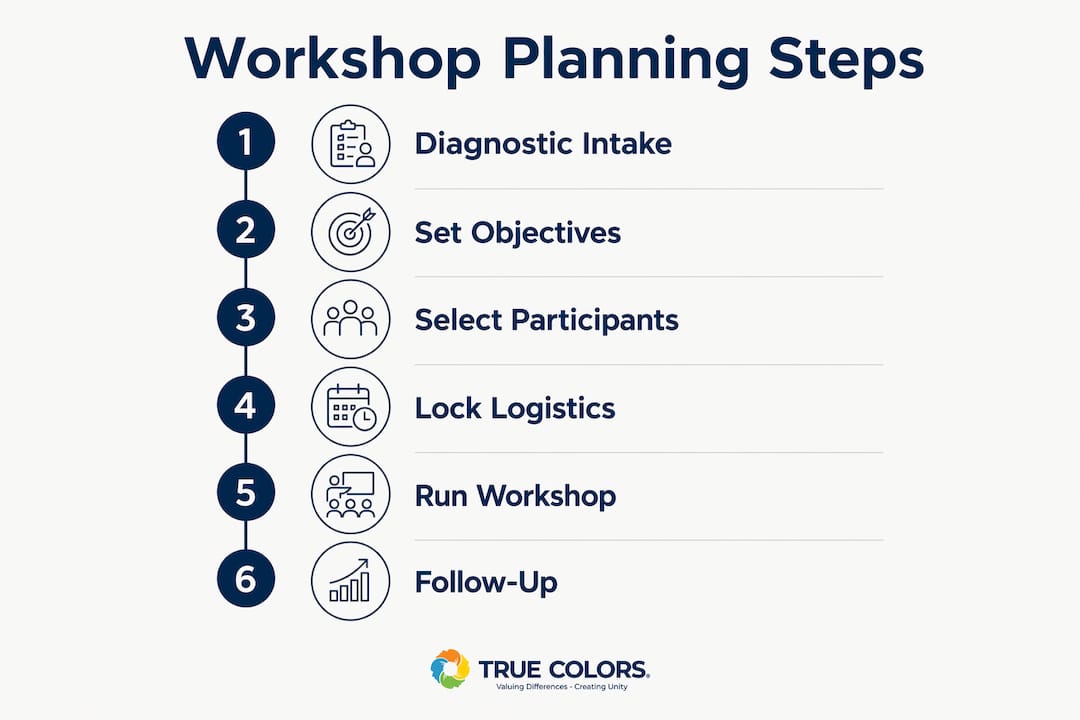
Step 1: Run a diagnostic intake
Before writing a single agenda item, answer these questions:
- What specific team process is underperforming? (role clarity, decision speed, conflict norms, trust, alignment)
- Who holds decision authority in the room, and how will that affect psychological safety?
- What baseline data exists? (prior survey scores, performance metrics, exit interview themes)
- Is a workshop the right intervention, or does the issue require a structural or personnel change first?
Score your team against the Six Conditions on a 1–5 scale. Conditions scoring 3 or below become your workshop priorities. This prevents the common mistake of designing a morale activity when the real gap is unclear decision authority.
Step 2: Convert vague aims into measurable objectives

Every objective should complete this sentence: "By the end of this workshop, participants will have [specific output]." Vague goals produce vague outcomes.
Sample objective templates:
- "Participants will produce a written decision-rights map covering the team's top five recurring decisions."
- "The team will agree on three observable communication norms and assign a 30-day accountability owner for each."
- "Leaders will identify the top two structural barriers to cross-functional collaboration and assign owners to address them within 60 days."
Step 3: Confirm participant selection
Ideal group size for a team effectiveness session is small to medium, balancing perspective diversity and facilitation complexity. Include the team leader, but plan for their presence to affect candor. Liberating Structures techniques (covered in Section 5) help equalize voice when senior leaders are present.
Step 4: Lock logistics and pre-work
Decisions to finalize before design begins:
- Outcome: what written deliverable leaves the room with participants
- Authority: who can commit to behavior changes on behalf of the organization
- Required deliverables: Team Agreement, decision map, action plan
- Follow-up cadence: 30-day pulse and 90-day review dates confirmed before the session ends
- Pre-work: send a short diagnostic survey or the Six Conditions self-assessment 5–7 days ahead to reduce warm-up time and surface tensions the facilitator needs to plan around
Ready-to-use agenda templates and timing
Three core formats cover most situations. Choose based on your time window and the complexity of the team's challenges. A well-designed workshop opening disproportionately determines engagement quality, so every template below protects opening time.
Agenda timing table
| Format | Total Time | Opening | Explore/Diagnose | Working Activities | Synthesis | Commitments + Close | Buffer |
|---|---|---|---|---|---|---|---|
| 90-minute | 90 min | 10 min | 15 min | 30 min | 15 min | 10 min | 5 min |
| Half-day (~4 hrs) | 210 minutes | 15 min | — | — | 30 min | 20 min | 15 min |
| Full-day (~7 hrs) | 420 minutes | 30 min | 60 min | 180 minutes | 60 min | 60 min | 30 min |
| Remote 90-min | 90 min | 15 min | 15 min | 30 min | 15 min | 10 min | 5 min |
Notes on each format:
- 90-minute session: Best for a single focused objective (one decision, one norm, one conflict to surface). Tight; skip any activity that requires more than one debrief cycle.
- Half-day: The most versatile format. Enough time for a diagnostic review, two working activities, and a written Team Agreement. Recommended for teams running their first effectiveness session.
- Full-day: Use when the team has multiple systemic gaps or when the session doubles as a planning retreat. Build in two 15-minute breaks and a 45-minute lunch; energy management is as important as agenda design.
- Remote 90-minute variant: Add 5 minutes to the opening for tech checks and camera norms. Use breakout rooms of 3–4 people maximum. Assign a co-facilitator as tech producer. Reduce working activity time and increase synthesis time because virtual convergence takes longer.
Hybrid modifications: Assign one facilitator to manage the in-room group and a second to monitor remote participants' chat and reactions. Use a shared digital board (Miro, Mural, or FigJam) as the single source of truth for all outputs. Check audio from the remote side before every major transition.
Which activities build real team effectiveness?
The principle here is method-to-outcome matching: choose an activity because it creates a specific cognitive or relational shift, not because it is popular. Research on team effectiveness consistently shows that high-leverage work targets team processes (role clarity, decision-making, conflict management) rather than morale alone.
Activity bank by objective
| Activity | Objective | Time | Group Size | Materials | Debrief Prompt |
|---|---|---|---|---|---|
| 1-2-4-All (Liberating Structures) | Equalize voice, surface assumptions | 15–15 min | — | Sticky notes or digital board | "What surprised you about what others said?" |
| Role Clarity Map | Clarify ownership and handoffs | 25 min | 6–12 | Whiteboard or shared doc | "Where do you see overlap or gaps?" |
| Decision Rights Matrix | Align on who decides what | 30–— | 6–15 | Printed or digital RACI template | "Which decisions cause the most friction today?" |
| Conflict Norms Agreement | Build productive conflict norms | 20–20 min | 6–15 | Flip chart | "What makes it safe to disagree here?" |
| Team Health Monitor | Diagnose strengths and gaps | 20 min | 6–15 | Health monitor cards or digital poll | "Which area needs attention first?" |
| Purpose Alignment Check | Reconnect to shared goals | 15–15 min | Any | None required | "What would change if we lived this purpose daily?" |
Facilitation notes by activity:
- 1-2-4-All works especially well when senior leaders are present. Participants reflect alone (1 minute), then in pairs (2 minutes), then in groups of four (4 minutes), then share with the full group. This structure prevents dominant voices from setting the frame before quieter members have formed their own view.
- Role Clarity Map produces the most value when each person writes their own role description first, then the group compares. Gaps and overlaps become visible without blame.
- Decision Rights Matrix often surfaces the real source of team friction faster than any other activity. Use a simple RACI (Responsible, Accountable, Consulted, Informed) format and limit the exercise to the team's top five recurring decisions.
- Team Health Monitor, adapted from the Atlassian Team Health Monitor approach, works as both a pre-workshop diagnostic and a post-workshop pulse. Using it as a repeated measure lets you track whether behavior commitments are holding at 30 and 90 days.
Sequencing principle: Move from divergent (generating, exploring) to convergent (prioritizing, deciding) within each activity block. Never run two convergent activities back to back; the group needs space to surface new information before narrowing.
Pro Tip: For mixed-seniority groups, run the Role Clarity Map and 1-2-4-All before any activity that requires open disagreement. Psychological safety builds in layers; rushing to conflict work before trust is established produces surface-level answers.
What does a skilled facilitator actually do in the room?
Facilitation is not hosting. It is actively managing the conditions under which a group thinks, disagrees, and commits. Investing in a practiced opening dramatically improves the depth of every conversation that follows.
Opening sequence
Start with a structured check-in that equalizes voice before the work begins. Sample wording: "In one sentence, share your name, your role, and one word that describes how you're showing up today." This takes 8–12 minutes for a group of 10 and accomplishes three things: it gives every voice airtime before the first substantive question, it surfaces energy levels the facilitator needs to calibrate pacing, and it signals that this session operates differently from a standard meeting.
Follow the check-in with a clear framing statement covering: the session's single measurable objective, what participants will produce, ground rules (one voice at a time, phones down, confidentiality within the room), and the follow-up commitment the organization is making.
Managing productive conflict
Productive conflict is disagreement about ideas, priorities, or approaches. Relationship conflict is personal. Your job is to keep the group in the first category.
- Fishbowl technique: When one perspective is dominating, move 3–4 people to an inner circle to discuss while others observe silently, then rotate. This slows the conversation and forces listening.
- TKI framing: Reference the Thomas-Kilmann Conflict Mode Instrument framework to name conflict styles without blame. "It sounds like we have a competing and an accommodating style in tension here" depersonalizes the dynamic.
- Structured prioritization: When the group is stuck between options, use dot voting or a 2x2 impact/effort matrix to move from debate to data.
Timing architecture
Run every working block with a visible timer. Use a parking lot (a designated space on the whiteboard or digital board) for important topics that emerge but fall outside the current objective. At the end of each block, run a 3-minute micro-debrief: "What did we just learn? What does that mean for our commitments?"
Pro Tip: When the agenda is clearly not working (energy has dropped, the group is circling, or a deeper issue has surfaced), pause and name it. Say: "I'm noticing we keep returning to X. Is that the real issue we need to address?" Naming the pattern gives the group permission to redirect without losing the facilitator's credibility.
Closing sequence
A strong close produces written commitments, not verbal ones. Walk through this sequence:
- Synthesize the session's key insights in 3–5 bullet points on the board.
- Ask each participant to write one behavior they will change and one they will stop.
- Compile these into a Team Agreement document before anyone leaves the room.
- Confirm the 30-day follow-up date, the owner, and the format (pulse survey, team meeting, or both).
Vague commitments predict rapid decay. A written agreement with named owners and dates is the single most reliable predictor of whether workshop behavior change survives the return to normal work.
What materials and tech do you need for in-person and hybrid sessions?
Logistical friction is a facilitation problem. Every minute spent troubleshooting a projector or hunting for markers is a minute of trust and momentum lost.
In-person materials checklist
- Flip chart paper and markers (at least two colors per table)
- Sticky notes in three sizes
- Printed agenda and activity templates for each participant
- A visible timer (physical or projected)
- Whiteboard or wall space for parking lot and synthesis
- Printed Team Agreement template for the closing
Virtual and hybrid tech stack
- Video platform with breakout room capability (Zoom, Microsoft Teams, or Google Meet)
- Collaborative digital board (Miro, Mural, or FigJam) with a pre-built template loaded before the session
- Live polling tool (Mentimeter or Slido) for check-ins and quick diagnostics
- A shared document (Google Docs or Microsoft Word Online) for the Team Agreement
- A backup audio option (phone dial-in) in case of connectivity issues
Facilitation roles for hybrid sessions:
- Lead facilitator: manages the agenda, activities, and group energy
- Tech producer / co-facilitator: monitors chat, manages breakout rooms, troubleshoots audio and video, and keeps remote participants visible
- Scribe: captures decisions and commitments in real time on the shared document
Hybrid-specific guidance: Position the in-room camera so remote participants can see the full group, not just the presenter. Use the digital board as the primary working surface for all participants, in-room and remote alike, so no one is watching others work. Check audio from the remote side at least 10 minutes before the session starts.
Room configuration for in-person sessions: clusters of 3–4 for group work, U-shape for full-group discussion, and theater only for brief presentations. Avoid rows; they signal a passive learning mode that undermines the collaborative intent of the session.
How do you measure whether a workshop actually changed anything?
Workshops fail most often not in the room but in the weeks after. Planning reinforcement and follow-up as part of the workshop design, not as an afterthought, is what separates a conversation from a culture shift.

Measurement plan
| Measure | Timing | Method | Owner |
|---|---|---|---|
| Baseline diagnostic | 5–7 days before | Six Conditions self-assessment or Team Health Monitor | HR or facilitator |
| Immediate reaction | End of session | 5-question pulse survey (clarity, safety, commitment, relevance, next step) | Facilitator |
| 30-day behavior pulse | 30 days post-session | 3-question check-in on Team Agreement commitments | Team leader |
| 90-day review | 90 days post-session | Repeat baseline diagnostic + qualitative discussion | HR or L&D partner |
Feedback and action-plan template
Immediate reaction survey (5 questions, 1–5 scale):
- How clear are you on the team's top priorities after today?
- How safe did you feel sharing your honest perspective?
- How committed are you to the behavior changes agreed today?
- How relevant was today's session to your day-to-day work?
- What one thing should we do differently at the next session?
Action-plan template (complete before participants leave):
- Commitment: [specific observable behavior]
- Owner: [named individual]
- By: [date, no more than 30 days out]
- How we'll know it happened: [observable indicator]
Governance for follow-up
The 30-day pulse owner should be the team leader, not the facilitator. This signals that behavior change is a leadership responsibility, not a training event. If commitments are slipping at 30 days, escalate to the sponsoring leader with the Team Agreement in hand, not a general update. The 90-day review should repeat the baseline diagnostic so the team can see movement on the same measures, making progress visible and reinforcing the habit of measurement. Measuring across multiple dimensions (task performance, contextual performance, adaptive performance) gives a more accurate picture than any single metric.
What diagnostic framework should back your workshop design?
The Six Conditions of Team Effectiveness, developed by J. Richard Hackman and widely applied in organizational development, gives facilitators a validated map of where team performance breaks down. Each condition addresses a distinct lever.
Six Conditions diagnostic checklist
| Condition | What it diagnoses | Score 1–5 | Workshop priority if score ≤ 3 |
|---|---|---|---|
| Real team | Stable membership, clear boundaries | __ | Clarify team membership and roles |
| Compelling purpose | Shared, meaningful direction | __ | Purpose alignment activity |
| Right people | Skills, diversity, size | __ | Role clarity and talent gap discussion |
| Sound structure | Norms, task design, decision rights | __ | Decision Rights Matrix, Conflict Norms Agreement |
| Supportive context | Resources, rewards, information | __ | Escalation to sponsoring leader |
| Team coaching | Access to skilled facilitation and coaching | __ | Schedule follow-up coaching cadence |
Score each condition 1–5. Conditions at 3 or below become the workshop's design priorities. This prevents the common failure of running a trust-building activity when the real gap is unclear decision authority or inadequate resources.
Embedding True Colors' behavior-to-action workflow
Truecolorsintl's behavior system maps directly onto the workshop and follow-up arc:
- Awareness: Use the True Colors assessment pre-workshop to surface behavioral style differences and communication preferences. This data feeds the opening and the Role Clarity Map.
- Agreements: The Team Agreement captures the behavioral commitments the group makes based on that awareness.
- Coaching: Post-workshop consulting and coaching reinforces the agreements through structured check-ins and leader behavior modeling.
- Measurement: The 30-day pulse and 90-day review close the loop, making behavior change visible and creating accountability.
This four-step cycle is what separates a one-off workshop from a team communication training system that compounds over time. For teams scaling this work across multiple departments, Truecolorsintl's corporate solutions provide the infrastructure to run the cycle organization-wide. The True Colors behavior system is grounded in decades of applied research and practitioner use across industries.
For facilitators looking to build in-house capability, advanced facilitator certification through Truecolorsintl provides the skills to run this diagnostic and facilitation cycle independently. Organizations building franchise-style training programs have found similar reinforcement structures essential for consistent outcomes across locations.
Key Takeaways
A well-designed team effectiveness workshop produces a written Team Agreement, named behavior owners, and a scheduled 30-day follow-up date—those three outputs are what determine whether the session changes anything.
| Point | Details |
|---|---|
| Plan before you design | Allocate 2–3 hours of diagnostic and design work for every 90 minutes of live session time. |
| Match activities to outcomes | Choose each activity because it creates a specific cognitive or relational shift, not because it is popular. |
| Protect the opening | A structured check-in that equalizes voice before the work begins dramatically improves the depth of every conversation that follows. |
| Written commitments only | Vague verbal commitments predict rapid decay; a Team Agreement with named owners and dates is the reliable predictor of behavior change. |
| Truecolorsintl reinforcement | Truecolorsintl's awareness-to-agreements-to-coaching-to-measurement cycle converts workshop insights into reinforced organizational habits. |
Why the workshop is the beginning, not the event
Most organizations treat a team effectiveness workshop as the intervention. The session happens, people feel energized, and then the normal rhythm of work reasserts itself within two weeks. The commitments fade. The Team Agreement sits in a shared drive no one opens.
The real failure is not the workshop design. It is the assumption that awareness creates change on its own. It does not. What creates change is repeated behavior, observed and reinforced by leaders who model it consistently. A workshop is the moment a team names what it wants to be different. The follow-up cadence is where that naming either becomes real or becomes another item on the list of things the organization tried.
The teams that improve fastest are not the ones with the best workshop design. They are the ones with leaders who treat the 30-day pulse as seriously as the session itself, who bring the Team Agreement back into team meetings, and who ask "are we living this?" as a regular question rather than a post-workshop formality. That discipline is harder to design into an agenda. It has to be built into leadership behavior, which is exactly why workshop work and leadership development belong in the same conversation.
How Truecolorsintl supports workshop design and long-term reinforcement
Designing and running a single team effectiveness workshop is achievable with this guide. Scaling that work into a repeatable culture-change program is where most organizations need a structured partner.
Truecolorsintl brings a complete system to that challenge: proprietary behavior-based assessments that feed your pre-workshop diagnostic, facilitated team-building workshops designed around the Six Conditions framework, and post-workshop reinforcement through the Connected Leadership Program and ongoing coaching. The Employee Experience Survey provides the baseline and follow-up measurement data your 30-day and 90-day reviews need to show real movement. For organizations ready to move from a single session to an organization-wide culture program, True Colors' corporate consulting provides the infrastructure, facilitator support, and measurement cadence to make that happen.
Contact Truecolorsintl to schedule a scoping call and get access to workshop templates, facilitator guides, and a customized program design for your team.
Useful sources and further reading
The research and practitioner sources behind this guide, with a note on what each offers:
- CIPD: High-Performing Teams Evidence Review — Synthesizes evidence on team interventions, with specific findings on trust, cohesion, and communication outcomes. Use this to justify your activity choices to stakeholders.
- NCBI: Overview of Research on Team Effectiveness — Academic review covering measurement dimensions and intervention levers. Useful for building a multi-metric measurement plan.
- TD.org: Six Conditions of Team Effectiveness — Practitioner guide to applying the Six Conditions diagnostic, including the 1–5 scoring approach.
- Workshop Weaver: Team Building Workshop Activities and Facilitation Guide — Practitioner-grade facilitation guidance covering the 30/90-day follow-up cadence, Team Agreement structure, and the Team Health Monitor as a repeated diagnostic.
- Workshop Weaver: Workshop Planning Guide — Step-by-step planning checklist from objective definition through post-session follow-up, including the 2–3:1 planning ratio and agenda flow principles.
- Sagepub: Enhancing the Effectiveness of Work Groups and Teams — Foundational academic review of team processes and intervention levers across 50 years of research. Recommended for facilitators building a theoretical grounding for their practice.
- Franchise Fast Track: Effective Franchise Training Programs — Practical guidance on building reinforced training habits at scale, relevant for organizations rolling out workshop programs across multiple teams or locations.