
Most useful employee surveys should be confidential, not anonymous, backed by transparent reporting rules, minimum group sizes, access controls, and strict comment handling. True anonymity sounds safer, but it strips away your ability to follow up, link results to outcomes, or act on what you learn.
If you're deciding between the two right now, favor confidential surveys with strict, testable controls. Anonymous formats work for one-off pulse checks, but they become impractical the moment you need longitudinal data or targeted follow-up. What makes "confidential" credible instead of a marketing word is a specific set of controls:
- A minimum reporting threshold (commonly n ≥ 5) before any breakdown gets shown
- De-identification or de-linking procedures separating identity from response data
- Role-based access controls limiting who can view raw or granular data
- Encryption and secure storage for data at rest and in transit
- A transparent reporting plan communicated to employees before launch
Employees who doubt confidentiality promises give shallower, less honest answers. The checklist below turns the promise into something you can actually test.
Key Takeaways
Confidential surveys with engineered controls protect respondents more reliably than anonymity alone, because tested reporting rules prevent re-identification that anonymous formats often miss.
| Point | Details |
|---|---|
| Choose confidential over anonymous | Confidential surveys with strict access controls support follow-up and longitudinal tracking that anonymous formats can't. |
| Set a minimum reporting threshold | Hide results for groups smaller than five respondents, and raise that bar for sensitive topics. |
| Test for differencing before publishing | Cross-check every planned report cut against every other cut to catch accidental re-identification. |
| Sanitize open-text comments | Paraphrase or theme verbatim responses and require a minimum count before attributing a theme to a group. |
| Work with a partner who builds this in | Truecolorsintl's Employee Experience Survey embeds secure linkage and a documented reporting plan from the start. |
Table of Contents
- Anonymous vs. Confidential Employee Survey Practices
- Can Employees Really Be Re-Identified From "Anonymous" Data?
- What Controls Make a Confidential Survey Trustworthy?
- How Do You Roll Out a Confidential Survey Without Losing Trust?
- How Truecolorsintl Applies Confidentiality Controls in Practice
- What Most Confidentiality Guidance Gets Wrong
- Get Help Designing a Confidential Employee Survey
- Sources
Anonymous vs. Confidential Employee Survey Practices
The two terms get used interchangeably in casual conversation, and that's a problem, because they describe fundamentally different systems.
An anonymous survey collects no linkable identifiers at all. Nobody, not HR, not the vendor, not an administrator with root access, can trace a response to a person. A confidential survey does retain identity, usually with the vendor or a restricted HR function, but access to that identity is locked down and separated from reporting views. Qualtrics frames this distinction as a trade-off between perceived candor and actionability, and that framing holds up in practice.
Here's how the trade-offs actually play out:
| Factor | Anonymous | Confidential |
|---|---|---|
| Perceived candor | Higher | Moderate to high with trust-building |
| Follow-up ability | None | Possible through controlled channels |
| Links to HRIS/longitudinal data | Not possible | Possible with strict access limits |
| Risk of duplicate submissions | Higher without controls | Lower, since identity is verifiable |
| Best for | One-time sensitive pulse checks | Ongoing engagement, DEI, retention tracking |
Use anonymous formats for a single sensitive check, something like a quick pulse on a reorganization announcement, where the goal is a temperature read, not a program. Reach for confidential design when you're running DEI tracking, retention analytics, or anything you plan to measure year over year. Attributed data under strict safeguards, as Workforce Science Associates argues, lets you act on results without pretending the data floats free of identity.
Can Employees Really Be Re-Identified From "Anonymous" Data?
Yes, and it happens more easily than most HR teams expect. Anonymity is a design goal, not a guarantee, and it fails in predictable ways.
Differencing attacks are the biggest hidden risk. Say a report breaks results out by department, then a separate cut breaks results out by tenure. Someone comparing both tables can often isolate the one person who fits both categories, even though neither report named them individually. Overlapping cuts, published side by side, do the re-identifying work nobody intended.
Open-text comments cause similar damage. A verbatim comment that mentions a specific project, a manager's name, or an unusual schedule can identify the writer instantly, no matter how the demographic fields were scrubbed. Add in multiple submissions from the same person (ballot-box stuffing) and you get skewed results layered on top of privacy risk.
Before you trust an "anonymous" label, run these checks:
- Simulate differencing on your draft reports by cross-referencing every planned cut against every other one.
- Read every open-text response for identifying details before it reaches a manager.
- Run a mock re-identification test with a colleague who wasn't involved in survey design.
Pro Tip: Print your planned report cuts on paper and physically lay them side by side. If you, a person who already knows the org chart, can guess who said what within two minutes, so can your employees.
What Controls Make a Confidential Survey Trustworthy?
Confidentiality becomes real through specific, documented mechanics, not through a policy statement. Treat this like an engineering spec, not a promise.
1. Set a minimum reporting threshold. The common industry default hides results for any group smaller than five respondents. Push that threshold higher for particularly sensitive topics like harassment or discrimination, where very small groups in a tight-knit team might be identifiable by context.
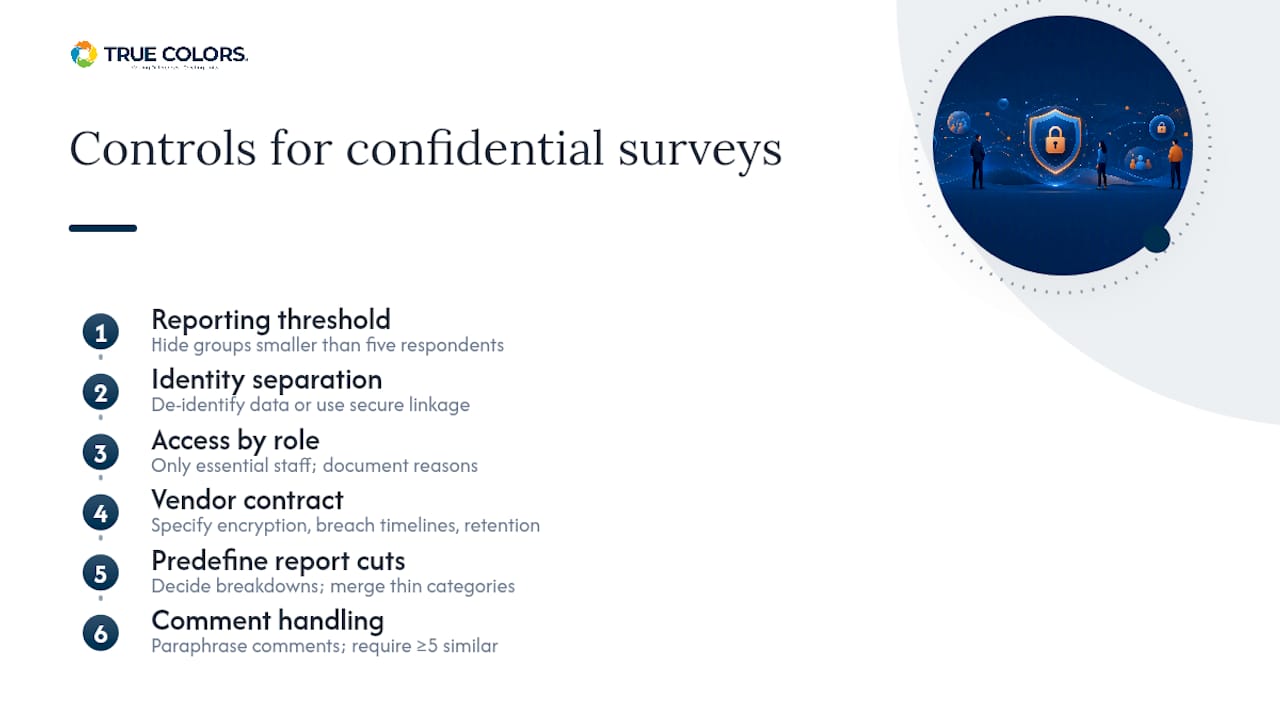
2. Separate identity from response data. De-identification means stripping identifiers permanently. Secure linkage means keeping a mapping between identity and response, but storing that mapping somewhere only a narrow, named set of people can reach. Know which one your vendor actually uses, because they get described interchangeably in sales conversations.
3. Restrict access by role. Restrict raw data access to only essential personnel and separate survey administration from analysis, and require a documented reason for anyone touching individual-level records.
4. Put data handling in the vendor contract. Encryption standards, breach notification timelines, and retention limits belong in writing, not in a verbal assurance during the sales call.
5. Predefine every report cut before launch. Decide in advance which demographic breakdowns you'll publish, and check every combination for differencing risk. Merge thin categories rather than reporting them separately.
6. Set comment handling rules up front. Paraphrase or theme verbatim comments rather than quoting them directly, and set a minimum count (often five or more similar comments) before any theme gets attributed to a specific group.
Vendors converge on this same pragmatic middle ground: attribute data when you need to act on it, but build the reporting safeguards in from day one rather than bolting them on after a leak.
How Do You Roll Out a Confidential Survey Without Losing Trust?
Getting the technical controls right matters less than getting them communicated right. Employees don't audit your database. They read your invite email and decide whether to believe you.
- Choose your approach and document the reporting plan before you write a single survey question. Set thresholds, establish vendor confidentiality clauses, and pilot the report format carefully.
- Run a re-identification test on your pilot data using the differencing checks described above.
- Write the invite script explicitly. State who sees raw data, what the minimum group size is, how comments get handled, and who to contact for a confidential follow-up conversation.
- Surface action plans without exposing individuals. Report themes and trends, not the comment that triggered the theme.
- Build a safety escalation path for anything touching harassment or misconduct, separate from standard reporting, with a named contact who isn't the employee's direct manager.
- Report back on a fixed timeline. Tell employees when they'll hear results and what happens next, then hit that date.
- Audit the whole system annually. Review retention schedules, confirm access logs match your policy, and keep an internal escalation path ready for any suspected re-identification.
Pro Tip: Put your reporting threshold and comment rules directly in the survey invite, not just in a policy document nobody reads. Specificity in the invite is what actually moves response rates, more than the word "confidential" ever will.
How Truecolorsintl Applies Confidentiality Controls in Practice
Truecolorsintl builds these controls into its Employee Experience Survey work rather than treating confidentiality as a checkbox. Secure linkage, controlled access, and a documented reporting plan get set before a single survey question goes out, which lets leaders act on findings without exposing who said what.
That structure supports the broader goal behind the work: moving organizations from personal awareness to aligned action, stronger leadership, and communication that holds up over repeated survey cycles. A few resources extend that:
- The Employee Experience Survey itself, built for organizations that need ongoing engagement data they can trust and act on.
- Company culture assessments that pair survey findings with behavior-based diagnostics.
- Workplace communication training that turns survey themes into changed manager behavior, not just a slide deck.
What Most Confidentiality Guidance Gets Wrong
Most advice on this topic treats "anonymous" and "confidential" as a marketing choice, pick the word that sounds safer, announce it, move on. That's backward. The word you use matters far less than whether your reporting plan can survive a differencing test.
I'd argue the conventional wisdom overstates anonymity's actual protection. Removing names from a spreadsheet feels like privacy, but if your department cut and your tenure cut sit next to each other in the same report, you've reconstructed the identity anyway. The safer path is confidential data with engineered constraints: predefined cuts, tested thresholds, sanitized comments.
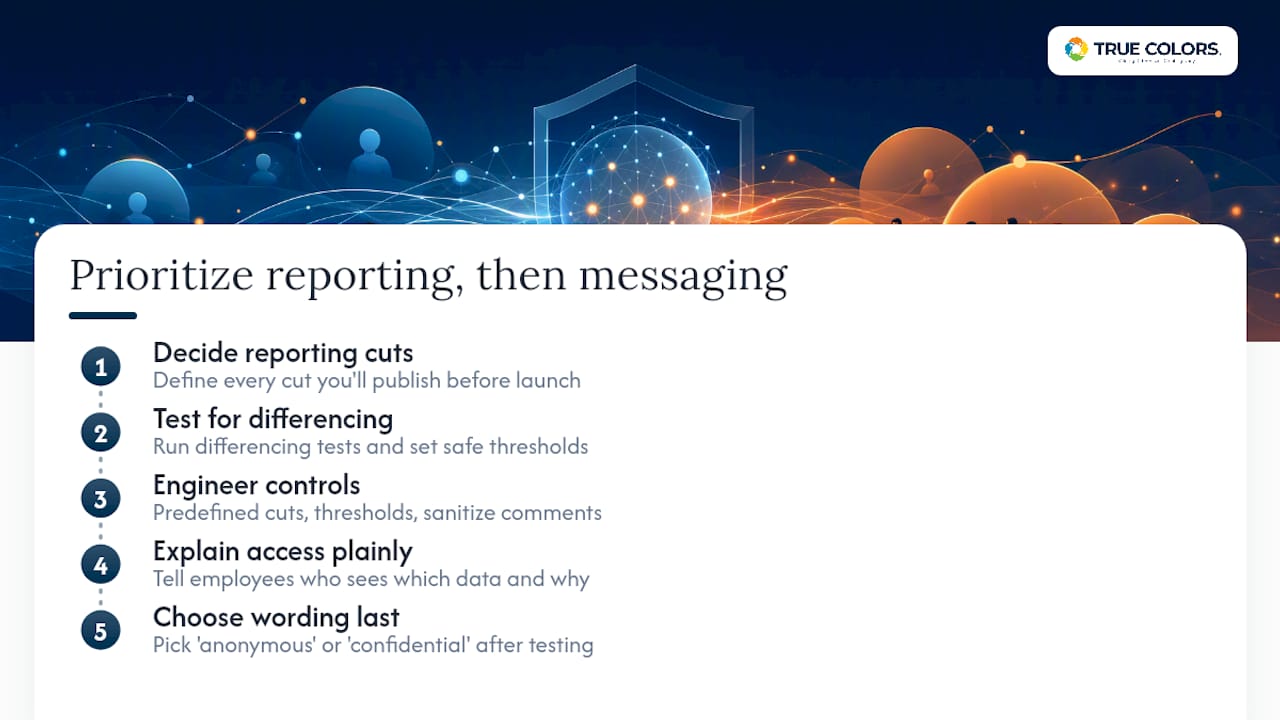
What gets underrated is the communications piece. Technical controls without an explicit, plain-language explanation of who sees what still produce guarded answers, because employees respond to what they believe, not what your architecture actually does.
If you're prioritizing one thing first, make it the reporting plan. Decide every cut you'll publish before launch, test it for differencing, and only then worry about which word goes on the invite.
— Theresa
Get Help Designing a Confidential Employee Survey
Running a technically sound, genuinely trusted survey takes more than good intentions. It takes a reporting plan built before launch, not patched after a complaint. Truecolorsintl designs Employee Experience Surveys with confidentiality controls built in from the start, not as a compliance afterthought, so leaders get data they can act on and employees get a process they can actually trust.

The approach pairs secure survey design with action planning: once results come in, you get support translating themes into leadership behavior change and communication practices that hold up over time, not just a report that sits in a folder. Governance support and manager training are available alongside the survey itself, so the insight turns into aligned action rather than a one-time snapshot.
Ready to see how it works for your organization? Visit the Employee Experience Survey page to review the approach and start a conversation about your next survey cycle.
Sources
- Anonymous vs. confidential surveys: which is best? — Qualtrics
- Survey confidentiality considerations — Workforce Science Associates