
Targeted feedback culture training does improve feedback quality and team performance, but only when it is practice heavy and reinforced after the workshop ends. Managers see the fastest gains, and those gains spread team wide only with follow up. The recommended first step is a short pilot workshop, built around simulation and role play, with a reinforcement plan attached before day one.
TL;DR:
- Short, simulation-heavy training sessions with follow-up coaching sustain feedback skill improvements for at least six months.
- Training should include practice in observing, describing, impacting, and suggesting actions, with role play and structured frameworks like SBI.
- Reinforcement through managerial modeling, peer feedback rituals, and micro-practice nudges significantly increases long-term habit formation.
- A system-based approach that involves leadership modeling first and ongoing measurement predicts more durable feedback culture change.
- Legally and ethically, feedback must be based on observable behavior, delivered privately, and documented consistently to avoid legal and trust risks.
Table of Contents
- What Does Feedback Culture Training Actually Cover?
- Which Delivery Format Fits Your Team?
- Which Frameworks and Skills Should Training Teach?
- How Do You Pilot and Roll Out a Feedback Culture Training Program?
- Why Does Feedback Training Fail to Stick?
- True Colors' Perspective on Turning Feedback Skills Into Habits
- What Is a Feedback Culture, and Why Does Training Matter?
- How Should Training Change by Role and Seniority?
- How Do You Measure Whether Training Actually Worked?
- What Do Successful Feedback Culture Transformations Look Like?
- What Legal and Ethical Lines Should Feedback Training Address?
- Editorial Take: What the Research Actually Supports
- How True Colors Can Help You Build This
- Sources
What Does Feedback Culture Training Actually Cover?
Feedback culture training programs share a common backbone, even when the branding differs. The core objectives are almost always the same: help people give feedback that is specific and useful, create enough psychological safety that people can receive it without shutting down, and turn feedback into a concrete next action instead of a vague comment that goes nowhere.
Most curricula, including those built by university professional development programs, organize around a handful of modules:
- Observation skills: separating what actually happened from the story a manager tells about it
- A feedback framework, used consistently across the organization
- Role play sessions where participants practice on real, current situations
- Structured practice receiving feedback, which is often skipped and shouldn't be
- Action planning, so every feedback conversation ends with a next step, not just a reaction
These objectives connect directly to business outcomes. Organizations that treat feedback as a skill, not a personality trait, tend to see it show up in engagement scores, retention, and performance review quality within a couple of cycles.
Which Delivery Format Fits Your Team?
The format you choose depends on what you are trying to build: awareness, skill, or scale. A half day workshop moves fast and raises awareness, but it rarely changes behavior on its own. A multi session cohort, spread across several weeks, builds actual skill because people practice, get feedback on their feedback, and come back. Blended programs, combining a live session with ongoing digital reinforcement, are usually the only way to reach scale without losing the practice component that makes training stick.
Simulation and role play matter more than most program designers admit. A controlled longitudinal study found that a short, simulation-heavy supervisor training produced feedback quality improvements that held for six months. That is a long half-life for a training intervention.
- Choose train-the-trainer when you need the skill embedded permanently inside HR or L&D.
- Choose external facilitation when you need neutrality for a sensitive rollout or a fast launch.
- Choose manager coaching when the gap is execution, not knowledge, and people already understand the framework.
Pro Tip: Never run a one-time workshop as your only investment. Pair it with at least one coaching touchpoint 30 to 45 days later, or the skill decays before it becomes habit.
Which Frameworks and Skills Should Training Teach?
Good feedback culture training does not invent a new framework for the sake of originality. It teaches one or two well tested models and drills them until they become second nature.
- SBI (Situation, Behavior, Impact): anchors feedback in observable fact, useful for quick, everyday feedback.
- DESC (Describe, Express, Specify, Consequence): built for higher stakes conversations where the other person needs a clear ask.
- GROW (Goal, Reality, Options, Way forward): less about delivering feedback and more about coaching someone toward their own solution.
- Radical Candor: less a framework than a stance, useful for leaders who tend toward "ruinous empathy" and avoid hard truths altogether.
Underneath any framework, four skills do the actual work: observing behavior without judgment, describing it plainly, naming the impact, and suggesting a specific next action instead of a general complaint. Listening and reflection round out the set. A person who can give feedback well but cannot receive it without getting defensive has only learned half the job.
University-based training programs that build in structured frameworks and role play consistently report stronger skill transfer than lecture-only formats. Video review of practice conversations, live role play, and short on-the-job assignments (give one piece of SBI feedback this week, report back) are what convert a workshop concept into a habit.
How Do You Pilot and Roll Out a Feedback Culture Training Program?
A pilot should be small enough to move fast and specific enough to measure. Pick one or two teams, ideally ones with an engaged manager and a real business reason to improve feedback (a recent engagement dip, a retention risk, a merger of two team cultures). Set measurable objectives before the session, not after.
- Design the pilot. Run a simulation-heavy session, two to three hours or a full day, and collect pre and post measures on feedback confidence and quality.
- Run a short window. Give the pilot one to three months to show early signal before deciding on a wider rollout.
- Phase the rollout. Expand over three to six months, department by department, so facilitators can adjust based on what the pilot revealed.
- Build reinforcement cycles. Schedule quarterly refreshers or coaching check-ins, since one session without a follow-up rhythm rarely holds.
| Phase | Timeline | Primary focus |
|---|---|---|
| Pilot | 1 to 3 months | Test format, collect baseline and post-training measures |
| Rollout | 3 months | Expand by department, adjust based on pilot feedback |
| Reinforcement | Ongoing, quarterly | Refresher sessions, manager coaching, habit tracking |
Measurement matters as much as the training itself. Track feedback quality ratings (often peer or manager rated), psychological safety survey scores, the count of concrete, actionable feedback instances given per team, and direct manager observation of conversations. Budget wise, an internal facilitator model costs staff time and preparation; an external consultant engagement usually includes needs assessment, delivery, and a defined set of deliverables such as a facilitator guide and measurement plan. Either route, building a program around a defined pilot before a full rollout keeps the investment proportional to what you actually know works for your organization.
Why Does Feedback Training Fail to Stick?
One-off training sessions decay for a predictable reason: the skill was never embedded into how people actually work. Without reinforcement, most participants slide back to old habits within weeks. Research on transfer of training found that what predicts whether new skills survive contact with the real job is the number and helpfulness of feedback sources in someone's social network, not how often any single person repeats the message. A manager nagging weekly does less than three or four colleagues each reinforcing the habit occasionally.
Practical reinforcement tactics include:
- Manager coaching sessions that specifically reference the framework taught in training
- Peer feedback rituals, such as a five-minute round at the end of a team meeting
- Building feedback prompts directly into 1:1 templates
- Short micro-practice nudges, sent a few weeks after the workshop, not just on training day
Pro Tip: Ask managers to model the framework publicly at least once in the two weeks after training. Visible role-modeling from leadership does more to normalize the habit than another all-hands reminder.
Governance closes the loop: leaders who visibly use the framework themselves instead of delegating it downward, a regular measurement cadence, and alignment between feedback practice and performance or career conversations all keep the gains from fading.
True Colors' Perspective on Turning Feedback Skills Into Habits
Truecolorsintl builds feedback culture training as one piece of a larger behavior system, not a standalone event. That system starts with behavior-based assessments that give people language for how they naturally communicate and where they tend to avoid conflict, then moves into leadership development that puts those insights into practice through team training.
The reinforcement layer is what separates the model from a typical workshop. Leadership follow-up sessions, employee experience surveys that track whether feedback behaviors are actually showing up months later, and ongoing coaching keep the skill from decaying the way a single training day almost always does.
What Is a Feedback Culture, and Why Does Training Matter?
A feedback culture is an organizational environment where giving and receiving honest, specific input is normal, expected, and safe, not an occasional event tied to an annual review. In a strong feedback culture, people correct course in real time instead of storing up frustration for a formal cycle six months later.
Training matters because feedback skill is not intuitive for most adults. Many managers were never taught how to describe a behavior without slipping into judgment, or how to receive criticism without getting defensive. Left untrained, most default to two failure modes: withholding feedback entirely to avoid discomfort, or delivering it so bluntly that it damages trust rather than building it.
Trust is not a soft add-on to feedback either. Organizational research on trust shows it directly shapes how feedback is received, meaning training that ignores psychological safety and focuses purely on framework mechanics tends to underperform. The skill and the environment have to be built together.
This is also why "feedback culture training" as a phrase can undersell what is actually happening. The more established framing in learning and development circles is communication skills training or performance feedback development, and it typically sits inside a broader leadership development or organizational development function rather than existing as an isolated course.
How Should Training Change by Role and Seniority?
A single, one-size curriculum tends to underserve every group it touches. Individual contributors mostly need practice receiving feedback well and giving useful peer feedback, since most of their interactions are lateral rather than top down.
First-line managers carry the heaviest lift. They need the full framework, real practice delivering both positive and corrective feedback, and specific coaching on the conversations they tend to avoid, like performance concerns with a tenured employee. This group benefits most from role play built around their actual direct reports' situations, not generic scenarios.
Senior leaders need something different: modeling and visibility training. Their feedback behavior gets watched and copied more than any policy document, so their sessions should focus on how their public behavior sets the tone for everyone below them, plus how to solicit upward feedback without accidentally punishing the people brave enough to give it.
Cross-functional and remote teams need an added layer on written and asynchronous feedback, since tone and intent are harder to read without body language. A structured approach to communication that accounts for these differences, rather than running everyone through the identical deck, is what makes training feel relevant instead of generic.
How Do You Measure Whether Training Actually Worked?
Basic pre and post surveys tell you whether people liked the training. They tell you almost nothing about whether behavior changed. A more useful measurement approach layers three types of data.
Behavioral observation catches what surveys miss: managers or trained observers noting whether feedback conversations actually use the framework taught, months after the session. Network mapping is the more advanced version, tracking how many distinct people an employee receives useful feedback from, since a wider, more helpful network predicts stronger training transfer than any single source repeating the message often. Outcome metrics close the loop by connecting the training to numbers the organization already tracks, like engagement scores, voluntary turnover in the trained population, and manager effectiveness ratings in the next review cycle.
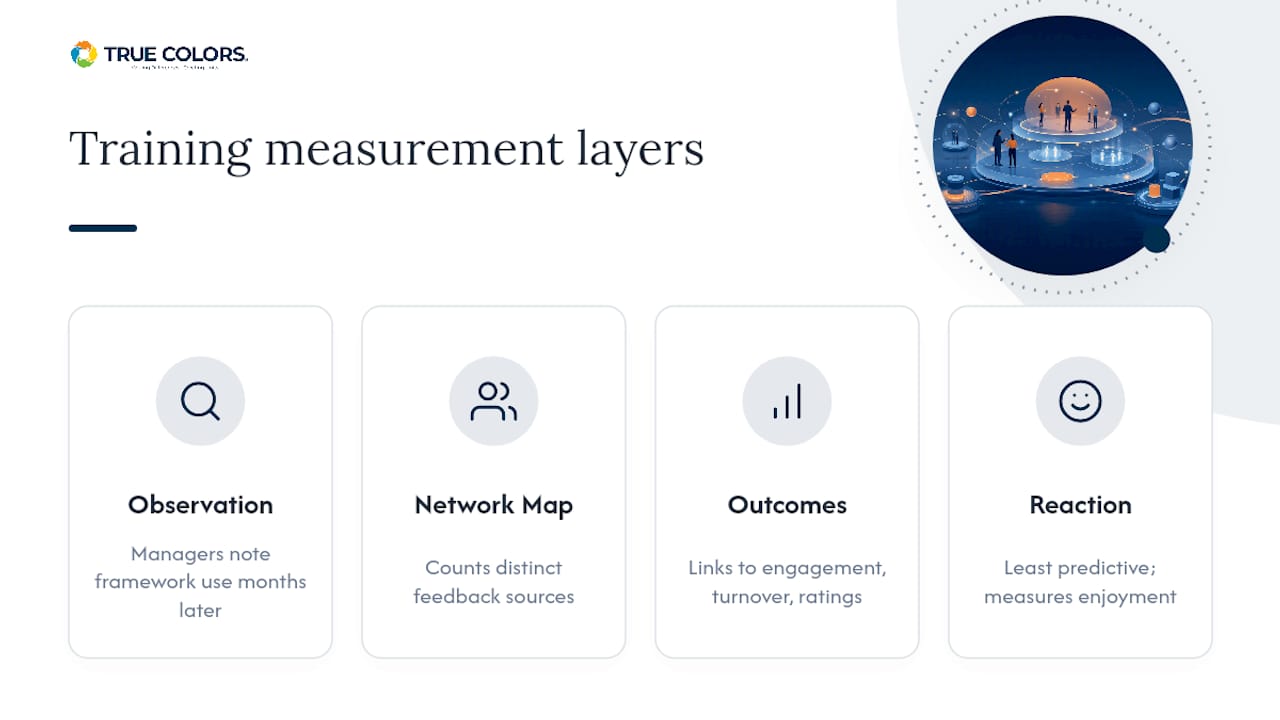
The mistake most programs make is measuring reaction (did people enjoy the workshop) and calling it done. Reaction data is the least predictive layer and the easiest to collect, which is exactly why it gets overused.
What Do Successful Feedback Culture Transformations Look Like?
The organizations that pull this off share a pattern more than a formula. They treat the first training session as a pilot, not a finish line, and they build the reinforcement plan before they book the room. Programs anchored in short, simulation-based sessions followed by structured coaching outperform lecture-heavy, one-time events, largely because the practice component forces people to use the framework under mild pressure before they need it for real.
A common thread across culture-focused programs that succeed is sequencing: leadership goes first, so the people modeling the behavior have already practiced it before asking their teams to adopt it. Skipping that order, training the front line before leadership has bought in, is one of the more common reasons a rollout stalls after an encouraging pilot.
The other pattern is patience with measurement. Teams that see real cultural shift tend to track quarter over quarter rather than expecting a single workshop to move an engagement score. Feedback habits behave like any other behavior change: visible within weeks, durable only after months of reinforcement.
What Legal and Ethical Lines Should Feedback Training Address?
Feedback training that ignores its legal and ethical edges leaves managers exposed. Feedback tied to performance decisions, promotions, terminations, or pay changes has to be documented consistently and applied without bias across protected characteristics. Training should explicitly cover the difference between subjective impression ("you seem disengaged") and observable, defensible behavior ("missed three deadlines this quarter"), because the second version holds up in a dispute and the first one does not.
Ethically, feedback delivered without consent to a wider audience than necessary, feedback used to publicly embarrass rather than improve, and feedback that crosses into personal characteristics unrelated to job performance all create real risk to trust and, in some cases, legal exposure. Good training builds in a simple check: is this feedback about behavior the person can change, delivered privately unless the context calls for public recognition, and consistent with how similar situations are handled for other employees. Programs that skip this piece are teaching a communication skill without the guardrails that keep it defensible.
Editorial Take: What the Research Actually Supports
Most feedback culture advice treats training as an event: book the workshop, check the box, move on. The evidence points somewhere else entirely. The BMJ Open study that found six months of sustained improvement did not use a marathon curriculum. It used a short, simulation-heavy session, which tells you the format matters more than the hours logged.
The bigger blind spot in conventional programs is the assumption that frequency drives change. It doesn't. The transfer-of-training research is fairly clear that a wider network of helpful feedback sources predicts lasting change better than one manager repeating the same message more often. Most organizations invest in manager training and stop there, missing the peer and network layer that actually sustains the habit.
If you take one thing from this, prioritize the system over the session. A single workshop, however well designed, is a starting point. What determines whether it survives contact with a busy quarter is whether leadership modeled it first, whether peers reinforce it casually, and whether anyone measures it past the thirty day mark.
— Theresa
How True Colors Can Help You Build This
An alternative to a one-off training vendor is a system that starts with behavior awareness, moves through structured leadership training, and stays in place with ongoing reinforcement built to the organization's actual culture, not a generic template.

The Connected Leadership Program is built for exactly this challenge: it maps directly to the feedback objectives outlined above, and layers in the leadership modeling and coaching that make training outlast the initial session. If you want to measure where your organization stands before you commit to a full rollout, the Employee Experience Survey gives you a baseline on psychological safety and feedback practices you can track against after training. The practical next step is a discovery call to scope a pilot, define your measurement plan, and set expectations for what a phased rollout looks like for your team.
Sources
For deeper reading, see the BMJ Open controlled study on supervisor feedback training, UNH's professional development course on feedback culture, UW–Madison's feedback program, and Harvard Business Review's analysis of trust and feedback reception.
- Effectiveness of a supervisor training on quality of feedback to internal medicine residents: a controlled longitudinal multicentre study | BMJ Open
- Cultivating Feedback Culture: Organizational and Professional Development | UNH Professional Development
- Transfer of training: the role of feedback in supportive social networks
- The neuroscience of trust | Harvard Business Review