
Emotional intelligence is defined as a trainable set of skills encompassing self-awareness, self-regulation, empathy, social connection, and motivation that individuals can build deliberately at any stage of life. Research confirms that EI can be developed through targeted practice of specific subskills, not through passive exposure or personality change alone. The Mayer-Salovey Four-Branch Model and Goleman’s Framework both treat EI as a competency system, meaning each component responds to structured training. Digital social-emotional learning (SEL) programs, reflective journaling, empathy exercises, and workplace coaching are among the most evidence-backed methods for building these skills. Understanding how emotional intelligence is developed gives individuals and organizations a clear path from awareness to lasting behavioral change.
What are the foundational emotional intelligence skills and how are they developed?
Emotional intelligence skills are best understood as distinct yet interconnected competencies, each requiring its own approach to development. The core subskills include emotional self-awareness, impulse control, empathy, stress tolerance, motivation, and social communication. Developing them is a skill-acquisition process with both cognitive and behavioral dimensions, not a personality overhaul.
Experiential learning drives the most durable gains. When people practice identifying emotions in real situations, receive structured feedback, and reflect on their responses, they build neural pathways that support more consistent emotional behavior over time. A 7-week soft-skills program produced statistically significant gains in EI, self-regulation, motivation, and communication among gifted high school students, demonstrating that structured, time-bound interventions work across age groups.
The table below maps each core EI subskill to a practical development activity and the method that best supports it.
| EI Subskill | Development Activity | Primary Method |
|---|---|---|
| Emotional self-awareness | Emotion journaling, body-scan check-ins | Reflective practice |
| Impulse control | Pause-and-name exercises, delayed response drills | Behavioral rehearsal |
| Empathy | Perspective-taking with media characters, role-play | Structured practice |
| Stress tolerance | Mindfulness, breathing protocols | Cognitive-behavioral techniques |
| Social communication | Active listening drills, feedback loops | Experiential learning |
| Motivation | Goal-setting with emotional anchors | Coaching and accountability |
The key insight here is that no single method develops all subskills equally. Reflective practice builds awareness; behavioral rehearsal builds regulation and empathy. Effective EI development programs combine both, cycling between insight and action.
How do digital SEL tools support emotional intelligence development?
Digital social-emotional learning interventions use immersive scenarios, gamification, and real-time feedback to create practice environments that traditional classroom settings can't replicate. Learners can rehearse emotionally charged situations without real-world consequences, thereby lowering the barrier to honest engagement and accelerating skill transfer.
The evidence base for these tools is growing. A meta-analysis of 37 studies involving 4,742 K-12 students found that digital SEL interventions produced medium effect sizes (SMD=0.631) on social-emotional skills, affect, and prosocial behaviors. That effect size is meaningful: it places digital SEL in the same effectiveness range as many in-person programs, while offering greater scalability and consistency.
Key features that make digital SEL effective include:
-
Simulation-based scenarios that mirror real interpersonal conflicts and require active emotional decision-making
-
Immediate feedback loops that help learners connect their choices to emotional outcomes
-
Gamification elements that sustain engagement over repeated practice sessions
-
Observational learning modules where learners watch modeled behavior before attempting it themselves
Digital SEL also engages sensorimotor and social cognitive mechanisms, which supports mastery learning and self-efficacy. That combination is what produces sustained competence rather than short-term awareness. Platforms built around these principles are increasingly used in workplace SEL programs to complement live facilitation.
Pro Tip: Pair digital SEL tools with in-person debrief sessions. The technology builds practice volume; the human conversation builds meaning and transfer.
What does research say about empathy training effectiveness?
Empathy is a multidimensional skill with distinct cognitive and affective components, and both can be trained through deliberate practice. Cognitive empathy involves understanding another person’s perspective intellectually. Affective empathy involves sharing their emotional experience. Most effective training programs address both, using behavioral rehearsal rather than passive instruction.
A 21-day empathy training program for male STEM students in China produced measurable gains in cognitive empathy, life satisfaction, and prosocial behavior, with effects sustained at a 6-month follow-up. The program combined two in-person group sessions with daily journaling and structured exercises. The durability of results at six months is significant. It confirms that short, intensive programs can produce lasting change when they include repeated practice and reflection.
The mechanism behind effective empathy training follows this sequence:
-
Intention setting: Participants explicitly commit to developing empathy as a skill, not a feeling state.
-
Attitude adjustment: Reframing empathy as a behavior rather than an innate trait removes the “I’m just not that kind of person” barrier.
-
Structured practice: Daily exercises, such as journaling from another person’s perspective or practicing active listening, build behavioral habits.
-
Reflection and feedback: Group sessions and written reflection consolidate learning and surface blind spots.
-
Repetition over time: Lasting empathy gains require weeks of practice, not single workshops.
Pro Tip: Stop treating empathy as a personality trait you either have or lack. Operationalize it as a set of behaviors: asking questions, paraphrasing, withholding judgment. Those behaviors can be practiced and measured.
How do personality traits and mental health interact with EI development over time?
Emotional intelligence development does not happen in isolation. Personality traits shape how readily individuals adopt adaptive emotion-regulation strategies, and mental health status can either accelerate or block skill growth. Understanding this interaction is what separates generic EI training from programs that stick.
Research tracking individuals from late adolescence into emerging adulthood found that Big Five personality traits assessed in adolescence predicted the use of emotion-regulation strategies seven years later. Higher Extraversion, Agreeableness, and Conscientiousness correlated with more adaptive regulation. Higher Neuroticism correlated with maladaptive strategies such as rumination and suppression. This means that someone high in Neuroticism entering an EI training program will likely need more support around stress tolerance and self-regulation before other skills become accessible.
The relationship between social-emotional skills and mental health is also reciprocal. A longitudinal study of 1,077 vocational-college students found that social participation skills predict well-being, while mental health problems can inhibit social-emotional skill development. The implication is direct: EI training programs that ignore mental health create a ceiling on outcomes.
| Personality Factor | Regulation Tendency | Training Implication |
|---|---|---|
| High Conscientiousness | Adaptive (planning, reappraisal) | Accelerates self-regulation skill gains |
| High Neuroticism | Maladaptive (rumination, suppression) | Requires stress-support integration |
| High Agreeableness | Adaptive (empathy, cooperation) | Supports social skills development |
| High Extraversion | Adaptive (social engagement) | Facilitates group-based EI activities |
EI development also does not progress linearly. The influence of core skills, whether self-management or social engagement, shifts over time. This means periodic reassessment is not optional. It is a structural requirement of any serious EI development program.
What practical steps build emotional intelligence in daily life and at work?
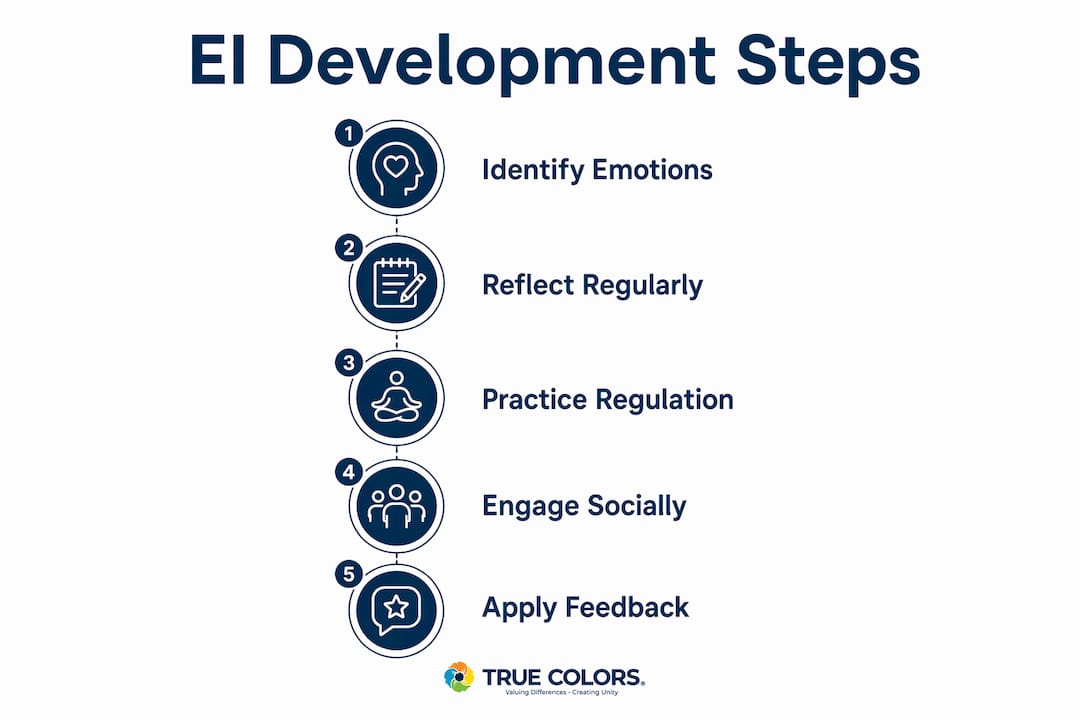
Building emotional intelligence starts with one foundational habit: becoming a deliberate student of your own emotional experience. Most people react to emotions rather than observe them. Shifting to observation is the entry point for all other EI skills.
Practical steps that create measurable progress include:
-
Expand your emotion vocabulary. Research from Psychology Today recommends stepwise awareness building, starting with naming emotions precisely rather than defaulting to “stressed” or “fine.” The more granular your vocabulary, the more accurately you can regulate.
-
Practice reflective journaling. Write three sentences each evening: what you felt, what triggered it, and how you responded. This builds the self-awareness loop that underpins all other EI skills.
-
Use empathy exercises with low stakes first. Practice perspective-taking with fictional characters in books or films before applying it to real colleagues. This builds the cognitive muscle without the social risk.
-
Seek behavioral feedback, not just self-assessment. Structured EI programs that combine self-report with expert observation produce more accurate growth measurement than self-report alone.
-
Integrate EI into existing workplace routines. Active listening in one-on-ones, naming the emotional tone of a meeting, and pausing before responding to conflict are all EI behaviors that require no additional time budget.
For organizations, emotional intelligence in the workplace grows fastest when leaders model the behaviors they want to see. Culture is not what is said. It is what is repeated. When leaders consistently demonstrate self-awareness and empathy in observable ways, those behaviors become the norm rather than the exception.
Pro Tip: HR managers can accelerate team-wide EI development by embedding emotional check-ins into existing meeting structures. A 60-second round of “what’s one word for how you’re showing up today” builds awareness without adding agenda time. See how HR teams apply EI in practice.
Key takeaways
Emotional intelligence is developed through deliberate, repeated practice of specific subskills across cognitive, behavioral, and social domains, not through insight alone.
| Point | Details |
|---|---|
| EI is trainable at any age | Structured programs produce measurable gains in self-awareness, empathy, and regulation across age groups. |
| Digital SEL tools scale practice | Meta-analytic evidence shows medium effect sizes for digital SEL on social-emotional skills. |
| Empathy requires repeated practice | A 21-day structured program produced empathy gains sustained at 6 months post-training. |
| Personality shapes the starting point | Big Five traits predict the use of regulation strategies years later, necessitating tailored training approaches. |
| Mental health and EI are reciprocal | Integrating stress support with EI training removes the ceiling on skill development outcomes. |
Why I think most EI training misses the most important variable
After working with organizations across industries on leadership and culture development, the pattern I see often is this: EI training programs focus heavily on awareness and almost not at all on the conditions that allow new behaviors to take root. You can teach someone to name their emotions with precision. You can run them through empathy exercises and give them a framework for active listening. But if they return to a team environment where emotional honesty is implicitly punished, none of it transfers.
The research on the interaction between mental health and EI confirms what I have observed firsthand. Social-emotional skill growth is inhibited when mental health problems go unaddressed. Organizations that pair EI training with psychological safety initiatives and stress management support see fundamentally different outcomes than those that treat EI as a standalone workshop.
The other misconception I encounter regularly is that EI development is a one-time intervention. The longitudinal data is clear: the skills that matter most shift over time. Self-management dominates early development. Social engagement becomes more influential later. A program that doesn't build in reassessment and adaptive focus is essentially training for a snapshot of who someone is today, not who they need to become. Commit to EI development as an ongoing practice, not an annual training event. The people and organizations that treat it that way are the ones that change.
— Theresa Stairs
Build emotional intelligence that lasts with Truecolorsintl

Truecolorsintl helps organizations move from EI awareness to observable, repeatable behavior change. Through programs like Connected Leadership and communication training, True Colors integrates emotional intelligence into the daily habits of leaders and teams, not just into workshop slides. The approach is grounded in the science of human behavior and designed to produce alignment that endures over time. Whether you are building EI capacity within a leadership team or embedding it into your broader culture strategy, TrueColorsIntl offers practical, facilitated pathways to build lasting competence. Explore the full range of leadership and culture programs to find the right fit for your organization’s goals.
FAQ
What does it mean to develop emotional intelligence?
Developing emotional intelligence means building specific, trainable skills including self-awareness, empathy, self-regulation, and social communication through deliberate practice and structured feedback. Research confirms these skills respond to targeted interventions at any age.
How long does it take to improve emotional intelligence?
Measurable EI gains can occur within weeks of structured training. A 21-day empathy program produced improvements sustained at 6 months, while a 7-week soft-skills program showed statistically significant gains across multiple EI subskills.
Can digital tools really build emotional intelligence?
Yes. A meta-analysis of 37 studies found digital SEL interventions produced medium effect sizes on social-emotional skills, comparable to many in-person programs. Effectiveness increases when digital tools are paired with live facilitation and reflection.
Does personality affect how emotional intelligence develops?
Personality traits assessed in adolescence predict emotion-regulation strategy use up to seven years later. Higher Neuroticism is associated with maladaptive regulation, so EI training programs should account for individual personality profiles when designing support structures.
How is emotional intelligence developed in workplace settings?
Workplace EI development works best when leaders model target behaviors consistently, training includes behavioral observation alongside self-report, and emotional skills are embedded in existing routines, such as meetings and feedback conversations, rather than treated as separate programs.