
When 89% of hiring failures trace back to poor cultural fit rather than missing technical skills, it becomes clear that most organizations are solving the wrong problem in their hiring process. To truly align talent acquisition with culture, you need more than a values statement on your careers page. You need deliberate processes, observable criteria, and hiring managers who understand that every offer letter either reinforces or erodes the culture you are trying to build. This guide gives HR executives and talent managers a practical framework for doing exactly that.
Table of Contents
Key Takeaways
| Point | Details |
|---|---|
| Culture mismatch drives failure | Most hiring failures stem from cultural misalignment, not skill gaps, making culture a primary hiring filter. |
| Replace “fit” with competencies | Define culture through observable, measurable behaviors to make assessments defensible and consistent. |
| Structure your evaluation process | Behavioral interview questions with rating scales reduce bias and improve the reliability of culture assessments. |
| Avoid homogeneity traps | Balance culture alignment with culture addition to prevent groupthink and preserve organizational adaptability. |
| Measure outcomes continuously | Track retention, engagement, and performance data by hire cohort to refine your culture-aligned hiring process over time. |
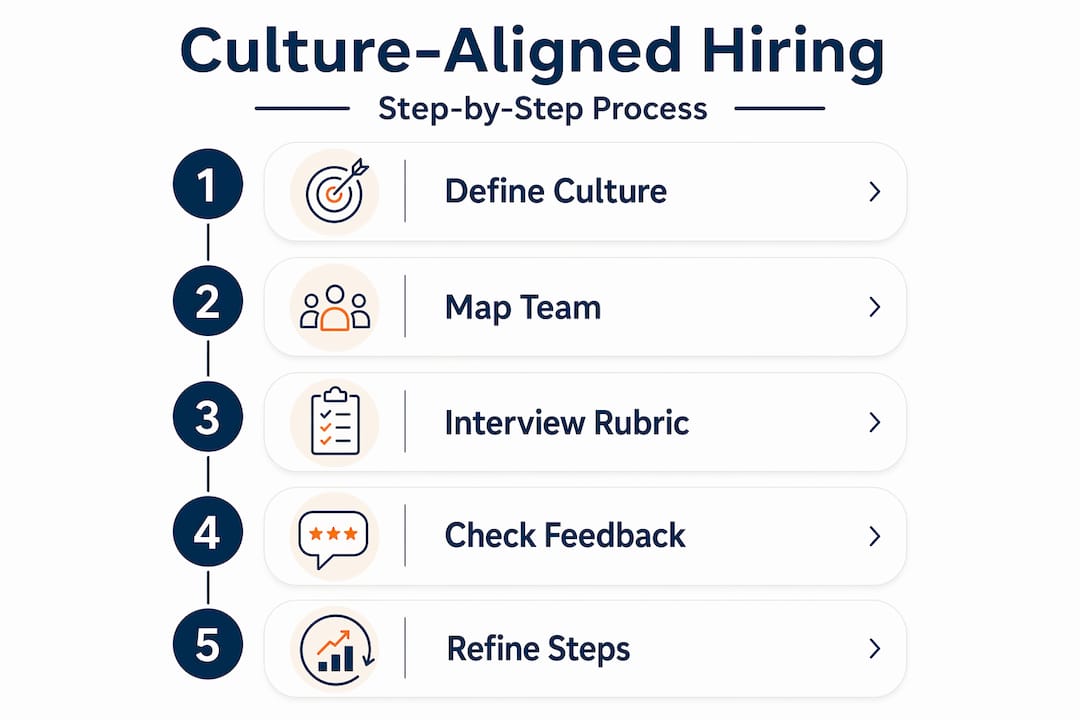
Aligning talent acquisition with culture starts with defining it
You can’t hire for something you can’t describe. That sounds obvious, but most organizations operate with a culture that, in the minds of senior leaders, exists as a feeling rather than a framework. Before you can integrate culture in recruitment, you need to translate that feeling into language your hiring managers can actually use.
Start by distinguishing between your espoused culture (what leadership says the organization values) and your enacted culture (what behaviors are actually rewarded, tolerated, and repeated). The gap between those two is where most cultural misalignment begins. When you are building a culturally aligned team, you need to hire against the enacted culture you want to create, not just the one you have.
From there, define your cultural competencies at the role level. These are not values like “integrity” or “collaboration.” Those words mean different things to different people. Cultural competencies are observable behaviors. For example, instead of “collaborative,” define it as “proactively shares information with teammates before being asked” or “volunteers to take on cross-functional work without being directed.” Replacing vague notions of cultural fit with defined behavioral competencies is the foundation for defensible, effective hiring.
It’s important to map the current team. Where are the behavioral gaps? What does the team need more of to perform at the next level? This gap analysis shapes which cultural competencies you prioritize in a given search, and it keeps your criteria from becoming a checklist for hiring people who think exactly like everyone already there.
Pro Tip: Involve team members in defining cultural competencies for open roles. They know what behaviors actually drive performance on the ground, and their input increases the accuracy and credibility of your criteria.
Building a culture-aligned hiring process step by step
Once your cultural competencies are defined, the hiring process itself needs to reflect them at every stage. This is where most organizations fall short. They define culture well but fail to integrate it into recruitment at the process level.
-
Rewrite your employer brand messaging. Your job postings, careers page, and social content should describe how people actually work at your organization, not just what the organization does. Strong culture branding can increase job applications by up to 50%. Describe the behaviors you expect, the decisions employees make independently, and what it looks like to succeed in your environment.
-
Develop behavioral interview questions based on your competencies. For each cultural competency, write two to three behavioral questions that ask candidates to describe past situations where they demonstrated that behavior. “Tell me about a time you disagreed with a manager’s decision and how you handled it” reveals far more about cultural alignment than “Are you comfortable with conflict?”
-
Use diverse interview panels. Include team members from different levels and functions in the interview process. This gives candidates a realistic view of your culture and provides you with multiple observational perspectives on how they engage. Panel diversity also reduces the risk of one interviewer’s bias driving the decision.
-
Conduct structured reference checks focused on behavior. Ask references the same behavioral questions you asked the candidate. Ask specifically about how the candidate handled feedback, conflict, ambiguity, and collaboration. Patterns across multiple references are highly predictive.
-
Create a realistic job preview. Before extending an offer, give candidates a candid picture of what day-to-day work looks like, including the challenges. Candidates who self-select out at this stage save you from a costly mismatch. Those who stay in are more likely to onboard successfully.
-
Extend cultural integration into onboarding. The first 90 days are when new hires form their mental model of how things actually work. Structured onboarding that explicitly connects daily behaviors to organizational values accelerates cultural integration and reduces early turnover.
Pro Tip: Score behavioral interview responses against a defined rubric before the debrief conversation. This prevents the most confident interviewer in the room from anchoring everyone else’s assessment.
Evaluating cultural alignment objectively
Subjective impressions of “fit” are not just unreliable. They are legally risky. Moving to an evidence-based process protects your organization and produces better hiring decisions. Here is how the two approaches compare:

| Approach | Method | Outcome |
|---|---|---|
| Subjective fit assessment | Gut feeling, general impression, social ease | High bias risk, inconsistent results, legally indefensible |
| Behavioral competency scoring | Structured questions, rating rubric, panel calibration | Reduced bias, consistent results, documented rationale |
| Validated assessments | Psychometric tools tied to role competencies | Objective data point, useful for development post-hire |
Structured behavioral interviews aligned with cultural competencies increase both the reliability and fairness of hiring. The key is calibration. Before interviews begin, all interviewers should agree on what constitutes a “strong,” “acceptable,” and “insufficient” response for each competency. Without that shared standard, you are still making subjective decisions, just with extra steps.
When balancing technical skills and cultural competencies in your final decision, consider this: when candidates are technically comparable, cultural alignment and soft skills should take precedence. Technical skills can be developed. The behavioral patterns that determine how someone treats colleagues, responds to setbacks, and engages with feedback are far harder to change after hire.
A few additional safeguards worth building into your process:
-
Document the specific behavioral evidence behind every hiring decision
-
Require panel consensus or a structured scoring threshold before advancing candidates
-
Audit your hiring data periodically for demographic patterns that might signal bias
-
Separate “culture add” criteria from “culture fit” criteria in your scoring rubric
Common pitfalls in culture-aligned hiring
Even well-designed processes run into predictable problems. Knowing what they are in advance lets you correct them before they compound.
The most common mistake is conflating cultural alignment with cultural similarity. When hiring managers unconsciously favor candidates who share their background, communication style, or social references, the result is a team that looks culturally cohesive but is actually just homogeneous. Over-indexing on cultural similarity creates echo chambers that stifle the innovation organizations need to scale.
The correction is to distinguish between “culture fit” and “culture add.” Culture fit means a candidate demonstrates the core behavioral competencies your organization requires. Culture add means the candidate brings perspectives, experiences, or approaches that strengthen the team without violating those core competencies. Both matter. Neither should be used as a proxy for familiarity.
A second common failure is inconsistent training for hiring managers. If your HR team has defined cultural competencies but your hiring managers have not been trained to assess them, the process breaks down at the most critical point. Hiring managers need to understand not just what the competencies are, but what they look like in practice and how to score them consistently.
Culture is not what is said. It is what is repeated. If your hiring managers are making decisions based on gut feeling rather than behavioral evidence, your culture-aligned hiring strategy exists only on paper.
The candidate experience also deserves attention here. Candidates who feel the process is unclear, inconsistent, or impersonal draw conclusions about your culture from that experience. A disorganized hiring process signals a disorganized organization. The way you hire communicates your values before anyone receives an offer.
Measuring whether your approach is working
Implementing a culture-aligned talent strategy without measuring its impact is like adjusting a process without reading the output. You need feedback loops that tell you whether the changes you made are producing better outcomes.
| Metric | What it tells you | Review cadence |
|---|---|---|
| 90-day and 1-year retention by hire cohort | Whether cultural alignment predicts early tenure | Quarterly |
| New hire performance ratings at 6 months | Whether cultural competencies correlate with performance | Semi-annual |
| Hiring manager satisfaction scores | Whether the process is producing candidates who fit the team | Per hire |
| Employee engagement scores by tenure | Whether culturally aligned hires stay engaged longer | Annual |
Beyond the numbers, build qualitative feedback loops. Conduct structured 30 and 90-day check-ins with new hires that specifically ask about cultural expectations versus reality. Ask hiring managers three months post-hire whether their assessment of the candidate’s cultural competencies held up. These conversations surface patterns your data alone will not catch.
Use what you learn to refine your recruitment practices on a regular cycle. Update behavioral interview questions when they no longer differentiate strong from weak candidates. Revisit your definitions of cultural competency when the organization’s direction shifts. The importance of cultural alignment only compounds over time when your process keeps pace with where the organization is going.
My perspective on culture and the hiring mandate
I have worked with enough organizations to say with confidence that the most costly hiring decisions are almost never the ones that failed on skills. They are the ones where a technically capable person systematically undermined the behaviors the team needed to function. The damage is rarely visible in the first 90 days. It accumulates.
What I have learned is that every leadership hire is effectively a culture hire. Leaders do not just work within the culture. They model it, reinforce it, and in many cases redefine it. When organizations treat leadership hiring as primarily a skills-and-experience exercise, they are handing enormous cultural influence to someone whose values and behavioral patterns they have not seriously examined.
The other thing I would push back on is the idea that culture should stay static in hiring criteria. Culture requires intentional evolution. The behaviors that served an organization of 50 people are not always the ones that will carry it to 500. Hiring for culture means periodically asking whether your current cultural competencies still reflect where the organization needs to go, not just where it has been.
The organizations I have seen get this right share one trait. They treat cultural alignment in talent strategy as a discipline with its own rigor, not as a soft consideration layered on top of the “real” hiring criteria. They define it. They measure it. They hold their hiring managers accountable for it.
— Theresa Stairs
How Truecolorsintl supports culture-aligned hiring
Building a hiring process that genuinely reflects your culture takes more than good intentions. It takes frameworks, training, and the kind of ongoing reinforcement that keeps progress from slipping back to old habits.
Truecolorsintl works with HR leaders and talent teams to make culture measurable and actionable across the full talent lifecycle. From leadership development programs that help leaders model and embed culture, to team-building solutions that strengthen how people work together after hire, the programs are designed to produce observable behavior change. Whether you are building cultural competency frameworks from scratch or looking to strengthen an existing talent acquisition and company culture strategy, Truecolorsintl offers consulting and certification options tailored to where your organization is. Visit truecolorsintl.com to explore how the programs can support your team.
FAQ
Why do most hiring failures come down to culture?
Most hiring failures are attributed to poor cultural fit rather than technical skill gaps because behavioral patterns, values, and working styles are harder to assess in a standard interview and harder to change after hire.
What is the difference between culture fit and culture add?
Culture fit means a candidate demonstrates the core behavioral competencies your organization requires. Culture add means the candidate brings perspectives that strengthen the team without violating those core competencies.
How do you assess cultural alignment without introducing bias?
Replace subjective impressions with structured behavioral interviews scored against defined rubrics, use diverse interview panels, and document the specific behavioral evidence behind every hiring decision.
How soon should you measure the impact of culture-aligned hiring?
Track 90-day and one-year retention rates, six-month performance ratings, and hiring manager satisfaction scores per hire cohort. Review these metrics quarterly to identify patterns and refine your process.
Why do leadership hires carry extra cultural weight?
Leadership hires shape culture through their daily communication, decisions, and behavior. Every leader effectively acts as a culture officer, modeling what the organization actually values regardless of what is written in a values statement.