
Most organizations hemorrhage knowledge daily. Experienced employees hold insights that never reach their teammates, onboarding drags on because institutional knowledge lives in silos, and training programs fail to stick because they sit outside the flow of real work. To build peer learning culture organization-wide, you need more than a new platform or a mentoring program. You need to shift how knowledge moves, how leaders behave, and how employees relate to each other’s growth. Only about 10% of organizations qualify as true learning organizations, which means the competitive advantage for those who get this right is substantial.
Table of Contents
Key Takeaways
| Point | Details |
|---|---|
| Psychological safety comes first | Employees will not share knowledge openly until they feel safe to ask questions and admit gaps. |
| Map your informal networks | Peer learning already exists in your organization. Find it, then build around it. |
| Leadership behavior drives culture | Managers who model learning ownership signal that growth is expected, not optional. |
| Measure beyond completion rates | Track behavioral change and productivity improvements, not just participation numbers. |
| Structure enables spontaneity | Loose frameworks like learning circles give peer learning a home without stifling it. |
How to Build a Peer Learning Culture: Laying the Foundation
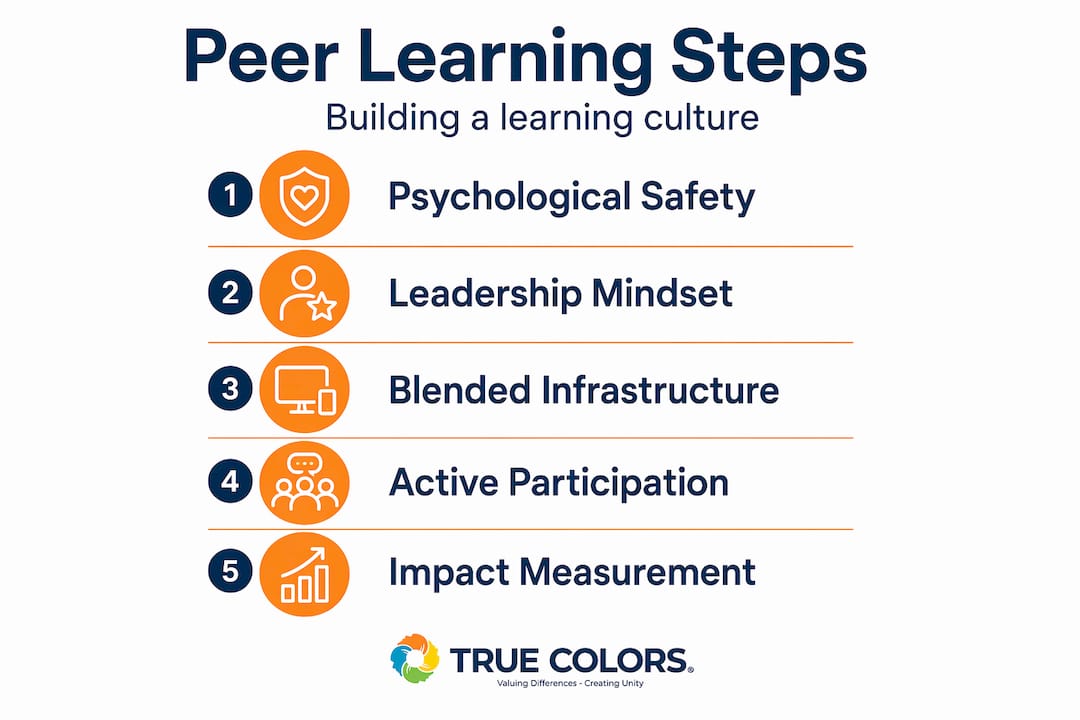
Before you launch a single learning circle or peer coaching program, three conditions must be in place. Without them, even the most thoughtful program design will underperform.
Psychological safety is non-negotiable. Employees share what they know only when they believe it is safe to do so. That means no visible punishment for admitting a knowledge gap, no ridicule for asking a basic question, and no hierarchy that signals “learning is for junior people.” Truecolorsintl consistently observes that psychological safety is one of the most frequently cited barriers when peer learning programs stall. If people fear judgment, they perform competence rather than build it.

Leadership mindset is the multiplier. Research is clear that managers must shift from instructors to learning leaders who actively sponsor experimentation, coach rather than direct, and openly model their own learning. This is harder than it sounds. Most managers were promoted for expertise, not for creating the conditions where others develop. Reframing the leadership role is foundational.
Infrastructure must blend formal and informal. You need digital channels where knowledge can flow quickly, and you need moments built into the work calendar for reflection and sharing by design. The combination matters because formal programs give structure, while informal channels give speed.
| Infrastructure Element | Purpose | Examples |
|---|---|---|
| Digital collaboration platform | Real-time knowledge sharing and peer connection | Slack channels, Teams spaces, Notion |
| Analytics and engagement tracking | Identify who shares what and where gaps exist | Platform dashboards, AI-driven tools |
| Structured learning moments | Scheduled time to share and reflect | Cohort sessions, project debriefs |
| Recognition mechanisms | Reward knowledge sharing behavior | Peer nominations, visible acknowledgment |
Pro Tip: Before investing in new technology, audit your existing tools. Most organizations already have platforms capable of supporting peer learning. The gap is almost never the tool. It’s the habit and the permission.
Identifying and activating peer learning networks
This is where most organizations skip a critical step. Peer learning is already happening in your organization. The question is whether you can see it, map it, and build around it strategically.
-
Run peer nomination surveys. Ask employees directly: “Who do you go to when you’re stuck?” and “Who helps you think through problems?” The answers reveal your informal knowledge hubs, the people who are already functioning as peer teachers regardless of their title.
-
Analyze collaboration channel data. In platforms like Slack or Microsoft Teams, look at who responds most frequently, who gets tagged by others for expertise, and which threads generate the most engagement. This data surfaces patterns that org charts never show.
-
Use project debriefs as mapping tools. At the close of every significant project, ask the team to name the knowledge exchanges that made a difference. You will start to see recurring contributors who accelerate learning for everyone around them.
-
Apply AI tools to identify “hidden champions.” AI-powered learning ecosystems continuously analyze engagement and behavioral patterns to surface people whose knowledge sharing has outsized impact but who may not be visible to leadership.
-
Form cohort groups around real business challenges. Once you know who your peer influencers are, build loose groups of 12 to 15 people focused on a specific operational problem or skill area. Peer learning groups of this size, oriented around real challenges and supported by rapid knowledge sharing channels, maximize both flow and responsiveness.
| Approach | Best For | Risk to Manage |
|---|---|---|
| Peer nomination surveys | Revealing informal knowledge leaders | Self-selection bias toward popular employees |
| Collaboration analytics | Objective mapping of knowledge flow | Privacy concerns; requires transparency |
| AI-driven identification | Scaling across large, distributed teams | Over-reliance on data without human judgment |
| Project debriefs | Capturing applied learning in context | Time constraints limit depth of reflection |
Pro Tip: Do not immediately formalize every informal network you discover. Some of the most effective peer learning happens in unstructured moments. Your job is to protect those moments, not to bureaucratize them.
Sustaining peer learning through culture, technology, and leadership
Finding your networks is only the beginning. Knowledge uptake increases by up to 25% and onboarding accelerates by 30% in organizations with active peer learning communities. Getting to those numbers requires sustained reinforcement, not a single program launch.
Here is what creates momentum that lasts:
-
Micro-learning moments built into daily work. Short, searchable knowledge artifacts like 2-minute videos or checklists get consumed and applied rapidly. They fit between meetings, they are easy to share, and they respect people’s time. Long courses do not compete with the pace of real work.
-
Leaders who publicly model vulnerability. When a vice president shares what they learned from a mistake in a team meeting, or when a manager asks a peer for help instead of pretending to know the answer, it gives everyone else permission to do the same. Culture is not what is said. It is what is repeated.
-
AI-driven personalization. Learning infrastructure that adapts using AI-driven insights outperforms static knowledge repositories by surfacing the right content to the right person at the right time. AI can also recommend peer mentors based on skill proximity and learning history, making connections that would never happen organically.
-
Recognition aligned to business goals. Rewarding knowledge sharing must feel meaningful, not performative. Tie recognition to outcomes: who helped a teammate solve a problem that moved a business result? That connection between sharing and impact is what signals that peer learning is genuinely valued.
-
Voluntary participation as a design principle. Google’s g2g program succeeds specifically because participation is voluntary and supported by leadership. Mandated peer learning creates compliance, not culture.
Pro Tip: Set a specific time cadence for your peer learning moments. Weekly is better than monthly. Even a 15-minute “what did we learn this week” conversation in a team meeting creates the habit of reflection and sharing that peer learning cultures run on.
Common pitfalls and how to avoid them
Organizations frequently underestimate the distance between permission and support. Leadership saying “we support peer learning” is not the same as leaders protecting time for it, reducing competing demands, or participating themselves. That gap is where most programs quietly collapse.
“Speed of knowledge sharing and turning lessons into actionable leverage are the main predictors of a successful learning culture.” — Uinta County Herald
Watch for these specific failure patterns:
-
Mandating participation. Coerced peer learning produces resentment, not engagement. The goal is to create conditions where people want to share, not conditions where they feel obligated to perform sharing.
-
Launching too many channels at once. Technology overload fragments attention and reduces the quality of engagement everywhere. Start with one or two well-chosen platforms and build density before expanding.
-
Measuring only activity. Tracking how many people joined a learning circle tells you nothing about whether anything changed in how they work. Behavioral and business metrics are the only honest measure of impact.
-
Neglecting facilitation quality. A peer learning group without a capable facilitator drifts. You do not need professional facilitators for every session, but someone needs to hold the structure, keep conversations productive, and surface takeaways.
Measuring the impact of your peer learning culture
Measurement is where commitment becomes credible. If you cannot show that peer learning is moving business needles, it will be deprioritized the moment budgets tighten.
| Metric Category | What to Track | Why It Matters |
|---|---|---|
| Participation and engagement | Active users, mentoring conversations, content shares | Signals adoption and network health |
| Onboarding speed | Time to full productivity for new hires | Directly linked to peer learning quality |
| Performance improvement | Productivity gains, error reduction, innovation rate | Connects learning to business outcomes |
| Employee sentiment | Pulse survey scores on collaboration and trust | Reveals cultural shift over time |
Use a framework like Kirkpatrick Level 4 to connect peer learning activity to actual business results. That means moving past “employees attended sessions” to “employees applied what they learned, and here is the measurable result.” Prior collaboration experience also compounds over time. Students with prior collaboration experience show statistically significant improvements in readiness for future collaboration, suggesting that the habit of peer learning builds on itself.
Implement short-pulse surveys every six to eight weeks to determine whether the culture is actually shifting or participation is occurring without genuine engagement. Adapt your approach based on what you find.
Pro Tip: Report peer learning metrics alongside business performance metrics in the same presentation to leadership. The visual proximity alone signals that learning is a business driver, not a human resources side project.
My take on what really changes organizations
I have worked with enough leadership teams to say this with confidence: the hardest part of building a peer learning culture is not the technology, the program design, or even finding the right peer facilitators. It is convincing leaders that their own behavior is the program.
When a leader asks good questions rather than delivers answers, the team learns to think. When a leader shares what they got wrong and what they learned from it, peers follow. When a leader protects 30 minutes a week for knowledge sharing despite the pressure of a full calendar, the signal is unmistakable. Why leadership development programs fail is often traceable to this exact gap: the program changes, but the daily behavior of the people at the top does not.
I have also seen organizations over-engineer peer learning to the point that it requires so much administration that spontaneity dies. The best peer learning I have observed was structured just enough to give people a reason to gather and a method for capturing what they learned. Beyond that, it ran on trust and genuine curiosity.
Technology matters, but it is never the answer by itself. The human connection underneath peer learning is what makes knowledge transfer actually stick. Use AI to identify connections and surface content, then get out of the way and let people learn from each other.
— Theresa Stairs
How Truecolorsintl can help you build this
Creating a peer learning culture requires changes at three levels: individual behavior, team habits, and organizational systems. Truecolorsintl works with leaders and HR teams to make all three shifts practical and measurable, not just aspirational.

Through leadership development programs designed to transform managers into learning leaders, and team-building frameworks that strengthen collaboration and trust, Truecolorsintl gives organizations the structure they need to develop a teamwork culture that holds. The behavioral science behind the True Colors system helps leaders understand what drives how people share, communicate, and engage with each other, which is exactly the foundation a peer learning culture requires. If you are ready to create a learning organization that actually learns, TrueColorsIntl offers consulting and coaching programs that support you from readiness assessment through sustained reinforcement.
FAQ
What is a peer learning culture in an organization?
A peer learning culture is an environment where employees regularly share knowledge, skills, and experiences with one another as part of their work, rather than relying solely on formal training programs.
How long does it take to build a peer learning culture?
A structured 90-day rollout can establish the foundational ecosystem, but embedding peer learning as a genuine cultural habit typically takes 12 to 18 months of consistent leadership reinforcement.
How do you encourage peer learning without mandating it?
Make participation voluntary, create genuine value for participants, and have leaders visibly model knowledge sharing. Google’s approach confirms that voluntary engagement, supported by leadership sponsorship, yields far stronger results than mandated participation.
What metrics show that peer learning is working?
Look at onboarding speed, productivity gains, participation rates in learning communities, and pulse survey scores on collaboration. Completion rates alone do not indicate real impact.
What is the biggest barrier to peer learning in organizations?
Lack of psychological safety is the most common barrier. When employees fear judgment for admitting gaps or asking questions, knowledge sharing stops, regardless of how good the program design is.