
Most executives believe they already know their culture. They’ve seen the survey scores, read the engagement reports, and sat through the all-hands presentations. What they haven’t done is measure the effectiveness of organizational culture in a way that distinguishes between what people say and what they do. That distinction matters enormously. Engagement surveys measure how employees feel, not whether they are prepared to change behavior. Building a measurement system that captures the full picture requires behavioral data, sentiment signals, and outcome metrics working together.
Table of Contents
-
Measuring organizational culture effectiveness: the foundation
-
How Truecolorsintl supports your culture improvement efforts
Key takeaways
| Point | Details |
|---|---|
| Surveys alone are insufficient | Engagement scores capture sentiment but miss behavioral norms, making triangulation with multiple data sources necessary. |
| Measure at the team level | Aggregating scores enterprise-wide can mask critical subgroup issues and delay targeted interventions. |
| Use time-phased expectations | Behavioral shifts appear within 30 to 90 days; meaningful outcome changes typically emerge by six months. |
| Prioritize leading indicators | Recognition frequency and alignment scores provide advance signals that predict turnover and engagement trends. |
| Make findings actionable | Effective culture evaluation ends with two to three clear interventions and an ongoing monitoring plan, not just a report. |
Measuring organizational culture effectiveness: the foundation
Before you can evaluate organizational climate or track cultural progress, you need clarity on what you are measuring. Organizational culture, as defined in the academic and practitioner literature, refers to the shared norms, assumptions, and values that govern how people behave when no one is explicitly telling them what to do. It is persistent, often invisible, and deeply tied to group identity.
Organizational climate is related but distinct. Climate reflects employees’ perceptions of their work environment at a given moment. It is more variable and more directly influenced by management behavior and recent events. Employee engagement, meanwhile, captures how committed and motivated individuals feel. All three concepts matter. None of them are interchangeable.
This distinction has direct implications for how you design a measurement approach. Common culture assessment tools such as the Organizational Culture Inventory (OCI), the Organizational Culture Assessment Instrument (OCAI), and the Denison Organizational Culture Survey (DOCS) each measure a combination of culture proxies and climate. None perfectly separates deep culture from surface-level climate, which is exactly why triangulation with behavioral and outcome data is not optional. It’s the only way to get an accurate read.
Understanding these limits also shapes what you ask from your instruments. Here’s what each layer of measurement is designed to reveal:
-
Culture instruments (OCI, OCAI, DOCS): Identify shared behavioral norms and dominant values across the organization or a specific team
-
Engagement surveys: Surface sentiment, motivation levels, and perceptions of fairness and recognition
-
Behavioral data: Track observable actions like recognition frequency, one-on-one meeting cadence, and collaboration patterns
-
Outcome data: Connect culture patterns to business results including retention, internal mobility, and manager effectiveness scores
Together, these layers give you a multi-dimensional view. Separately, any one of them can mislead.
Preparing to assess workplace culture
Preparation determines whether your measurement effort produces insight or noise. The first step is defining the purpose and scope of the assessment. Are you evaluating culture at the enterprise level, within a business unit, or at the team and manager level? The answer shapes every subsequent decision, from instrument selection to reporting design.
Once scope is clear, choose your measurement instruments with an understanding of their construct validity. No single survey does everything well. Psychometric limitations mean that instruments should be selected with awareness of what they measure versus what they claim to measure, and they should always be paired with behavioral and outcome metrics.
The most effective preparation involves collecting data across three distinct layers:
| Data Layer | Source Examples | What It Reveals |
|---|---|---|
| Behavioral data | Recognition platform logs, one-on-one meeting frequency, meeting load analysis | Whether stated values are reflected in daily habits |
| Sentiment data | Pulse surveys focused on Feeling, Focus, and Progress dimensions | How employees perceive their environment and leaders right now |
| Outcome data | Engagement scores, regrettable attrition rates, internal mobility rates, manager effectiveness scores | Whether culture is producing the business results it should |
Evaluation cadence matters as much as instrument choice. A quarterly review cycle is the minimum. Monthly behavioral tracking is more effective for catching early signals before they become systemic problems. Organizations that run only annual surveys often discover culture problems after they’ve already driven out key talent.

Pro Tip: Before launching any culture assessment, align your executive team on what a “good” result looks like and what decisions you will make at each score threshold. Without that agreement upfront, data becomes a topic of debate rather than a driver of action.
The step-by-step process to evaluate organizational climate
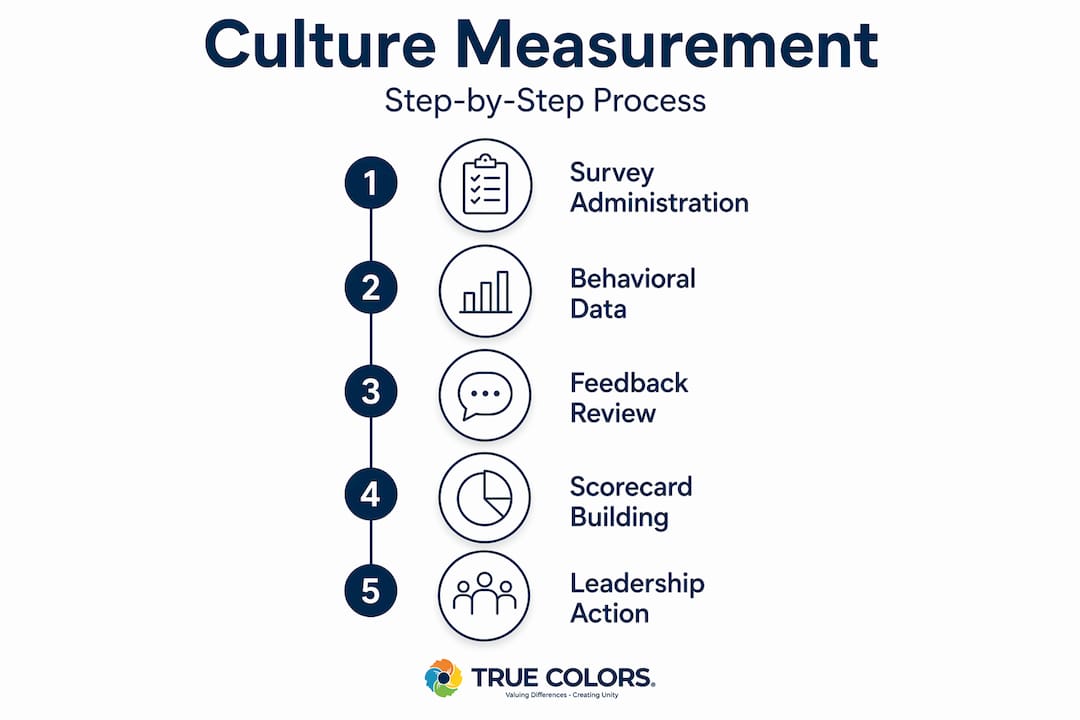
Knowing what to collect is one thing. Following a disciplined process to collect, analyze, and act on it is another. The following sequence draws on a 5-step CEO framework that produces a usable one-page scorecard within 30 days.
-
Administer a culture assessment survey. Focus questions on behavioral norms and normative values, not just opinions or satisfaction levels. Ask what people do, not just what they believe. Use a validated instrument appropriate to your scope.
-
Collect behavioral data. Pull data from your recognition platform, your calendar or meeting management system, and your performance management tools. Track the frequency of one-on-ones, the volume of peer recognition, and patterns of collaboration or avoidance. This is the layer most organizations skip, and skipping it is why their culture assessments produce little change.
-
Gather sentiment data via pulse surveys. Keep these short and targeted. Focus on three dimensions: how employees feel about their work and team (Feeling), whether they have clarity on priorities (Focus), and whether they sense progress toward meaningful goals (Progress). Pulse surveys administered in this format surface early warning signals before they affect retention.
-
Assemble outcome metrics. Compile engagement scores, regrettable attrition figures, internal mobility rates, and manager effectiveness data. These numbers translate culture patterns into business language that executives can act on. Culture explains 35.8% of the variance in people management efficiency, which means weak culture signals have measurable operational consequences.
-
Analyze data at the team and manager level. Do not aggregate everything into a single enterprise score before you understand what’s happening at the sub-group level. Team-level analysis uncovers pockets of exceptional culture and pockets of dysfunction that get hidden when you average everything together.
-
Create culture profiles and identify priority interventions. Use findings to build a one-page culture profile per team or business unit. From there, identify two to three specific behaviors or norms you want to shift, assign accountability, and build a measurement checkpoint into the next 90 days.
| Step | Primary Output |
|---|---|
| Culture survey administration | Normative value profiles by team |
| Behavioral data collection | Daily habit signals and collaboration patterns |
| Pulse survey deployment | Feeling, Focus, Progress scores by unit |
| Outcome metric assembly | Business-impact scorecard |
| Team-level analysis | Pockets of strength and concern identified |
| Culture profile creation | Two to three targeted interventions with owners |
Pro Tip: Build your culture scorecard so that every metric links to a named leader or manager. Culture without ownership is just observation.
Interpreting results and avoiding common pitfalls
Collecting data is only half the work. Interpreting it accurately and communicating it honestly is where most culture measurement efforts either gain traction or lose credibility.
The most dangerous misreading is treating high engagement scores as proof of a healthy culture. Engagement surveys measure how employees feel, not whether they have the behavioral readiness to execute against change. An organization can have high engagement scores and a culture that actively resists transformation. Without behavioral data, you won’t catch that until it’s too late.
Time-phased expectations prevent another common mistake: abandoning culture initiatives too early. Research shows behavior shifts are visible within 30 to 90 days, but statistically meaningful outcome changes typically take up to six months to appear. Leaders who expect instant results on attrition or engagement after a culture initiative will be disappointed. Leaders who track behavioral leading indicators will see progress and stay committed.
Watch for these specific errors in your own process:
-
Premature aggregation: Rolling up team scores to an enterprise average before analyzing the distribution obscures which teams need attention
-
Confusing subcultures with outliers: Departments with very different score profiles may reflect genuine subcultures worth preserving, not just noise in the data
-
Reporting without accountability: Sharing findings in a slide deck without assigning owners to specific interventions converts measurement into theater
-
Treating measurement as a project: Effective culture evaluation ends with clear interventions and ongoing monitoring, not a one-time audit report
When communicating findings to leadership, lead with behavioral data first. Numbers tied to observable actions carry more authority than survey scores, which leaders can too easily dismiss as opinion. Framing the conversation around what is being reinforced every day versus what the stated values say creates productive tension. That tension is what drives change. You can learn more about how culture consulting surfaces gaps in workplace culture.
Advanced approaches for continuous culture measurement
Organizations that move beyond the annual survey cycle gain a significant advantage. The goal is to build a continuous measurement system in which daily behavioral signal updates correlate with business outcomes and flag emerging culture risks before they surface in attrition data.
Several practices define this more mature approach:
-
Composite behavioral indices: Combine recognition frequency, one-on-one cadence, and alignment scores into a single daily or weekly index. Some organizations refer to this as the Dynamic Engagement Behavior Index (DEBI). It functions as a real-time culture health signal.
-
Leading indicator frameworks: Recognition frequency and alignment scores serve as 30 to 90-day advance signals for turnover and engagement outcomes. Tracking them consistently transforms culture measurement from reactive to predictive.
-
AI-assisted scorecards: Automated tools can aggregate behavioral and sentiment data into dashboards that give HR and executives real-time visibility without waiting for a quarterly review cycle.
-
Qualitative anchoring: Quantitative data tells you where the problems are. Exit interviews, focus groups, and manager conversations tell you why they exist. Both layers are necessary for developing an organizational culture that sticks.
-
Integration with leadership development: Culture measurement produces the most sustained change when findings are embedded directly into leadership coaching conversations, team training programs, and performance development cycles. You can see this in practice through culture-focused training programs that translate data into behavior.
My perspective on making culture measurement sustainable
I’ve spent years watching organizations invest significant effort in culture measurement and walk away with nothing they can use. The pattern is almost always the same. They launch a survey, collect responses, aggregate the scores, and hand leadership a report. Six months later, nothing has changed. Not because the data was wrong, but because the process treated measurement as a destination rather than a discipline.
What I’ve learned is that culture measurement works best when it functions as a diagnostic mirror. Its real value is not predicting financial performance. Scientific evidence shows the correlations between culture scores and financial outcomes are small and inconsistent. The value is in showing you the gap between what your organization says it stands for and what it reinforces every day.
I’ve seen executives dismiss team-level data because it was uncomfortable. A high-performing business unit had a culture profile that contradicted company values. Instead of addressing it, leadership averaged the score into the enterprise number and called it progress. That team’s attrition doubled in the following year.
The organizations that get this right treat culture measurement as an ongoing leadership routine, not a periodic HR project. They tie behavioral indicators to manager accountability. They review cultural data at the same cadence as financial data. And they use what they find to make specific, named changes to how leaders behave, not just to refresh the values poster on the wall.
Culture is not what is said. It’s what is repeated.
— Robert Cook
How Truecolorsintl supports your culture improvement efforts
Culture measurement tells you where you are. Truecolorsintl helps you do something about it.
Truecolorsintl works with organizations to make culture data actionable through leadership development programs designed to translate measurement findings into consistent, observable leadership behavior. The True Colors system connects awareness to aligned action, strengthening communication, reinforcing the norms your culture needs, and building the leadership habits that sustain progress over time. If your organization needs a structured way to translate survey scores into behavior change, the employee experience survey tools and team training programs at Truecolorsintl provide a starting point grounded in real human behavior.
FAQ
What does it mean to measure organizational culture effectiveness?
Measuring organizational culture effectiveness means evaluating whether the shared norms and behaviors in your organization are producing the engagement, collaboration, and performance outcomes you intend. It requires combining culture survey data with behavioral indicators and outcome metrics rather than relying on any single source.
Why aren’t engagement surveys enough to assess workplace culture?
Engagement surveys capture how employees feel at a moment in time, but they do not measure behavioral readiness or shared norms. A team can be highly engaged yet culturally misaligned with organizational values, making behavioral data a necessary complement to sentiment scores.
How long does it take to see results from culture measurement initiatives?
Behavioral shifts are typically visible within 30 to 90 days of targeted interventions. Statistically meaningful changes in outcome metrics like attrition and engagement scores generally appear within three to six months.
What are the most reliable cultural assessment tools?
The OCI, OCAI, and DOCS are the most widely validated instruments, but each measures a combination of culture and climate proxies. None should be used in isolation. Pairing any validated instrument with behavioral and outcome data produces significantly more reliable results.
How should culture data be reported to leadership?
Lead with behavioral data tied to named leaders and specific team results, not enterprise averages. Framing findings around observable actions rather than opinion scores creates accountability and makes culture data harder to dismiss as subjective.