
Write down your channel rules and start structured weekly check-ins this week. Those two moves alone cut through the noise of scattered messages and reduce missed decisions faster than any new tool. Templates for both, plus ready-to-run team exercises, follow below so you can put this in place before your next sprint or project cycle begins.
TL;DR:
- Clear documentation of channel rules and matching message types to appropriate channels can drastically reduce confusion and save time across teams.
- Running weekly structured check-ins and meetings with documented agendas promotes faster decision-making and keeps everyone aligned.
- Practicing psychological safety through direct invitation of dissent and addressing conflicts promptly strengthens trust and reduces long-term misunderstandings.
- Implementing targeted exercises like role-rotation facilitation and decision-recording practice builds communication skills and enhances team cohesion over time.
- Long-lasting change relies on leadership modeling desired behaviors consistently and reinforcing new habits through assessment, training, and measurement over several months.
Table of Contents
- What Is Team Communication, and Why Does It Matter to Managers?
- A Manager's Playbook: The Strategies That Actually Move the Needle
- Designing Channel Rules and a Short Written Plan
- Meeting and Feedback Routines That Make Decisions Stick
- Six Exercises That Build Real Communication Skills
- Diagnosing Where Communication Breaks Down
- How True Colors International Turns This Into a Lasting System
- The One Habit That Separates Leaders Who Fix This From Leaders Who Don't
- Where Truecolorsintl Fits Into Your Next Step
- Sources
- FAQ
What Is Team Communication, and Why Does It Matter to Managers?
Team communication is the movement of information, decisions, and feedback between people using whatever channels a group relies on: chat, email, meetings, shared documents, and the hallway conversation that never gets written down. It sounds simple. It rarely runs smoothly.
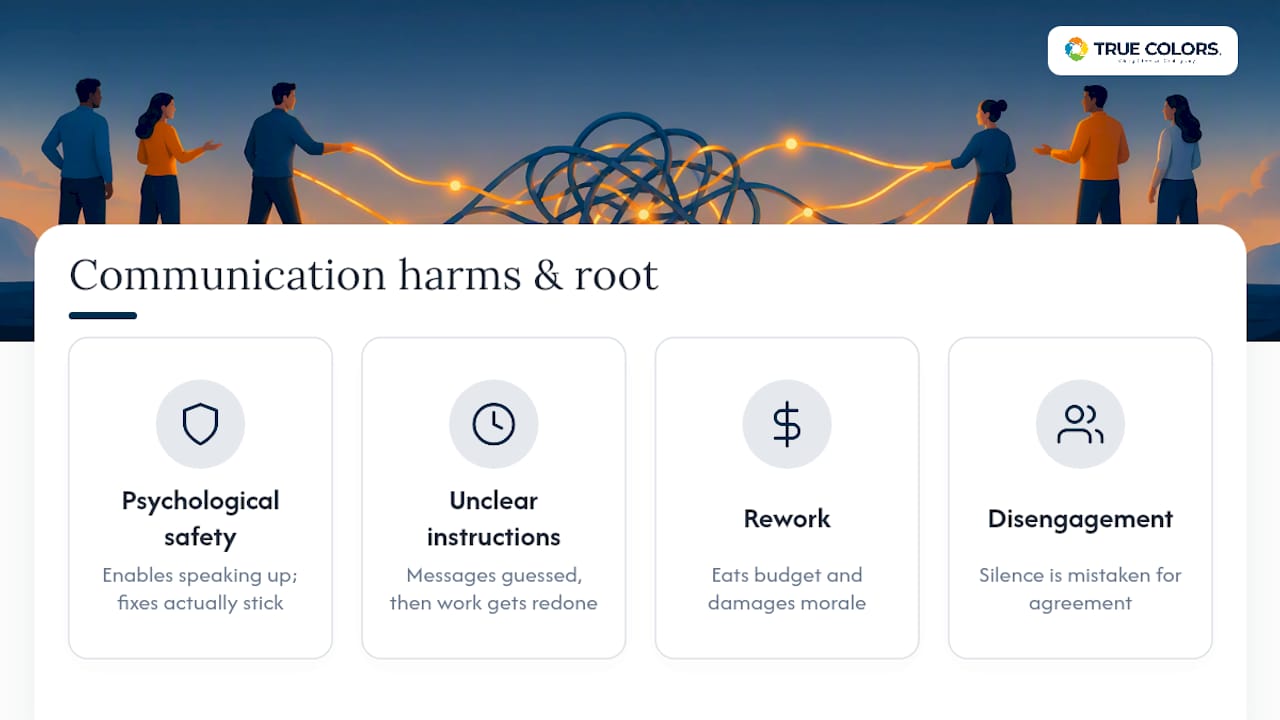
Three business costs make this more than a soft skill issue. First, time lost to unclear instructions: employees who don't know what a message means often guess, then redo the work when the guess is wrong. Second, rework itself, which eats budget and morale in equal measure. Third, disengagement. Teams that don't understand priorities or decisions stop offering opinions, and silence gets mistaken for agreement.
Underneath all three sits psychological safety, the sense that speaking up won't cost you socially or professionally. Without it, even a well-designed communication strategy collapses, because people default to saying what's safe rather than what's true. Fix the safety problem and the tactical fixes that follow actually stick. Skip it, and every template in this playbook becomes decoration.
A Manager's Playbook: The Strategies That Actually Move the Needle
Not every fix deserves equal attention right now. This order reflects what changes fastest and what everything else depends on.
- Document your channel rules first. Write a one-page plan naming what goes where: decisions in a shared doc, status updates in an async channel, quick questions in chat, external matters in email. Teams that document these protocols reduce confusion and prevent the "always-on" burnout that comes from treating every channel as urgent, according to Slack's internal communications guidance.
- Match the channel to the message, not the habit. Urgent, complex, or emotionally loaded topics belong on a call or in person. Status updates and decisions belong in writing, where they can be searched later.
- Run weekly one-on-ones and build in a real feedback loop. Structured, recurring check-ins catch problems while they're still small, and they outperform annual review cycles for keeping people aligned, based on recent organizational research. Ask three questions every time: what's working, what's stuck, what do you need from me?
- Give every meeting a written agenda and record the decision. A meeting without a documented outcome is a conversation that will happen again next week.
- Practice psychological safety on purpose. Invite dissent directly ("What am I missing here?") rather than hoping it surfaces on its own. The "three levels of speaking up," a framework for raising a clarifying question, flagging missing information, and respectfully challenging an assumption, gives hesitant team members a low-risk entry point into disagreement, an approach detailed by Forbes contributor Esther Choy.
- Address conflict within days, not quarters. Use behavior-focused language: describe what happened, not who someone is. "You missed the deadline twice" is workable. "You're unreliable" is not.
- Close the loop with recognition and lessons-learned. Feedback only keeps flowing if people see it produce visible change; otherwise, they stop offering it, a pattern Atlassian's team management research confirms repeatedly.
- Centralize documentation. One hub for decisions and status updates saves the hours teams otherwise spend hunting for context, a friction point HubSpot's team communication research ties directly to lost productivity.
Skip step one and every strategy after it inherits the same problem: nobody agrees on where information should live.
Designing Channel Rules and a Short Written Plan
Most teams don't lack communication tools; however, choosing the right ones involves matching channel to message and choosing tools thoughtfully. They lack agreement on which tool handles which job. A channel matrix solves that in one sitting.
Build it around message type, not personal preference:
- Decisions go in a shared document or topic thread, never buried in a chat scroll.
- Status updates go async, on a schedule everyone knows in advance.
- Quick questions go in chat, with an understood response window.
- External communication goes through email, kept separate from internal noise.
Once the matrix exists, write the rules that make it enforceable: expected response times by channel, who gets copied on what, and where every decision gets logged so nobody has to ask "wait, did we decide that?" three weeks later. Rock's guidance on team communication strategies backs a version of exactly this approach, favoring short, explicit rules over long mission statements that nobody rereads.
For the plan itself, keep the template brutally simple: what needs to happen, why it matters, by when, and from whom. Most friction on teams traces back to sender-focused habits, vague asks broadcast to everyone instead of framed from the receiver's point of view, a pattern HubSpot's research identifies as one of the most common breakdowns.
Pro Tip: Ban @channel for anything that isn't genuinely urgent. One overused broadcast tag trains your team to ignore every future one, including the messages that actually matter.
Meeting and Feedback Routines That Make Decisions Stick
A meeting without structure produces conversation, not alignment. Four routines fix that, and none require new software.
- Weekly team check-in. Fifteen minutes, three questions: what's moving, what's stuck, what needs a decision this week.
- Weekly one-on-ones. Protected time for direct reports to raise what they wouldn't say in a group setting.
- Async status updates. A standing written update, posted on the same day each week, so nobody has to ask for a summary.
- Quick daily standups where the work demands it. Not every team needs this; fast-moving projects usually do.
For every meeting that involves a decision, use a fixed structure: purpose, a short pre-read, a timebox, named roles, a place to capture the decision, and next steps with owners attached. Structured agendas paired with clear decision capture shorten the need for follow-up meetings, according to monday.com's research on team communication. Automated reminders and a short follow-up summary close the loop without adding a manual chore to your week.
Six Exercises That Build Real Communication Skills
Skills improve with practice, not with a slide deck. These six exercises work across in-person, remote, and hybrid setups, and each takes under 30 minutes.
- Three levels of speaking up (any format): team members practice a clarifying question, a missing-information flag, and a respectful challenge, in that order.
- Paired reflective listening (in-person or video): one person talks for two minutes, the other restates it before responding.
- Mini-retrospectives (any format): 15 minutes, three questions, what worked, what didn't, what changes next sprint.
- Win/loss share (remote-friendly): each person names one thing that went right and one that didn't, no judgment attached.
- Role-rotation facilitation (in-person or hybrid): a different person runs the meeting each week, building shared ownership of structure.
- Decision-recording practice (any format): the team drafts a decision log together until it becomes automatic.
Well-run activities like these strengthen psychological safety and improve remote and hybrid interaction, but only when facilitation matches the format, according to Harvard Business Review's guidance on team-building activities. Facilitate with a clear time limit and no interruptions during listening turns; skip the exercise entirely if the room doesn't feel safe enough for honesty yet.
Diagnosing Where Communication Breaks Down
Fix the cause, not the symptom. A three-step flow gets you there fast: observe the specific symptom (missed deadlines, repeated questions, silent meetings), map it to a channel or process, then apply one targeted fix rather than a broad new policy.
- Channel mismatch (urgent news sent async): fix by moving time-sensitive topics to calls or live conversation.
- Unclear ownership (nobody follows through): fix by naming a decision owner in every meeting record.
- Ambiguous asks (people guess at intent): fix by requiring the what/why/by when/from whom format on every request.
- Low psychological safety (nobody objects, then everything falls apart later): fix by inviting dissent directly and rewarding the first person who raises it.
Diagnosing the root cause before applying a fix, rather than defaulting to generic training, tracks with Atlassian's approach to workplace communication problems. Track improvement through fewer follow-up questions, less rework, and meetings that end with decisions instead of more meetings.
How True Colors International Turns This Into a Lasting System
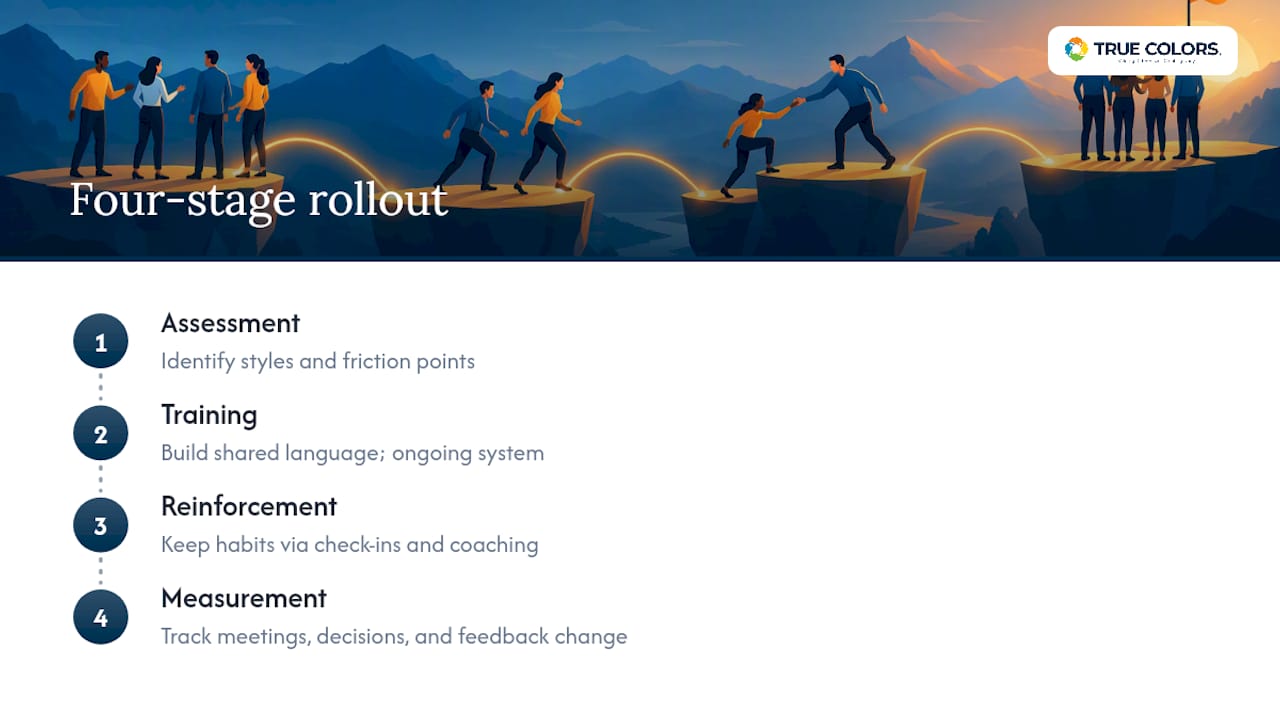
A one-time workshop rarely survives contact with a busy quarter. Lasting change follows four stages: assessment, training, reinforcement, and measurement, typically rolled out over three to six months.
Assessment identifies communication styles and friction points across the team. Training builds shared language and skills, including team communication training built to function as an ongoing system rather than a single session. Reinforcement keeps the habits alive through check-ins and coaching. Measurement tracks whether meetings run shorter, decisions get logged, and feedback actually produces visible change.
Culture is not what is said. It's what is repeated. A communication plan only works if the organization keeps practicing it long after the training ends.
Success indicators worth tracking monthly: fewer repeated questions, faster decision turnaround, and rising scores on team communication and culture assessments.
The One Habit That Separates Leaders Who Fix This From Leaders Who Don't
The single habit worth adopting above all others: model the behavior you're asking for, out loud, in the next meeting you run. Write your own decision down where the team can see it. Ask the clarifying question first, before anyone else has to. Leaders who narrate their own communication choices give their teams permission to do the same, and that permission is worth more than any policy document.
— Theresa
Where Truecolorsintl Fits Into Your Next Step
Truecolorsintl exists to move organizations from personal awareness to aligned action, which is exactly the gap between reading a communication playbook and actually living inside one six months from now. If the channel matrix and weekly check-ins above feel doable but you're not sure your team has the shared language to sustain them, that's where a structured engagement earns its cost.

Three services map directly onto what this article covers. The Individual Personality Assessment Consultation diagnoses how your team's communication styles differ before you write a single channel rule. Communication Training builds the shared vocabulary that makes feedback loops and conflict conversations less awkward. Team Building sessions turn the six exercises above into facilitated, repeatable practice instead of one-off tries.
A typical first engagement starts with an assessment, then delivers a prioritized roadmap your leadership team can act on within weeks, not quarters. If you're ready to see where your team's communication actually breaks down, start with the personality assessment and build from there.
Sources
- Internal communications strategy | Slack
- 12 tried-and-true ideas to improve team communication | HubSpot
- Team-building activities for in-person, remote, and hybrid teams | Harvard Business Review
- How to Overcome Poor Communication in the Workplace: A Guide | Atlassian
- Forbes contributor Esther Choy — practitioner insight on encouraging speaking up
FAQ
What Are the 5 C's of Communication?
Most versions of this framework name clarity, conciseness, consistency, completeness, and courtesy as the five pillars of effective messaging. Applied to teams, that means writing requests that state what's needed, keeping messages short, using the same channel rules every time, giving full context up front, and phrasing feedback with respect rather than blame.
What Are the 5 Ways to Improve Communication Skills?
Practice active listening by restating what you heard before responding. Ask clarifying questions instead of guessing at intent. Match your channel to the message, saving calls for anything urgent or emotional. Give feedback that describes behavior, not character. Close the loop by showing people their input led to a visible change.
What Are 8 Ways to Improve Communication Skills at Work?
Document channel rules, match channel to message, run weekly one-on-ones, structure every meeting with a written agenda, record decisions where the team can find them, practice active listening, address conflict within days, and close feedback loops with visible follow-through. Each one addresses a different point where teams typically lose alignment.
What Are the 5 C's of Teamwork?
Definitions vary across sources, but a common version includes communication, collaboration, coordination, commitment, and conflict resolution. Of those, communication tends to be the foundation the other four depend on, since coordination and commitment both break down fast when information isn't flowing clearly.
How Long Does It Take to See Results From These Strategies?
Teams that document channel rules and start structured weekly check-ins often notice less noise and fewer missed decisions within a few weeks. Deeper habits, like psychological safety and consistent conflict navigation, tend to take a full three to six months of reinforcement to stick permanently.