
Your leadership communication style shapes what your team believes is possible. The way you communicate each day brings your strategy to life, gives your org chart meaning, and helps people understand where they fit. It influences how people build trust, align on shared goals, and deliver strong work.
When leaders understand their communication style, they gain one of the most practical tools for strengthening team culture and improving performance. This guide explores the core pillars of effective leadership communication, the most recognized communication styles, and the techniques that help leaders create clarity, connection, and momentum.
Table of Contents
Key Takeaways
| Point | Details |
|---|---|
| Three pillars define effectiveness | Clarity, confidence, and connection form the foundation of any high-impact leadership communication style. |
| Style adaptation is a core skill | Knowing when to shift from directive to coaching or visionary communication separates good managers from great leaders. |
| Explicit asks reduce confusion | Ending every communication with a named owner and deadline eliminates organizational ambiguity faster than any process update. |
| Stress reveals default patterns | Leaders revert to less effective communication habits under pressure; recognizing that pattern is the first step to changing it. |
| Communication is a learnable skill | Leadership communication is not a fixed personality trait. It improves with deliberate practice and honest self-assessment. |
What is leadership communication style, and why it matters
A leadership communication style is the consistent pattern of how a leader conveys information, direction, and vision to their team. It includes word choice, tone, listening behavior, and the level of transparency a leader maintains across different situations. Most leaders have a default style they rely on, but the most effective ones treat communication as a practice rather than a personality type.
The stakes are high. Only a small share of employees agree that their leadership communicates well, indicating a persistent and costly gap. When communication breaks down, so does alignment, and when alignment breaks down, performance follows. The importance of communication in leadership is not abstract. It shows up in missed deadlines, disengaged teams, and decisions that stall because no one is sure who owns them.
Leadership and interpersonal communication are deeply linked. What you say to an individual in a one-on-one conversation sends signals that spread across your entire team. Culture is not what is said once. It is what is repeated consistently, across every interaction, every week.
The three pillars of effective leadership communication
Effective leadership communication is built on three interdependent pillars: clarity, confidence, and connection. Each one fails without the others, and together they create the conditions for real organizational coherence.
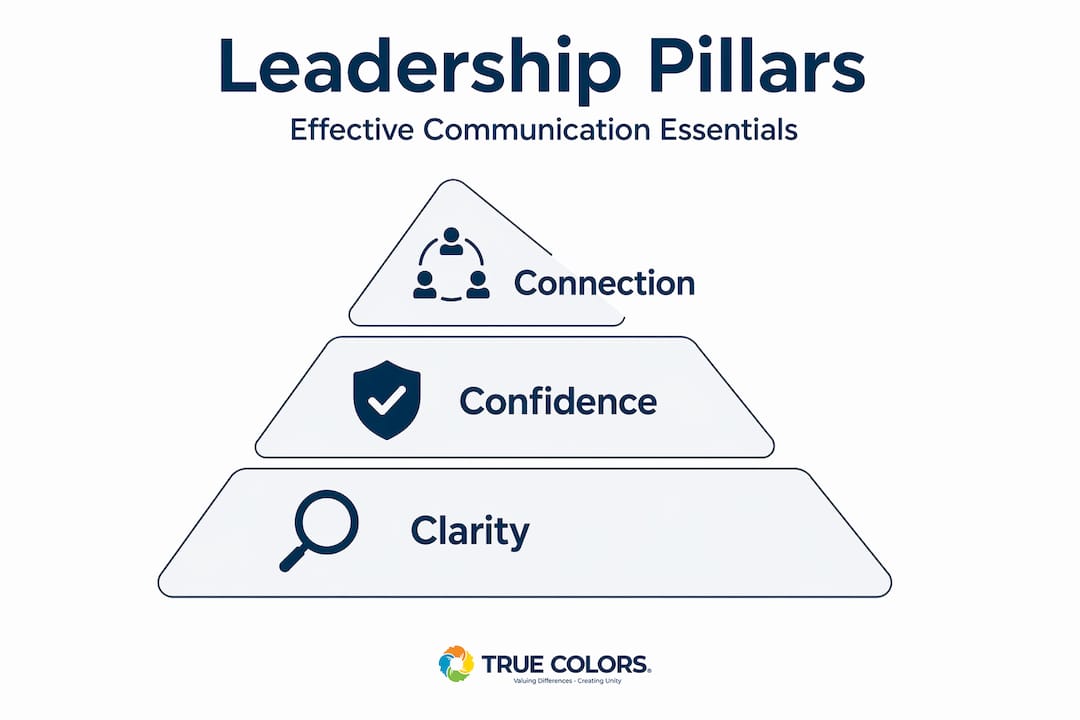
Clarity is about specificity. Vague language creates vague outcomes. When a leader says, “Let’s move quickly on this,” the team hears ten different timelines. When a leader says, “Marta owns this deliverable, and the deadline is Thursday at noon,” everyone knows exactly what is expected. This distinction matters more than most leaders realize. Clarity also means choosing concrete verbs over abstract ones. “Review the proposal and flag gaps” is clearer than “look into the proposal.”
Confidence is often misunderstood. Many leaders equate it with projecting certainty, but calm ownership of reality actually builds more credibility than loud certainty. A confident leader can say, “Here’s what we know, what we don’t, what we’re doing next, and what I need from you.” That kind of transparency about unknowns builds trust rather than eroding it. Teams do not expect leaders to have every answer. They expect leaders to be honest about where things stand.
Connection is the human layer. Organizational communication is compelling when it situates people in context, uses clear, jargon-free language, and gives them a reason to care. Visual content, storytelling, and specific calls to action all accelerate understanding and reinforce belonging.
-
Avoid hedge words like “maybe,” “kind of,” or “hopefully” in directives
-
Replace “I think we should consider” with “I recommend we do X because Y”
-
End every update with a named ask, not an open question
-
Check for connection by asking whether your message gives people a reason to act
Pro Tip: Audit your last three written updates. Count how many had a named owner and a deadline. If the answer is fewer than two, that is where your clarity gap lives.
Common leadership communication styles compared
Types of leadership communication fall into several recognized patterns, each suited to different team needs and contexts. No single style works in every situation. The skill is knowing which one to deploy and when.
| Style | Core behavior | Best used when | Watch out for |
|---|---|---|---|
| Directive | Clear orders, defined expectations, fast decisions | Crisis situations, new teams needing structure | Can stifle creativity and autonomy over time |
| Collaborative | Shared input, consensus building, open dialog | Strategic planning, high-trust teams | Slower decisions; can create confusion about authority |
| Visionary | Future-focused narrative, inspiration, purpose | Organizational change, low morale, new direction | Loses impact without follow-through on execution |
| Coaching | Questions over answers, development focus | High-potential individuals, long-term growth goals | Requires significant time investment |
Four recognized styles include directive, collaborative, visionary, and coaching, and each carries distinct advantages depending on context. The directive leader excels in a crisis because it removes ambiguity. The collaborative leader builds stronger buy-in on complex decisions. The visionary leader can re-energize a team that has lost its sense of purpose. The coaching leader invests in the long game of individual and team growth.

What makes a good leader in terms of communication is not mastery of one style. It is the ability to read a situation and adapt. A leader who only operates in directive mode during a period of calm growth will find their team disengaged. A leader who uses a coaching style during an operational emergency will frustrate their team with questions when decisions are needed.
Leadership communication styles are also shaped by the audience. A well-structured communication approach considers who is in the room, what they already know, and what they need to feel heard and directed. The same message often needs to be delivered differently to a frontline team than to a senior stakeholder group.
Techniques to improve leadership communication
How to improve leadership communication comes down to building specific habits, not just absorbing general principles. Here are the practices that have the clearest evidence behind them.
-
Practice active listening with intent. Active listening means you stop preparing your response while the other person is speaking. You reflect back what you hear. You ask clarifying questions before problem-solving. Empathy as a skill is the engine behind this. Leaders who listen actively collect better information, spot problems earlier, and create the psychological safety that drives honest feedback.
-
Use storytelling to connect data to meaning. Raw information rarely moves people to action. A brief, honest story about why a decision was made, or what a customer experienced, lands differently than a bulleted list of rationale. Compelling communication situates people in context. It tells them why this matters, not just what was decided.
-
Structure your communication with a narrative framework. Leading with narrative structure means organizing your message as: Why (the purpose or reason), What (the decision or update), How (the plan and next steps). This keeps communication brief without stripping away necessary context. It also prevents the rambling that undermines executive presence.
-
Navigate difficult conversations with a structured approach. The Nonviolent Communication framework helps leaders address conflict by focusing on observations, impacts, feelings, and requests. It prevents blame spirals and keeps the conversation productive. Instead of “You always miss deadlines,” it becomes “When the report was submitted two days late, the client presentation had to be rescheduled. I need us to agree on a realistic timeline before the next cycle.”
-
Adapt your style deliberately. Leadership communication techniques are not one-size-fits-all. Match your communication style to the context, the individual, and the desired outcome. Building team confidence often requires a coaching style, while managing through organizational change calls for a more visionary one.
Pro Tip: Under stress, most leaders revert to a default communication pattern that is rarely their best. Identify yours. Is it withdrawing, over-directing, or over-explaining? Name it, and build a simple reset habit before high-stakes conversations.
Common communication challenges and how to overcome them
Even leaders with strong communication skills run into recurring obstacles. The most common one is organizational ambiguity. Teams are often unsure who owns a decision, what the deadline is, or whether a conversation resulted in a commitment. Explicit asks with named owners and deadlines cut through this confusion faster than process redesigns or follow-up meetings.
A second challenge is maintaining confidence and connection during uncertainty. When leaders feel pressure, they often either over-communicate reassurance that sounds hollow or go quiet to avoid saying the wrong thing. Both responses damage trust. The more effective path is transparency. State what you know, what you do not know, and what your next step is. That sequence gives people something real to hold onto.
The third challenge is synthesizing complexity without losing meaning. Senior leaders regularly face situations where the full picture is complicated, but the team needs a clear signal. Framing reality and synthesizing complexity are core leadership communication skills. It’s not about simplifying facts. It is about knowing which facts your audience needs, in what order, and at what level of detail.
.“Lead every communication with Why first — the purpose or context that makes everything else make sense. Then state what was decided or changed. Then explain how it will be executed. Without that structure, even accurate information creates confusion.” — Elevating Communication & Leadership
A fourth, often overlooked challenge is stress-triggered reversion to unhelpful communication patterns. Transactional Analysis describes this as shifting from an Adult mode of calm, direct engagement into Parent or Child modes that introduce blame, avoidance, or defensiveness. Recognizing the shift and consciously returning to Adult mode is one of the most practical conflict management tools available to leaders today.
My perspective: why communication style is never finished
I’ve worked with leaders across industries, and the most effective communicators tend to share one powerful habit. They see communication as a living leadership practice, something they continue to refine as their teams, goals, and circumstances evolve.
Strong leaders bring consistency, clarity, and direction. Great communicators also know how to read the moment. Sometimes a team needs decisive guidance. Sometimes they need space to be heard. Sometimes they need a clear next step, and sometimes they need a leader who can reconnect the work to a larger purpose.
The leaders who create the strongest team cultures understand that emotional connection carries real weight. Clear direction matters. Confidence matters. And people respond more fully when they feel their leader understands what they’re carrying, what they’re trying to solve, and what support would help them move forward. That’s especially important in remote and hybrid environments, where every message, meeting, and follow-up becomes part of the culture.
My take: leadership communication grows with intention. It’s something worth revisiting regularly, especially when a team needs renewed energy, clearer decisions, or more open feedback. Those moments are valuable cues. They invite leaders to pause, listen, recalibrate, and communicate in ways that bring people back into alignment with the work, the mission, and each other.
— Theresa
How Truecolorsintl can sharpen your communication

If you recognize gaps in your team’s alignment, engagement, or communication within your organization, Truecolorsintl offers programs designed to bridge them. The Connected Leadership Program develops the communication behaviors that drive team cohesion, helping leaders build the habits of clarity, connection, and adaptability in practice, not just theory. For organizations looking at the full picture, the leadership communication training program at Truecolorsintl offers specialized skill-building that maps directly to real team and culture challenges. These are not one-time workshops. They are structured, reinforced learning experiences designed to create observable, lasting change in how leaders communicate and how teams perform.
FAQ
What is a leadership communication style?
A leadership communication style is the consistent pattern of how a leader conveys information, direction, and feedback across different contexts. It includes tone, listening behavior, transparency, and the way a leader structures messages to align their team.
What are the main types of leadership communication?
The four most recognized types of leadership communication are directive, collaborative, visionary, and coaching. Each serves a different context, and effective leaders adapt between them based on team needs and situational demands.
Why does communication style matter for team performance?
When leaders communicate with clarity and connection, teams experience less ambiguity, faster decision-making, and higher engagement. Poor leadership communication is one of the most direct contributors to disengaged teams and misaligned execution.
How can a leader improve their communication style?
Active listening, structured narrative frameworks like Why/What/How, explicit ownership and deadlines in every directive, and awareness of stress-triggered communication patterns are among the highest-impact techniques for improvement.
What makes a good leader in terms of communication?
A good leader communicates with honest confidence, adapts their style to the situation and the individual, and ends every interaction with clarity about what happens next. They do not pretend to have answers they don’t have, but they always provide a clear next step.
Recommended
-
How Do I Build Team Confidence and Competence? A Practical Strategy for People Leaders
-
Bridging the Communication Gap: Building Strong Teams Through Effective Communication
-
Effective Communication: The Cornerstone of Healthcare Leadership
-
Unlocking Healthcare Performance: Mastering Team Communication Skills