
Remote leadership training teaches managers to build trust across distance, run outcome-based teams, and facilitate meetings that end in decisions instead of more calendar invites. Every manager overseeing a distributed or hybrid team benefits from it, but it matters most for anyone who has watched engagement slip, decisions stall, or team members quietly disengage without ever raising a flag.
A credible program leaves you with more than notes and good intentions. Expect to walk away with:
- A written team operating agreement covering communication norms and decision rights
- A meeting facilitation routine that replaces status updates with actual problem-solving
- Two or three outcome metrics you can track to prove the training changed behavior, not just awareness
Key Takeaways
Remote leadership training works when it pairs applied deliverables like team charters and meeting routines with cohort-based practice and measurable follow-up.
| Point | Details |
|---|---|
| Five core competencies | Trust, operating principles, psychological safety, outcome-based performance, and meeting facilitation form the foundation. |
| Format shapes retention | Cohort programs with live practice build durable skills better than lecture-only or purely asynchronous courses. |
| Evaluate on deliverables | Choose programs that produce a team charter, communication map, and decision protocol, not just concepts. |
| Sequence the rollout | Establish operating principles before introducing outcome metrics to avoid measuring against undefined norms. |
| True Colors applies the model | Truecolorsintl delivers behavior-based, applied workshops with follow-up reinforcement matched to the competencies above. |
Table of Contents
- What Does Remote Leadership Training Actually Cover?
- How Long Does a Remote Leadership Program Take?
- How Do You Choose the Right Remote Leadership Program?
- What Does a Sample Curriculum Look Like?
- How Do You Apply This on the Job in 90 Days?
- Why True Colors International's Approach Fits This Model
- What Managers Get Wrong About Remote Leadership Training
- Give Your Team a Leadership System, Not Just a Workshop
- Sources
What Does Remote Leadership Training Actually Cover?
Most credible programs organize around five core competencies: building trust across distance, setting operating principles, fostering psychological safety, managing performance through outcome-based metrics, and facilitating virtual meetings that produce decisions. Each one maps to a specific failure mode in distributed teams.
Trust erodes fastest when people can't see each other work, which is why eCornell's leading remote teams program treats it as competency one, not an afterthought. Operating principles close the gap that causes silos, since nobody agreed on who decides what. Psychological safety keeps small problems from becoming resignations. Outcome-based performance management replaces the instinct to measure hours online with measuring what actually got shipped, a key principle in outsourcing and remote team performance. And meeting facilitation fixes the single biggest complaint on any remote team: too many calls, too few resolutions.
Training built around these five areas typically produces:
- A team charter defining norms, response times, and decision authority
- A communication map showing which channel handles which type of message
- A written decision protocol for calls that don't need a meeting
Effective programs also address three specific risks head on: isolation, siloed information, and decision delays. The University of Salford's research on remote leadership found that training which teaches managers to diagnose these problems early, using structured frameworks, prevents them from becoming entrenched habits that require much harder remedial work later.
How Long Does a Remote Leadership Program Take?
Programs generally take one of four shapes, and the right one depends on how much practice time you can realistically protect on your calendar.
- Single-day intensives for a quick refresh on one skill, like meeting facilitation or feedback delivery
- Two to three day workshops that cover the full competency set at a fast pace
- Cohort programs spanning four to twelve weeks, often with two to four hours of weekly commitment, built around live sessions plus practice between them
- Asynchronous modules you complete on your own schedule, trading structure and cohort accountability for flexibility
Cohort formats built around live practice tend to produce deeper skill retention because you're rehearsing the behavior, not just hearing about it. Self-paced modules fit better when your schedule can't absorb a fixed weekly block, but they ask more of you to actually apply what you read.
How Do You Choose the Right Remote Leadership Program?
Most programs look similar on a landing page. The differences show up in the syllabus details, and those details predict whether the training changes behavior or just fills a training budget line.
Prioritize these criteria when comparing options:
- Applied projects, not just concepts. Does the syllabus name a deliverable like a team charter or communication plan?
- Cohort structure with facilitator feedback. Programs with peer interaction and coaching produce more durable change than solo, lecture-only courses.
- Facilitator experience leading actual remote or hybrid teams, not just teaching theory.
- Customization to your industry, team size, or existing tools.
- Follow-up and reinforcement after the core sessions end.
- Measurable outcomes tied to specific behaviors, not attendance certificates.
- Accessibility and inclusive facilitation practices, especially for teams spanning time zones or including people with disabilities.
Ask providers directly: "What deliverable does each module produce?" "How do you measure whether a manager applied this on the job?" "What does reinforcement look like 30 and 60 days after the program ends?" Vague answers here are the red flag itself.
Watch for lecture-only formats with no practice component, no feedback loop, and no follow-up measurement. If a "curriculum" is really just a series of webinars, you're paying for information you could get from a book.
Pro Tip: Ask to see a sample module, not just a syllabus outline. A program confident in its content will show you an actual activity or template, not just a bullet list of topics.

What Does a Sample Curriculum Look Like?
Comparing a provider's syllabus against a concrete module list tells you fast whether you're looking at applied training or a repackaged webinar series. Reputable courses tend to converge on similar themes:
- Vision and operating principles. Deliverable: a draft team charter defining norms and decision rights. Best done live, since it requires real-time negotiation among the group.
- Trust and psychological safety. Deliverable: a trust-building plan and vulnerability exercise. Synchronous, because trust exercises don't translate to a solo module.
- Communication and meeting design. Deliverable: a communication map and a redesigned recurring meeting agenda. Mixed: concepts asynchronous, practice live.
- Performance and outcomes. Deliverable: two or three outcome metrics tied to team goals. Can be studied asynchronously, then applied with a coach.
- Coaching and feedback. Deliverable: a simulated coaching conversation with peer feedback. Requires live practice.
- Conflict resolution. Deliverable: a role-play resolving a distributed-team conflict scenario. Synchronous by nature.
- Inclusion and cultural intelligence. Deliverable: an audit of meeting practices against inclusive facilitation standards. Works well asynchronously with a live debrief.
- Implementation plan. Deliverable: a 90-day rollout plan for everything learned. Best built live with facilitator input.
A syllabus this specific is a strong signal the applied deliverables are designed for immediate use, not just discussion.
How Do You Apply This on the Job in 90 Days?
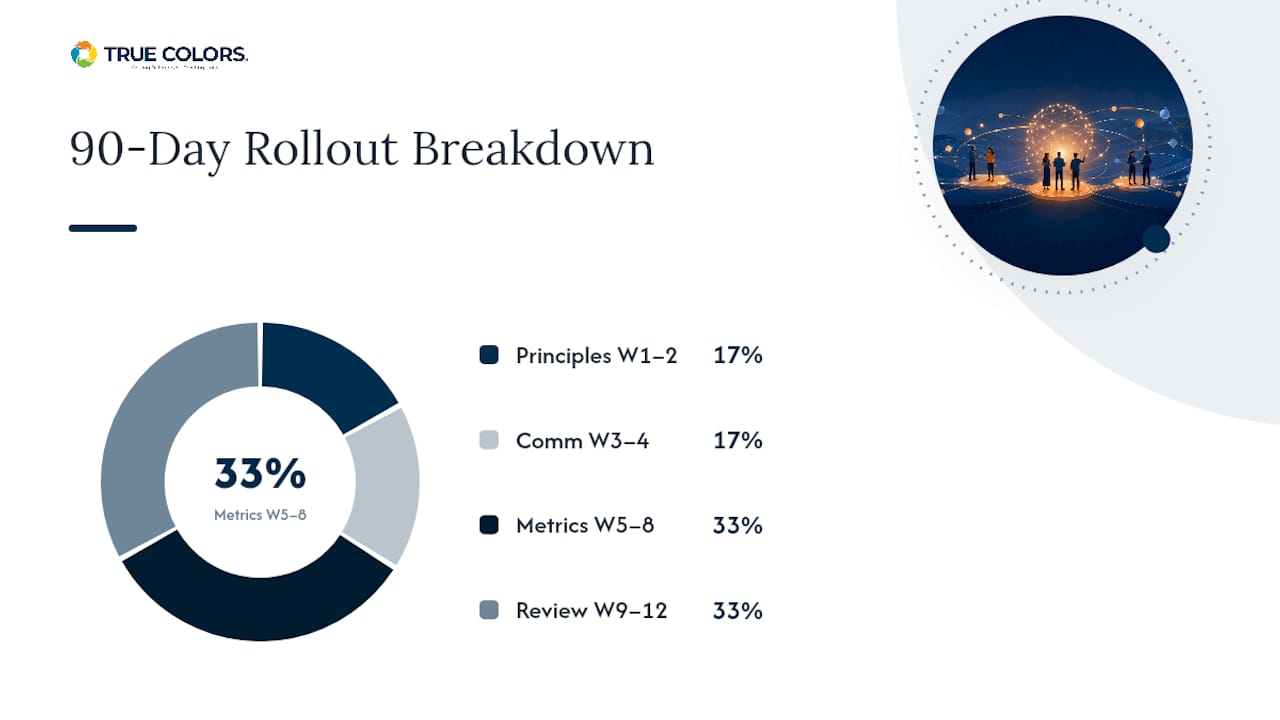
Training only pays off if you sequence the rollout instead of trying to change everything the Monday after the workshop ends. Insiders recommend establishing operating principles first, then training the team on communication, then introducing outcome metrics, in that order.
- Weeks 1 to 2: Share the team charter draft, get feedback, finalize it.
- Weeks 3 to 4: Roll out the new meeting agenda and communication map. Run one facilitation ritual weekly.
- Weeks 5 to 8: Pilot two outcome metrics. Don't introduce more than that at once.
- Weeks 9 to 12: Run an engagement pulse check, review meeting outcomes, and adjust based on what's stalling.
Watch engagement scores, whether meetings end with clear decisions, and whether approvals are taking fewer days than before. A simple check-in agenda script, "What's on track, what's blocked, what decision do you need from me," replaces status theater with actual movement.
Pro Tip: Resist measuring outcome metrics before the operating principles are in place. Measuring performance against undefined norms just breeds resentment, not clarity.
Why True Colors International's Approach Fits This Model
Truecolorsintl builds remote leadership training around the same five competencies covered above, but roots them in behavior change rather than concept delivery. The method starts with personal awareness, moves to team-level operating agreements, and reinforces new habits long after the workshop ends.
Culture is not what is said. It's what is repeated. Training that stops at a single workshop rarely survives contact with a busy quarter.
...
Typical engagements include:
- Customized virtual leadership workshops built around your team's actual friction points
- Team assessments that surface where trust and communication break down
- Follow-up reinforcement that keeps new routines from fading after 90 days
What Managers Get Wrong About Remote Leadership Training
The conventional advice treats remote leadership training as a tools problem: pick the right video platform, add a project tracker, done. That's backward. The research consistently points to sequencing, not software, as the variable that separates teams that improve from teams that stay stuck. Skip the operating principles phase and jump straight to dashboards, and you get a team that resents being measured against rules nobody agreed to.
The other overrated idea is that a single intensive workshop fixes anything. It doesn't. Behavior change requires the cohort structure, the applied deliverable, and the follow-up check weeks later. A two-day workshop without a 90-day plan is expensive inspiration, not training.
If you take one thing from this, prioritize the operating principles conversation before anything else. It's the least glamorous module and the one every stalled remote team skipped. Everything else, from psychological safety to outcome metrics, builds on whether that foundation actually exists.
— Theresa
Give Your Team a Leadership System, Not Just a Workshop
Most remote leadership training ends when the workshop does, leaving managers to translate slides into habits on their own. Truecolorsintl builds the operating principles, trust practices, and reinforcement routines directly into the engagement, so the behavior change survives past week one.

Where a generic course hands you a syllabus, Truecolorsintl builds a customized program around your team's actual friction points, backed by assessments that show exactly where trust or communication is breaking down before the first session even starts. That specificity is the difference between training that gets forgotten by the next sprint and one that reshapes how your team actually works together.
If you manage a distributed or hybrid team and want training that produces a real operating agreement, not just a certificate, start with the Connected Leadership Program or explore True Colors International's full program lineup to find the right fit for your team's size and industry.
Sources
- Leading Remote Teams — eCornell
- How to be a leader in a remote work environment — University of Salford