Culture in remote global teams is defined not by what leaders say, but by what they consistently do, document, and repeat across every time zone. Employees who feel connected to their organization’s culture are 3.7 times more likely to engage at work. That number tells you culture is not a morale initiative. It is an operational system. To strengthen culture in remote global teams, leaders must replace the spontaneous interactions of a shared office with deliberate structures: communication charters, documented behavioral values, and recurring rituals that work across borders. Cultural systems like async-first norms take 12 to 18 months to fully internalize. The organizations that start building now are the ones that will see cohesion and performance gains in the years ahead.
What foundational systems does a strong remote global team culture require?
Culture in remote teams must be treated as operational infrastructure, not a collection of fun activities. The distinction matters because infrastructure requires documentation, maintenance, and accountability. Fun activities do not.
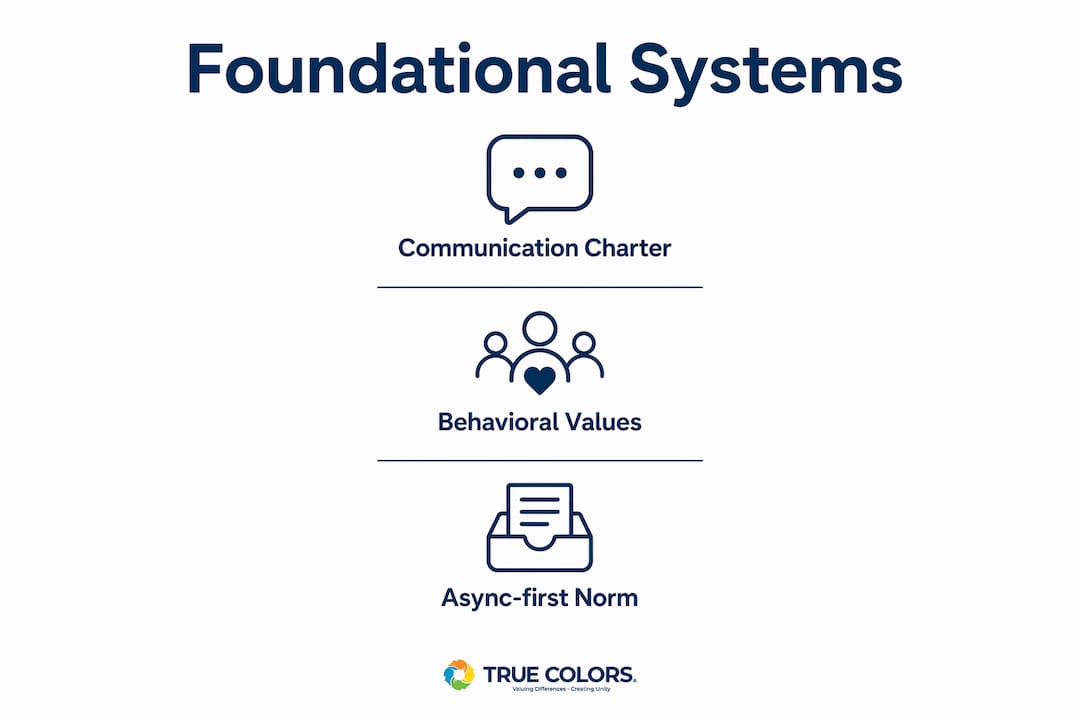
The first foundational system is a communication charter. A communication charter defines how the team shares information, handles conflict, and makes decisions. Without it, every team member defaults to the communication style they grew up with, which creates friction across cultures and time zones. A strong charter covers three areas:
-
Feedback norms: How feedback is given, by whom, and in what format (written vs. spoken, synchronous vs. asynchronous)
-
Conflict resolution: Who facilitates disputes, what the escalation path looks like, and how disagreements are documented
-
Inclusive communication: Which languages are acceptable in shared channels, how non-native speakers are supported, and what response time expectations apply across regions
The second foundational system is documented behavioral values. Aspirational values posted on a website do not change behavior. Behavioral values describe observable actions. “We respond to async messages within 24 hours” is a behavioral value. “We value communication” is not. The difference is measurable accountability.
The third system is an async-first norm. Async-first means the default mode of work does not require real-time presence. This is the most inclusive practice a global team can adopt because it removes the structural advantage held by employees in the headquarters time zone.
Pro Tip: Build your communication charter in a shared document and require every new hire to read and sign it during onboarding. Treat it as a living document, reviewed every six months.
| System | What it does | How long to internalize |
|---|---|---|
| Communication charter | Aligns feedback, conflict, and inclusion norms | 3–6 months |
| Documented behavioral values | Replaces aspirational statements with observable actions | 6–12 months |
| Async-first norms | Creates equity across time zones | 12–18 months |
These three systems do not operate in isolation. They reinforce each other. A team with a communication charter but no behavioral values will drift. A team with behavioral values but no async norms will exclude members in distant time zones. All three must be built together and maintained over time.
How can leaders build cohesion and inclusive leadership in remote teams?
Inclusive leadership in a remote context is defined by empathy, not just policy. Digital collaboration tools influence inclusive leadership by fostering empathy and team cohesion, not through technology use alone. The tool is not the solution. The leader’s behavior within the tool is.

The psychological pathway from distributed work to cohesion runs through three stages: digital collaboration, empathy, and cross-cultural communication. Leaders who skip the empathy stage and jump straight to cross-cultural communication training find that the training does not stick. Empathy must be built first through consistent, low-stakes interactions that allow team members to see each other as people, not just task contributors.
Remote teams become siloed without deliberate leadership to create cross-group bridging ties. Silos form quietly. A team in Singapore develops its own norms. A team in Germany develops different ones. Within six months, both groups have stopped sharing information across the boundary. Leaders must architect cross-functional connections before silos form, not after.
Cultural intelligence, often called CQ, is the leadership skill that makes this possible. CQ is the ability to function effectively across national, ethnic, and organizational cultures. Leaders with high CQ recognize when a team member’s silence in a meeting reflects cultural deference rather than disengagement. They adjust their facilitation style accordingly.
Practical actions that build cohesion and inclusive leadership include:
-
Rotating meeting facilitators across regions so every voice leads at some point
-
Structured check-ins at the start of meetings that are personal, not task-focused
-
Cross-functional project pairings that connect members from different regions for short-term work
-
Coaching conversations that focus on communication style differences, not performance deficits
-
Empathy-building exercises such as sharing one professional challenge and one personal win each week
Pro Tip: Cultural intelligence among managers improves team cohesion more than the use of technology tools alone. Invest in CQ training before rolling out new collaboration platforms.
Understanding how different work styles adapt to remote work is the first step toward building a leadership approach that fits your team’s makeup.
What daily practices help strengthen team bonds over time?
Culture is not what is said. It is what is repeated. The daily and weekly practices a team maintains are the actual culture, regardless of what the values document says.
-
Start every meeting with a structured opening. A two-minute personal check-in before the agenda begins builds familiarity over time. Teams that skip this step consistently report lower psychological safety scores.
-
Rotate meeting times across quarters. A team with members in New York, London, and Singapore cannot hold all meetings at 9 a.m. Eastern. Rotating times distributes the inconvenience fairly and signals that no region is the default center.
-
Integrate recognition into daily workflows. Recognition and feedback systems integrated into daily remote workflows increase engagement and connectedness. A weekly async channel where team members call out a colleague’s contribution costs nothing and builds belonging.
-
Document decisions publicly. When decisions are made in private channels or verbal calls, remote members who were not present feel excluded. A shared decision log keeps everyone aligned.
-
Onboard new hires into the culture explicitly. Culture onboarding is separate from role onboarding. New hires need to understand the communication charter, behavioral values, and the team’s rituals before they can contribute to the team. Keeping talent engaged before day one sets the tone for long-term cultural alignment.
Fully remote workers face a 25% loneliness rate, but engaged remote employees are 64% less likely to feel isolated. That gap is closed by consistent, intentional practices, not by occasional virtual events. Balancing structure and flexibility with consistent rituals enhances inclusion and a sense of belonging across diverse time zones.
Pro Tip: Structured learning loops such as regular debriefs can improve team performance by 20% to 25%. Schedule a 15-minute team debrief after every major project milestone.
What are the most common mistakes in building a remote global culture?
The most common mistake leaders make is treating remote culture as a morale problem. They schedule virtual happy hours and call it culture work. When engagement does not improve, they conclude that remote culture is simply harder to build. The real issue is that they never built the infrastructure.
The hardest part of remote culture is defining how the team handles conflict and decisions explicitly within communication charters to avoid silos.” This is the work most leaders skip because it feels uncomfortable. It is also the work that determines whether the culture holds.
Common mistakes that undermine remote global team culture include:
-
Relying on synchronous meetings as the primary communication channel. This excludes members in inconvenient time zones and creates information asymmetry.
-
Ignoring the cultural context of global team members. A feedback norm that works in the United States may feel aggressive to a colleague in Japan. Communication charters must account for this.
-
Allowing accidental culture defaults. When no norms are documented, the loudest voices and the headquarters time zone set the culture by default. This is rarely the culture leaders intended.
-
Skipping async fluency in hiring. Hiring for async fluency and cultural intelligence helps avoid a six-month struggle with acclimatization. Candidates who cannot write clearly, manage their own time, or communicate without real-time feedback will struggle in a distributed environment regardless of their technical skills.
-
Treating culture as a one-time rollout. Culture requires ongoing reinforcement. A values workshop in January does not create a values-driven team by December.
The fix for most of these mistakes is the same: document the norms, train leaders to model them, and review them regularly. Culture is not self-sustaining. It requires active maintenance, especially in organizations that are growing or changing rapidly. Reviewing your corporate culture and values framework at least annually keeps the system aligned with where the organization is.
Key takeaways
Strengthening culture in remote global teams requires documented systems, inclusive leadership behaviors, and daily practices maintained consistently over 12 to 18 months.
| Point | Details |
|---|---|
| Culture is infrastructure | Document communication norms, behavioral values, and async rituals before expecting cultural alignment. |
| Empathy precedes cohesion | Leaders must build empathy through consistent low-stakes interactions before cross-cultural communication training will stick. |
| Daily practices define culture | Rotating meeting times, public decision logs, and integrated recognition build a sense of belonging more reliably than one-off events. |
| Hiring shapes culture early | Screen candidates for async fluency and cultural intelligence to avoid long productivity losses after onboarding. |
| Silos form without design | Leaders must actively architect cross-functional connections, or remote teams will fragment into isolated subgroups. |
What I’ve learned about remote culture that most playbooks miss
Remote culture work is leadership work. That is the part most organizations underestimate.
I have seen organizations invest heavily in collaboration platforms, virtual event budgets, and culture decks. Then they wonder why their global teams still feel disconnected. The technology was fine. The events were well-intentioned. But no one had defined how the team handles a disagreement over Slack at 11 p.m. No one had documented what “responsive” means when your colleagues span eight time zones. Those gaps do not close on their own.
The organizations that build genuinely strong remote cultures share one trait: their leaders treat culture as a personal responsibility rather than an HR program. They model the communication norms. They rotate meeting times even when it is inconvenient for them. They name the values in real conversations, not just in annual reviews.
The timeline also matters more than most leaders expect. Twelve to eighteen months is not a pessimistic estimate. It is the realistic window for new norms to become habits. Leaders who expect culture change in a quarter will pull the plug too early and conclude the approach did not work. The approach works. The timeline requires patience and consistency.
My honest advice: start with the communication charter. Get the conflict and decision-making norms documented first. Everything else, the rituals, the recognition systems, the CQ training, builds on that foundation. Without it, you are decorating a building that has no frame.
— Theresa Stairs
How Truecolorsintl supports remote global culture building
Building a strong culture across distributed teams takes more than good intentions. It takes a system that leaders can use.

Truecolorsintl helps organizations make culture operational. Through leadership development and culture-building programs, Truecolorsintl works with corporate leaders and HR professionals to identify what is helping or hurting team performance, define observable behavioral norms, and build the reinforcement habits that keep culture moving forward. For teams that need focused support on communication across distributed environments, the communication consulting programs provide practical frameworks that translate directly into daily team behavior. For organizations ready to embed cultural intelligence at the leadership level, corporate consulting and coaching offer custom solutions built around your team’s specific structure and goals.
FAQ
What does it mean to strengthen culture in remote global teams?
Strengthening remote global team culture means replacing the informal norms of a shared office with documented systems: communication charters, behavioral values, and recurring rituals that work across time zones and cultures.
How long does it take to build a remote team culture?
Foundational cultural systems, such as async-first norms and documented behavioral values, take 12 to 18 months to fully internalize across a distributed team.
Why do remote teams become siloed?
Remote teams silo when leaders do not actively design cross-functional connections. Without deliberate bridging ties, each regional subgroup develops its own norms and stops sharing information across boundaries.
What is the most important thing to hire for in a remote global team?
Hiring for async fluency and cultural intelligence is the most critical factor. Candidates who cannot communicate clearly in writing or manage their time without real-time oversight will struggle regardless of their technical qualifications.
How does recognition reduce loneliness in remote teams?
Engaged remote employees are 64% less likely to feel isolated. Recognition integrated into daily workflows, such as a weekly async shoutout channel, builds the sense of belonging that reduces loneliness over time.