
The strongest TestGroup.com alternatives available to US-based HR teams right now are TestGorilla, iMocha, Testlify, SHL, HireVue, Adaface, Xobin, PMaps, ThriveMap, WeCP, and Equip. Each addresses a different gap: some prioritize technical screening, others behavioral depth, and a few focus on culture fit and leadership alignment. TestGroup itself offers scientifically validated psychometric tools developed with universities and available in around 20 languages, so the bar for alternatives is genuinely high.
Here is a quick orientation by use case:
- TestGorilla — broad pre-built test library, fast deployment, best for general screening
- iMocha — technical and cognitive assessments with pay-as-you-go flexibility
- Testlify — AI-powered evaluations with over 3,000 tests and 100+ ATS integrations
- SHL — enterprise-grade psychometric validation with global reach
- HireVue — AI-driven video interviewing combined with structured assessment
- Adaface — customizable technical and soft skills tests for mid-sized teams
- Xobin — broad assessment types with strong AI proctoring and ATS compatibility
- PMaps — psychometric mapping focused on personality and behavioral profiling
- ThriveMap — behavioral analytics oriented toward culture fit and team alignment
- WeCP — live coding assessments built specifically for technical hiring
- Equip — asynchronous video evaluation paired with multi-format assessments
Why organizations look for TestGroup.com alternatives
Pricing structure is often the first friction point. Platforms like TestGorilla require a 12-month minimum commitment, and TestGroup's own Bridge subscription model, while powerful, may not suit organizations that need short-term or project-based access. Budget-conscious HR teams, particularly those managing seasonal hiring cycles, frequently find that annual lock-ins create unnecessary financial exposure.
Feature access is the second driver. On several platforms, core capabilities such as branded assessments, ATS integrations, and candidate-facing video responses sit behind the highest pricing tier. When those features are table stakes for your candidate experience, paying for a lower plan and hitting a wall mid-process is a real operational problem.
Integration compatibility shapes the decision as much as any feature list. HR teams running Workday, Greenhouse, or Lever need assessment tools that connect without custom development. Platforms vary considerably here: some offer native integrations on all plans, others restrict them to premium tiers or require API work.
Candidate experience also matters more than it used to. A clunky assessment interface reflects on your employer brand. Organizations increasingly want platforms that support custom branding, mobile-friendly delivery, and a warm, professional feel throughout the evaluation process.
How do these platforms compare on price and value?
Third-party ratings from G2 and Capterra give HR teams a reliable proxy for overall quality, especially when direct trials are not yet possible. Pricing varies widely across the category, and the gap between starting price and actual cost of ownership can be significant once you factor in per-user fees, ATS add-ons, and annual commitments.
| Platform | Starting Price | Value Rating (G2) | Pros | Cons | Bonus Features |
|---|---|---|---|---|---|
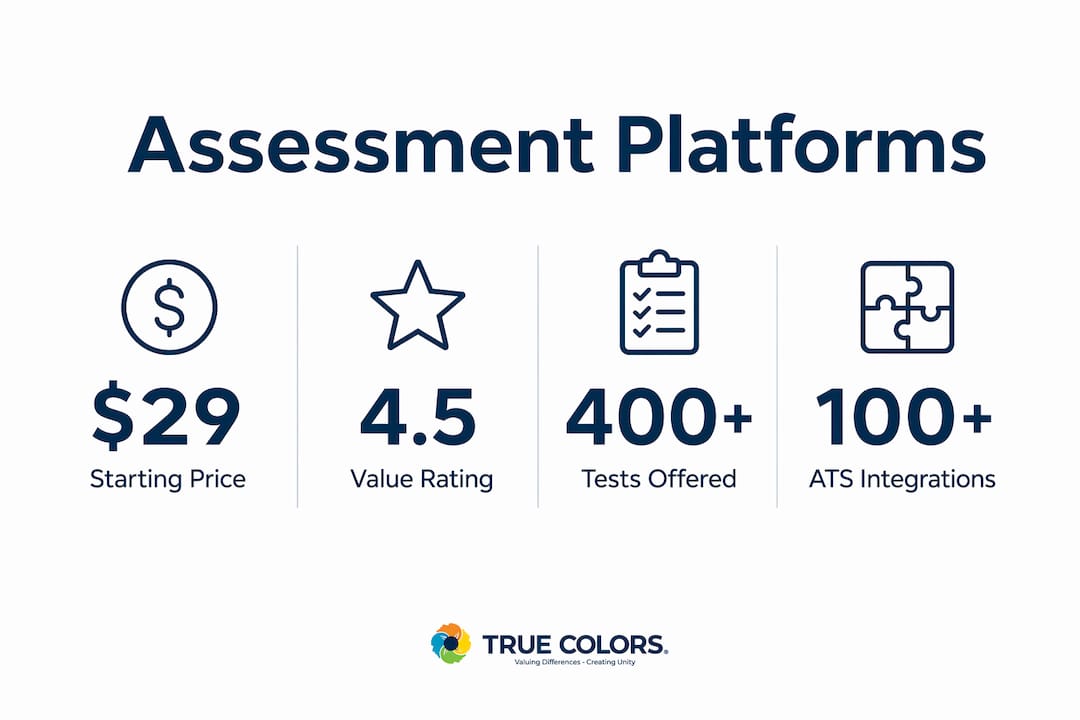
| TestGorilla | $900/year | 4.4/5 | 400+ pre-built tests, fast setup | 12-month minimum, ATS only on top tier | Anti-cheating tools |
| iMocha | $400/month | 4.4/5 | 2,500+ skills assessments, pay-as-you-go | Can be costly at scale | Skill intelligence dashboards |
| Testlify | Custom pricing | 4.4/5 | 3,000+ tests, 100+ ATS integrations | Pricing not publicly listed | Conversational AI interviews |
| SHL | Custom pricing | — | Scientifically validated, global reach | Higher cost, complex setup | Occupational personality questionnaires |
| HireVue | Custom pricing | — | AI video analytics, structured interviews | Requires change management | Game-based assessments |
| Adaface | Custom pricing | — | Highly customizable, automation-friendly | Smaller test library than TestGorilla | Conversational assessment bot |
| Xobin | From $699/year | 4.4/5 | Large test library, strong AI proctoring | Higher cost, steeper learning curve | ATS and HR system integrations |
| PMaps | Custom pricing | 4.4/5 | Deep behavioral profiling, culture alignment | Niche focus, less technical coverage | Leadership potential mapping |
| ThriveMap | Custom pricing | — | Culture fit analytics, team alignment | Smaller brand recognition | Realistic job preview tools |
| WeCP | Custom pricing | 4.4/5 | Live coding tests, real-time collaboration | Developer-focused only | Pair programming evaluation |
| Equip | Custom pricing | — | Async video plus multi-format assessments | Less known in enterprise | Custom scoring rubrics |
Detailed review of leading TestGroup.com alternatives
The platforms above differ not just in price but in the depth and type of assessment they deliver. Understanding those differences is what separates a good hire from a costly one.
TestGorilla deploys fast. Its library of 400+ pre-built tests covers cognitive ability, personality, situational judgment, and role-specific skills. The tradeoff is customization: you get limited ability to tailor questions for niche roles, and ATS integrations are locked to the Pro Plan. For teams that need to screen at volume without heavy configuration, it works well.
iMocha targets technical and cognitive evaluation with over 2,500 skills assessments and a skill intelligence layer that maps workforce capability gaps. Its pay-as-you-go option gives smaller teams flexibility that annual-commitment platforms cannot match. The G2 rating of 4.4/5 reflects solid user satisfaction, particularly among tech-heavy hiring teams.

Testlify stands out for scale. With over 3,000 tests and native integrations with more than 100 ATS platforms, it handles high-volume hiring without requiring manual workarounds. Its conversational AI interview feature creates realistic job simulations, which candidates consistently rate as more engaging than static questionnaires.
SHL is the enterprise standard for scientifically validated psychometrics. Its Occupational Personality Questionnaire has decades of research behind it, and its global delivery infrastructure supports multinational hiring programs. The setup complexity and cost reflect that positioning: SHL is not a self-serve tool, but for large organizations that need defensible, legally compliant assessments, it earns its place.

HireVue combines structured video interviews with AI-driven scoring. Its game-based assessments add a behavioral dimension that traditional questionnaires miss. The platform requires meaningful internal change management to deploy well, but organizations that commit to it gain a consistent, data-rich candidate evaluation process.
Adaface takes a different approach: its conversational assessment bot simulates a real technical interview rather than presenting a static test. That format reduces candidate anxiety and produces more authentic responses. Mid-sized companies find it particularly useful for screening software engineers and customer-facing roles simultaneously.
Xobin covers the broadest range of assessment types in this group, from pre-employment testing to AI-powered interview evaluation. Its AI proctoring is among the strongest available, which matters for remote hiring programs where test integrity is a concern. The starting price of $699/year positions it as a mid-market option with enterprise-adjacent features.
PMaps focuses on psychometric depth. Its behavioral mapping tools align closely with culture and leadership profiling, making it a natural fit for organizations that want assessment data to inform not just hiring but also team design and succession planning.
ThriveMap builds its entire platform around behavioral analytics and culture fit. Its realistic job preview tools show candidates what a role actually involves before they accept an offer, which reduces early attrition. For organizations where culture alignment is a measurable priority, ThriveMap delivers insights that generic skill tests simply cannot.
WeCP (We Create Problems) is purpose-built for technical recruitment. Its live coding environment and real-time collaborative evaluation tools let hiring managers observe how developers actually think and work, not just how they perform on multiple-choice questions.
Equip rounds out the list with asynchronous video evaluation paired with multi-format assessments. It suits recruiters who need to evaluate candidates across time zones without scheduling live interviews at every stage.
Key advantages and limitations to keep in mind:
- Personality and behavioral depth: PMaps, ThriveMap, and SHL lead here; TestGorilla and Xobin are more surface-level
- Technical hiring: WeCP, iMocha, and Adaface are purpose-built; general platforms add technical tests but lack the depth
- ATS integration breadth: Testlify (100+ integrations) and Xobin offer the widest native connectivity
- Pricing flexibility: iMocha's pay-as-you-go and Adaface's custom plans offer the most adaptability for variable hiring volumes
- Candidate experience: HireVue and Equip invest most heavily in the candidate-facing interface
What experts say about choosing the right assessment platform
Scientific validity is the criterion most often overlooked when HR teams evaluate platforms by feature count alone. Tests developed with academic research collaboration predict long-term workplace behavior more accurately than those built purely for speed or volume. A large test library is not the same as a validated one.
Behavioral intelligence extends the value of assessment data well beyond the hiring decision. Platforms that feed behavioral insights into leadership development programs, team communication training, and culture reinforcement generate a return that one-time screening tools cannot match.
High-volume platforms prioritizing speed can overshadow the quality of behavioral insight. The most effective hiring programs combine AI automation with human-centered evaluation, using data to inform judgment rather than replace it.
Expert recommendations for evaluating any assessment platform:
- Confirm scientific validation: ask vendors for peer-reviewed research or university collaboration behind their core assessments
- Assess integration depth: verify that ATS connectivity is available on your actual plan, not just the enterprise tier
- Evaluate candidate experience: run a test candidate through the full flow before committing
- Check ongoing development support: platforms that support talent lifecycle management beyond initial screening deliver compounding value
- Prioritize self-managed accounts: independently managed assessment environments give HR teams control over invitations, branding, and reporting without third-party delays
- Match platform type to hiring need: pre-built libraries suit broad screening; specialized behavioral tools suit culture-critical or leadership roles
Pro Tip: Before signing any annual contract, request a full-access trial that includes ATS integration testing. The integration experience on a lower plan often differs significantly from what the sales demo shows.
Truecolorsintl offers a different path to talent alignment
The platforms compared above are all built primarily for candidate screening. Truecolorsintl takes a different approach to the same goal.
Where screening tools measure candidates at a point in time, Truecolorsintl helps organizations build the behavioral habits and leadership consistency that make hiring decisions stick. Its system connects individual behavior to team alignment, culture reinforcement, and leadership development, so the insight generated during hiring continues to drive performance long after onboarding. For HR leaders who want assessment data to do more than fill a role, Truecolorsintl's talent acquisition programs and leadership development offerings address the layer that screening platforms leave untouched: what happens to culture and performance after the hire.
Key Takeaways
The most effective approach to replacing TestGroup.com is to match the platform's assessment depth and pricing model to your specific hiring volume, role type, and culture priorities.
| Point | Details |
|---|---|
| Scientific validity matters most | Choose platforms with peer-reviewed or university-backed assessments, not just large test libraries. |
| Pricing flexibility varies widely | TestGorilla requires a 12-month minimum commitment; iMocha offers pay-as-you-go flexibility. |
| ATS integration depth differs by plan | Verify that integrations are available on your actual plan tier, not only on enterprise contracts. |
| Behavioral depth beats volume | PMaps, ThriveMap, and SHL deliver deeper culture and leadership insights than general screening tools. |
| Truecolorsintl extends beyond screening | Truecolorsintl connects behavioral assessment to leadership development and culture reinforcement post-hire. |