
Most leaders treat growth as a product problem or a sales problem. Build something better, sell it harder, and the numbers follow. That framing leaves out one of the most durable growth drivers available: culture. Understanding what culture-led growth means means recognizing that how your organization behaves, what it stands for, and how it connects with customers and employees is not a soft concern. It is a structural one. This article breaks down the concept clearly, supports it with evidence, and offers a practical path forward.
Table of Contents
Key takeaways
| Point | Details |
|---|---|
| Culture is structural, not decorative | Culture-led growth treats organizational values and behaviors as core business infrastructure, not a branding exercise. |
| CLG outperforms product-led growth for consumer brands | Brands that embed culture into every function build deeper loyalty than those relying on product features alone. |
| Preservation beats assimilation in mergers | Protecting acquired cultures, as Microsoft did with GitHub, drives measurable revenue and user growth. |
| Measurement must go beyond traditional metrics | Leaders need to track cultural resonance, trust, and engagement alongside revenue to evaluate culture-driven development. |
| Embedding culture requires leadership consistency | Culture is not what is said. It is what is repeated, modeled, and reinforced at every level of the organization. |
What is culture-led growth?
Culture-led growth (CLG) is a business strategy in which an organization’s values, identity, and cultural practices become the primary engine of sustainable growth. Rather than relying on product features or aggressive sales tactics to acquire and retain customers, CLG focuses on building deep cultural resonance with both customers and employees. The result is a brand that people genuinely believe in and return to, not because they were sold to, but because they feel a real connection.
To understand CLG clearly, it helps to contrast it with product-led growth (PLG). PLG relies on the product itself as the primary mechanism for acquisition and retention. Users experience the product, find value, and convert. CLG goes further. It recognizes that culture influences customers before, during, and long after the product interaction. The emotional and social context around a brand shapes behavior at every touchpoint.
The core elements of culture-led growth include:
-
Cultural insight: Continuously listening to and understanding the communities, behaviors, and values that shape your audience
-
Brand authenticity: Aligning your organization’s stated values with observable actions across all functions
-
Continuous engagement: Sustaining cultural connection beyond campaigns through ongoing community participation and value delivery
-
Organizational alignment: Ensuring that internal culture mirrors the external brand promise employees live what customers experience
Here is a direct comparison between the two approaches:
| Dimension | Product-led growth | Culture-led growth |
|---|---|---|
| Primary growth driver | Product features and usability | Cultural identity and emotional resonance |
| Customer acquisition | Self-service product trials | Community advocacy and cultural alignment |
| Retention mechanism | Product stickiness | Brand loyalty rooted in shared values |
| Measurement focus | Activation, retention, revenue | Engagement, trust, cultural resonance |
| Risk profile | Feature commoditization | Culture misalignment or inauthenticity |
CLG challenges traditional linear funnels by integrating the entire consumer experience through cultural advocacy rather than pushing prospects through a conversion sequence. For consumer brands especially, this distinction is significant.

Real-world evidence for culture-led growth
The case for culture-driven development is not theoretical. The data is concrete, and the examples are instructive.
London’s sustained investment in its creative sector offers one of the clearest macroeconomic proofs. A decade-long cultural investment unlocked nearly £12 billion in economic activity, with creative industries contributing approximately £64 billion annually to the UK economy. That is culture functioning as genuine infrastructure, not as a marketing budget line.
At the organizational level, behavioral research shows that culture-focused programs produce measurable changes in how people spend time and money. Participants in structured cultural aspiration programs made 29% more consumer durable purchases and spent 36% more on children’s education over five years. They also worked an hour longer daily and reduced food insecurity by 1.5 weeks. Culture shifted behavior in ways that conventional incentive programs rarely achieve.
The Microsoft and GitHub acquisition is one of the most cited examples of culture-led growth in corporate history. When Microsoft acquired GitHub in 2018, it deliberately chose to preserve GitHub’s developer culture rather than absorb it into Microsoft’s existing structure. The outcome was striking. GitHub grew from 28 million to 84 million users by 2022, and annual recurring revenue climbed from $250 million to $1 billion in four years. The product did not change dramatically. The cultural preservation did the work.
Research from Harvard Law School reinforces this at the organizational level, showing that embedded culture provides a comparative advantage through lower monitoring costs, higher trust, and wider spans of control. These are efficiency gains that show up directly on the income statement.
Pro Tip: When evaluating the return on culture investment, look at employee retention rates, customer lifetime value, and net promoter scores alongside revenue. These are the leading indicators that culture is compounding as a growth asset.
Pitfalls that undermine culture-led strategies
Understanding the benefits of culture-led growth is straightforward. Executing it without falling into common traps is harder.
The most frequent mistake leaders make is treating culture as an amenity rather than infrastructure. Culture becomes a set of perks, a values poster in the lobby, or a campaign theme. None of that is culture-led growth. Success requires embedding values into every business function, from hiring and onboarding to product decisions and customer service. Superficial gestures do not compound. Consistent behaviors do.
Here are the four most damaging pitfalls to watch for:
-
Using culture as a marketing tool only. When culture lives only in the communications department, it creates a gap between what the brand promises and what employees and customers actually experience. That gap erodes trust faster than any competitor can.
-
Forcing cultural homogenization in mergers. Acquisitions fail when leadership tries to replace the acquired organization’s identity with the acquirer’s. Alignment on shared purpose with flexible execution works better than imposing uniform cultural norms across distinct teams.
-
Treating cultural investment as philanthropy. Organizations that fund cultural programs without governance structures or reinvestment mechanisms often see those programs fade or get cut during budget cycles. Portfolio models with governance safeguards create sustainability.
-
Confusing cultural activity with cultural alignment. Running workshops, events, and engagement programs is not the same as having a culture that drives decisions. Activity without alignment produces noise, not growth.
Pro Tip: Before launching any culture initiative, ask: “Will this change how decisions are made here, or just how we talk about decisions?” If the honest answer is the latter, redesign the initiative.
Understanding how misaligned culture costs organizations in concrete terms is one of the fastest ways to build the internal case for doing this work properly.
How to operationalize culture-led growth
Knowing what culture-led growth is gets you to the starting line. Embedding it across your organization is the actual work. These are the areas where leaders need to focus their attention.
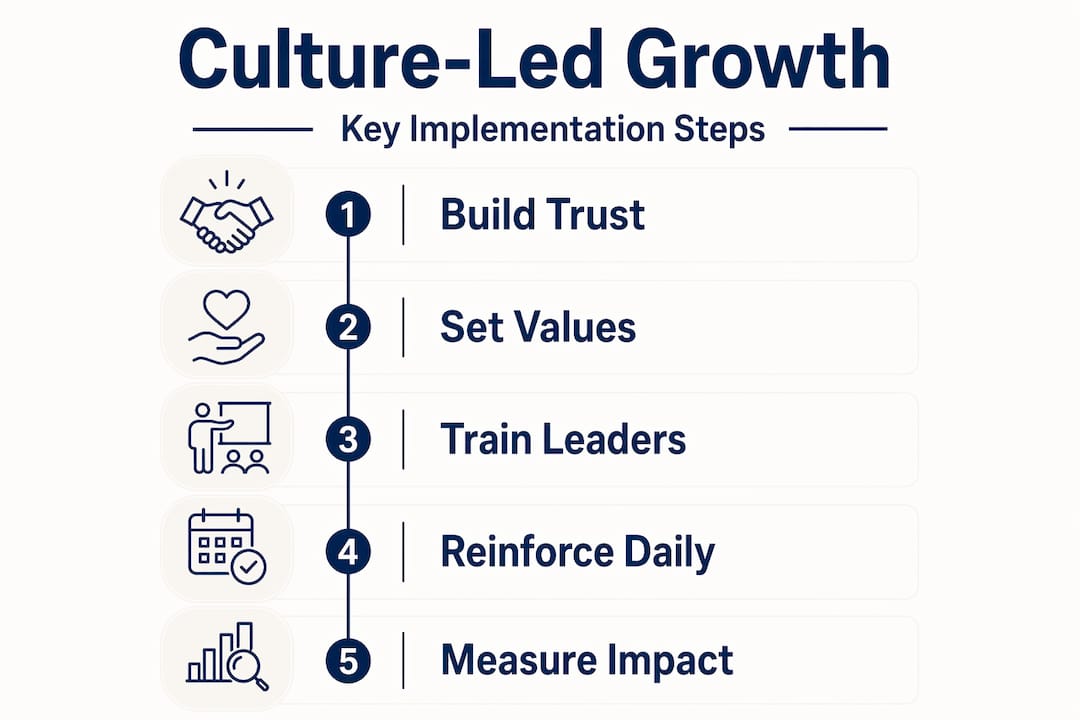
Build cultural intelligence at the leadership level. Leaders who lack a genuine understanding of the communities and values that shape their workforce and customer base cannot make sound cultural decisions. This means investing in listening systems, not just surveys, but structured feedback loops that surface what people actually believe and experience.
Embed culture into decisions, not just communications. Every significant business decision, whether it is a product launch, a hiring choice, or a market entry, should be evaluated against cultural criteria. Does this reinforce who we are? Does it align with what our customers and employees expect from us? These questions must be part of the standard decision process.
Here is what that looks like in practice:
-
Hiring for culture and contribution rather than credentials alone, using behavioral assessments that reveal how candidates actually operate
-
Measuring cultural resonance through employee engagement data, customer sentiment analysis, and brand perception tracking alongside traditional financial metrics
-
Developing leaders who model the behaviors the organization claims to value, because employees follow what they observe, not what they are told
-
Sustaining cultural investment through economic cycles rather than treating it as discretionary spending that disappears when margins tighten
-
Connecting onboarding, performance management, and recognition systems to cultural values so that culture is reinforced through daily operations, not just annual retreats
Proven strategies for improving workplace culture consistently point to one common factor: leaders who make culture visible through their own behavior create organizations where culture actually functions as a growth driver.
The strategic advantages of culture-led growth
When culture-led growth is working, the advantages compound in ways that are difficult for competitors to replicate. A competitor can copy your product. They cannot copy your culture.
“Brands that treat culture as core growth strategy, not just marketing, outperform by resonating emotionally with audiences.” — Kantar’s 2025 BrandZ report
The specific advantages leaders report when culture-driven development takes hold include:
-
Stronger brand loyalty. Customers who connect with a brand’s values become advocates. They refer others, defend the brand publicly, and are far less price-sensitive than customers acquired through promotions.
-
Enhanced talent attraction and retention. People want to work in organizations that stand for something real. A strong culture reduces recruiting costs and turnover, which are significant drains on growth capacity.
-
Reduced dependence on aggressive marketing. CLG minimizes aggressive sales and marketing by nurturing deep consumer brand advocacy. When your community does the growth work, your cost of acquisition drops.
-
Resilience through authenticity. Organizations with authentic, embedded cultures weather crises better. Trust built over time provides a buffer that transactional brands lack.
-
Competitive differentiation that cannot be purchased. Cultural depth takes years to build. That timeline is a barrier to imitation that no product patent or marketing budget can replicate.
My take on why culture-led growth demands real courage
I’ve spent years watching organizations invest in culture programs that never moved the needle, and I’ve seen a smaller number of organizations where culture genuinely drove performance. The difference was never the program design. It was leadership commitment.
What I’ve found is that most leaders intellectually accept that culture is important while, behaviorally, treating it as secondary. They approve the workshop budget but skip the follow-up. They declare values but make decisions that contradict them. Culture is not what is said. It is what is repeated. And what gets repeated is what leadership actually does under pressure.
The misconception I encounter most often is that culture is a “soft” asset. In my experience, it is one of the most structurally significant assets an organization has. It determines how fast decisions get made, how much oversight is needed, how well teams collaborate under stress, and how much customers trust the brand over time. Those are not soft outcomes. They are operational and financial ones.
The organizations that get culture-led growth right are the ones where leaders are willing to be held accountable to the same standards they set for their teams. That takes more courage than launching a product feature. It also produces results that last longer.
— Theresa Stairs
How Truecolorsintl helps you build a culture that drives growth
Culture-led growth does not happen by accident. It requires a system, consistent reinforcement, and leaders who know how to translate values into observable behavior. That is exactly what Truecolorsintl is built to support.
Truecolorsintl helps organizations move from culture as a concept to culture as a daily practice. Through leadership development programs, team training, employee experience tools, and corporate consulting solutions, Truecolorsintl gives leaders the frameworks and reinforcement they need to make culture a real performance driver. Whether you are working to align a leadership team, integrate cultures after a merger, or build the habits that sustain engagement over time, the work starts with understanding what is actually happening in your organization. Explore how Truecolorsintl’s culture and leadership programs can help your team turn culture into a measurable competitive advantage.
FAQ
What is culture-led growth in business?
Culture-led growth is a strategy where an organization’s values, identity, and cultural practices serve as the primary driver of sustainable growth, building loyalty and advocacy rather than relying on product features or sales pressure alone.
How does culture-led growth differ from product-led growth?
Product-led growth relies on the product experience to acquire and retain users, while culture-led growth builds emotional and social resonance around the brand so that customers connect with the organization’s identity, not just its product.
What are the main benefits of culture-led growth?
The core benefits include stronger brand loyalty, lower customer acquisition costs through advocacy, improved talent retention, greater organizational resilience, and competitive differentiation that competitors cannot easily replicate.
Can culture-led growth be measured?
Yes. Leaders should track employee engagement scores, customer lifetime value, net promoter scores, brand sentiment, and cultural alignment indicators alongside revenue metrics to get a complete picture of culture-driven development.
What causes culture-led growth strategies to fail?
The most common causes are treating culture as a communications exercise rather than an operational system, failing to align leadership behavior with stated values, and abandoning cultural investment during financial pressure rather than sustaining it as infrastructure.