
A talent retention strategy is a deliberate, systematic organizational approach to keeping skilled, engaged employees committed to staying. It goes well beyond offering competitive pay. The most effective retention frameworks address the full employee experience, from the quality of day-to-day management to how clearly career paths are defined, and whether the culture people experience at work matches what the organization says it stands for.
The core components of a strong talent retention strategy include:
- Leadership and management quality: How managers communicate, recognize, and develop their people
- Employee engagement: Whether employees feel connected to their work, their team, and the organization's purpose
- Compensation and benefits: Pay, health coverage, and total rewards aligned with market standards and individual needs
- Career development: Clear pathways for growth, internal mobility, and continuous learning
- Organizational culture: The values and behaviors that are consistently modeled, not just stated
- Flexibility: Work arrangements that respect employees' lives outside the office
What separates a genuine talent retention strategy from a collection of HR programs is coherence. Each of these elements must reinforce the others. When the internal employee experience aligns with the external brand promise, organizations build the kind of trust that keeps top performers from looking elsewhere.
Table of Contents
- Why talent retention matters more than most leaders realize
- What makes a talent retention strategy actually work?
- Practical strategies for keeping your best employees
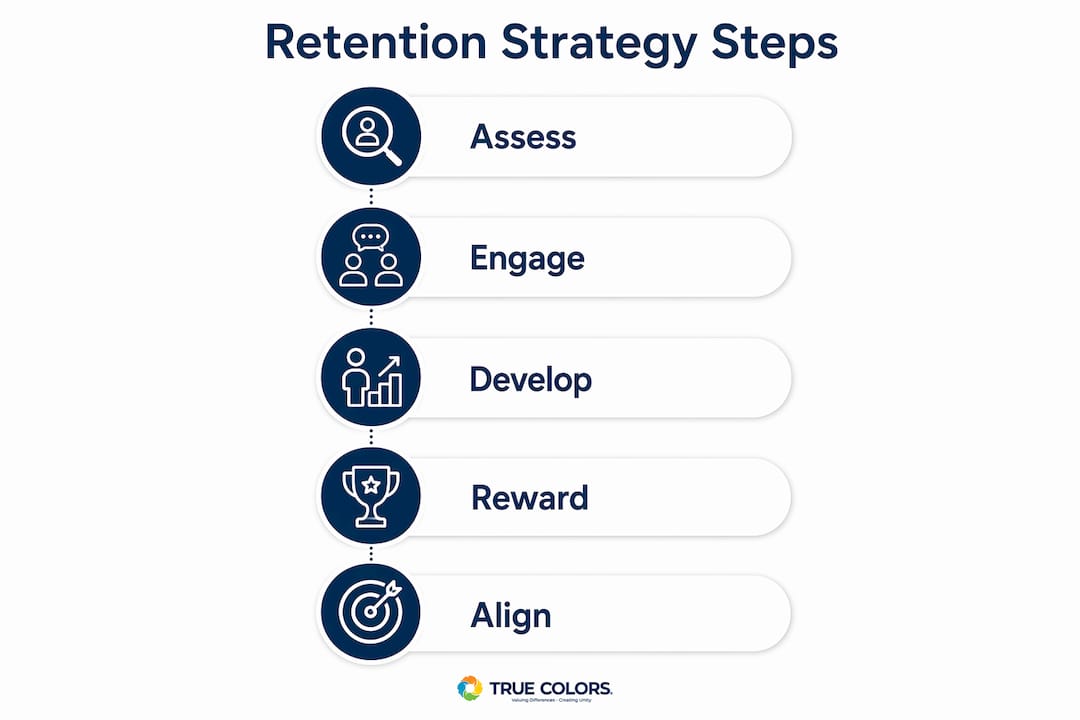
- Five steps to build a stronger retention framework
- How behavioral alignment and leadership drive lasting retention
- How different industries approach talent retention
- Truecolorsintl brings your retention strategy to life
- Key Takeaways
Why talent retention matters more than most leaders realize
The financial case for retaining talent is stark. Replacing an employee can cost a significant portion of that person's annual salary when considering separation costs, the vacancy period, recruiting, and the time it takes a new hire to reach full productivity. For a mid-level professional earning $80,000, that means a single departure can represent a substantial expense for the organization.
The operational damage compounds quickly. When experienced employees leave, their colleagues absorb the workload, collaboration patterns break down, and team morale often drops before a replacement is even hired. Organizations with chronically high turnover struggle to build the stable, trust-based cultures that drive consistent performance.
There is also a direct line between employee retention and customer experience. Tenured employees understand products, processes, and client relationships in ways that new hires simply cannot replicate in their first months. High turnover in customer-facing roles tends to show up in service quality before it shows up in any internal report.
The importance of talent retention extends to organizational effectiveness as well. Teams with low voluntary turnover develop stronger communication norms, deeper institutional knowledge, and more consistent execution. Retention is not a soft HR metric. It is a core driver of business performance.
What makes a talent retention strategy actually work?
Most organizations have some version of the right policies in place. The gap is usually in execution, consistency, and integration. The following elements distinguish retention strategies that reduce voluntary turnover from those that merely look good on paper.
Leadership and management behavior
Manager quality is a critical factor influencing variation in team engagement. A poor manager greatly increases the likelihood of resignation. No compensation package, no matter how generous, fully offsets the daily experience of working for someone who fails to communicate clearly, recognize effort, or support growth. Leadership behavior is the single highest-leverage variable in any retention framework.

Employee engagement and experience
Engagement is not a survey score. It is the degree to which employees feel that their work matters, that they are seen as individuals, and that the organization is invested in their success. Organizations that treat engagement as an ongoing discipline rather than an annual measurement tend to catch disengagement early, before it becomes a departure decision.
Compensation and total rewards
Pay needs to be competitive with the market, but it rarely needs to be the highest available. Employees who feel fairly compensated and who value their total rewards package, including flexibility, recognition, and development opportunities, are significantly less likely to leave for a marginal salary increase elsewhere.
Career development and internal mobility
"People don't leave jobs. They leave when they stop seeing a future." This is one of the most consistent findings in retention research, and it points directly to the importance of visible, accessible career pathways.
Structured learning opportunities, mentorship programs, and a genuine commitment to promoting from within signal to employees that their growth matters to the organization. When internal mobility is limited or opaque, high performers look outward.
Culture and behavioral alignment
Culture is not what is said. It is what is repeated. The behaviors that leaders model every day, the way conflict is handled, the degree to which stated values show up in actual decisions — these define the culture employees experience. When that experience is consistent and positive, it becomes a retention force in itself.
Flexible work arrangements
Flexibility has moved from a perk to a baseline expectation for many employees. Organizations that offer meaningful flexibility, whether in schedule, location, or how work gets done, tend to retain employees who would otherwise leave for roles that better accommodate their lives.

Pro Tip: Don't treat flexibility as a one-size-fits-all policy. The most effective approaches let managers and employees negotiate arrangements that work for the role and the individual, within clear organizational guidelines.
Practical strategies for keeping your best employees
The following tactics are grounded in what actually reduces turnover in organizations, not what sounds good in a policy document.
-
Conduct stay interviews regularly. Stay interviews, conversations where managers ask current employees what keeps them engaged and what might cause them to leave, are among the highest-impact retention tools available. They cost nothing and generate real-time intelligence that exit interviews never can. The key is authenticity: a stay interview that feels like a compliance exercise produces nothing useful.
-
Build a structured onboarding program. Structured onboarding significantly improves one-year retention, reducing costly early departures. Early role clarity, regular manager check-ins during the first 90 days, and peer support reduce the new-hire turnover that organizations often accept as inevitable. The first three months are when impressions solidify and departure decisions begin forming.
-
Segment retention efforts by tenure. A flat retention approach misallocates resources. New hires need clarity and connection. Mid-tenure employees need growth and recognition. Senior employees need influence and purpose. Tenure-segmented strategies target the right interventions at the right cohorts, rather than applying the same program to everyone.
-
Make managers accountable for retention outcomes. Retention cannot be a side project owned exclusively by HR. When retention outcomes become KPIs for line managers, the behavior changes. Managers begin having proactive conversations instead of reactive ones. They notice early warning signs rather than being surprised by resignations.
-
Replace administrative tasks with retention conversations. Many managers spend significant time on low-value administrative work that could be automated or delegated. Redirecting that time toward meaningful one-on-ones, development discussions, and recognition activities produces measurable retention improvements without adding headcount.
-
Align recognition with what employees actually value. Recognition programs that default to public praise or tenure-based awards often miss the mark. Some employees value public acknowledgment; others prefer a private conversation with their manager. Understanding individual preferences and acting on them consistently is what makes recognition land.
-
Address wellbeing as a retention driver. Chronic stress, burnout, and workload imbalance are among the leading causes of voluntary turnover that organizations underestimate. Wellbeing support, whether through mental health resources, workload management, or manager training on recognizing burnout, reduces absenteeism and keeps employees from reaching the point of departure.
-
Use team building approaches that reinforce belonging. Employees who feel genuinely connected to their colleagues are more likely to stay through difficult periods. Structured team experiences that build trust and improve communication create the social fabric that makes an organization worth staying in.
Five steps to build a stronger retention framework
A talent retention strategy is only as good as the process behind it. These steps give HR leaders and organizational leaders a systematic path from diagnosis to sustained improvement.
-
Diagnose your turnover patterns. Start by segmenting voluntary turnover data by tenure, department, role level, and manager. Patterns that are invisible in aggregate data become clear when you break them down. A department with 40% annual turnover is a different problem than an organization with 12% turnover concentrated among employees in their first year.
-
Identify root causes, not just symptoms. Exit interview data, engagement survey results, and stay interview findings each reveal different layers of the retention problem. Exit interviews tell you why people left. Engagement data tells you who is at risk. Stay interviews tell you what would make people stay. Using all three together gives you a complete picture. Retention failures often stem from addressing symptoms, such as adding a new benefit, rather than the underlying issues, such as a manager who consistently fails to develop their team.
-
Develop targeted response protocols. Once root causes are clear, build specific interventions for specific cohorts. If new-hire turnover is driven by unclear role expectations, the response is a stronger onboarding process and 30/60/90-day check-ins. If mid-tenure turnover is driven by limited growth opportunities, the response is a visible internal mobility program and structured development conversations.
-
Equip frontline managers with the right tools. Managers are the front line of retention, but most receive little training on how to conduct effective stay interviews, how to recognize early disengagement, or how to have development conversations that actually motivate. Providing managers with practical frameworks, not just policies, and holding them accountable for retention KPIs shifts the dynamic from reactive to proactive.
-
Measure continuously using both leading and lagging indicators. Voluntary turnover rate is a lagging indicator. By the time it rises, the damage is done. Leading indicators, such as engagement scores, absenteeism trends, internal transfer requests, and manager effectiveness ratings, give you early warning. Build a retention dashboard that tracks both, and review it with the same regularity you review financial performance.
How behavioral alignment and leadership drive lasting retention
The organizations that sustain low voluntary turnover over time share a common characteristic: they treat retention as an integrated system, not a collection of programs. Policies alone do not retain top talent. What retains people is the consistent, daily experience of working in an environment where leadership behavior, culture, and organizational systems all point in the same direction.
This is where behavioral alignment becomes a genuine competitive advantage. When leaders understand how different people are motivated, how they prefer to communicate, and what they need to feel valued, they can build the kind of trust that makes employees resilient to outside offers. That understanding does not come from a policy manual. It comes from self-awareness, practiced communication skills, and a commitment to treating people as individuals.
Embedding retention outcomes as KPIs for line managers is one of the most direct ways to operationalize this shift. When managers know their retention numbers are visible and consequential, they invest differently in their people. The conversations change. The attention to early warning signs improves. The relationship between manager and employee becomes less transactional.
Truecolorsintl's approach to leadership and culture alignment is built on exactly this principle. By helping leaders and teams develop personal awareness and stronger communication habits, Truecolorsintl creates the conditions where retention becomes a natural outcome of how the organization operates, rather than a problem HR is constantly trying to solve.
Pro Tip: Stay interviews are most effective when conducted by the employee's direct manager, not HR. The relationship context makes the conversation more honest, and the manager is in the best position to act on what they hear. Train managers on how to ask open-ended questions and how to follow through on what employees share.
For a deeper look at how stay interviews can be structured for maximum impact, the specific techniques matter as much as the intention behind them.
How different industries approach talent retention
Retention challenges vary significantly by industry, and the strategies that work in one context may need meaningful adaptation in another.
Healthcare
Healthcare organizations face some of the most acute retention pressures in the U.S. workforce. Burnout, high-acuity workloads, and the emotional demands of patient care create conditions where even well-compensated employees reach their limits. The most effective retention strategies in healthcare combine workload management with strong peer support structures, clear advancement pathways for clinical staff, and leadership development that helps nurse managers and department heads build psychologically safe team environments. Flexible scheduling is particularly high-value in this sector, where shift work is unavoidable but schedule predictability can be meaningfully improved.
Technology
In technology, the primary retention risk is not dissatisfaction with the work itself but the constant availability of competing offers. High performers in software engineering, data science, and product management are regularly recruited. Organizations that retain them tend to offer not just competitive compensation but genuine autonomy, interesting technical challenges, and a culture where engineers have visible influence on product direction. Career development in tech retention means access to cutting-edge work, not just a promotion track.
Retail and hospitality
These industries contend with structurally high turnover, but the organizations that outperform their peers on retention share a consistent pattern: they invest in frontline manager quality. In retail and hospitality, the direct supervisor relationship is the dominant retention driver. Employees who feel respected, fairly scheduled, and recognized by their immediate manager stay significantly longer than those who do not, regardless of pay. Recognition programs, clear advancement criteria, and manager accountability for team retention metrics produce measurable results.
Financial services and professional services
In these sectors, retention is closely tied to career trajectory visibility and compensation structure. High performers expect to see a clear path to advancement, and they expect compensation to reflect their contribution. Firms that retain top talent in these industries tend to combine transparent promotion criteria with strong mentorship programs and a culture where high performance is consistently recognized. The hidden drivers of retention in professional services often come down to whether employees feel their work is meaningful and whether they trust their leadership.
Nonprofit and government
These sectors cannot always compete on compensation, which means retention strategy must lean harder on mission alignment, culture, and development. Employees who join nonprofits and government agencies are often motivated by purpose, and organizations that keep that purpose visible and connected to daily work retain people who would otherwise leave for higher-paying private-sector roles. Flexible work arrangements and strong internal community also carry more weight here than in sectors where compensation differentials are smaller.
Truecolorsintl brings your retention strategy to life
Building a retention strategy that actually holds requires more than a new policy or an annual engagement survey. It requires leaders who understand their people, teams that communicate with trust, and a culture that reinforces the right behaviors every day.

Truecolorsintl gives organizations the practical system to make that happen. Through leadership development programs, team training, and employee experience insights, Truecolorsintl helps HR leaders and organizational leaders move from awareness to aligned action. The approach is grounded in human behavior, not abstract frameworks, which means the changes leaders make are observable, repeatable, and sustainable. For organizations where culture and retention are genuinely connected to business outcomes, Truecolorsintl offers the structure and reinforcement to keep progress moving. Connect with Truecolorsintl to see how the system applies to your organization's specific retention challenges.
Key Takeaways
A talent retention strategy works when leadership behavior, culture, and organizational systems are aligned and consistently reinforced across every level of the organization.
| Point | Details |
|---|---|
| Turnover carries real financial cost | A single departure can represent a substantial expense for the organization. |
| Manager quality is the top driver | Manager behavior accounts for 70% of variation in team engagement and directly influences voluntary turnover. |
| Structured onboarding pays off early | Structured onboarding significantly improves one-year retention, reducing costly early departures. |
| Retention requires a system, not just policies | Policies alone do not retain top talent; integrated management systems and behavioral alignment are what sustain low turnover. |
| Truecolorsintl builds the behavioral foundation | Truecolorsintl's leadership development and culture programs help organizations turn retention strategy into consistent, observable practice. |