
Team dynamics training is a structured intervention designed to improve how team members interact, communicate, and collaborate by targeting the behavioral and social mechanisms that drive team performance. Unlike technical skills training, it focuses on trust, conflict management, role clarity, and communication patterns that determine whether a team functions well or falls apart. Tools like DiSC and frameworks from organizations like Truecolorsintl are built on this premise: that how people work together matters as much as what they know. Managers who invest in this training see measurable gains in engagement, retention, and team output.
What is team dynamics training and what does it cover?
Team dynamics training is a structured process that improves team behaviors like trust, communication, and conflict management rather than individual technical skills. It addresses the invisible forces that shape how a team operates every day. When those forces go unexamined, small friction points compound into performance problems that no amount of technical expertise can fix.
The training covers the full range of behavioral and social mechanisms that affect team output. These include how people communicate under pressure, how roles are defined and respected, and how disagreements get resolved before they become entrenched. Understanding team dynamics means recognizing that a team is not just a collection of individuals. It is a system with its own patterns, norms, and blind spots.
At its core, team dynamics training gives teams a shared language for talking about how they work together. That shared language is what makes behavior change possible. Without it, feedback feels personal, conflict feels threatening, and accountability feels like blame.

What are the key components of team dynamics training?
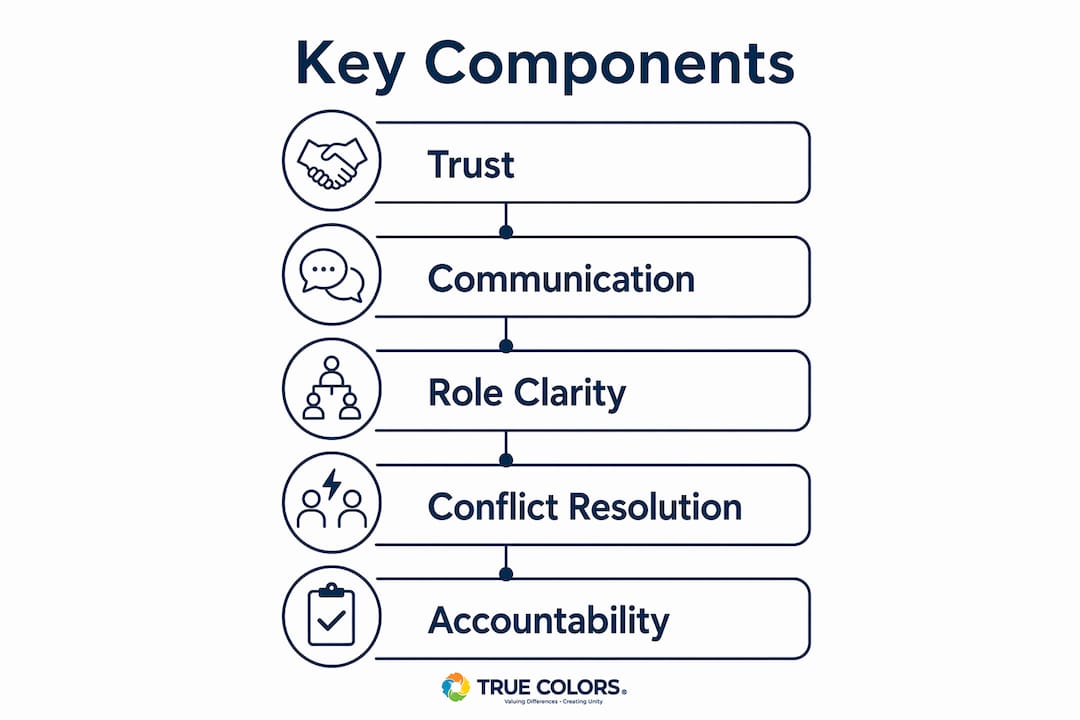
Effective team dynamics training addresses five interconnected areas. Each one reinforces the others, which is why training programs that focus on only one component tend to produce limited results.
- Communication styles: Teams learn to recognize different communication preferences and adapt accordingly. This reduces misreading of intent and improves clarity across the team.
- Role clarity: Every member needs to know what they own, what others own, and where the boundaries are. Ambiguity here is one of the most common sources of team friction.
- Conflict resolution: Conflict management strategies give teams a structured way to address tension before it damages relationships or derails projects.
- Decision-making processes: Teams that agree on how decisions get made move faster and with less internal resistance.
- Psychological safety: Google's Project Aristotle identified psychological safety as the single most important factor in high-performing teams. Without it, people withhold ideas, avoid conflict, and disengage.
These components do not operate in isolation. A team with strong communication skills but no role clarity will still struggle. A team with clear roles but no psychological safety will underperform. The training works because it addresses all five together.
Pro Tip: Before launching any team dynamics program, survey your team on which of these five areas feels most broken. Starting where the pain is highest builds buy-in and accelerates early wins.
What are the measurable benefits of team dynamics training?
The benefits of team dynamics training extend well beyond better meetings. They show up in retention numbers, project velocity, and the quality of decisions teams make under pressure.
Team coaching enhances engagement, clarity, and accountability by aligning roles and improving communication habits across hybrid and remote teams. That alignment directly reduces the confusion that slows work down and pushes good people out the door. When team members understand their roles and feel heard, they stay longer and contribute more.
The benefits managers report most consistently include:
- Improved trust: Teams that complete dynamics training report higher levels of interpersonal trust, which accelerates collaboration and reduces the need for micromanagement.
- Faster conflict resolution: Trained teams address tension earlier, before it becomes a performance bottleneck.
- Higher engagement: Shared accountability builds momentum and satisfaction, two drivers of sustained engagement.
- Better retention: Stronger team cohesion leads to measurable improvements in retention and productivity. People leave managers and toxic team environments, not companies.
- Cultural reinforcement: Over time, the behaviors practiced in training become the team's default operating norms.
The long-term cultural gains are often the most significant. A team that has internalized healthy dynamics becomes self-correcting. It does not need a manager to intervene every time tension arises.
How is effective team dynamics training delivered and sustained?
Delivery model is where most team dynamics programs succeed or fail. A single workshop can raise awareness, but it rarely changes behavior. Habit formation takes 2–8 months, which means one-off events produce short-lived improvements at best.
The most effective programs use sustained, multi-session formats. A six-session program spread over three months, for example, gives teams time to practice new behaviors between sessions, reflect on what is working, and adjust. That spacing is not optional. It is the mechanism through which behavior change actually sticks.
Here is what a well-structured delivery model looks like in practice:
- Baseline assessment: Map current communication patterns, role clarity gaps, and conflict norms before any training begins. This gives you a benchmark and shows participants that the program is grounded in their actual reality.
- Structured workshops: Use simulations, role-playing, and collaborative training methods to build skills in a low-stakes environment. Structured debriefs after each exercise are non-negotiable.
- Peer feedback loops: Build in regular feedback sessions between workshops. These keep new behaviors visible and give teams a chance to course-correct before old habits reassert themselves.
- Team norm setting: Have the team co-create explicit agreements about how they will communicate, make decisions, and handle conflict. Written norms create accountability without requiring a manager to police behavior.
- Follow-up coaching: Engagement dips 4–6 weeks after most interventions. Planned follow-up sessions and embedded feedback loops prevent that dip from becoming a regression.
| Delivery format | Best use case | Limitation |
|---|---|---|
| Single workshop | Awareness building | No lasting behavior change |
| Multi-session program | Skill development over time | Requires sustained commitment |
| Ongoing coaching | Embedding new norms | Higher resource investment |
| Simulation and role-play | Practicing difficult conversations | Needs skilled facilitation |
Pro Tip: Schedule your follow-up check-in at the end of the first session, not after the fact. Teams that have a confirmed date on the calendar are far more likely to sustain momentum.
What practical strategies can managers use to improve team dynamics daily?
Training programs create the foundation. Daily manager behavior is what determines whether that foundation holds. The most effective managers treat team dynamics as an ongoing practice, not a project with a start and end date.
Making dynamics visible means creating regular, safe spaces for honest dialogue about how the team is functioning. This prevents small issues from accumulating into long-term performance problems. A five-minute check-in at the end of a weekly meeting, asking "what is working and what is getting in the way," does more for team health than most formal interventions.
Practical strategies that work consistently include:
- Use structured questions in meetings: Replace open-ended "any concerns?" with specific prompts like "where do you feel unclear on ownership this week?" Specificity lowers the barrier to honest answers.
- Address early-stage conflict directly: Unaddressed negative patterns become harder to fix over time. Name tension when you see it, and create space for the team to work through it together.
- Recognize peer-to-peer accountability: When team members hold each other accountable without manager intervention, acknowledge it explicitly. That behavior is the goal, and naming it reinforces it.
- Separate team-building events from dynamics work: Off-site events build rapport, but they do not fix structural problems. Use them as supplements, not substitutes, for real dynamics work.
- Build psychological safety through consistency: Safety is not created in a single conversation. It is built through repeated experiences of speaking up without negative consequence.
The shift from top-down control to peer accountability is the most significant change a manager can make. It is also the hardest, because it requires trusting the team to self-regulate. That trust is earned through the behaviors the training instills.
Pro Tip: Keep a short log of team dynamics observations each week. Patterns you notice over a month will tell you more about where to focus than any single incident.
Key Takeaways
Team dynamics training works because it targets the behavioral patterns that determine how a team functions, not just the skills individuals bring to the table.
| Point | Details |
|---|---|
| Definition matters | Team dynamics training improves interaction, trust, and conflict management, not just technical skills. |
| Five core components | Communication, role clarity, conflict resolution, decision-making, and psychological safety all require attention. |
| Sustained delivery wins | Multi-session programs over 2–8 months produce lasting behavior change; single workshops do not. |
| Daily practice is required | Managers must reinforce training through consistent behavior, structured dialogue, and visible accountability. |
| Culture is the long-term outcome | Teams that internalize healthy dynamics become self-correcting and more resilient over time. |
Why one-off training events keep failing teams
I have seen this pattern more times than I can count. A leadership team invests in a well-designed team dynamics workshop. Energy is high at the end of day two. People leave with notebooks full of insights and genuine intentions to do things differently. Then six weeks pass, and nothing has changed. The same conflicts resurface. The same communication breakdowns repeat. The same people dominate every meeting.
The problem is not the training. The problem is the assumption that awareness creates behavior change on its own. It does not. Behavior change requires repetition, feedback, and an environment that rewards the new behavior. That environment does not build itself.
What I have found actually works is treating team dynamics as a leadership habit rather than a training event. The managers who see lasting results are the ones who make honest team conversations a weekly ritual, not a quarterly exercise. They name what they observe. They ask questions that create space for real answers. They model the accountability they want to see from their teams.
The shift from top-down control to peer-to-peer accountability is the real measure of whether training has taken hold. When team members start holding each other to the norms they agreed on, the manager's job gets easier, not harder. That is the outcome worth building toward.
— Theresa
How Truecolorsintl helps teams build lasting dynamics
Truecolorsintl works with leaders and organizations that are ready to move beyond awareness and into consistent, observable behavior change. The programs are built on a practical system rooted in human behavior, designed to help teams identify what is helping or hurting performance and build the habits that create healthier, more effective organizations.

From leadership development programs to communication training and culture reinforcement, Truecolorsintl supports the full arc of team development. Whether you are starting from scratch or trying to sustain progress after a previous initiative, the solutions at Truecolorsintl give you the structure and tools to make team dynamics a permanent part of how your organization operates.
FAQ
What is the team dynamics training definition?
Team dynamics training is a structured intervention that improves how team members interact, communicate, and collaborate by addressing behavioral patterns like trust, role clarity, and conflict management rather than individual technical skills.
How long does team dynamics training take to produce results?
Lasting behavior change requires 2–8 months of consistent practice. Single workshops raise awareness but rarely produce sustained change without follow-up sessions and embedded feedback loops.
What are the most important benefits of team dynamics training?
The primary benefits include improved trust, faster conflict resolution, higher employee engagement, better retention, and the development of self-correcting team norms that reduce the need for manager intervention.
How do managers reinforce team dynamics between training sessions?
Managers reinforce dynamics by making honest team conversations a weekly habit, using structured questions in meetings, addressing tension early, and recognizing peer-to-peer accountability when it occurs.
What role does psychological safety play in team dynamics?
Psychological safety is foundational to team effectiveness. Google's Project Aristotle identified it as the single most important factor in high-performing teams, because without it, people withhold ideas and disengage from collaboration.