
Employee wellbeing is the primary driver of workplace culture, shaping the behaviors, norms, and trust levels that define how organizations function. Low employee wellbeing costs the global economy $8.9 trillion annually, and only 34% of workers worldwide report “thriving.” That gap is not a wellness problem. It is a cultural problem. When leaders treat wellbeing as a perk rather than a practice, they produce cultures defined by disengagement, distrust, and turnover. The field of organizational psychology calls this the distinction between employee wellbeing as an outcome and wellbeing as a cultural input. Understanding why employee wellbeing affects culture requires examining how daily leadership behavior, embedded support systems, and inclusive practices either build or erode the conditions where people do their best work.
Why employee wellbeing affects culture through leadership behavior
Leadership behavior is the single most direct channel through which wellbeing shapes organizational culture. What leaders do consistently becomes what the culture expects. Research linking leadership style to employee wellbeing and culture confirms that health-promoting leadership reduces turnover intentions and stress, while health-impairing leadership increases cynicism and psychological strain. The effect is not subtle. It is measurable in engagement scores, absenteeism rates, and retention data.
Managers function as the primary gatekeepers of wellbeing culture. They decide whether a team member feels safe raising a concern, whether workloads are realistic, and whether mental health conversations happen openly or in silence. Psychological safety, defined by Harvard Business School professor Amy Edmondson as the belief that speaking up will not result in punishment, is built or destroyed at the manager level. Organizations that train managers to create psychological safety produce cultures where people stay, contribute, and perform.

The research on altruistic leadership adds another layer. Leaders with altruistic values produce measurably happier and more effective teams compared to leaders who prioritize self-interest. That finding matters because it shifts the conversation from leadership style as a personality trait to leadership behavior as a cultural signal. Culture is not what is said. It is what is repeated.
The most common leadership failure in wellbeing culture is not malice. It is a skill deficit. Managers often lack training to handle mental health conversations effectively, which limits the impact of even well-designed wellbeing programs. Organizations that invest in leadership development before rolling out wellbeing initiatives see better adoption and stronger cultural outcomes.
Key leadership behaviors that build a culture of wellbeing at work include:
-
Modeling boundaries. Leaders who take breaks and use time off signal that recovery is acceptable.
-
Normalizing mental health conversations. Asking “how are you really doing?” in one-on-ones sets a cultural norm.
-
Addressing workload proactively. Managers who flag unsustainable demands protect team capacity before burnout sets in.
-
Following through on commitments. Consistency between what leaders say and what they do builds the trust that wellbeing culture requires.
Pro Tip: Before launching any wellbeing program, audit your managers’ readiness to have mental health conversations. A program without prepared managers is a program that will underperform.
Does embedding wellbeing into daily work build a stronger culture?
Standalone wellness perks do not build culture. They signal intent, but intent without integration produces little lasting change. Employee Assistance Programs are a clear example. Despite widespread availability, EAP utilization remains below 10%, largely because employees do not trust that their use will remain confidential or consequence-free. The benefit exists. The culture to support it does not.
The more effective approach is to make support unremarkable. When wellbeing is embedded in daily workflows, it stops being a special program and starts being how work is done. Wellbeing culture is normalized when support appears in everyday routines rather than in quarterly wellness challenges or annual benefit fairs. This is the difference between a culture of wellbeing at work and a workplace with a wellness budget.
Mental health culture is created when managers, policies, and systems communicate genuine care beyond stand-alone wellness programs. The message employees receive from daily interactions carries more weight than any benefit package.
Practical integration looks like this:
-
Flexible scheduling as a standard policy. 95% of caregivers report that flexible scheduling is critical for their mental health. When flexibility is a norm rather than a negotiation, it removes a daily stressor that compounds over time.
-
Healthy boundaries built into meeting culture. No-meeting blocks, protected lunch hours, and clear after-hours communication norms reduce cognitive overload.
-
Manager training that precedes benefit communication. Employees trust wellbeing programs more when their direct manager already demonstrates care. Training managers first creates the cultural context that makes benefits credible.
-
Peer support structures. Formal peer networks reduce isolation and distribute the emotional labor of support beyond the manager relationship alone.
The organizations that get this right treat wellbeing not as a benefit category but as a design principle. They ask, “Does this policy make it easier or harder for people to sustain their performance?” That question, applied consistently, produces culture change that perks alone never will. For a deeper look at improving workplace culture through integrated practices, the connection between daily norms and long-term culture is well documented.
How does wellbeing affect engagement, retention, and productivity?
The impact of wellbeing on culture becomes most visible in organizational outcomes. Engagement, retention, and productivity are not just performance metrics. They are culture indicators. When wellbeing is low, those numbers reflect it before any survey asks the question directly.
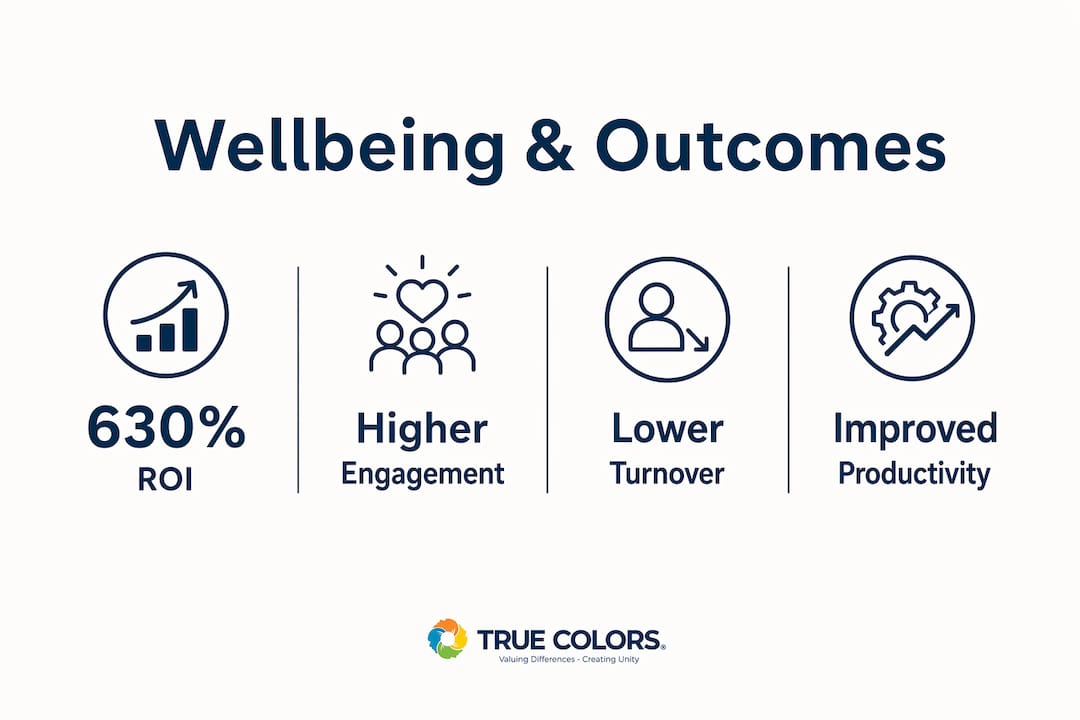
Cultural integration of wellbeing produces a $6.30 return for every $1 invested in culture-based mental health interventions, according to Deloitte research. That return comes from reduced absenteeism, lower turnover costs, and higher discretionary effort. Each of those outcomes is also a cultural signal. High absenteeism tells you that people do not feel safe or supported enough to show up consistently. Low discretionary effort tells you that people are present but not invested.
Organizational mental health interventions improve wellbeing in the short term, but only sustained cultural commitment produces lasting results. One-time programs create temporary lifts. Embedded practices create durable change. The distinction matters because leaders often measure the success of a wellbeing initiative at launch rather than at 18 months.
| Outcome | Effect of low wellbeing | Effect of embedded wellbeing culture |
|---|---|---|
| Employee engagement | Disengagement and presenteeism | Higher discretionary effort and commitment |
| Retention | Elevated turnover intentions | Stronger loyalty and reduced attrition |
| Absenteeism | Frequent unplanned absences | Reduced sick days and improved attendance |
| Productivity | Cognitive impairment from stress | Sustained focus and output quality |
| Psychological safety | Fear of speaking up | Open communication and idea-sharing |
HR mental health initiatives that connect these outcomes to culture strategy give leaders a clearer picture of where to act. The data in engagement surveys and exit interviews already contains the wellbeing signal. Most organizations are not reading it that way.
How do cultural differences shape wellbeing at work?
Wellbeing is not a universal concept. Wellbeing definitions vary significantly across cultures, ranging from individualistic models focused on self-actualization to relational models centered on harmonious community and collective responsibility. Organizations that assume a single definition of wellbeing risk designing programs that exclude the employees who need support most.
This matters for global organizations and for any team with meaningful demographic diversity. An employee from a collectivist cultural background may experience well-being primarily through team cohesion and relational harmony. An employee from an individualistic background may prioritize autonomy and personal achievement. A wellbeing initiative that addresses only one model will feel irrelevant or even alienating to the other group.
Building an inclusive culture of wellbeing at work requires deliberate design choices:
-
Survey for wellbeing across multiple dimensions. Ask about belonging, autonomy, workload, relationships, and purpose. Do not assume that one dimension captures the full picture.
-
Offer choice in support formats. Group programs, one-on-one coaching, digital resources, and peer networks serve different preferences and cultural comfort levels.
-
Train managers in cultural humility. Managers who recognize that their own wellbeing assumptions are culturally shaped are better equipped to support diverse teams.
-
Avoid performative inclusion. Translating a wellness newsletter into multiple languages without changing the underlying model is not inclusion. It is translation.
The workers wellbeing research from organizational consulting confirms that inclusive wellbeing strategies produce stronger culture outcomes than uniform programs. The goal is not to offer the same thing to everyone. It is to create conditions where everyone can thrive in ways that are meaningful to them. Truecolorsintl approaches this through behavior-based frameworks that help leaders recognize and respond to individual differences, making wellbeing support more precise and more effective across diverse teams.
Key Takeaways
Employee wellbeing shapes organizational culture through leadership behavior, embedded daily practices, and inclusive design, not through perks or programs alone.
| Point | Details |
|---|---|
| Leadership drives culture | Health-promoting leadership reduces stress and turnover; health-impairing leadership increases cynicism and disengagement. |
| Perks alone do not build culture | EAP utilization stays below 10% without the cultural trust and manager behavior to support it. |
| Integration outperforms programs | Wellbeing embedded in daily workflows produces lasting culture change; one-time initiatives create only temporary improvement. |
| Outcomes reflect culture health | Engagement, absenteeism, and retention data are direct indicators of whether wellbeing culture is working. |
| Inclusion requires diverse design | Wellbeing definitions vary across cultures; effective programs offer multiple formats and respect different models of thriving. |
What I’ve learned about wellbeing and culture after years in this work
The most persistent mistake I see organizations make is investing in wellbeing programs before they have invested in leadership behavior. They announce a new mental health benefit, send a company-wide email, and then wonder why utilization is low and culture scores do not move. The sequence is wrong. Culture follows behavior. Behavior follows leadership. If the manager has not changed how they run a one-on-one, the benefit announcement lands in a vacuum.
Psychological safety is not a soft concept. It is the structural condition that determines whether any wellbeing initiative will work. I have seen organizations with generous benefit packages where people are afraid to take a sick day. The package is irrelevant if the culture punishes vulnerability. Getting that right requires leaders who are willing to examine their own behavior, not just their org chart or their benefits menu.
The other thing I would tell any HR leader or executive reading this: do not wait for culture to be “ready” before addressing wellbeing. The readiness comes from starting. Small, consistent actions by managers, repeated over time, are what build the trust that makes wellbeing culture real. Culture is not what is said. It is what is repeated. Start repeating the right things.
For practical strategies on managing employee stress at the team level, the connection between daily manager behavior and long-term culture outcomes is where the real leverage lives.
— Theresa Stairs
How Truecolorsintl helps organizations build wellbeing into culture
Truecolorsintl works with organizational leaders and HR professionals who are ready to move beyond awareness and into sustained culture change. The work starts with understanding how people behave, what drives them, and where the gaps between stated values and daily experience are widest.

Through leadership development programs and corporate consulting, Truecolorsintl helps organizations build the leadership behaviors that make wellbeing culture real. The Employee Experience Survey gives leaders a clear picture of where culture and wellbeing intersect, and where action is most needed. If your organization is ready to make culture measurable and leadership behavior consistent, Truecolorsintl provides the frameworks and support to get there.
FAQ
Why does employee wellbeing affect workplace culture?
Employee wellbeing shapes the behaviors, norms, and trust levels that define culture. When people feel supported and psychologically safe, they engage more fully, communicate more openly, and contribute more consistently.
What is the difference between wellness perks and a wellbeing culture?
Wellness perks are benefits offered to employees, such as gym memberships or EAPs. A wellbeing culture is built through consistent leadership behavior, embedded policies, and manager practices that make support a daily norm rather than an optional resource.
How does psychological safety connect to employee wellbeing?
Psychological safety, the belief that speaking up will not result in punishment, is a foundational condition for wellbeing at work. Research by Amy Edmondson links it directly to team performance and individual mental health outcomes.
What role do managers play in employee wellbeing culture?
Managers are the primary gatekeepers of wellbeing culture. Their daily behavior, including how they handle workload, mental health conversations, and boundary-setting, determines whether wellbeing programs succeed or fail.
How can organizations measure the impact of wellbeing on culture?
Engagement surveys, absenteeism rates, turnover data, and exit interviews all contain wellbeing signals. Organizations that track these metrics over time and connect them to leadership behavior changes can measure culture progress directly.