
Team-based experiential learning accelerates skill transfer and team performance more reliably than lecture-style training. The evidence is consistent: when teams learn by doing, reflecting, and applying together, they retain more, coordinate faster, and produce measurable business outcomes that passive instruction rarely achieves. The three benefits that show up most reliably are stronger individual skill retention, faster collective problem-solving, and shorter time-to-competency across the team.
The immediate next step for any L&D or HR leader reading this: design a 90-day team pilot with defined KPIs, a facilitator-guided reflection cycle, and a transfer task tied to a real business metric. That structure is what separates a program that changes behavior from one that fills a calendar.
The World Economic Forum's Future of Jobs Report 2025 identifies analytical thinking, creative problem-solving, and resilience as the skills most urgently needed as roles shift. Those are exactly the capabilities that team-based experiential learning builds, because they require practice under realistic conditions, not passive absorption. David A. Kolb's Experiential Learning Cycle provides the theoretical backbone for why this works, and organizations like Truecolorsintl have built practical systems around it to move teams from personal awareness to aligned, observable action.
- Individual benefit: Higher skill retention and self-efficacy through active application
- Team benefit: Faster coordination, shared mental models, and stronger psychological safety
- Organizational benefit: Shorter time-to-productivity, higher engagement, and better problem-solving at scale
Table of Contents
- Why the research supports team-based experiential learning
- What are the concrete benefits for individuals, teams, and organizations?
- Where does team experiential learning deliver the highest impact?
- How do you implement experiential learning for your team?
- How do you measure the impact of team experiential programs?
- How do you get started with a 90-day team pilot?
- Key Takeaways
- Why transfer tasks matter more than the experience itself
- Truecolorsintl can help you design and run your first team pilot
- Useful sources
Why the research supports team-based experiential learning
The theoretical case for experiential learning rests on constructivist learning theory: people build knowledge by connecting new experience to existing understanding, and that process deepens when it happens in social contexts. Peter Senge's systems thinking adds a practical layer, noting that experiential learning is most effective when learners are highly motivated and facilitators act as coaches rather than directors. Both conditions are easier to create in a team setting, where peer accountability raises motivation and the facilitator can step back once the group develops its own inquiry habits.
The empirical record is consistent. A systematic literature review synthesizing 16 studies from 2015 to 2025 found positive effects on academic achievement, critical thinking, collaboration, motivation, and problem-solving across education levels. A separate literature review published in PMC found that experiential approaches boost motivation, engagement, critical thinking, and transfer of learning to real-world tasks, with multiple empirical studies showing gains in higher-order thinking linked to these methods.
Key findings that translate directly to workplace KPIs:
- Gains in critical thinking and problem-solving map to faster cycle times and better decision quality
- Improvements in collaboration and engagement correlate with lower voluntary turnover and higher internal promotion rates
- Stronger transfer of learning to real tasks reduces the gap between training completion and on-the-job performance
Research on team composition and learning styles adds a nuance worth noting: the configuration of learning styles within a team affects learning behavior, psychological safety, and satisfaction. Diverse style configurations tend to produce richer reflection; more homogeneous teams often report higher cohesion but narrower problem-solving. Neither is universally better. The implication for program design is that team composition is a deliberate variable, not an afterthought.
What are the concrete benefits for individuals, teams, and organizations?
The advantages of experiential learning distribute across three levels, and the strongest business case comes from showing decision-makers how each level connects to a metric they already track.
Individual benefits
| Benefit | Metric indicator |
|---|---|
| Higher skill retention | Post-training assessment scores; 30/60/90-day performance reviews |
| Increased self-efficacy | Self-reported confidence surveys; willingness to take on stretch assignments |
| Stronger higher-order thinking | Quality of decisions on observed work tasks; peer feedback ratings |
| Greater content knowledge | Pre/post knowledge checks; manager observation rubrics |
The University of Tennessee's experiential learning program data identifies content knowledge, higher-order thinking, persistence, and self-efficacy as consistent individual outcomes. In a workplace context, self-efficacy is particularly valuable: employees who believe they can handle novel challenges are more likely to apply new skills without waiting for permission or additional training.
Team benefits
Teams that learn together through structured experience develop shared mental models, which is the common understanding of how work gets done and why. That alignment reduces coordination friction. Teams with strong shared mental models spend less time re-explaining context and more time executing. Psychological safety, the belief that it is safe to speak up, take risks, and admit mistakes, also improves when teams work through challenging experiences together and debrief honestly. Team-based assignments with guided reflection consistently help learners apply theory to organizational settings, and the reflection process itself builds the trust that makes future collaboration more effective.

Organizational benefits
At the organizational level, the most measurable outcomes are shorter time-to-productivity for new hires or newly formed teams, higher engagement scores, and better performance on complex problems. Project-based onboarding, where new employees complete a real work challenge with a team rather than sitting through orientation modules, can compress time-to-competency significantly. Engagement follows naturally when employees feel their learning is connected to real work rather than compliance checkboxes.
Where does team experiential learning deliver the highest impact?
Five use cases consistently produce strong outcomes across enterprise settings.
Team onboarding sprint: New hires join a cross-functional project team for weeks 2 through 6 of onboarding. They contribute to a real deliverable while learning the organization's systems, norms, and decision-making patterns. The facilitator runs weekly reflection sessions. Expected outcome: faster time-to-productivity and stronger peer relationships than cohort-style orientation. Facilitator note: Keep the project scope narrow enough to complete within the sprint, but consequential enough that the outcome matters to a business owner.
Cross-functional action-learning project: A team from different functions works on a defined business problem over 8 to 12 weeks, with bi-weekly facilitated debriefs. This format is particularly effective for breaking down silos and building empathy across departments. For remote teams, asynchronous reflection tools (shared documents, recorded video debriefs) can replace in-person sessions without losing the reflective quality, provided the facilitator reviews and responds to each submission.
Leadership simulation: A cohort of emerging leaders works through a realistic scenario, such as a product launch under resource constraints, over one or two days. Observers provide structured feedback. Debrief focuses on decision patterns, communication under pressure, and how the team's behavior aligned with stated values. Facilitator note: Psychological safety must be established before the simulation begins; leaders who fear judgment will play it safe and learn little.
Post-merger integration micro-team assignment: Small, mixed teams from both legacy organizations work on a shared deliverable. The experience surfaces cultural differences in how work gets done, which the facilitator uses as material for structured reflection. Expected outcome: faster cultural alignment and reduced "us vs. them" friction.
Early-career cohort project: Structured team projects for Gen Z employees entering the workforce pair well with experiential methods, since this cohort tends to value applied learning over passive instruction. Pairing the project with a senior mentor who participates in reflection sessions adds a coaching layer that accelerates development.
For hybrid and remote teams, the key adaptations are: schedule synchronous reflection sessions at predictable intervals, use asynchronous tools for individual reflection before group debrief, and establish explicit norms for psychological safety in digital spaces. The types of team collaboration workshops available today include formats designed specifically for distributed teams, so the format choice is no longer a barrier.
How do you implement experiential learning for your team?
A repeatable design checklist prevents the most common failure modes before they occur.
- Design the experience. Select a format (simulation, project, field assignment) that requires the team to use the target skills under realistic conditions. The Microsoft Research workplace learning whitepaper highlights project-based design and transfer mechanisms as the most effective elements for workplace learning.
Pro Tip: Require every participant to submit a one-paragraph "transfer commitment" at the end of the final debrief, naming the specific action they will take and the date by which they will report results. Follow up at the two-week mark with a brief check-in. This single step dramatically increases the rate at which learning transfers to on-the-job behavior.
Scaling beyond the pilot requires building internal facilitators, creating reusable templates for each program format, and establishing a quality-review process for each cohort. Building a peer learning culture within the organization accelerates this process by distributing facilitation capacity across teams rather than centralizing it in the L&D function.
How do you measure the impact of team experiential programs?
Measurement works best when it is designed before the program runs, not retrofitted afterward.
Recommended KPIs
- Time-to-competency (days from program start to independent performance on target tasks)
- Performance quality on observed work tasks (manager rubric or peer assessment)
- Engagement and retention signals (pulse survey scores, voluntary turnover rate)
- Customer-facing metrics where applicable (satisfaction scores, resolution time)
Data collection framework
| Measure type | Method | Timing |
|---|---|---|
| Quantitative: skill performance | Pre/post assessment; manager observation rubric | Before program; 30 and 90 days after |
| Quantitative: business metric | Pull from existing systems (CRM, HRIS, project tools) | Baseline; 30 and 90 days after |
| Qualitative: reflection quality | Facilitator notes; participant reflection submissions | After each debrief cycle |
| Qualitative: team dynamics | Psychological safety survey; peer feedback | Before program; 30 days after |
| Engagement signal | Pulse survey; voluntary participation in follow-on programs | 30 and 90 days after |
Attribution is the hardest measurement challenge. The most practical approach for a pilot is a pre/post design with a comparison group: run the program with one team and track the same metrics for a comparable team that did not participate. Even an informal comparison provides enough signal to justify scaling or adjusting the design. Short-cycle A/B pilots, where two slightly different program designs run simultaneously with different teams, can isolate which design elements drive the most impact.
How do you get started with a 90-day team pilot?
A 90-day pilot is the right scope for a first engagement: long enough to complete a full experiential cycle with transfer measurement, short enough to maintain stakeholder attention and control costs.
90-day milestone timeline
| Week | Milestone | Owner |
|---|---|---|
| 1 | Define business outcome, select team, secure facilitator | L&D leader |
| 2 | Baseline measurement (KPIs, assessments) | L&D leader + HR |
| 3 | Program kickoff; first experience or simulation | Facilitator |
| 4 | First structured debrief | Facilitator |
| 6 | Transfer task assigned; mid-point check-in | Facilitator + Manager |
| 8 | Second debrief; transfer task review | Facilitator |
| 10 | Final experience or capstone activity | Facilitator + Team |
| — | Final debrief; transfer commitments documented | Facilitator |
| 12 | 90-day measurement; stakeholder report | L&D leader |
Cost considerations
Cost bands vary significantly based on three drivers: number of teams, facilitator source, and simulation or materials complexity.
- Full consulting engagement with assessment, facilitation, and measurement: Higher investment; appropriate for enterprise-scale pilots or programs tied to a significant business outcome. Truecolorsintl's corporate consulting engagements fall into this category and include assessment, facilitation design, and reinforcement planning.
The World Economic Forum's Future of Jobs findings make a clear case for investing in applied learning approaches now, as the skills gap between what organizations need and what traditional training delivers continues to widen. A 90-day pilot is the lowest-risk way to generate internal evidence before committing to scale.
Key Takeaways
Team-based experiential learning produces measurable gains in skill retention, team coordination, and organizational performance when it includes structured reflection, a defined transfer task, and a KPI tied to a real business outcome.
| Point | Details |
|---|---|
| Reflection is non-negotiable | Skipping structured debriefs is the single most common reason experiential programs fail to transfer. |
| Measure before you start | Define your KPI and collect baseline data before the program launches, or attribution becomes impossible. |
| Team composition matters | Learning-style diversity within a team affects reflection quality and psychological safety; treat it as a design variable. |
| 90-day pilot is the right entry point | A 90-day cycle is long enough to complete the full experiential loop and short enough to maintain stakeholder support. |
| Truecolorsintl connects awareness to action | Truecolorsintl's behavior-based approach maps assessment data to facilitated experience and reinforcement, moving teams from insight to aligned behavior. |
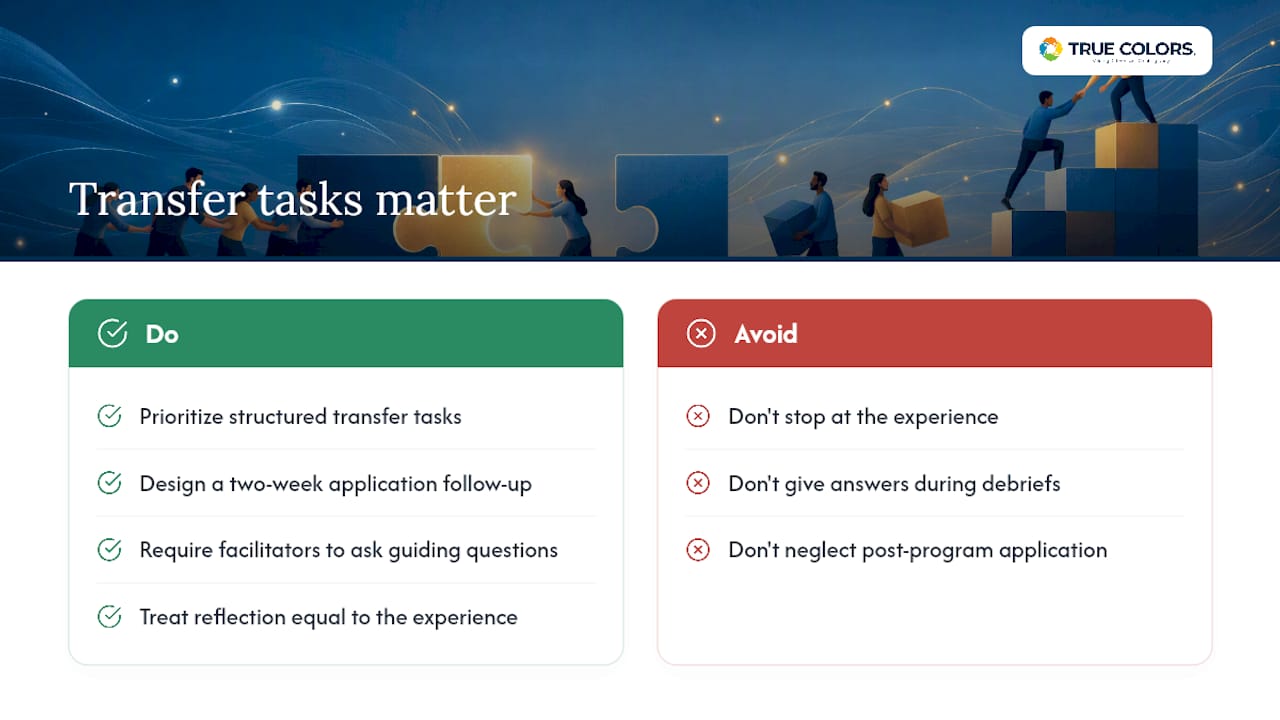
Why transfer tasks matter more than the experience itself
Most L&D leaders spend the majority of their design time on the experience, the simulation, the workshop, the project, and far too little on what happens in the two weeks after. That is where the program either works or doesn't.
The research is consistent on this point: experiential learning increases motivation, engagement, and critical thinking during the program. But motivation fades quickly without a structured application task that forces the learner to use the new skill in a real context with a real consequence. The experience creates the conditions for learning. The transfer task is where learning becomes behavior.
There is also a facilitation trap worth naming. Many facilitators who come from a training background instinctively want to provide answers during the debrief. That impulse, however well-intentioned, short-circuits the conceptualization phase of the Kolb cycle. When the facilitator gives the team the insight, the team does not own it. When the team arrives at the insight through guided questioning, it sticks. The facilitator's job is to ask better questions, not to deliver better content.
The organizations that get the most from team experiential learning are not necessarily the ones with the biggest budgets or the most sophisticated simulations. They are the ones that treat reflection and transfer as seriously as the experience itself, and that hold facilitators accountable for both.
Truecolorsintl can help you design and run your first team pilot
Truecolorsintl gives L&D and HR leaders a structured path from team assessment to aligned behavior, without the guesswork of building a program from scratch. The behavior-based assessment identifies exactly what is helping or limiting your team's performance, and the facilitated experience is designed around those specific patterns, not a generic curriculum. That specificity is what makes the reflection phase productive and the transfer tasks stick.
The Connected Leadership Program pairs well with team experiential pilots, providing a leadership development structure that reinforces the same behavioral habits the team is building. For organizations ready to move at the organizational level, Truecolorsintl's corporate consulting team can design a full 90-day pilot, including assessment, facilitation, measurement, and reinforcement planning.
Schedule a pilot discovery call with Truecolorsintl's consulting team to get a proposed program design and cost estimate tailored to your team's size, goals, and timeline.
Useful sources
- The Role of Experiential Learning on Students’ Motivation and Classroom Engagement — PMC
- Experiential Learning | Center for Innovative Teaching and Learning | Northern Illinois University
- Systematic Literature Review: The Effect of Experiential Learning (EL) on Learning Outcomes | Jurnal Penelitian Pendidikan IPA
- Experience Learning | University of Tennessee, Knoxville
- Study on experiential learning styles and team outcomes (Kayes et al., 2005) | Sage Journals
- Experiential learning-based team assignment outcomes | ERIC
- Microsoft Research whitepaper on workplace learning and applied design (Markel & Guo)