
Communication styles at work are the repeatable patterns people use to send and receive information, ranging from assertive and direct to passive, aggressive, or passive-aggressive. Learning to recognize a colleague's default style, in an email, a meeting, or a tense one-on-one, is what lets you adjust your delivery so the message actually lands. This guide breaks down the core styles, how to spot them across channels, and exactly how to shift your approach for each one.
TL;DR:
- Recognizing whether a colleague is assertive, passive, aggressive, or passive-aggressive helps you adjust your communication approach effectively.
- Email response patterns, reaction times in chat, and behavior in meetings provide clues to their default style, especially under conflict or pressure.
- Adjusting your delivery with scripted wording, matching tone, and channel choice improves clarity with each communication style, especially in remote settings.
- Consistent observation over multiple interactions is essential before diagnosing someone’s style, as one-off behaviors may not reflect their typical pattern.
- Building team habits around shared language and reinforcement ensures communication style awareness leads to long-term improvements, especially across cultural and gender differences.
Table of Contents
- Common Workplace Communication Styles: Definitions and Signs
- How to Read Someone's Style Across Email, Chat, Meetings, and Conflict
- Adapting Your Delivery: Scripts and Habits for Each Style
- Remote and Hybrid Teams Need Different Rules
- What Style Mismatches Cost Teams, and What Fixing Them Buys Back
- How Truecolorsintl Turns Style Awareness Into a Team Habit
- Cultural Differences Shape Communication Styles More Than You'd Expect
- What the Research Actually Supports, and What Gets Oversold
- Ready to Build a Shared Communication Language on Your Team?
- Sources
- FAQ
Common Workplace Communication Styles: Definitions and Signs
Most organizational development frameworks trace workplace behavior back to several common styles, including assertive, passive, aggressive, and passive-aggressive. A parallel framework, popularized by tools like DiSC, sorts people into direct, analytical, collaborative, or expressive tendencies instead. Neither taxonomy is more "correct." They describe the same behavioral territory from different angles, and most people show traits from more than one bucket depending on the day, the stakes, or who they're talking to, according to workplace communication research from Charleston Southern University.
Assertive. States needs and opinions directly while respecting the other person's perspective. Signs: makes eye contact, uses "I" statements, states a clear ask with a reason attached. Sample line: "I need this by Thursday because the client reviews it Friday morning. Can you commit to that?"
Passive. Avoids stating opinions or needs to sidestep conflict. Signs: frequent hedging ("maybe," "I guess"), agrees quickly in meetings then raises objections privately later, rarely initiates difficult conversations. Sample line: "Whatever works for everyone else is fine with me."
Aggressive. Pushes a point of view without regard for how it lands on others. Signs: interrupts, uses absolute language ("this is wrong," "that never works"), raises volume or clips sentences short. Sample line: "That approach doesn't work. We're doing it my way."
Passive-aggressive. Expresses resistance indirectly rather than stating it outright. Signs: sarcasm in written messages, agreeing verbally but missing deadlines, copying extra people on an email to make a point. Sample line: "Sure, no problem," followed by silence and a missed deliverable.
Assertive communication is genuinely the odd one out here. It's the only one of the four consistently linked to better long-term working relationships and sharper problem-solving, according to a University of Iowa communication styles resource. The other three can work situationally, but they extract a cost in trust over time.
Mapped to the behavior-focused frame:
- Direct overlaps heavily with assertive, sometimes aggressive under pressure.
- Analytical often reads as passive in group settings, holding input until data is verified.
- Collaborative tends toward assertive with a consensus-building lean.
- Expressive can look assertive or aggressive depending on how much filter is applied in the moment.
How to Read Someone's Style Across Email, Chat, Meetings, and Conflict
Every channel leaves different fingerprints. Email reveals pacing: one-line responses with no pleasantries usually signal a direct or aggressive tendency, while long, hedged paragraphs point toward passive or analytical patterns. Chat tools expose reaction speed. Someone who responds within minutes and asks clarifying questions immediately is likely collaborative or direct; someone who goes quiet for hours on a direct question may be passive or conflict-avoidant. Meetings are the clearest stage. Watch who speaks first, who waits to be asked, and who agrees out loud but pulls a colleague aside afterward to voice disagreement. That last move is the passive-aggressive tell managers miss most often.
Conflict moments strip away the performance. Under real pressure, aggressive types escalate volume or certainty, passive types disengage entirely, and assertive types stay specific about the issue rather than the person.
Use this short sequence to diagnose a colleague's default pattern before assuming anything:
- Note how they respond to a direct request in writing (tone, length, hedging).
- Watch how they behave when they disagree in a group setting.
- Check whether their private follow-up matches what they said publicly.
- Observe what happens when a deadline is missed, do they raise it, absorb it, or deflect it.
Pro Tip: Don't diagnose someone's style from a single bad day. Track the pattern across at least three interactions before you adjust how you work with them.
One caution matters here: assertive communication is frequently mislabeled as aggressive, particularly for women and in cultural contexts where directness reads as impolite, according to Princeton's UMatter program. A woman stating a clear boundary and a man doing the same often get read very differently by the same room. Keep that bias in mind before you file someone under "difficult."
Adapting Your Delivery: Scripts and Habits for Each Style
Adjusting your approach doesn't mean becoming a different person for every conversation. It means changing the packaging, not the substance.
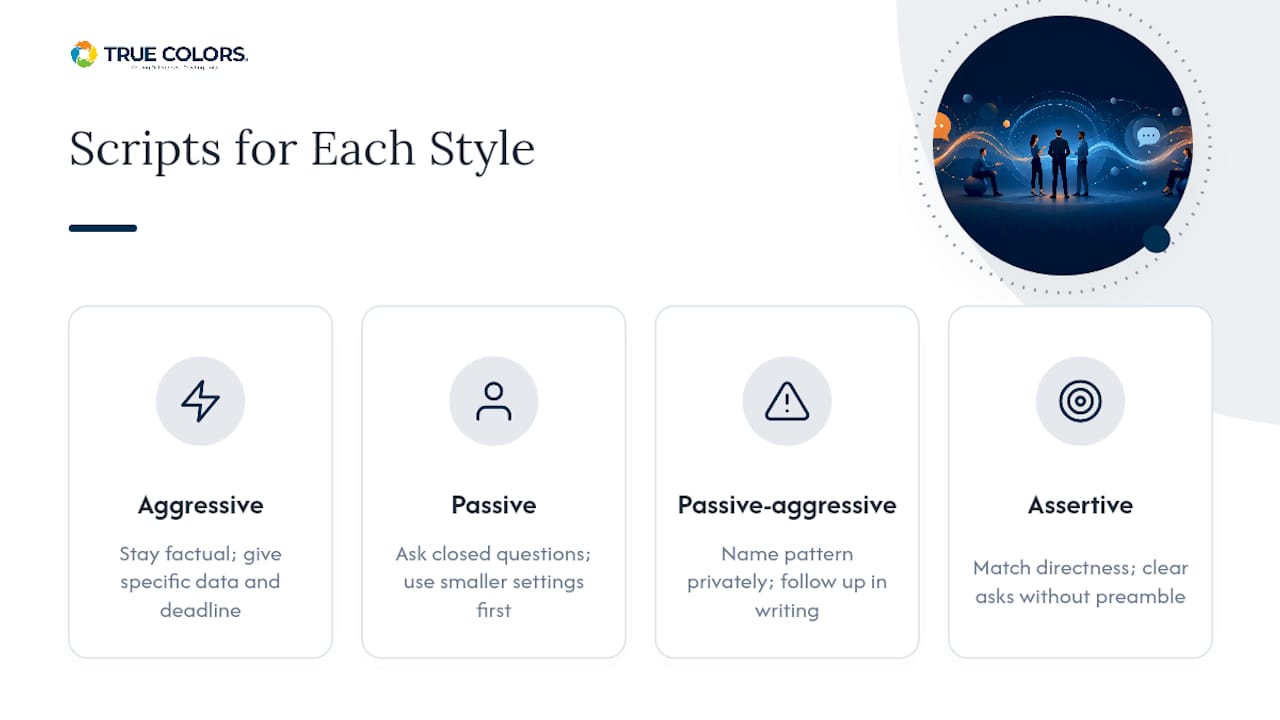
With aggressive communicators: Stay factual and specific rather than matching their intensity. Avoid vague pushback that gives them room to argue tone instead of substance. Written script: "Here's the data behind the recommendation: [specifics]. I'd like your feedback on the approach by Wednesday." Spoken script: "I hear the concern. Let's separate what we agree on from what we don't."
With passive communicators: Ask direct, closed questions instead of open ones that invite a noncommittal answer. Give them space in smaller settings before large meetings. Written script: "Quick check, does this plan work for your team, yes or no?" Spoken script: "You mentioned a concern earlier. What specifically worried you about the timeline?"
With passive-aggressive communicators: Name the pattern gently and privately rather than publicly. Follow up in writing so intent is documented. Written script: "I noticed the deadline slipped. Can you walk me through what got in the way?" Spoken script: "I want to make sure we're aligned, not just polite. What's the real concern?"
With assertive communicators: Match their directness and skip the preamble. They respond well to clear asks and clear feedback, delivered without excessive cushioning.
A simple micro-framework helps you choose the right channel before you even open your mouth: use written channels for anything requiring a paper trail or processing time, and live conversation for anything emotionally charged or ambiguous. Assertiveness training works better paired with reinforcement than as one-off coaching, according to guidance from Harvard's Division of Continuing Education, so treat these scripts as habits to practice, not a one-time fix.
Pro Tip: When coaching someone toward more assertive communication, pair the ask with an explicit expectation line, such as "I want X by Y; I'd like your view on Z by Friday." That single addition cuts down on the follow-up questions that usually signal unclear delivery.
Remote and Hybrid Teams Need Different Rules
Video calls and chat threads strip out most of the nonverbal signal that used to fill in the gaps. A flat tone in a Slack message can read as irritation when none was intended, because nonverbal cues shrink dramatically in remote settings, which means intent has to be stated outright rather than implied.
Set channel norms explicitly rather than letting each person guess:
- Use chat for quick status updates, not disagreements.
- Escalate to video the moment a thread hits three back-and-forth replies without resolution.
- Build in a standing round for quieter voices during video meetings. Don't rely on volunteers.
- Flag response-time expectations up front so a slow reply doesn't get read as passive resistance.
What Style Mismatches Cost Teams, and What Fixing Them Buys Back
A direct manager paired with a passive report often produces a quiet compliance that hides real problems until they surface as missed deadlines. An aggressive team member paired with a conflict-avoidant one usually drives the decision speed up in the short term and trust down over the long term. Neither trade-off shows up on a scorecard until it's expensive.
Teams that adapt deliberately see the opposite pattern: faster decisions because people raise objections early instead of after the fact, and fewer escalations because friction gets addressed in the room instead of in side conversations. Three simple metrics worth tracking: how often decisions get revisited after being "finalized," how many issues get raised in one-on-ones versus group settings, and how quickly a disagreement surfaces once it starts.
How Truecolorsintl Turns Style Awareness Into a Team Habit
Recognizing a style is the easy part. What separates teams that actually change is reinforcement, not a one-time workshop. Truecolorsintl builds that reinforcement through behavior-based assessments, guided workshops, and follow-up structures that keep a shared communication language alive long after the initial training ends. Exercises typically pair role-play with immediate peer feedback and a short follow-up assignment, a format that holds up better than lecture-only sessions. The goal is a common vocabulary teams actually use in daily standups and one-on-ones, not a binder that gets filed away.
Cultural Differences Shape Communication Styles More Than You'd Expect
Directness reads differently depending on where someone was raised or trained professionally. In many East Asian and Latin American business cultures, indirect phrasing and deference to hierarchy are signs of respect, not passivity. In parts of Northern Europe and the U.S., blunt directness is often the professional default and rarely intended as aggression. A manager who reads every hedge as weak conviction, or every direct statement as rudeness, will misjudge a large share of a diverse team.
The safer approach is to ask rather than assume. If a colleague consistently defers in meetings, check privately whether that's a communication preference or a genuine lack of conviction before treating it as either. Cross-cultural friction also shows up heavily in feedback delivery: some cultures expect criticism wrapped in context and softened language, others expect it stated plainly and quickly. Neither is wrong, but mismatched expectations on this one point cause a disproportionate share of workplace tension.
Gender adds another layer worth naming directly. Assertive women are more likely to be labeled aggressive for the exact same words a man would use, a bias that Princeton's UMatter program flags as a persistent pattern worth correcting for, not accommodating. Building a team norm that separates the content of a statement from the tone assumptions attached to the speaker's identity is one of the more overlooked fixes available to a manager.
What the Research Actually Supports, and What Gets Oversold
Most advice on this topic treats communication styles like fixed personality traits, something you diagnose once and file away. That framing is convenient but wrong. People shift styles under stress, with different audiences, and across channels, which means a one-time assessment tells you less than a pattern observed over weeks.

The conventional advice also overweights "just be more direct" as a universal fix. Directness helps some mismatches and makes others worse, especially across cultural lines where bluntness reads as disrespect rather than clarity. What the research actually supports is narrower and more useful: assertive communication, specifically stating needs while respecting the other person's position, is the one pattern with consistent evidence behind it, and it works best when reinforced repeatedly rather than taught once.
If you take one thing from this guide, prioritize observation over labeling. Watch how someone behaves across three or four real interactions before you decide how to adjust to them. The label matters less than the pattern.
— Theresa
Ready to Build a Shared Communication Language on Your Team?
Reading this guide gets you halfway there. Turning it into a habit your team actually uses under deadline pressure is the harder half, and it's the part most one-off training sessions never get to. Truecolorsintl approaches culture change as a behavior system rather than a single workshop: assessments that identify real tendencies, training that translates them into daily habits, and reinforcement that keeps the shared language alive months after the session ends.

If you want a clear read on how your team communicates under pressure, the Individual Personality Assessment gives leaders and teams a concrete starting point rather than a guess. For teams ready to build habits together, the Communication Training program turns the concepts in this guide into a structured, reinforced experience. Start with an assessment, or reach out to scope a training program suited to where your team is right now.
Sources
For deeper research on assertiveness and workplace behavior, see Mayo Clinic's assertiveness guide and Atlassian's guidance on navigating coworker styles. For a leadership-focused deep dive, read Truecolorsintl's guide to leadership communication style.
- Understanding Your Communication Style | UMatter (Princeton)
- Communication Styles (University of Iowa tutoring resource)
- How to navigate your coworkers' communication styles (Atlassian)
- Is Your Workplace Communication Style As Effective As It Could Be? (Harvard DCE)
FAQ
What Are the Four Main Communication Styles at Work?
The core communication styles commonly discussed are assertive, passive, aggressive, and passive-aggressive, each defined by how directly someone states needs and how much they weigh the other person's perspective. A parallel framework sorts people into direct, analytical, collaborative, or expressive tendencies, and most people show traits from more than one category depending on context.
How Do I Know if I'm Being Assertive or Aggressive?
Assertive communication states your position clearly while respecting the other person's rights and feelings; aggressive communication pushes your point without regard for how it lands. Assertive communication is frequently mislabeled as aggressive, particularly for women, according to Princeton's UMatter program.
Why Does Communication Style Matter More in Remote Teams?
Remote channels strip out nonverbal cues like tone and body language, which means intent has to be stated explicitly rather than assumed. Without clear channel norms, a flat message can be misread as irritation or resistance when none was intended.
Can Someone Change Their Communication Style?
Yes, though it requires practice rather than a single training session. Assertiveness training works best when paired with team norms and ongoing reinforcement, according to Harvard's Division of Continuing Education, which is the model Truecolorsintl builds its training programs around.
How Much Does a Truecolorsintl Personality Assessment Cost?
The Individual Personality Assessment Consultation is priced at $350 as a one-time service. Pricing for group and organization-wide assessments is available on request through the same page.