
Employee journey mapping is the practice of visualizing what people experience at every stage of employment, from first application to final exit interview, so leaders can pinpoint where engagement breaks down. The goal isn't a pretty diagram. It's identifying the specific moments that drive retention or attrition, then acting on them. Skip the full lifecycle audit. Pick one persona, one high-impact moment, and map that first.
TL;DR:
- Mapping a high-impact onboarding moment within the first 30 days has the strongest link to reducing early employee attrition.
- Use specific metrics like first-30-day eNPS, time-to-access, and exit interview analyses to measure and track improvements effectively.
- Leadership must own the follow-through and coaching to turn diagnostic insights into lasting behavioral change.
- Starting with one clear moment and proven success makes scaling more feasible and impactful than full lifecycle mapping.
- Practical tools such as surveys, visual boards, and simple templates are enough for initial pilots, while governance ensures sustained action.
Table of Contents
- What Is Employee Journey Mapping and Why Does It Matter?
- Employee Lifecycle Stages and the Moments That Actually Matter
- How to Build a Journey Map That Actually Gets Used
- How to Measure the Business Impact of a Journey Map
- Why Journey Maps Fail (and How Governance Fixes It)
- Tools and Templates for Mapping Without Overbuilding
- How True Colors International Turns Maps Into Leadership Behavior Change
- Your 90-Day Pilot Checklist
- What the Research Actually Supports, and What HR Gets Wrong
- Ready to Turn Journey Mapping Into Leadership Change
- Sources
What Is Employee Journey Mapping and Why Does It Matter?
Employee journey mapping traces the employee experience from hire to exit, surfacing the friction points that push good people out the door and the moments that make them stay. HBS Online's guide to the practice frames it as a diagnostic tool: it exposes where job descriptions overpromise, where onboarding underdelivers, and where resourcing decisions quietly erode the experience you think you're offering.
This is not the same discipline as customer journey mapping, though the two share DNA. Customer maps track a buyer's path to purchase. Employee maps track a worker's path to mastery, contribution, and eventually departure. Organizations with mature CX practices often run both in parallel because employee experience directly shapes customer experience, particularly in service roles where every interaction is a live handoff.
The value-creation case matters more than the visual. Mapping helps you do one of two things: reduce what researchers call Willingness to Suffer, the friction employees tolerate before they disengage or leave, or improve how you allocate compensation and resources so spending actually moves retention. HBS's research found mapping can reveal mismatches between job descriptions and lived reality, mismatches that, once fixed, make roles measurably more attractive to both current and prospective employees.
A few things a well-run map consistently exposes:
- Gaps between what recruiting promises and what onboarding delivers
- Systems and handoffs no single department owns, so nobody notices when they fail
- Moments where manager behavior, not policy, determines whether someone stays
Employee Lifecycle Stages and the Moments That Actually Matter
A workable stage model has seven parts: attract, hire, pre-board, onboard, perform and develop, advance, and exit (with alumni as an optional eighth for organizations that rehire or rely on referrals). Each stage carries its own set of employee journey touchpoints, but only a handful in each one actually move the needle on engagement or retention.
Here's where the highest-impact moments tend to cluster:
- Attract: the candidate's first interaction with your careers page or a recruiter's outreach message
- Hire: the offer call, and how quickly questions about pay or start date get answered
- Pre-board: the gap between signed offer and day one, when silence breeds doubt
- Onboard: the first 30 days, especially whether IT access and team introductions happen on schedule
- Perform and develop: the first real performance conversation and whether it feels earned or arbitrary
- Advance: the promotion or lateral-move conversation, and whether criteria feel transparent
- Exit: the offboarding process and whether the exit interview leads anywhere
When resources are tight, and they usually are, pick the moment with the clearest tie to a business metric you already track. First-30-day onboarding is a common starting point because it's contained, measurable, and directly linked to early attrition. HBS's guidance is explicit on this point: map one narrow, high-impact moment before attempting the full lifecycle, or you'll drown in data with nothing to show for it.
Pro Tip: If you're not sure which moment to pick, ask your exit interview data which stage employees mention most in the first six months. That's your starting point.
How to Build a Journey Map That Actually Gets Used
A journey map earns its place on the calendar only when it changes what leaders do next. Here's a sequence that keeps the work from stalling out in a slide deck nobody opens again.
- Define objectives and success metrics before you map anything. Decide up front whether you're targeting retention, eNPS, time-to-productivity, or manager satisfaction. Mapping without a metric attached is an art project, not an HR initiative.
- Segment personas and set scope. A frontline hourly employee and a remote engineering hire experience onboarding completely differently. Choose one persona for the pilot; expand later once the process is proven.
- Collect data through both fast and deep channels. Pulse surveys and HRIS event logs give you speed. Stay interviews and exit interviews give you depth. A common, effective approach combines both, and pairing structured surveys with a handful of open-ended stay interviews usually surfaces the "why" that survey scores alone can't explain.
- Map the touchpoints, the emotions attached to them, the systems involved, and who owns each one. This step is where most teams underinvest. A touchpoint without a named owner and a documented service-level agreement (SLA) is a touchpoint nobody will fix when it breaks.
- Identify opportunities and prioritize by impact versus effort. Not every gap deserves a project. Rank what you find, then design a pilot around the highest-impact, lowest-effort fix first.
- Run the pilot, measure the result against your baseline, and communicate what changed. Then schedule the next review. Treat the map as a living document, not a one-time deliverable.
A few practical notes worth flagging along the way:
- Quick-win data sources include pulse surveys, exit interviews, and HRIS-triggered check-ins timed to specific dates like day 30 or day 90.
- Qualitative interviews take longer to run but catch nuance that a five-point Likert scale misses entirely.
- Document SLAs at the touchpoint level (for example, "IT access provisioned 48 hours before start date") so accountability doesn't evaporate after the mapping workshop ends.
Teams piloting an onboarding-focused map often pair it with a structured pre-boarding communication plan to close the gap between offer acceptance and day one, one of the leakiest points in the entire lifecycle.
How to Measure the Business Impact of a Journey Map
A map that doesn't attach to a number is a map nobody defends at budget season. Five metrics do most of the heavy lifting: employee Net Promoter Score (eNPS), retention or attrition by cohort, offer-acceptance rate, time-to-productivity, and manager satisfaction scores. Each one should trace back to a specific touchpoint on your map, not float loose as a general HR health indicator.
Attach metrics to touchpoints with explicit triggers. A few examples that work well in practice:
- IT and building access provisioned before day one, tracked as a pass/fail SLA
- First-30-day eNPS pulse, sent automatically through an HRIS trigger
- Manager check-in completion rate at the 90-day mark
- Exit interview completion rate, segmented by voluntary versus involuntary departure
Qualtrics recommends using consistent core survey items, a short set of Likert questions plus one open-text field, across every touchpoint you measure. That consistency is what lets you compare a score at onboarding against a score six months later and actually trust the comparison.
Statistic Callout: Journey mapping's value case rests on HBS's finding that mapping reveals where compensation and resourcing decisions don't match the actual demands of a role, a gap that directly affects both retention and how attractive a position looks to outside candidates.
Watch your sample sizes on smaller teams; a five-person department generating a single bad eNPS score isn't a trend, it's noise. Quarterly dashboard reviews, with a lighter monthly check on the metric tied to your active pilot, strike the right balance between staying informed and drowning leadership in updates nobody reads.
Why Journey Maps Fail (and How Governance Fixes It)
The most common failure mode isn't bad data. It's organizational inaction after the map is built. Leadership nods at the findings in a workshop, then nothing changes, and the next employee survey shows the same complaints, now paired with cynicism about whether feedback matters at all.
Three failure patterns show up again and again:
- Analysis paralysis: trying to map the entire lifecycle at once instead of starting with one moment
- Lack of leadership buy-in: a map built by HR in isolation, with no executive sponsor accountable for follow-through
- Siloed data: engagement survey results sitting in one system, exit interview notes in another, HRIS events in a third, with nobody connecting them
Governance is what prevents all three. Name a single accountable owner for the map, not a committee. Set SLAs for how quickly findings turn into action items. Build a small cross-functional steering group, HR, a manager sponsor, and someone from analytics or IT, and put a quarterly review on the calendar before the pilot even launches. G2's playbook is blunt about this: a map is diagnostic, not curative, unless it's paired with a committed change process behind it.
Start small, co-design the map with the employees living the experience rather than guessing on their behalf, and close the loop publicly. Tell people what you heard, what you changed, and what you're tracking next. That visible follow-through is what separates a map that drives change from one that just decorates a slide deck. Leadership commitment to acting on frontline insight, not just collecting them, is the pattern behind most successful service and culture turnarounds.
Pro Tip: Before you launch a mapping project, ask your executive sponsor one question: "What will you personally do differently if this map tells us onboarding is broken?" If they can't answer, you have a buy-in problem, not a data problem.
Tools and Templates for Mapping Without Overbuilding
You don't need enterprise software to start. Four tool categories cover almost everything a mapping project needs: survey and feedback platforms for pulse checks and stay interviews, visualization boards for laying out the touchpoint timeline, HRIS-triggered workflows for automating check-ins at key dates, and analytics dashboards for tracking metrics over time.
A whiteboard and a shared spreadsheet are genuinely sufficient for a single-moment pilot. Save the dedicated platform investment for when you're running multiple concurrent maps across departments or need automated triggers firing off HRIS events at scale.
Whatever format you choose, a usable template needs five columns and nothing more:
- Touchpoint — the specific moment (e.g., "day-30 check-in")
- Owner — the named person accountable, not a department
- Metric — the number this touchpoint should move
- SLA — the timing or quality standard expected
- Next action — what happens when the metric misses target
Resist the urge to add columns. A template that takes fifteen minutes to fill out gets used. One that takes an hour gets abandoned after the first quarter.
How True Colors International Turns Maps Into Leadership Behavior Change
A map tells you where the experience breaks. It doesn't fix the leadership behavior causing the break, and that's the gap most mapping projects never close. Turning a diagnostic into sustained change requires coaching managers on the specific behaviors your data flags, then reinforcing those behaviors long after the mapping workshop ends.
Truecolorsintl approaches this the same way: culture change starts with personal awareness, moves into aligned leadership action, and gets locked in through ongoing reinforcement rather than a single training event.
Culture is not what is said. It's what is repeated. A journey map can tell you where a manager's behavior is costing you an employee, but only sustained coaching turns that insight into a habit that holds.
Three offerings support this path from data to behavior:
- An Employee Experience Survey that gives mapping projects a structured, externally validated measurement instrument
- The Connected Leadership Program that coaches managers on the specific behaviors survey data flags as friction points
- Ongoing corporate consulting engagements that keep the review cadence and accountability structure alive past the pilot phase
Your 90-Day Pilot Checklist
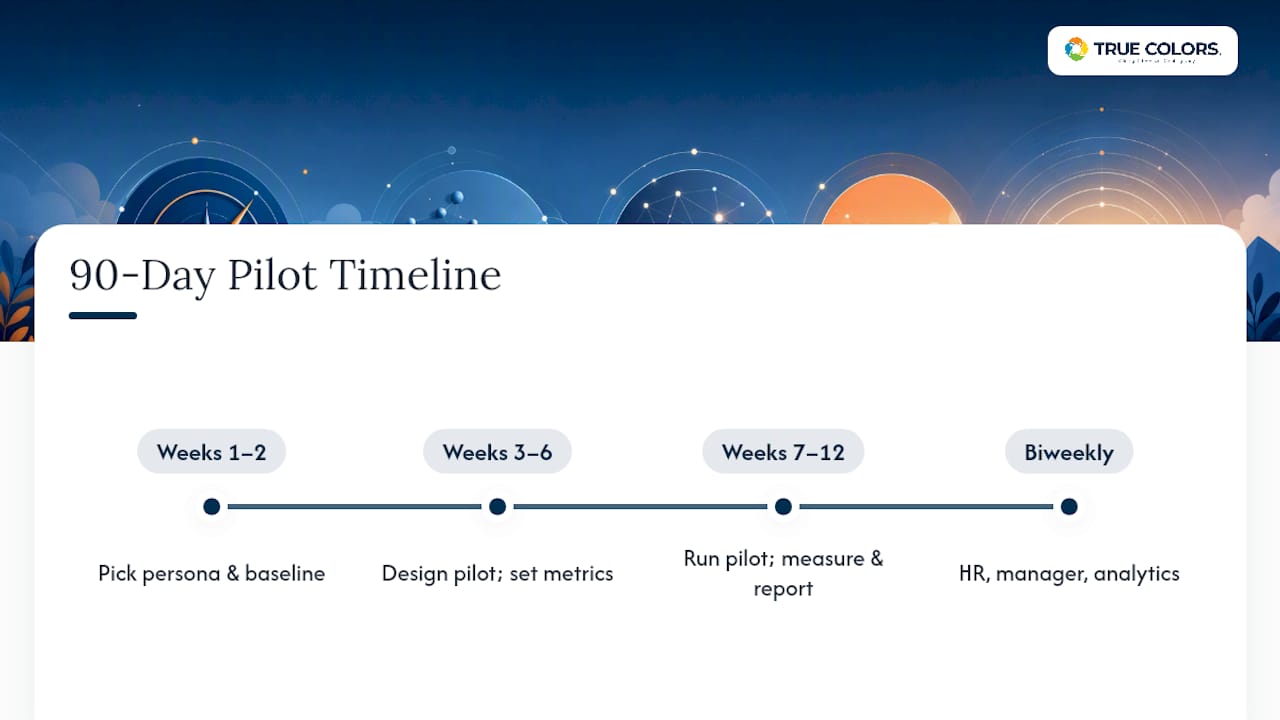
Weeks 1 to 2: choose one persona and one moment that matters, then pull baseline data from existing surveys and exit interviews. Weeks 3 to 6: design the pilot and define success metrics tied to a real business number. Weeks 7 to 12: run it, measure against baseline, and report results. Involve an HR lead, one manager sponsor, and someone who owns your analytics, meeting biweekly. If the pilot moves the metric, expand to a second moment using the same governance structure.
What the Research Actually Supports, and What HR Gets Wrong
Most advice on employee journey mapping treats the map itself as the deliverable. It isn't. The research consistently points to the same failure: organizations build a beautiful lifecycle diagram, present it once, and then nothing changes because nobody owns the follow-through. That's not a mapping problem. It's a leadership behavior problem wearing a mapping costume.
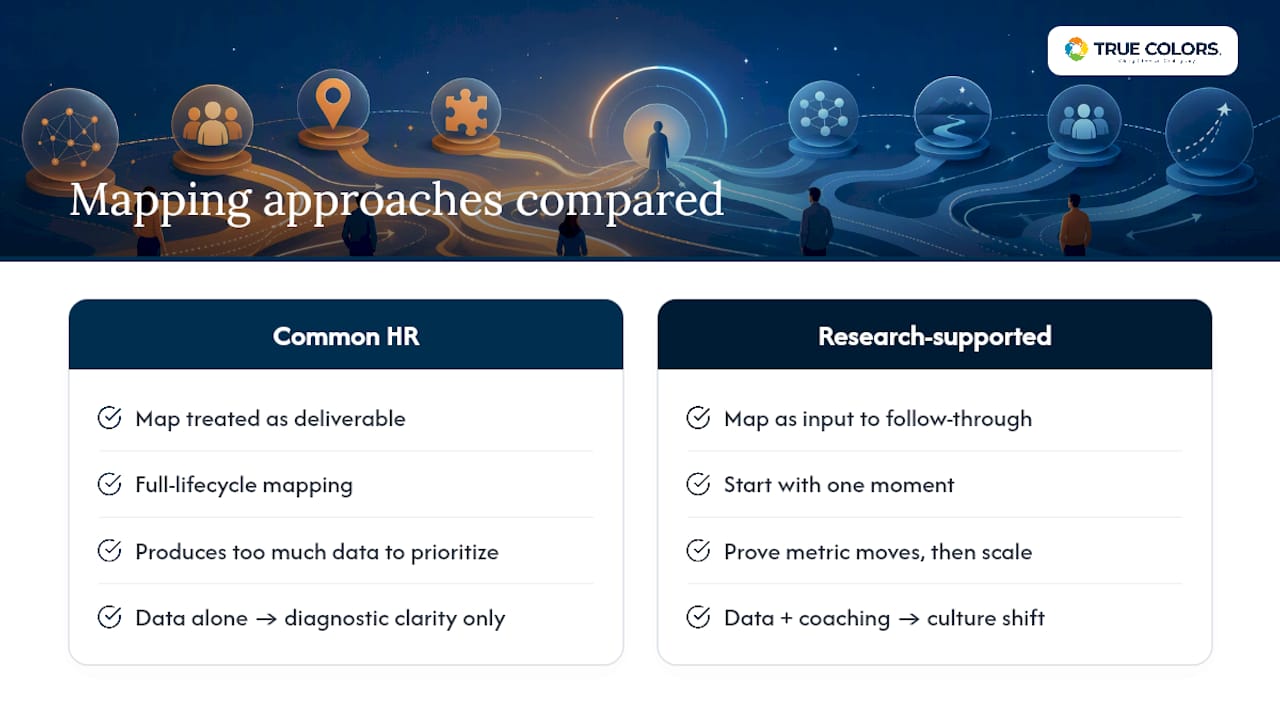
The conventional advice to "map the full employee lifecycle" is where most projects go wrong. Full-lifecycle mapping sounds thorough, but it produces so much data that prioritization becomes impossible, and impossible prioritization is exactly what stalls projects before they reach a single pilot. Start with one moment. Prove the metric moves. Then expand, because the resourcing argument for scaling gets infinitely easier once you have one concrete win instead of a comprehensive but unproven plan.
What deserves more attention than it gets: the connection between a map's findings and a manager's actual behavior. Data without coaching is a report. Data paired with leadership development is a culture shift. Organizations that treat mapping as a one-off HR exercise, rather than the first input into an ongoing behavior-change system, tend to get diagnostic clarity and nothing else.
— Theresa
Ready to Turn Journey Mapping Into Leadership Change
You've got the diagnostic playbook. What most HR teams lack isn't the map. It's the coaching infrastructure to turn what the map finds into behavior managers actually change. Truecolorsintl is built for exactly that gap: a practical culture and behavior system that moves organizations from awareness of a problem to aligned leadership action, and keeps that action reinforced quarter after quarter instead of fading after one training session.

If your pilot map surfaces a manager-behavior issue at onboarding or a performance-conversation touchpoint, the Connected Leadership Program coaches leaders on the specific behaviors your data flags, not generic leadership theory. Organizations without an existing measurement instrument can start with the Employee Experience Survey to establish the baseline your first pilot needs. For teams ready to build the governance structure around ongoing mapping and leadership reinforcement, corporate consulting engagements at Truecolorsintl pick up exactly where your 90-day pilot leaves off. Book a conversation with the team to map your first moment that matters.
Sources
- A Guide to Employee Journey Mapping | HBS Online
- Employee Journey Mapping: 6 Essential Steps - Qualtrics
- Employee Journey Mapping Made Simple: A Complete Playbook | G2 Learn