
Design-culture onboarding is a human-centered process that teaches organizational culture explicitly rather than assuming new hires will absorb it by proximity. The single most valuable action HR leaders can take this week: pick one role, assign one team, and launch a 30–90 day ramp-up guide as a pilot. That one decision converts onboarding from an administrative checklist into a repeatable culture-building system.
The urgency is real. Brandon Hall Group research found that organizations with a strong onboarding process improve new hire retention significantly and productivity notably. Yet the same research notes that a small portion of employees strongly agree their organization does a great job of onboarding. That gap is where culture gets lost.
Here is where to start:
- Choose a pilot role with a clear ramp-up arc (a designer, product manager, or cross-functional lead works well).
- Assign a cultural carrier — a peer mentor who explains unwritten norms, not just a buddy who shows someone where the coffee is.
- Build a 30–60–90 ramp-up guide with week-by-week milestones, a stakeholder map, and a starter project.
- Use Truecolorsintl's behavior-based system to move new hires from personal awareness to aligned action, grounding culture in observable behavior rather than values posters.
Table of Contents
- How to apply design thinking when onboarding new hires
- Ready-to-use templates for ramp-up guides and 30/60/90 plans
- How to run a pilot and scale your onboarding program
- How to measure onboarding success and reinforce culture past day 90
- Common pitfalls in cultural onboarding and how to fix them
- How Truecolorsintl turns design thinking into a culture-onboarding system
- Key Takeaways
- Why culture must be taught, not assumed
- Truecolorsintl's culture-onboarding programs are built for this work
- Curated sources and further reading
How to apply design thinking when onboarding new hires
Applying design thinking to onboarding reframes the process from a compliance exercise into a human-centered integration experience. The five-step framework gives HR a structured way to uncover friction, design meaningful moments, and iterate until the experience actually works.
Empathize: understand what new hires actually experience
Interview recent hires, managers, IT, and HR partners to surface emotional highs and lows. Use empathy maps and journey maps to visualize the full arc from offer acceptance to day 90. For design and creative roles, ask specifically: "What did you wish you knew about how decisions get made here?" and "When did you first feel like you understood the team's standards?"

Define: reframe friction into solvable problems
Turn interview findings into "How Might We" questions. "How might we help managers deliver consistent cultural context in the first 30 days?" is more useful than a vague goal to "improve onboarding." This step forces specificity and keeps the team focused on the problems with the highest emotional impact.
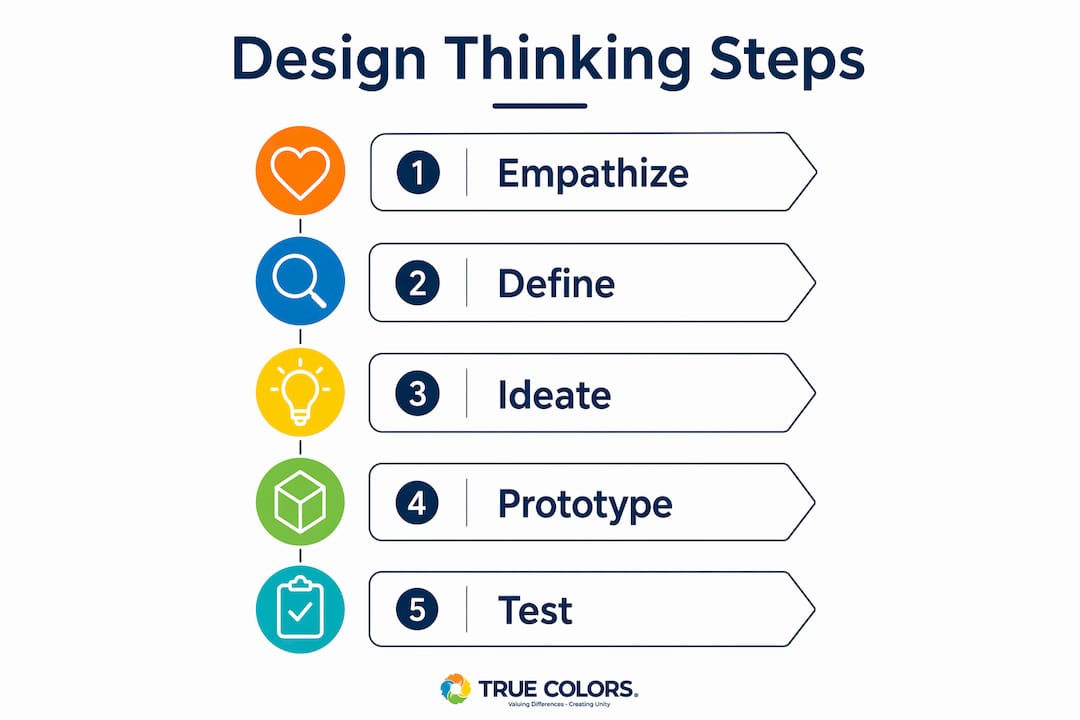
Ideate: generate solutions without editing
Bring HR, IT, design ops, and hiring managers into a single session. No filtering yet. Ideas like a preboarding portal, role-specific learning paths, and automated manager nudges at key milestones all belong on the board. A one-day cross-functional workshop that introduces shared terminology and research practices can align non-design team members faster than weeks of informal catch-up.
Prototype: build the minimum viable experience
Choose one idea to test quickly. A shared preboarding tracker, a "questions we've all had" document, or a personalized welcome letter from the hiring manager are all low-cost, high-signal prototypes. Map the "moments that matter" from offer acceptance to day 90, then design those moments with intentionality — a manager's "why we hired you" letter costs nothing and lands hard.
Test: measure, learn, and iterate
Run the prototype with a small cohort. Collect both qualitative feedback (how new hires felt) and quantitative signals (time-to-productivity, engagement scores). Refine before scaling. Design thinking reframes onboarding as a problem of emotional connection and staged learning, not a paperwork exercise — and iteration is what separates a pilot from a permanent program.
Pro Tip: Sequence content deliberately to avoid information dumping. Drip culture-specific material across weeks two through four rather than front-loading it on day one. Scaffolded tasks — starting with low-stakes contributions and building toward ownership — create the emotional connection that a policy handbook never will.
Ready-to-use templates for ramp-up guides and 30/60/90 plans
Design teams scale onboarding with ramp-up guides — self-driving templates that reduce manager bandwidth while keeping the experience consistent. Here is what a functional ramp-up guide includes:
Ramp-up guide structure:
- Overview section: role context, team mission, and how this position connects to organizational goals
- Stakeholder map: who to meet, why, and suggested conversation starters
- Access and tools checklist: software licenses, Slack channels, shared drives, and design system access
- Starter project: a low-stakes, real contribution scoped for the first two to three weeks
- Discoverable documentation: a curated list of internal docs — design principles, critique norms, decision logs — the new hire can explore at their own pace
Sample 30/60/90 outline for creative and design roles:
Days 1–30: Shadow team rituals (critiques, standups, retros). Complete all access and tool setup. Deliver one starter project. Meet every direct stakeholder. Read the team's documented norms around feedback and decision-making.
Days 31–60: Take ownership of one defined workstream. Run or co-facilitate one team ritual. Identify one process gap and propose a fix. Complete a culture-check pulse with their manager.
Days 61–90: Own a full project from brief to delivery. Contribute to a team retrospective. Confirm role responsibilities with manager. Provide structured feedback on the onboarding experience to improve the template.
Pre-day-one checklist (HR and IT):
- Hardware shipped and confirmed received
- Software licenses provisioned
- Slack and email accounts active
- Welcome message sent from manager (personal, not templated)
- Buddy introduced via email or Slack before day one
- Ramp-up guide shared with a brief orientation note
Starting onboarding before day one reduces first-day anxiety and measurably improves first-week engagement. A new hire who receives a buddy introduction and a roadmap before they walk in the door arrives oriented, not anxious.
How to run a pilot and scale your onboarding program
A pilot does not require a complete overhaul. It requires a defined scope, clear owners, and a short feedback loop.
| Phase | Timeline | Owner | Key Activity |
|---|---|---|---|
| Pilot design | Days 1–30 | HR + Design Ops | Build ramp-up guide, assign buddy, define success criteria |
| Pilot launch | — | Manager + HR | Pre-day-one outreach, day-one experience, starter project assigned |
| Mid-pilot check | Day 30 | Manager | Culture-check conversation, adjust workload or support |
| Pilot close | Day 60–90 | HR | Collect feedback, measure KPIs, iterate template |
| Rollout | — | HR + Leadership | Adapt template for additional roles, train managers |
Stakeholder responsibilities:
- HR: owns the ramp-up guide, pulse surveys, and pilot feedback loop
- Manager: delivers cultural context, runs 30/60/90 check-ins, and models norms explicitly
- Cultural carrier/buddy: provides low-pressure access to unwritten norms — Slack etiquette, critique rituals, how decisions actually get made
- Design ops or IT: handles access provisioning and tool setup before day one
- Leadership: sponsors the pilot and signals that culture-building is a priority, not an HR side project
Resource estimates are straightforward: plan for roughly four to six hours of HR time to build the initial ramp-up guide, two to three hours per week of buddy time in the first month, and one hour per week of manager check-in time. Tooling costs depend on your existing stack. Management coaching for leaders can accelerate manager readiness if your team leads are new to delivering culture-focused onboarding.
How to measure onboarding success and reinforce culture past day 90
Culture is not what is said. It is what is repeated. Measurement keeps that repetition honest.
| Metric | What It Measures | How to Collect |
|---|---|---|
| Time-to-productivity | Days until new hire contributes independently | Manager assessment at 30/60/90 |
| New-hire engagement (pulse) | Sense of belonging, clarity, and support | Short survey at 30 and 60 days |
| Cultural alignment score | Alignment with team norms and values | Manager + peer rating at 90 days |
| — | Whether the hire stays and stays engaged | HR tracking |
Beyond day 90, reinforcement is what separates a good onboarding program from a culture-building system. Tactics that work:
- Monthly team retrospectives that explicitly name what is working and what is not
- Quarterly culture refreshers tied to real business moments (a product launch, a reorg)
- Recurring manager calibration sessions to keep cultural messaging consistent
- An employee experience survey at six months to surface drift before it becomes disengagement
Common pitfalls in cultural onboarding and how to fix them
Most onboarding programs fail for predictable reasons. Recognizing the pattern early is the fix.
- Information dumping: Front-loading every policy, tool, and process in week one overwhelms new hires and produces almost no retention. Stagger content across the first 30 days.
- Inconsistent manager messages: When managers describe culture differently, new hires default to watching behavior, not listening to words. Train managers on the same documented norms before the hire starts.
- Unclear expectations: Ambiguity about what "good" looks like in the first 90 days creates anxiety and slows contribution. The ramp-up guide should define milestones explicitly.
- Overloaded first week: A packed schedule of back-to-back introductions and mandatory training leaves no room for reflection or relationship-building. Build in unstructured time.
- Skipping role-specific craft context: Generic onboarding ignores how designers, product managers, and engineers actually work. Documenting norms around feedback, decision-making, and communication rituals is more effective than assuming culture will be absorbed organically.
- No psychological safety scaffolding: Putting a new hire in a high-stakes client meeting or a contentious review in week one signals that performance matters more than belonging.
Pro Tip: Protect new hires from high-stakes exposure for the first 30 days. Keep creative and specialized roles out of client-facing meetings and critical reviews until they have had time to observe team norms in lower-pressure settings. Psychological safety is built in the margins, not the spotlight.
How Truecolorsintl turns design thinking into a culture-onboarding system
Truecolorsintl operationalizes the design-thinking approach by grounding it in observable human behavior. The system moves organizations from personal awareness to aligned action — which is exactly what the five-step onboarding loop requires at each stage.
The practical mapping looks like this:
- Empathize and Define: Truecolorsintl's employee experience tools surface what new hires actually feel and where alignment breaks down, giving HR the data to write meaningful "How Might We" problem statements.
- Ideate and Prototype: Leadership development programs and consulting services help managers and cultural carriers build the skills to deliver culture-focused onboarding consistently, not just once.
- Test and Reinforce: Ongoing pulse surveys and reinforcement tools track whether the culture is sticking and flag drift before it becomes turnover.
Truecolorsintl's approach also addresses the cultural carrier gap directly. By training peer mentors to explain the reasoning behind how work gets done — not just what the handbook says — organizations build a network of culture teachers that scales without adding headcount. For organizations managing remote or hybrid teams, this distributed model is especially important for keeping culture consistent across locations.
Key Takeaways
Designing culture into onboarding requires explicit teaching, structured templates, and consistent reinforcement — not passive absorption.
| Point | Details |
|---|---|
| Start with a pilot | Choose one role and one team; build a 30–90 day ramp-up guide before scaling. |
| Teach culture explicitly | Document feedback norms, decision rituals, and communication standards — do not assume new hires will absorb them. |
| Assign cultural carriers | Peer mentors explain unwritten norms more effectively than managers alone and scale without adding headcount. |
| Measure what matters | Track time-to-productivity, pulse engagement, and cultural alignment. |
| Truecolorsintl as the system | Truecolorsintl maps behavior-based tools to each design-thinking step, moving teams from awareness to aligned action. |
Why culture must be taught, not assumed
The most persistent mistake in onboarding is treating culture as ambient — something new hires will pick up by sitting near the right people. That assumption costs organizations real money and real talent. The 2025 Work Institute Retention Report found that early attrition comprises roughly 40% of all turnover, and the primary driver is a failure to connect new hires to the organization's norms and expectations in the first 90 days.
What actually changes outcomes is the decision to treat onboarding as a design problem. That means interviewing new hires to understand their experience, documenting the norms that shape daily work, building cultural carriers into the structure, and iterating the program the way a product team iterates a feature. Organizations that do this do not just retain people longer — they build teams that operate from shared understanding rather than guesswork about what is expected.
Truecolorsintl exists precisely for this work. The system gives leaders a practical mechanism to move from good intentions to consistent behavior, and consistent behavior is what culture actually is.
Truecolorsintl's culture-onboarding programs are built for this work
Truecolorsintl gives HR leaders and team managers a ready-to-run system for embedding culture into every stage of onboarding — from pre-day-one communications to 90-day reinforcement. The Connected Leadership Program trains managers to deliver culture-focused onboarding with consistency, not improvisation. Corporate consulting services build the ramp-up templates, cultural carrier programs, and measurement frameworks your team needs to run a credible pilot in 30 days.

The practical next step: schedule a discovery conversation with Truecolorsintl's consulting team to scope a pilot for one role or one team. You will leave with a clear plan, a starter template, and the manager training framework to make it repeatable. Visit truecolorsintl.com/corporate to get started.
Curated sources and further reading
- SHRM Complete Employee Onboarding Guide — The authoritative HR framework for onboarding structure, buddy programs, and cultural integration standards.
- Rival HR: Applying Design Thinking to Onboarding — A detailed walkthrough of the five-step design-thinking process applied to new hire experience design.
- Grove HR: Employee Onboarding Best Practices — Comprehensive guide covering pre-boarding through 90-day reviews with checklists and retention data.
- iCreatives: The First 90 Days Onboarding Checklist — Role-specific 30/60/90 framework and cultural norms documentation guidance for creative hires.
- Practicing Design: How Klaviyo Scaled Onboarding — Case study on ramp-up guides as self-driving onboarding toolkits for design teams.
- Truecolorsintl: Culture Onboarding Program Examples — Templates and toolkits for scaling culture onboarding efficiently, with downloadable ramp-up guide examples.
- Truecolorsintl: From Offer to Onboarding — Practical preboarding tactics to reduce first-day anxiety and improve early engagement.
- Truecolorsintl: Defining Corporate Culture and Values — Guidance on documenting norms, decision-making standards, and communication rituals for onboarding use.