
HR assesses team dynamics by measuring four interdependent dimensions — trust (vulnerability-based), clarity (roles and goals), conflict quality, and accountability — then using those scores to prioritize one to three behavior-based interventions. The fastest first move is a 6–8 minute team-level check-in (anonymized, aggregated) that creates a diagnostic baseline before any facilitated conversation begins.
Three signals anchor this approach from the start:
- Google Project Aristotle identified psychological safety, dependability, structure and clarity, meaning, and impact as the top predictors of team effectiveness — and found that combining qualitative and quantitative data gives the most accurate picture.
- The Team Dynamics Check-in is a 16-item self-report covering Trust, Clarity, Conflict Quality, and Accountability, answered on a 1–5 scale and completable in about 6–8 minutes.
- Truecolorsintl translates those assessment findings into leader-led behavior change and reinforced culture habits — not just a report.
When scores are in hand, the goal is not to describe the team but to change it. Improved decision speed, reduced rework, and lower regrettable turnover are the outcomes worth measuring against.
Table of Contents
- Which tools and models give HR the clearest view of team dynamics?
- What core dimensions should HR actually measure?
- What assessment methods does HR use in practice?
- How do you run a team dynamics assessment from start to finish?
- How do you turn assessment scores into a focused action plan?
- What legal and ethical guardrails apply to team assessments in the U.S.?
- How do you choose the right assessment tool and avoid low-ROI vendors?
- Key Takeaways
- The assessment is not the intervention
- Ready to move from assessment data to real behavior change?
- Useful sources and further reading
Which tools and models give HR the clearest view of team dynamics?
The market offers a wide range of instruments, from deep psychometric profiles to lightweight pulse tools. The table below maps the most widely used options across the dimensions HR cares about most.
| Tool / Model | Focus / Best for | Format | Typical cadence | Cost bracket | Actionability | Evidence base |
|---|---|---|---|---|---|---|
| CliftonStrengths | Individual strengths, role fit | 177-item survey | Onboarding, team launches | Medium | Moderate (team grid report) | Strong norming sample; Gallup research |
| DiSC Profile | Communication styles, behavioral fit | 16-item self-report survey | Onboarding, conflict resolution | Medium | High (style-specific coaching tips) | Decades of criterion validity research |
| Predictive Index (PI) | Behavioral drives, role alignment | 2-part cognitive + behavioral | Hiring, team design | Medium–High | High (team type report) | Peer-reviewed validity studies |
| GRPI Model | Goals, roles, processes, interpersonal — team diagnosis | Facilitator-led workshop | Project launch, restructure | Low (internal) | High (structured debrief) | Widely cited in OD literature |
| Google Project Aristotle | Psychological safety, team conditions | Mixed-method (survey + interview) | Annual or post-reorg | Low (DIY) | Moderate (framework, not a scored tool) | Google internal research; published findings |
| Tilt365 (Team Agility Predictor) | Agility, character strengths under pressure | 16-item self-report survey | Quarterly or change events | Medium | High (individual + team agility map) | Proprietary norming; positive psychology base |
| TeamDynamics (Check-in) | Trust, Clarity, Conflict Quality, Accountability | 16-item self-report | Baseline + quarterly pulse | Low | High (dimension scores + gap flags) | Structured item design; 1–5 scale |
Key selection tradeoffs to consider:
- Personality fit vs. team-process diagnostics. CliftonStrengths, DiSC, and PI tell you who is on the team; GRPI, the Team Dynamics Check-in, and Project Aristotle-style tools tell you how the team is functioning. Most HR teams need both, but at different moments.
- Long-form psychometric vs. short pulse. A 177-item instrument like CliftonStrengths is appropriate at onboarding or team launch. A 16-item check-in is better for quarterly tracking, where survey fatigue is a real risk.
- Facilitated vs. self-administered. Tools like GRPI and Tilt365 produce their best outputs when a skilled facilitator guides the debrief. Pulse surveys can run without facilitation, but the data loses value quickly if no one acts on it.
- Prescriptive vs. descriptive outputs. Some tools describe the team; the best ones prescribe next steps. Ask vendors specifically what the output looks like for a team scoring low on conflict quality.
- Personality assessments applied in daily work require integration into ongoing team rituals, not just a one-time debrief, to produce lasting behavior change.
What core dimensions should HR actually measure?
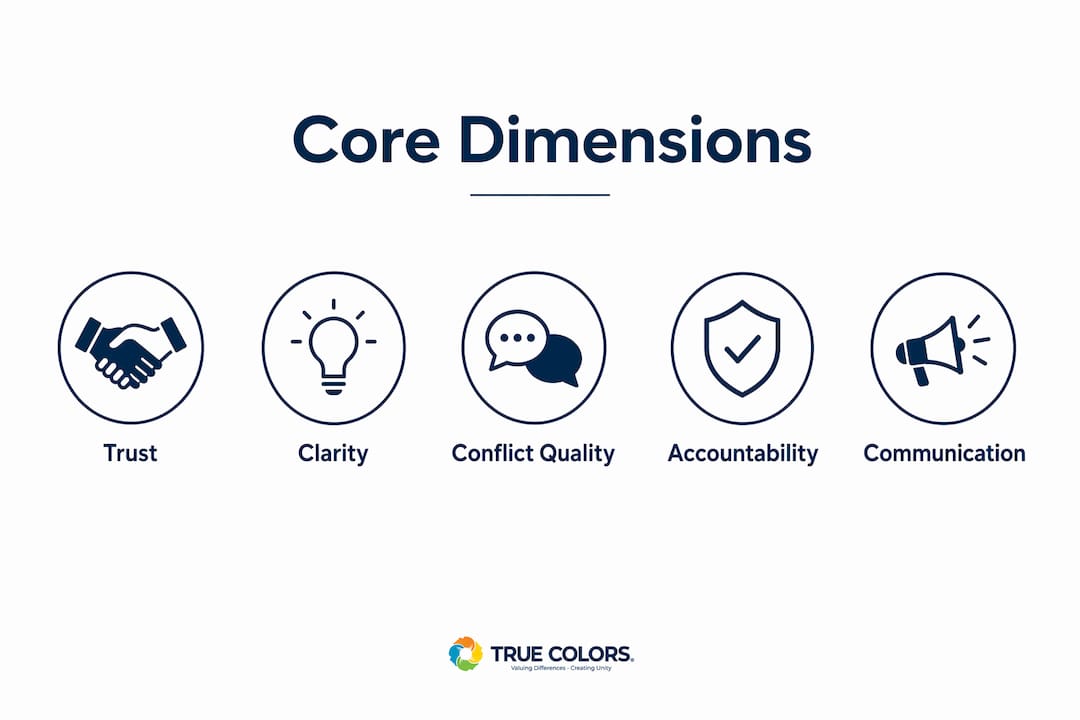
A structured team dynamics questionnaire captures patterns across communication, trust, cohesion, role clarity, decision-making, and accountability. The four dimensions most consistently measured in validated tools are trust, clarity, conflict quality, and accountability.
Trust (vulnerability-based / psychological safety)
Teams with high psychological safety take interpersonal risks without fear of punishment. Google Project Aristotle ranked this as the single most important predictor of team effectiveness. Without it, every other dimension suffers — people withhold information, avoid conflict, and underperform.
Sample items: "I can admit mistakes on this team without negative consequences." / "Team members ask for help when they need it."
Clarity (roles, goals, decision rights)
Ambiguity about who owns what is one of the most common causes of duplicated effort and stalled decisions. Clarity covers three sub-dimensions: goal alignment, role definition, and decision authority.
Sample items: "I know exactly what I am responsible for on this team." / "Our team has a shared understanding of our top priorities."
Conflict quality (productive vs. suppressed)
Healthy conflict means disagreements surface and get resolved. Suppressed conflict means the team appears harmonious but decisions get relitigated in side conversations. Signs of poor team dynamics include repeated relitigation, passive non-compliance, and frequent side conversations — all symptoms of suppressed conflict.
Sample items: "We address disagreements directly rather than avoiding them." / "Debates on this team focus on ideas, not personalities."
Accountability (follow-through and ownership)
Accountability is not about blame — it is about whether commitments are made explicitly and honored consistently. Low accountability scores almost always co-occur with low clarity scores.
Sample items: "Team members follow through on commitments." / "When someone misses a deadline, the team addresses it directly."
Communication and information flow
Poor communication is the most visible symptom of deeper dysfunction, but it is rarely the root cause. Measure it to surface where information gets blocked or distorted.
Sample items: "I receive the information I need to do my work effectively." / "Important updates reach the whole team, not just some members."
Cohesion and alignment
Cohesion reflects whether team members feel connected to each other and to a shared purpose. Low cohesion in a high-clarity team often signals a values or culture mismatch rather than a structural problem.
Dependability and structure
Borrowed directly from Google's research, dependability measures whether team members reliably complete quality work on time. Structure measures whether roles and plans are clear enough to act on.
The most common stuck-team profile shows moderate-to-high clarity, moderate trust, low conflict quality, and moderate accountability. That pattern typically signals that people understand their roles but are unwilling to surface disagreements — which means decisions get made, then quietly undermined.
What assessment methods does HR use in practice?
Each method captures a different slice of team reality. Choosing the right one depends on team size, sensitivity of the topic, and how quickly you need data.
| Method | What it measures | Pros | Cons | Best cadence |
|---|---|---|---|---|
| Pulse survey / check-in | Dimension scores over time | Fast, low burden, trackable | Surface-level without follow-up | Quarterly |
| 360-degree feedback | Individual behaviors as seen by peers, reports, manager | Rich behavioral data | Time-intensive; can feel threatening | Annually |
| Structured interviews / retrospectives | Qualitative context, root causes | Explains the "why" behind scores | Hard to aggregate; interviewer bias risk | After major events or low scores |
| Observational / behavioral sampling | Meeting dynamics, decision patterns, communication habits | Objective; not self-reported | Requires trained observer; time-intensive | Ongoing or spot-check |
| Social network analysis | Information flow, influence patterns, isolation | Reveals hidden structure | Requires specialized tools; privacy-sensitive | Annually or post-reorg |
Combining methods produces the most defensible picture. Researchers recommend moving beyond single-source measurement to reduce response bias and survey fatigue. A practical combination: a quantitative pulse survey, followed by a facilitated team review that uses open-ended prompts to explain the scores, followed by a short behavioral experiment (one changed habit, tracked over 30 days).
Two protection rules apply regardless of method:
- Anonymity thresholds. Never report individual scores from a team of fewer than five respondents. Aggregate to the team level by default.
- Access controls. Raw responses should be visible only to the HR practitioner or external facilitator running the assessment. Leaders receive aggregated reports, not individual data.
How do you run a team dynamics assessment from start to finish?
A reproducible process keeps the assessment defensible and the findings usable. Here is a step-by-step timeline HR can follow this quarter.
- Define goals and outcomes. Tie the assessment to a business problem — slower decision-making, rising turnover, post-reorg confusion. Vague goals produce vague action plans.
- Choose method and assign stakeholder owners. Decide who commissions the assessment, who administers it, and who receives the results. Separate the data owner from the team leader.
- Set privacy rules before launch. Communicate anonymity thresholds, who sees what, and how long data is retained. Do this in writing.
- Administer the check-in. A 16-item survey on a 1–5 scale, covering Trust, Clarity, Conflict Quality, and Accountability, takes a few minutes. Target a high participation rate for reliable aggregation.
- Analyze aggregate results. Look for dimension averages, high-variance items (disagreement within the team), and leader-vs-team gaps.
- Run a facilitated team review. Share aggregated scores, invite the team to interpret them, and use open-ended prompts to surface the "why." Keep the conversation forward-looking.
- Commit to one to three actions with owners and measures. Each action should be observable, time-bound, and tied to a specific dimension score.
- Track with pulse check-ins. Run a shortened version at 30, 60, and 90 days to measure whether the needle is moving.
Rough cost and time expectations
| Approach | Estimated cost | HR time investment |
|---|---|---|
| DIY internal survey (Google Forms, etc.) | Minimal | 4–8 hours design + analysis |
| Licensed tool (e.g., TeamDynamics, DiSC) | — | 2–4 hours administration + debrief prep |
| External facilitator (full diagnostic + workshop) | — | 2–4 hours coordination |
External partners add the most value when trust or conflict quality scores are low enough that an internal facilitator would be perceived as part of the problem. They also help when HR capability gaps limit the team's ability to translate data into facilitated conversation.
Pro Tip: Run the baseline assessment before any team intervention — not after. Post-intervention scores are only meaningful when you have a pre-intervention benchmark to compare them against.
How do you turn assessment scores into a focused action plan?
Reading scores is the easy part. The harder work is deciding which dimension to address first and what specifically to change.
Four analysis patterns point to different root causes:
- Low team average on a single dimension — usually a structural or process problem. Low clarity scores, for example, typically trace back to undefined decision rights, not interpersonal issues.
- High variance on a single item — signals a subgroup or role-based gap. When half the team rates "I receive the information I need" at 4–5 and the other half rates it at 1–2, the problem is not communication broadly; it is a specific information channel.
- Leader-vs-team gap — the manager rates the team significantly higher than the team rates itself. This pattern almost always reflects a blind spot in leadership behavior, not a data error.
- Low scores across all dimensions — often a sign of a team in crisis or in the storming phase of Tuckman's five stages. Broad dysfunction requires a different intervention than a single-dimension gap.
Three action-plan templates by dimension:
- Low conflict quality (short-term, 30 days): Introduce one structured disagreement norm — for example, a "pre-mortem" before major decisions. Measure whether the team reports more direct debate in the next pulse.
- Low trust (medium-term, 60–90 days): Run a vulnerability-based trust exercise, then ask the manager to model the behavior weekly. Track whether psychological safety scores rise by the 90-day check.
- Low accountability (medium-term, 60 days): Introduce a weekly commitment log — each team member states one commitment publicly and reports back the following week. Pair with a conflict resolution framework for when commitments are missed.
Example mini case: An example product team shows low scores on conflict quality and accountability, with varied responses on addressing disagreements directly. The diagnosis: suppressed conflict is undermining follow-through. The prioritized moves: (1) introduce a structured pre-mortem ritual, (2) coach the manager to name and reward direct disagreement, (3) run a 30-day pulse to track conflict quality. The measure: conflict quality score rises above 3.8 and relitigation of past decisions drops, as reported in the retrospective.
Practical recommendations should link diagnosis to business outcomes — improved decision speed, reduced rework, lower regrettable turnover — and be constrained by what the team can realistically sustain.
What legal and ethical guardrails apply to team assessments in the U.S.?
Running a defensible assessment in the U.S. requires attention to three areas: consent and privacy, psychometric quality, and EEOC/ADA compliance.
Consent and privacy checklist:
- Inform participants in writing what data is collected, how it is stored, who can access it, and how long it is retained before deletion.
- Never use team dynamics assessment data in hiring, promotion, or termination decisions without documented job-relatedness and legal review.
- Apply anonymity thresholds consistently: aggregate-only reporting for teams of fewer than five respondents.
- Store raw responses separately from HR records; limit access to the practitioner running the assessment.
Psychometric signals to ask vendors for:
- Reliability coefficients (Cronbach's alpha of 0.70 or higher is a reasonable minimum for team-level constructs).
- Norming samples that match your workforce in size, industry, and role type.
- Evidence that the tool measures team-level constructs, not just individual traits summed across members.
- Item-level clarity documentation — each question should have a clear, single interpretation.
EEOC and ADA considerations:
- Assessments used for any employment decision must demonstrate criterion-related or content validity and must not produce adverse impact on protected groups without business justification.
- Personality and behavioral tools used purely for team development (not selection) carry lower legal risk, but the distinction must be documented and consistently applied.
Vendor procurement questions:
- How is participant data stored, encrypted, and deleted?
- What norm groups were used to validate the tool, and how recent are they?
- Can results be reported at the team level only, with no individual-level output?
- What is the tool's reliability coefficient for each dimension?
Pro Tip: If your team has fewer than five members, skip individual-level reporting entirely and use the assessment as a facilitated conversation prompt rather than a scored diagnostic. The conversation is the intervention.
How do you choose the right assessment tool and avoid low-ROI vendors?
Selection criteria should match the problem you are trying to solve, not the vendor's marketing materials.
Five criteria that predict useful outcomes:
- Alignment to your target dimensions. A tool that measures personality styles is not a substitute for one that measures conflict quality or accountability. Map the tool's constructs to your diagnostic goals before purchasing.
- Prescriptive outputs. The report should tell the team what to do differently, not just describe how they currently behave. Ask to see a sample output for a low-scoring team.
- Data privacy and aggregation options. Confirm the vendor can deliver team-level-only reports and that individual responses are not visible to managers.
- Facilitation support. The best tools come with a facilitation guide or a certified practitioner network. A scored report without a facilitated debrief rarely produces behavior change.
- Cost structure that fits your cadence. A per-person licensing fee makes sense for annual assessments; a subscription model makes more sense for quarterly pulses.
Red flags that predict low ROI:
- No published reliability or validity data — the vendor cannot tell you the tool's Cronbach's alpha or norming sample.
- Outputs that describe the team but prescribe nothing — a report full of adjectives and no action steps.
- Low participation rates in vendor demos — if the vendor cannot show you a real team's aggregated output, ask why.
- No anonymity controls — the tool reports individual scores to the manager by default.
- Resistance to a pilot — a confident vendor welcomes a small-scale test with pre-defined success metrics.
Pilot design guidance: Start with one team of eight to fifteen people. Define success before you launch: what dimension score improvement, behavior change, or business outcome would justify scaling? Run the full cycle (baseline, intervention, 90-day pulse) before committing to an organization-wide rollout. Scale only when the pilot produces measurable behavior change, not just positive participant reactions.
Key Takeaways
Effective team dynamics evaluation combines four measurable dimensions, a repeatable assessment cadence, and behavior-based interventions tied to specific business outcomes.
| Point | Details |
|---|---|
| Four core dimensions | Measure trust, clarity, conflict quality, and accountability — in that priority order — to diagnose what is limiting team performance. |
| Start with a short check-in | A 16-item, 1–5 scale survey takes 6–8 minutes and creates the baseline every intervention plan needs. |
| Use a repeatable cadence | Run a baseline, then 30/60/90-day pulse check-ins, then quarterly tracking to separate transient stress from persistent dysfunction. |
| Legal and ethical must-dos | Aggregate to team level, apply anonymity thresholds for teams under five, and never use developmental assessment data in employment decisions without documented job-relatedness. |
| Truecolorsintl as a delivery partner | Truecolorsintl translates assessment findings into leader-led behavior change through facilitated diagnostics, leader coaching, and reinforced culture habits. |
The assessment is not the intervention
Most HR teams invest heavily in choosing the right tool and almost nothing in what happens after the scores come in. That is where the real work lives.
The single most reliable lever on trust and conflict quality is manager behavior — not a workshop, not a new norm document, not a revised RACI chart. When a manager consistently models vulnerability, names disagreement as healthy, and follows through on their own commitments, scores on those dimensions move. When they do not, no assessment tool closes the gap.
The second mistake is treating the facilitated team review as a reveal session. Sharing scores and waiting for the team to react is not facilitation. The most productive reviews start with a question, not a slide deck: "Looking at these results, what is one thing we are doing that is working, and one thing we are avoiding that we know we should address?" That framing shifts the conversation from diagnosis to ownership. Teams that leave a review with a commitment they wrote themselves are far more likely to follow through than teams handed an action plan by HR.
Finally, assessments are instruments for conversation, not verdicts. A low conflict quality score does not mean the team is broken. It means the team has not yet built the habits and safety to surface disagreement productively. That is a solvable problem, and the solution starts with one changed behavior, tracked over 30 days, owned by the team.
Ready to move from assessment data to real behavior change?
Most organizations can run a solid diagnostic. Fewer know what to do with the results once the scores are on the table. That is where a practitioner partner changes the outcome.
Truecolorsintl works with HR leaders and organizational teams to turn assessment findings into leader-led culture change. The work includes facilitated diagnostic reviews that surface root causes, leader coaching tied to the specific behaviors your scores flag, custom workshop design for conflict quality and trust-building, and a measurement cadence that tracks whether change is actually sticking. The employee experience survey offering handles assessment administration and aggregated reporting for teams that want to outsource the diagnostic work entirely.
A discovery conversation typically covers scope, timeline (most engagements run 60–90 days for a focused intervention), and the two or three behavior changes most likely to move your lowest-scoring dimensions. If you are ready to connect assessment data to measurable outcomes, start the conversation with Truecolorsintl.
Useful sources and further reading
- Google re:Work — Understand Team Effectiveness: The primary summary of Project Aristotle's findings on psychological safety and the five team conditions. Essential reading for the evidence base behind any trust-focused intervention.
- Team Dynamics Check-in — My Path: A free 16-item self-report covering the four core dimensions. Useful as a starting template for HR teams building their own pulse survey.
- Frontiers in Psychology — Advancing Teams Research: Academic review of methodological tools for measuring team dynamics over time. Supports the case for continuous, multi-method assessment rather than annual snapshots.
- OAD.ai — Team Dynamics Assessment: Practical operational guide covering assessment process steps, measurable constructs, and outcome-linked recommendations.
- Centre for Teams — Signs of a Dysfunctional Team: Observable behavioral signals that indicate poor team dynamics — useful for HR practitioners doing observational assessment alongside survey data.
- AIHR — HR Skills Assessment: Covers the internal capability gaps that limit HR's ability to assess and improve teams, including the finding that only a small share of HR leaders report having reliable data on workforce skills.