
Inclusive leadership training teaches leaders specific, observable behaviors, not abstract values, so they can turn a diverse workforce into better decisions and fairer outcomes. It's built for people managers, executives, and HR and L&D leaders who set the tone for how teams operate. Done well, it reduces biased decision-making, increases psychological safety in meetings, and improves retention among underrepresented employees.
TL;DR:
- Training must include ongoing reinforcement and measurement, with validated assessments before and after to ensure lasting behavior change.
- Leaders should practice inclusion in specific daily moments, such as holding structured interviews and addressing bias in real time, not just in theory.
- Programs combining workshops, coaching, and follow-up activities are more effective at embedding inclusive behaviors than single-session seminars.
- Embedding training into performance systems and securing visible executive participation drastically increases the likelihood of sustained cultural change.
- Behavior systems that reinforce inclusive traits through processes like coaching and accountability outperform one-time training efforts.
Table of Contents
- What Does Inclusive Leadership Training Actually Teach?
- How Does Inclusive Leadership Show Up in Everyday Scenarios?
- What Training Formats Actually Change Behavior?
- How Do You Design and Embed an Inclusive Leadership Program?
- How Do You Measure Whether the Training Worked?
- Why Behavior Systems Beat One-Time Training
- Build a Program That Sticks: The Connected Leadership Program
- Sources
What Does Inclusive Leadership Training Actually Teach?
Most credible programs build around research-backed traits rather than generic sensitivity messaging. Deloitte's research identifies six signature traits that separate inclusive leaders from well-meaning ones: commitment, courage, cognizance of bias, curiosity, cultural intelligence, and collaboration. Training translates each trait into something a leader actually does at work, not something they merely believe.
The distinction matters between diversity outcomes (who is in the room) and inclusion outcomes (whether people in the room are heard, developed, and promoted). A program that only teaches the first is incomplete.
In daily practice, the six traits show up as:
- Commitment: a leader defends inclusion goals even when it costs time or convenience
- Courage: challenging a peer's biased comment in a meeting, not just in private
- Cognizance of bias: pausing before a hiring or promotion call to check assumptions
- Curiosity: asking questions across difference instead of assuming shared context
- Cultural intelligence: adapting communication style without losing authenticity
- Collaboration: distributing credit and airtime deliberately, not by habit
Credible programs pair this framework with pre and post assessments, facilitators with real organizational development backgrounds, and a defined measurement plan, not just a certificate at the end.
How Does Inclusive Leadership Show Up in Everyday Scenarios?
Leaders don't practice inclusion in the abstract. They practice it in five recurring moments, and practitioner research from IMD outlines exactly where good intentions tend to fall short of great execution.
- Meetings. The same three voices dominate every discussion. A trained leader uses round-robin input or sends pre-reads so quieter or less senior participants can contribute prepared thoughts instead of competing to speak first.
- Hiring. Gut-feel interviews favor familiarity. Structured interviews with consistent questions and scoring rubrics reduce the halo effect that lets charisma substitute for capability.
- Performance reviews. Vague feedback ("just needs more polish") disproportionately harms employees outside the reviewer's own background. Specific, behavior-based feedback tied to defined criteria closes that gap.
- Employee resource groups. ERGs often get budget but no real influence. Leaders who actively sponsor ERG initiatives, rather than simply funding them, convert visibility into career capital for members.
- Addressing bias in the moment. Letting a microaggression pass in a meeting signals tolerance. Naming it calmly, in real time, is one of the clearest tests of whether courage is a value or a habit.
Recent research on inclusive leadership adds a layer most training misses: leaders must manage the tension between celebrating individual uniqueness and building collective belonging, and 2025 research published in the Journal of Business Ethics argues that exemplary leaders hold both at once rather than defaulting to one. That's a harder skill to teach than a checklist, and it's exactly why scenario-based practice, not slide decks, tends to produce leaders who can actually navigate it.
What Training Formats Actually Change Behavior?
Format determines whether a program produces a memory of a good workshop or a durable shift in how leaders operate. Three formats dominate the market, and they are not interchangeable.
- Single-session workshops (half day to full day) build shared vocabulary and awareness fast. They work well as a kickoff, poorly as the entire intervention.
- Multi-session cohorts spread learning across weeks or months, with practice assignments between sessions. Leaders return with real scenarios from their own teams, which is where the traits actually get tested.
- Blended programs combine workshops with 1:1 or small-group coaching and pre/post assessments. These tend to produce the most durable change because they pair instruction with accountability.
Practitioner guidance is consistent on one point: one-off seminars rarely change behavior on their own. Without reinforcement, most training fades within weeks, and leaders slide back into default habits under deadline pressure.
When evaluating a program, look for a few concrete signals that it's built for behavior change rather than awareness alone:
- A validated assessment used before and after the program, not just a satisfaction survey
- Facilitators with actual organizational development or coaching credentials
- Explicit connections to your existing HR systems, like hiring rubrics or performance criteria
- A defined reinforcement cadence, not a single closing session
Pro Tip: Ask any vendor how they measure behavior change six months after the last session, not just satisfaction scores from the final day. If they can't answer, the program was built to be memorable, not to be sustained.
How Do You Design and Embed an Inclusive Leadership Program?
Building or buying a program is the easy part. Embedding it into how the organization actually operates is where most efforts stall. Use this as a working checklist.
Selection criteria before you commit:
- Does the program include a pre-training assessment tied to specific traits or competencies?
- Do facilitators have documented experience in organizational behavior, not just public speaking?
- Can the content be customized to your industry, org chart, and known friction points?
- Is there a written measurement plan with named metrics and a follow-up date?
- Does an executive sponsor visibly participate, not just approve the budget?
Implementation steps, in order:
- Run a baseline assessment across the leadership population you're targeting, using either a validated 180/360 tool or an engagement survey with disaggregated data.
- Pilot with one cohort, ideally 15 to 30 leaders, before rolling out organization-wide.
- Build in a measurement checkpoint at 90 days, not just immediately after training.
- Set a reinforcement cadence, monthly coaching touchpoints or peer accountability groups work well, to keep the behaviors active.
- Tie observed behaviors to performance conversations, promotion criteria, and recognition programs so inclusion becomes part of how success is defined, not a separate initiative.
Red flags that predict failure:
- The program is a single event with no follow-up scheduled
- There's no pre-agreed measurement plan
- No executive is visibly participating or modeling the behaviors
- The content isn't customized to your organization's actual friction points
Programs like Culture Alignment frameworks show why the tie-in to existing systems matters most: training that lives outside performance management and hiring practices gets treated as optional, and optional rarely survives budget season.
How Do You Measure Whether the Training Worked?
Track a small set of measures instead of one satisfaction score. Useful signals include inclusion-specific items on your engagement survey, broken out by demographic group, plus promotion and stretch-assignment parity across those same groups. A pre and post 180 or 360 assessment tied to the six inclusive leadership traits gives you a direct behavior measure rather than a proxy, and it's the same kind of assessment tool that supports trait-to-measure mapping in well-designed programs.
Short feedback loops matter more than annual reviews. Monthly manager check-ins, brief coaching nudges, and simple meeting-participation tracking catch backsliding early. Report results to stakeholders in plain terms, tied directly to talent decisions, so the data drives action instead of sitting in a slide deck.
Why Behavior Systems Beat One-Time Training
Most organizations already know the traits worth building. The harder truth is that awareness rarely survives a Tuesday afternoon crisis. Leaders default to old habits under pressure unless a system, not a memory, keeps pulling them back to the new behavior.
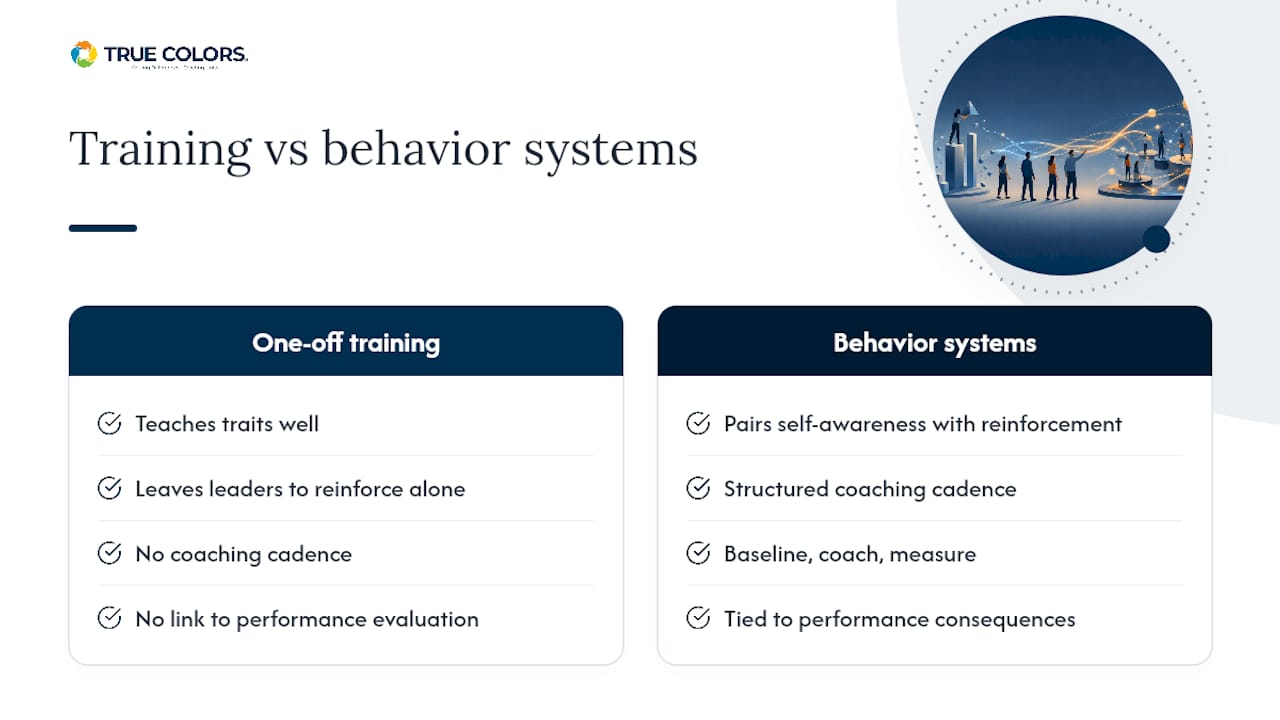
That's the gap most training programs never close. They teach the six traits well, then leave leaders to reinforce them alone, with no coaching cadence and no link to how performance gets evaluated. Behavioral intelligence approaches that pair personality-based self-awareness with structured reinforcement tend to outperform lecture-based models precisely because they build the follow-through into the design instead of hoping it happens on its own.
The organizations that get this right treat inclusive leadership the way they'd treat any other operational discipline: baseline it, coach it, measure it, and tie it to consequences that matter. Culture is not what a leader says in a training session. It's what a leader repeats after the training ends.
— Theresa
Build a Program That Sticks: The Connected Leadership Program
If your organization has run a workshop before and watched the energy fade within a month, you already know the problem isn't awareness. It's reinforcement. Truecolorsintl's Connected Leadership Program is built specifically to close that gap, using behavior-based assessments, tailored curriculum, and facilitator-led workshops that connect directly to how your organization hires, evaluates, and promotes people.

The program includes a diagnostic assessment to establish where your leadership population stands today, customized workshop content built around your organization's real friction points, and a reinforcement cadence designed to keep new behaviors active long after the last session ends. It's built for organizations that want inclusion to show up in promotion decisions and performance conversations, not just in a values statement.
If you're ready to move past one-time training toward a system that sustains behavior change, visit the Connected Leadership Program page to request more information and see how it fits your organization's structure.
Sources
- Six signature traits of inclusive leadership | Deloitte Insights
- Every Rose Has Its Thorns - How Exemplars Manage the Tensions in Inclusive Leadership | Journal of Business Ethics
- Inclusive Leadership: Traits, Behaviors, and Examples | ReWork
- Five everyday scenarios that call for inclusive leadership – and how to go about it - I by IMD