
Culture alignment is the degree to which an organization’s stated values, daily behaviors, and strategic goals are consistently practiced by its people, not just posted on a wall. When alignment is strong, employees at every level make decisions that reinforce the same priorities. When it breaks down, even a well-crafted strategy stalls at execution.
The core components of cultural alignment include:
-
Shared values that employees genuinely understand and act on
-
Observable behaviors that reflect those values in daily decisions
-
Leadership modeling that demonstrates what the organization rewards
-
Consistent reinforcement through hiring, performance reviews, and recognition
-
Employee commitment rooted in purpose, not compliance
Culture alignment differs from culture itself. Culture is the broader system of beliefs, assumptions, and norms that shape how people behave. Alignment is the practice of closing the gap between what an organization says it values and what its people do.
What company culture really means, and where alignment fits in
Company culture is the invisible system that shapes what people believe matters most inside an organization. It influences which risks feel acceptable, how quickly decisions get made, and which ideas ever reach a decision-maker. As Harvard Business School’s Disruptive Strategy course frames it, culture acts as a prioritization engine, telling people what to focus on and what to ignore.

Culture operates at three levels: the deep assumptions people rarely question, the espoused values an organization articulates, and the visible artifacts like office design and policies. Most organizations manage only the surface level. Alignment requires working across all three.
Where culture describes the system, alignment describes how well that system is functioning. An organization can have a clearly defined culture and still suffer from misalignment if leaders behave inconsistently, if incentives reward the wrong things, or if new employees are never socialized into what the values look like in practice. The gap between espoused values and lived behaviors is where most execution problems begin, which is why understanding how to launch a consulting firm LinkedIn outreach campaign can connect company culture and strategic decision-making for measurable outcomes.
Key distinctions leaders should hold:
-
Culture is descriptive; alignment is evaluative
-
Culture exists whether managed or not; alignment requires deliberate effort
-
Culture change is slow; alignment improvements can happen through targeted behavioral shifts
Why cultural alignment matters for organizational success
Only 21% of U.S. employees strongly feel connected to their organization’s culture. That gap between intention and experience has real consequences. When employees do not see their daily work connected to the organization’s values, engagement drops, execution slows, and talent walks.
The benefits of strong alignment are concrete:
-
Improved collaboration because teams share a common decision-making framework
-
Higher retention as employees who resonate with purpose stay longer
-
Faster execution when values reduce the need for constant managerial oversight
-
Greater trust between leadership and employees, built through consistent behavior
Strong culture organizations exhibit high consensus on norms and values combined with high commitment, which enables peer enforcement of behaviors and reduces the need for formal management layers. That self-managing quality is one of the most underappreciated operational advantages alignment creates.
Misalignment carries its own costs. Silos form when teams optimize for different priorities. Disengagement spreads when employees see leaders say one thing and do another. And research shows that aligned cultures can lift employee performance by up to 22%, while 65% of portfolio failures trace back to people and organizational issues rather than flawed products or market conditions. Culture is not a morale initiative. It is a performance variable.
Practical strategies to build and sustain cultural alignment
Alignment does not happen organically. It requires deliberate, repeatable action across leadership, systems, and communication. The following steps give leaders and HR professionals a structured path forward.
-
Define values in behavioral terms. Vague values like “integrity” or “innovation” mean nothing without behavioral definitions. Specify what each value looks like in a hiring decision, a performance conversation, or a budget trade-off.
-
Integrate culture into daily decision-making. Culture alignment works best as a decision-making framework, not a quarterly initiative. Ask in every major meeting: does this choice reflect our values, and does it advance our strategy?
-
Model the behaviors you expect. Leaders who visibly live the values create permission for everyone else to do the same. Leaders who tolerate exceptions signal that values are negotiable. The real standard is not what is written; it is what is rewarded and what is tolerated.
-
Hire for mission resonance, not just skills. Effective alignment focuses on shared mission resonance and peer-to-peer accountability rather than rigid top-down rules. Culturally selective hiring is one of the most powerful levers available.
-
Socialize new employees intentionally. Onboarding is the highest-leverage moment for alignment. Use it to translate values into specific behavioral expectations, not just company history.
-
Align incentives with desired behaviors. If the compensation and recognition systems reward behaviors that contradict stated values, the incentives win every time. Audit what you reward.
-
Build peer accountability. Strong cultures rely on social norms, not just managerial oversight. Create conditions where employees hold each other to the standard, which reduces the burden on formal management and increases ownership.
Pro Tip: When reviewing your performance management process, ask one question: are we recognizing the behaviors that reflect our values, or the outcomes that happen to look good this quarter? The answer usually reveals where alignment is breaking down.
How to measure cultural alignment in your organization
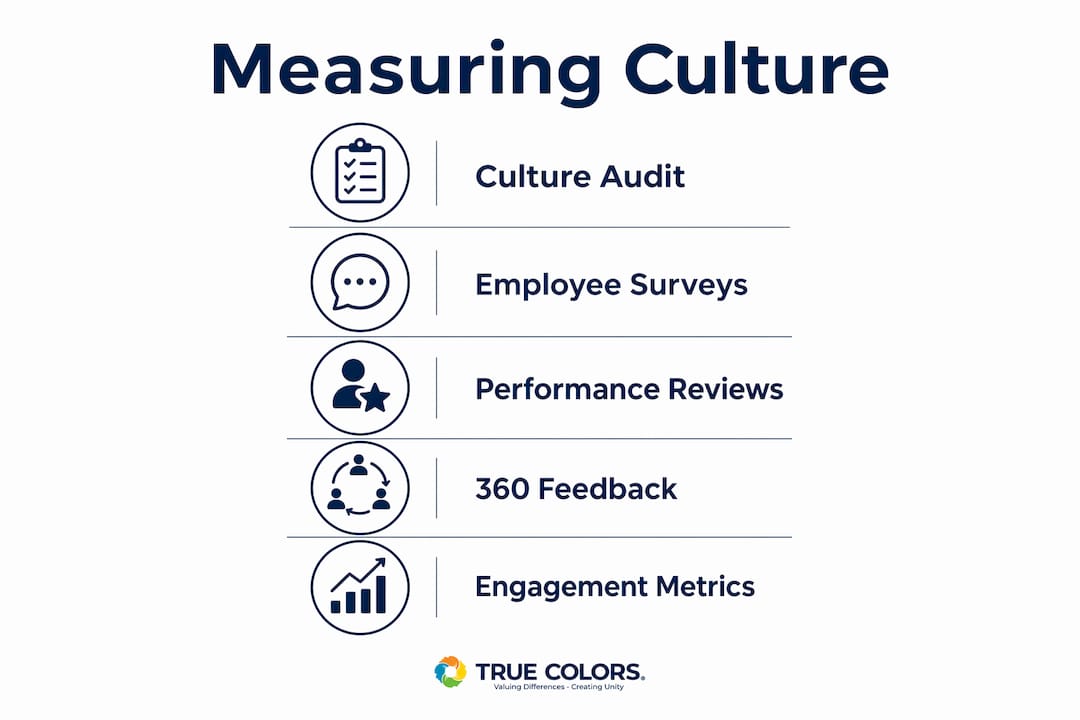
Measurement turns alignment from a feeling into a manageable system. A five-step approach covers the full cycle: define values in behavioral terms, assess gaps through cultural audits, create alignment plans, embed culture into decisions and reviews, and monitor continuously through employee feedback and KPIs.
-
Conduct a culture audit. Go beyond engagement scores. Look at how decisions get made under pressure, how teams collaborate across functions, and how leaders behave when no one is watching. The question that cuts through noise: what does your culture make easy, and what does it make hard?
-
Survey employees on specific behaviors. Ask whether managers explain how daily work connects to company values. Research shows that while 83% of leaders believe they are responsible for shaping culture, only 21% of U.S. employees strongly feel connected to their organization’s culture.
-
Define alignment metrics. Track cultural performance alongside traditional KPIs. Useful metrics include internal promotion rates for employees who model values, voluntary turnover among high performers, and frequency of values-based language in performance reviews.
-
Run pulse checks regularly. Annual surveys capture sentiment, not behavior. Monthly or quarterly pulse checks catch drift before it becomes entrenched.
-
Visualize and act on the data. Measurement only creates value when it drives decisions. Share results with leadership, identify the top two or three friction points, and build a visible action plan.
| Measurement method | What it reveals | Frequency |
|---|---|---|
| Culture audit | Gap between stated values and actual behaviors | Annually |
| Employee engagement survey | Perceived connection to values and leadership | Bi-annually |
| Pulse check | Real-time sentiment and emerging friction | Monthly or quarterly |
| Performance review analysis | Whether values appear in coaching conversations | Each review cycle |
| Promotion and recognition data | Which behaviors the organization rewards | Quarterly |
For a deeper look at the frameworks organizations use to track progress, how culture is measured in practice offers a practical starting point.
Why culture alignment is a leadership responsibility, not an HR program
Culture often drifts when it is treated as a program rather than a core business function. The organizations that sustain alignment over time treat it the way they treat financial performance: with clear ownership, defined outcomes, and ongoing accountability. HR’s role is not to own culture but to orchestrate alignment, helping leaders see that their daily decisions are the actual culture-building mechanism.
Culture alignment functions best as a decision-making filter, not a set of slogans. When leaders consistently ask whether a decision reflects core values, culture gains operational credibility. When they skip that question under pressure, values become decorative.
Cultural drift caused by growth, remote work, and organizational silos requires proactive reinforcement. Aligning daily rituals, promotion criteria, and incentives to desired behaviors is what prevents drift from becoming the new norm. The CEO’s role in culture is particularly consequential here: what the most senior leader tolerates sets the ceiling for everyone else.
Pro Tip: Use values as a filter in your next leadership team meeting. Before finalizing a major decision, ask explicitly: “Does this choice reflect our values?” The discomfort that question sometimes creates is usually a signal worth following.
Common challenges that prevent cultural alignment from taking hold
Even well-intentioned organizations run into predictable barriers. Recognizing them early makes them easier to address.
The values-behavior gap. Organizations articulate values clearly but fail to translate them into specific, observable behaviors. Employees are left to interpret what “customer focus” or “accountability” looks like on a Tuesday afternoon.
Leadership inconsistency. When senior leaders behave in ways that contradict stated values, especially under pressure, it signals to the organization that values are aspirational at best. One visible exception can undo months of messaging.
Misaligned incentives. Compensation, promotion, and recognition systems that reward behaviors inconsistent with stated values create a credibility problem that no communication campaign can fix. Incentives must align with the behaviors the culture requires.
Cultural drift during growth. Rapid hiring, leadership transitions, and remote or hybrid work all dilute cultural consistency. What worked in a 50-person organization rarely scales automatically to 500.
Treating alignment as a one-time initiative. Culture alignment is not a launch event. Organizations that treat it as a project with a start and end date consistently find themselves rebuilding from scratch after the next disruption.
Fragmented ownership. When culture is delegated entirely to HR, leaders disengage from the work. Culture changes when leaders behave differently, not when HR launches a new program. Shared accountability across the leadership team is what makes alignment durable.
Understanding the role of HR in culture change helps clarify where HR adds the most value: not as the owner of culture, but as the architect of the systems that make alignment everyone’s responsibility.
Key Takeaways
Cultural alignment is the practice of closing the gap between stated values and daily behavior, and it requires consistent leadership action, aligned incentives, and continuous measurement to hold.
| Point | Details |
|---|---|
| Alignment is behavioral, not aspirational | Values only create alignment when translated into specific, observable behaviors people practice daily. |
| Leadership modeling sets the standard | What leaders tolerate and reward defines the real culture, regardless of what is written in a values statement. |
| Only 21% feel connected to culture | Only 21% of U.S. employees strongly feel connected to their company’s culture, exposing a widespread execution gap. |
| Measurement requires multiple methods | Culture audits, pulse checks, and performance review analysis together reveal where alignment is holding and where it is breaking down. |
| Drift is the default without reinforcement | Growth, leadership change, and remote work erode alignment unless incentives, rituals, and promotion criteria are actively managed. |
Truecolorsintl helps organizations move from cultural awareness to consistent, practiced alignment. Through leadership development, team training, and employee experience tools, the work goes beyond defining values to building the habits and systems that make those values real. If your organization is ready to close the gap between what you say and what you do, explore culture building programs designed to create lasting behavioral change at every level.