
HR is the primary architect of culture change in any organization, not a support function that reacts after decisions are made. The role of HR in culture change is to design, embed, and sustain the systems that make desired behaviors the default. Culture is not what leadership announces in an all-hands meeting. It is what gets rewarded, promoted, and tolerated every day. Organizations that treat culture as a communication problem consistently fail to shift it. Those that treat it as an operational system, engineered by HR through hiring criteria, performance incentives, and decision rights, build cultures that hold. SHRM, Gartner, and Truecolorsintl all point to the same conclusion: culture requires systemic design, not persuasion.
What is the role of HR in culture change?
HR’s role in culture change is to function as a systems engineer, not a communications team. The distinction matters because most culture initiatives fail at the systems level, not the messaging level. HR owns the processes that either reinforce or contradict the culture an organization says it wants.
Embedding values into hiring, promotion, and reward systems is what separates HR teams that drive real culture change from those that run engagement surveys and hope for the best. When HR actively maps desired behaviors to every people process, culture becomes structural. When HR limits its role to communication and training, culture stays aspirational.

Gartner describes this work as identifying culture catalysts and collisions, integrating culture design with 12–24 month business planning cycles. A culture catalyst is a process that accelerates the behaviors you want. A culture collision is a process that directly contradicts them. Most organizations have more collisions than they realize, and HR is the only function positioned to find and fix them.
How does HR architect culture through systems and processes?
Culture shifts when incentives, promotion criteria, and leadership accountability change. Persuasion alone is insufficient to move a culture. HR must audit every people process against the behaviors the organization wants to see and redesign the ones that reward the wrong things.
The processes HR controls that most directly shape culture include:
-
Hiring criteria: Are interviewers selecting for the behaviors the culture requires, or defaulting to technical skills alone?
-
Onboarding: Does the first 90 days teach new employees how culture works here, or just what the values poster says?
-
Performance reviews: Do managers assess behavioral alignment, or only output metrics?
-
Promotion decisions: Are people advancing because they model the culture, or despite the fact that they undermine it?
-
Reward and recognition: Does the recognition program reinforce the behaviors that matter, or celebrate whoever hits the biggest number?
Each of these processes either builds or erodes culture. HR’s job is to audit them systematically, identify the collisions, and redesign the structures that are working against the stated values.
Pro Tip: Avoid treating culture change as a communication or soft skills initiative. If the incentive structure rewards behaviors that contradict your stated values, no amount of training will fix it. Fix the system first.
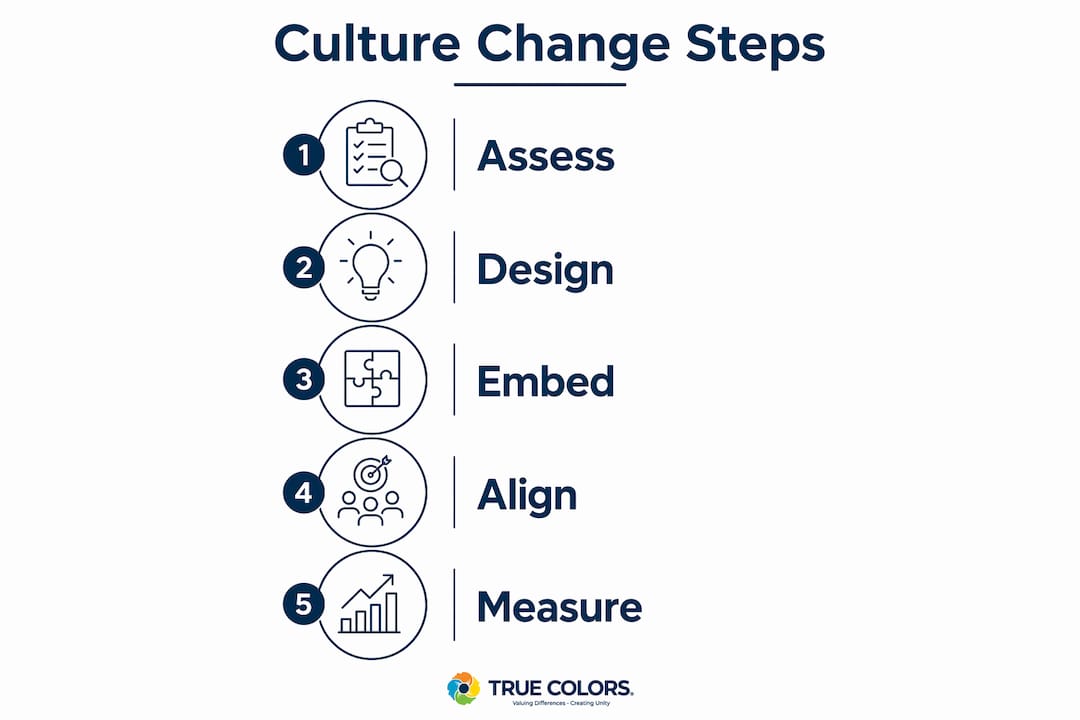
Building a thriving workplace requires HR to move from program delivery to process ownership. That shift is the difference between culture as an event and culture as an operating condition.
Why does leadership alignment determine whether culture change sticks?
Leadership behavior is the single most powerful signal in any organization. When executives model the culture, it spreads. When they contradict it, it collapses, regardless of what HR communicates or trains.
Tying executive compensation and KPIs to cultural outcomes is the most direct mechanism HR has to close the gap between stated values and actual leadership behavior. When a leader’s bonus depends in part on culture metrics, the conversation about culture changes from philosophical to operational. HR must build that linkage into performance frameworks, not leave it as a suggestion.
The risks of misalignment are concrete. Over 50% of employees in organizations with poor cultures are actively looking for new jobs. That is not a morale problem. It is a retention and performance problem with a direct cost. Leadership behavior that contradicts stated values is the fastest path to that outcome.
HR must also address accountability at the structural level. Accountability requires redesigned decision rights, not just clearer policies. When individuals have genuine ownership over outcomes, accountability becomes a cultural capability rather than a compliance exercise. HR builds that by clarifying who decides what, and ensuring those decision rights align with the behaviors the culture demands.
The behaviors HR leaders should monitor in the executive layer include:
-
Do leaders give credit publicly and assign blame privately?
-
Do they make decisions consistent with the stated values when it costs them something?
-
Do they hold peers accountable, or only direct reports?
-
Does their behavior change when they think no one is watching?
The answers to those questions define the real culture, not the values on the wall.
How should HR measure culture change as an operational metric?
Culture health is measurable, and HR should treat it as a quarterly operational metric alongside financial and operational data. The practice of running an annual engagement survey and waiting 12 months for results is too slow for culture to be managed effectively.
Experts recommend quarterly culture scorecard reviews at the executive level. A culture scorecard tracks the leading indicators of culture health, not just lagging outcomes like turnover. The metrics worth tracking include:
| Metric | What it measures |
|---|---|
| Engagement index | Degree of emotional commitment to the organization |
| Internal mobility rate | Whether talent moves across the organization or stagnates |
| Behavior alignment score | How consistently employees demonstrate desired behaviors |
| Manager effectiveness rating | Quality of leadership behavior at the team level |
| Voluntary turnover by cohort | Whether specific groups are leaving at higher rates |
Each metric tells a different part of the culture story. Engagement alone misses the structural signals. Combining behavioral alignment data with mobility and turnover data gives HR a complete picture of where culture is holding and where it is breaking down.
Pro Tip: Use culture measurement data to set the agenda for quarterly executive reviews. When culture metrics sit alongside revenue and operations data, leaders treat them with the same urgency.
Integrating culture metrics into 12–24 month business planning cycles ensures that culture is not a separate workstream. It becomes part of how the organization sets goals and allocates resources.
What are the most common pitfalls in HR-led culture change?
The most common mistake HR makes in culture change is buying technology before fixing the underlying behavior. HR technology fails when the processes it automates are already broken. A new performance management platform does not fix a culture where managers avoid honest feedback. It just makes the avoidance faster and more visible.
The second most common mistake is treating culture change as a persuasion campaign. Culture does not change because employees are convinced of new values. Culture changes through consistent consequences. When a leader undermines the stated culture without consequence, every employee notices. The informal signal is louder than any formal communication.
A third pitfall is underestimating the relational dimension of culture. Formal strategies collide with informal culture when peer networks and daily interactions reinforce old behaviors. HR must build culture networks, groups of peer leaders who model and reinforce the new behaviors at the team level, to complement top-down initiatives.
The practical checklist for avoiding these pitfalls:
-
Fix the behavioral process before selecting the technology tool
-
Build consequences for culture violations into leadership performance frameworks
-
Identify and activate informal culture carriers across the organization
-
Treat culture reinforcement as an ongoing operational task, not a launch event
-
Measure behavior alignment, not just satisfaction scores
From support function to culture architect: a perspective
The organizations I have seen make real, lasting culture change share one characteristic. HR stopped waiting for permission to be strategic and started acting like the culture architect the organization needed.
The shift is not about titles or reporting lines. It is about how HR frames its own mandate. When HR leaders treat culture as a system they are responsible for engineering, they ask different questions. They stop asking “How do we communicate our values?” and start asking “Which of our processes are working against our values right now?”
The role of HR in organizational transformation is not to support the change. It is to design the conditions that make the change inevitable. That means building the measurement systems, redesigning the incentive structures, and holding the mirror up to leadership behavior, even when that is uncomfortable.
What I have found consistently is that HR professionals already know where the culture collisions are. They see the promotion decisions that send the wrong signal. They know which leaders are undermining the values. The gap is rarely insight. It is the organizational authority and the practical frameworks to act on what they already know.
Truecolorsintl works with HR teams to close that gap, moving from awareness to structured, repeatable action. The organizations that get there are the ones where HR owns culture the same way finance owns the numbers.
— Theresa
How Truecolorsintl supports HR-led culture change
Culture change requires more than good intentions. It requires a practical system that connects leadership behavior, team dynamics, and organizational processes into a coherent whole.
Truecolorsintl helps HR leaders and organizational leaders build that system. Through leadership development programs, team training, and employee experience surveys, Truecolorsintl gives HR the tools to measure culture health, align leadership behavior, and reinforce the habits that make culture change stick. The approach is grounded in human behavior, not abstract frameworks, so the results show up in how people work together. If your organization is ready to move from culture aspiration to culture operation, Truecolorsintl is built for that work.
Key takeaways
HR drives lasting culture change by engineering the systems, incentives, and leadership behaviors that make desired actions the organizational default.
| Point | Details |
|---|---|
| HR as systems engineer | Map every people process against desired behaviors and redesign those that create culture collisions. |
| Leadership accountability | Tie executive KPIs and compensation to cultural outcomes to close the gap between stated values and real behavior. |
| Quarterly culture metrics | Track engagement, behavior alignment, and mobility data on a quarterly scorecard reviewed at the executive level. |
| Consequences of persuasion | Culture shifts through consistent consequences for behavior, not communication campaigns or training events. |
| Fix process before technology | Resolve behavioral and process issues before deploying HR technology, or the technology will amplify existing failures. |
FAQ
What is the primary role of HR in culture change?
HR’s primary role in culture change is to design and manage the systems, including hiring, performance, and rewards, that make desired behaviors the organizational default. Culture is not changed through communication alone; it requires structural redesign of the processes HR controls.
How does HR drive culture accountability?
HR drives culture accountability by redesigning decision rights so individuals have genuine ownership over outcomes and by linking leadership performance metrics directly to cultural behaviors. Accountability becomes a cultural capability when the structure supports it, not just a policy expectation.
What is HR technology for culture, and when does it work?
HR technology for culture refers to platforms that support performance management, engagement measurement, and behavior tracking. These tools work only when the underlying behavioral processes are already sound; applying technology to a broken process accelerates failure rather than fixing it.
How does HR enable culture reinforcement over time?
HR reinforces culture by establishing quarterly review cycles, activating peer culture networks, and maintaining consistent consequences for behaviors that contradict stated values. Reinforcement is an ongoing operational task, not a one-time program launch.
Why do most culture change initiatives fail?
Most culture change initiatives fail because they treat culture as a communication problem rather than a systems problem. When incentives, promotion criteria, and leadership behavior remain unchanged, no amount of messaging or training shifts the culture.