
The role of the executive team in culture is defined by one principle: culture is not what is announced. It is what is repeated, rewarded, and modeled from the top. Organizational culture, the shared norms and behaviors that determine how work gets done, is shaped primarily by executive leadership behavior, not HR programs or values posters. High-performing organizations intentionally shape culture as a strategic asset, directly linking it to engagement, performance, and brand reputation. When executives treat culture as their responsibility, the entire organization follows. When they delegate it, culture drifts.
What is the role of the executive team in culture?
Culture is shaped more by what leaders do than what they say. The signals executives send through their visible decisions, including who gets promoted, how they run meetings, and how they respond to failure, are the real curriculum employees study. Visible executive actions send cultural signals that employees internalize far more deeply than any stated value.
Consider promotion decisions. When a high-performing individual who consistently undermines colleagues advances to a senior role, the message to the organization is clear: results matter more than how you treat people. No values statement can undo that signal. The same logic applies to how executives handle mistakes. Leaders who respond to errors with blame create cultures of concealment. Leaders who frame failures as learning opportunities reinforce a growth mindset that spreads through every layer of the organization.

Meeting conduct is another underestimated culture signal. When executives dominate conversations, dismiss dissenting views, or allow certain voices to go unheard, those patterns replicate themselves in team meetings across the company. Conversely, executives who ask questions, invite disagreement, and close meetings with clear accountability model the behaviors they want to see at every level.
Storytelling is a tool most executives underuse. Celebrating wins that reflect organizational values and framing setbacks as learning moments reinforces a growth mindset and positions executives as active culture builders rather than passive observers.
-
Promotion decisions signal which behaviors and values the organization rewards
-
Handling of mistakes communicates risk tolerance and psychological safety
-
Meeting conduct and communication styles set the daily cultural tone
-
Storytelling and recognition rituals reinforce what the organization values most
Pro Tip: Audit your last five promotion decisions. Ask whether the people selected exemplify the cultural behaviors you say you want. If the answer is inconsistent, that gap is your culture problem.
How do executives align HR systems with cultural values?
Executives operationalize culture by embedding values into the systems that govern how people are hired, evaluated, rewarded, and developed. SHRM’s culture toolkit identifies concrete culture-shaping actions leaders can take across hiring, performance management, and communications. Without this alignment, culture remains aspirational rather than operational.
Hiring is the first leverage point. When executives define cultural fit as a genuine selection criterion, not a vague preference, and build it into structured interview processes, they shape the organization’s future from the first conversation. Onboarding that immerses new hires in cultural norms, stories, and expectations accelerates alignment and reduces the time it takes them to understand how things work. Truecolorsintl supports this through talent acquisition alignment strategies that connect hiring decisions to culture goals from the start.
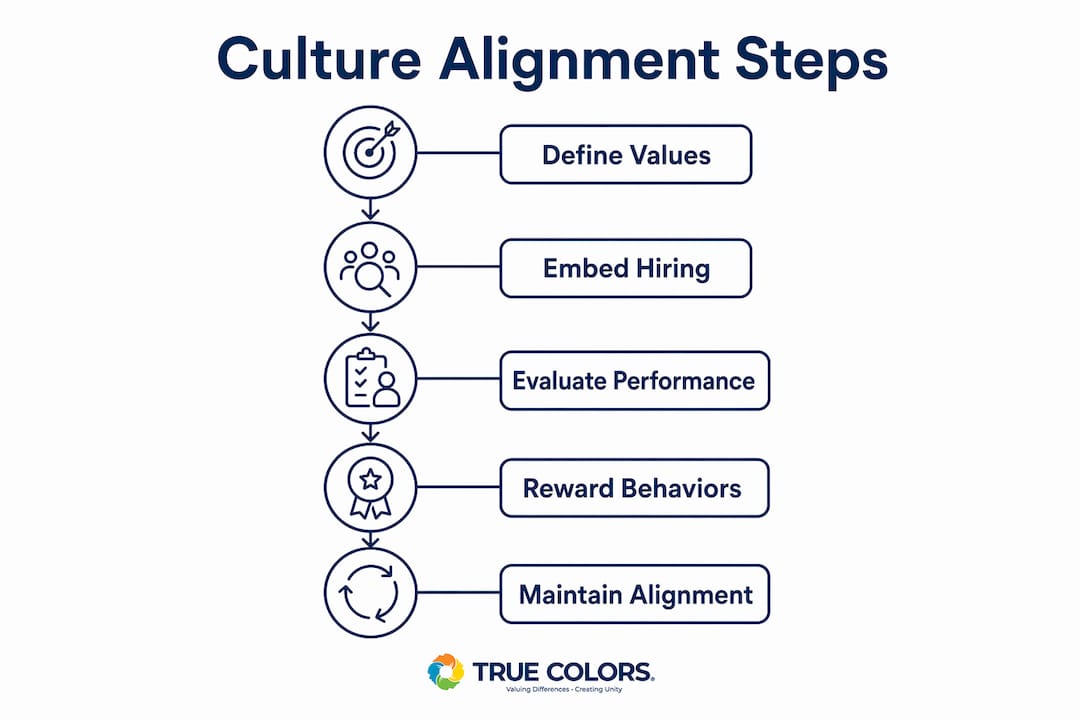
Performance evaluations are where culture alignment either holds or breaks down. Organizations that assess only outcomes, not how those outcomes were achieved, inadvertently reward behavior that contradicts stated values. Executives who insist on evaluating the “how” alongside the “what” send a consistent message that culture is not optional.
The table below illustrates the difference between traditional HR practices and those embedded with cultural intent:
| HR Practice | Traditional Approach | Culture-Embedded Approach |
|---|---|---|
| Hiring | Skills and experience only | Skills, experience, and cultural alignment |
| Performance review | Outcomes and metrics | Outcomes plus behavioral alignment with values |
| Promotions | Tenure and results | Results achieved through culturally aligned behavior |
| Onboarding | Role-specific training | Role training plus cultural immersion |
| Recognition | Individual achievement | Achievement that reflects organizational values |
Maintaining cultural alignment during organizational change, such as a merger, restructuring, or shift to hybrid work, requires executives to be especially deliberate. Culture evolves through leadership decisions and consistency, not through memos. When systems change, but cultural reinforcement does not, employees default to old behaviors.
How does executive leadership build psychological safety?
Psychological safety is defined as the belief that one can speak up, ask questions, or admit mistakes without fear of punishment or humiliation. Google’s Project Aristotle identified psychological safety as the single most critical factor in high-performing teams, placing it above individual talent, resources, or structure. This finding means that executive behavior directly determines whether a team reaches its potential.
Executives create or destroy psychological safety through small, repeated actions. A leader who responds to a dissenting opinion with visible irritation teaches the room to stay silent. A leader who says, “That’s a perspective I hadn’t considered,” teaches the room that honesty is safe. These micro-signals accumulate into the cultural norm that governs how freely information flows across the organization.
Leadership must interpret silence and tension as systemic safety signals rather than resistance. When employees go quiet in meetings, avoid raising problems, or give uniformly positive feedback, that is not agreement. It is a signal that the environment does not feel safe enough for honest input. Executives who recognize this distinction can respond with curiosity rather than frustration, thereby shifting the dynamic. TrueColors Intl addresses this directly through resources on workplace emotional safety.
-
Silence in meetings is a culture signal, not a sign of consensus
-
Visible irritation from leaders teaches employees to withhold honest input
-
Curiosity-based responses to disagreement model the safety needed for open communication
-
Psychological safety is a systemic design challenge, not a personality trait
Pro Tip: Replace “Why did this happen?” with “What can we learn from this?” in post-incident conversations. That single shift in language changes what employees believe is safe to say.
What are the most common pitfalls in executive culture leadership?
Culture initiatives fail most often not because the strategy is wrong, but because leadership espouses values while acting inconsistently. Employees are highly attuned to the gap between what executives say and what they do. That gap, when visible, destroys credibility faster than any external threat.
The second most common failure is delegation. When executives hand culture ownership to HR, they signal that culture is a support function rather than a strategic priority. HR can design the systems, but only executives can model the behaviors that make those systems credible. Culture requires consistent behavioral reinforcement under pressure, not just during culture workshops or all-hands meetings.
Ignoring systemic feedback is a subtler but equally damaging pitfall. When turnover rises in specific teams, when certain leaders consistently receive low engagement scores, or when cross-functional collaboration repeatedly breaks down, these are not isolated problems. They are culture signals pointing to specific leadership behaviors or structural misalignments that require executive attention. Understanding why culture initiatives fail at the root level is the first step toward addressing the root causes.
Here are five practical steps executive teams can take to avoid these pitfalls and sustain cultural momentum:
-
Conduct a quarterly behavior audit. Review your own decisions and actions against stated cultural values. Ask a trusted colleague or coach to provide honest feedback.
-
Reclaim culture ownership from HR. HR designs the systems. Executives model the behaviors. Clarify this distinction explicitly within the leadership team.
-
Treat engagement data as operational intelligence. Low scores in specific areas are not HR problems. They are leadership feedback that requires executive response.
-
Change reinforcement loops, not just messaging. Durable culture shifts occur when promotions, recognition, and decision rituals change, not when a new values statement is published.
-
Build reflection into leadership rituals. Monthly leadership team discussions focused on cultural health, not just business performance, keep culture visible as an operational priority.
Key takeaways
The executive team’s role in organizational culture is to own it, model it, and embed it into every system and decision that shapes how people work.
| Point | Details |
|---|---|
| Executives own culture | Culture is shaped by leadership behavior and decisions, not HR programs alone. |
| Visible actions outweigh words | Promotion decisions, meeting conduct, and responses to mistakes are the real culture curriculum. |
| HR systems must align | Hiring, performance reviews, and recognition must reinforce cultural values to make them operational. |
| Psychological safety is a leadership output | Executives create or destroy safety through repeated micro-signals in everyday interactions. |
| Consistency sustains culture | Durable culture change requires changing reinforcement loops, not just publishing new values. |
What I’ve learned about executives and culture ownership
Working with organizations across industries, one pattern stands out above all others: the executives who build the strongest cultures are not the ones with the most polished values statements. They are the ones with the most disciplined daily habits.
I have seen leadership teams invest significantly in culture programs, only to watch the investment evaporate within six months because the executives themselves never changed their behavior. The workshops were excellent. The frameworks were sound. But when the CEO still interrupted people in meetings, still promoted the aggressive performer over the collaborative one, and still responded to bad news with blame, the culture stayed exactly where it was.
What separates the leaders who move culture is a willingness to treat their own behavior as the primary variable. They ask hard questions about what their decisions are communicating. They use tools like the True Colors system to understand how different people on their teams experience leadership, and they adjust accordingly. They recognize that measuring culture effectiveness is not a once-a-year survey exercise. It is an ongoing discipline built into how they lead every week.
The most important mindset shift I encourage executives to make is this: stop thinking of culture as something your organization has, and start thinking of it as something your leadership team does. That reframe changes everything about how you show up.
— Theresa Stairs
How Truecolorsintl helps executive teams build culture that lasts

Truecolorsintl works directly with executive teams to make culture operational, not aspirational. Through the Connected Leadership program, leaders develop the self-awareness and behavioral discipline needed to consistently model culture, communicate across diverse working styles, and build teams that perform under pressure. The employee experience survey gives executive teams the data they need to understand where culture is working and where leadership behavior is creating friction. Together, these tools move culture from a stated priority to a measurable, reinforced reality. Explore the full range of leadership and culture programs at Truecolorsintl to find the right starting point for your organization.
FAQ
What is the executive team’s primary role in organizational culture?
The executive team’s primary role is to model, reinforce, and embed cultural values through their daily decisions and behaviors. Culture is defined by what leaders consistently do, not what they say.
How do executives shape culture without relying on HR?
Executives shape culture by controlling the signals that matter most: who gets promoted, how they respond to mistakes, and how they conduct meetings. HR designs supporting systems, but executive behavior gives those systems credibility.
Why does psychological safety depend on executive leadership?
Google’s Project Aristotle identified psychological safety as the top factor in high-performing teams, and executives create or destroy it through repeated micro-behaviors. A single dismissive response in a meeting can suppress honest input for months.
How can executives tell if their culture efforts are working?
Engagement data, turnover patterns, and the quality of information that reaches senior leadership are all reliable indicators. When employees stop raising problems or feedback becomes uniformly positive, that is a signal the culture needs attention.
What is the biggest mistake executives make with culture?
The most common mistake is delegating culture ownership to HR while continuing to model behaviors that contradict stated values. Employees notice the gap immediately, and that inconsistency undermines every culture initiative the organization invests in.