
Strategic culture change is not a communication project. It isn't a new set of values printed on office walls or a company-wide email from the CEO. What is strategic culture change, then? It is the deliberate process of aligning an organization's shared beliefs, norms, and daily behaviors with its broader strategy, so that culture becomes a vehicle for performance rather than a barrier to it. This distinction matters enormously for leaders and HR professionals who have watched well-intentioned culture initiatives fade within months of launch.
Table of Contents
Key Takeaways
| Point | Details |
|---|---|
| Culture change is behavioral | Real culture shift happens through repeated leadership behavior, not messaging or announcements. |
| Systems must reinforce norms | Aligning formal processes, incentives, and accountability structures is non-negotiable for sustained change. |
| Middle managers are the multiplier | Managers translate strategy into daily experience; their enablement determines whether culture change lives or dies. |
| Measure behavior, not just sentiment | Tracking observable actions and behavior frequency gives more useful data than pulse surveys alone. |
| Culture directly drives performance | Research shows culture acts as a job resource that predicts engagement, satisfaction, and initiative success. |
What strategic culture change means
The term “strategic culture change” is widely used, but it often gets treated as shorthand for “we need a better vibe.” The more precise concept in organizational development is planned cultural transformation, which involves deliberately reconfiguring the shared beliefs, expectations, and norms that shape how work gets done every day.
Organizational culture includes the shared beliefs and expectations that form an organization’s identity, shaped by leadership, mission, and formal strategy. When culture change is strategic, it means those beliefs and behaviors are being consciously redirected to support a specific organizational direction. A company shifting from a siloed structure to one built on cross-functional collaboration, for example, is not just reorganizing teams. It is attempting to rewire how people interpret their roles, relationships, and responsibilities.
| Culture element | What it looks like in practice | Influence on outcomes |
|---|---|---|
| Shared beliefs | Assumptions about what success looks like | Shapes decision-making and priorities |
| Norms | Unwritten rules about how to behave | Determines what behaviors are rewarded or penalized |
| Observable behaviors | What leaders and peers do daily | The most direct signal of real culture |
| Formal systems | Hiring, promotion, recognition structures | Reinforces or contradicts stated values |
Pro Tip: When assessing your current culture, focus first on the gap between stated values and observable behaviors. That gap is the real starting point for any culture change initiative.
Why wholesale culture change approaches fail
Most culture change efforts fail for a straightforward reason: they treat culture as a communications problem rather than a behavior change problem. Wholesale tactics like reorganizations, videos, and values launches attempt to shift culture at a systemic level without changing anything at the interpersonal level. The result is a polished rollout that employees recognize as performance and quietly ignore.
Roger L. Martin, a leading voice on strategy and culture, argues that culture shifts only when leadership behaviors create new shared interpretations consistently at the retail level. This is the day-to-day, conversation-by-conversation level where culture is built. An executive who espouses psychological safety but interrupts employees in meetings is not building a psychologically safe culture, regardless of what the slide deck says.
Culture fails when treated as branding, not behavior. Leadership must live the values consistently, especially when doing so is inconvenient.” AAPL Publication
The role of middle managers is particularly underestimated. Without manager engagement and accountability, culture change stays aspirational rather than lived. Middle managers are the daily point of contact for most employees. They are the ones who translate a leadership vision into the tone of a Monday morning meeting, how a missed deadline is addressed, and whether speaking up feels safe or risky.
Common patterns in failed culture change efforts include:
-
Launching values without modeling them at the leadership level
-
Running training programs that are not connected to how performance is measured
-
Treating culture communication as a one-time campaign rather than ongoing reinforcement
-
Ignoring middle management in planning, then expecting them to carry out the change
-
Measuring culture by survey sentiment alone, which captures opinion rather than behavior
The fix is not more communication. It is different behavior, starting at the top.
How to implement culture change effectively
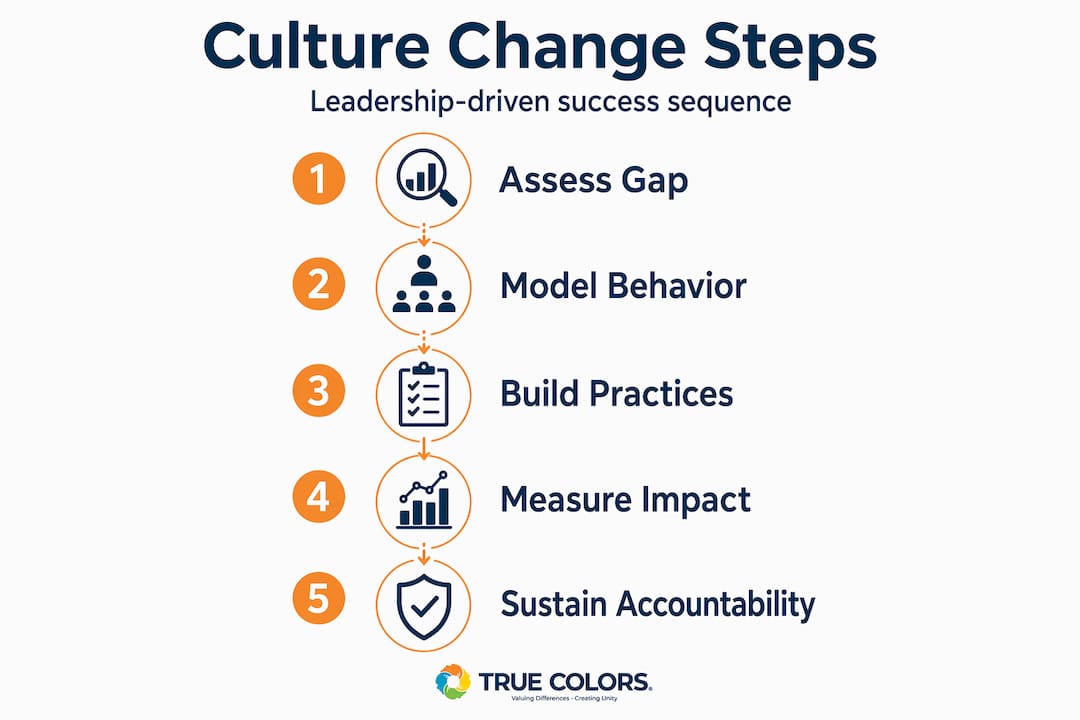
Effective cultural transformation follows a sequence that most organizations skip in their urgency to see results. Understanding how to implement culture change begins with clarity: defining a small set of observable operating norms rather than a sprawling list of aspirational values. When an organization tries to change everything at once, nothing changes at all.
Here is a practical sequence for leaders and change agents:
-
Define two to four observable norms. Choose behaviors specific enough to measure, such as “managers give direct feedback within 48 hours of a performance issue” rather than “we value transparency.”
-
Audit the current state. Map what behaviors are being modeled, rewarded, and penalized. This exposes the real culture, not the stated one. Resources like workplace culture consulting can accelerate this diagnostic process.
-
Start with leadership behavior change. Leadership must change first, especially in moments when doing so is costly or uncomfortable. Symbolic gestures followed by inconsistent behavior accelerate cynicism.
-
Align formal systems. Hiring criteria, promotion decisions, recognition programs, and performance reviews must reinforce the target culture. Misaligned systems are the most common silent saboteur of culture change.
-
Enable and pilot with middle managers. Give managers the language, tools, and support to model and reinforce new norms in their teams before rolling out broadly.
-
Measure behavior frequency, not just satisfaction. Track how often target behaviors occur, not just how employees feel about the culture in a quarterly survey.
-
Reinforce and iterate. Culture is not a project with an end date. Build in regular reviews of both behavior data and business outcomes.
Pro Tip: Do not wait for perfect conditions to start. Pick one high-visibility behavior, model it consistently at the senior level for 90 days, and use that as your proof of concept before expanding the initiative.
Building sustainable workplace practices into this sequence from the start is what separates transformations that hold from those that revert when attention shifts.
The measurable benefits of culture change
When culture change is done well, the benefits are not just anecdotal. Research published in F1000Research shows that organizational culture functions as a job resource that directly boosts psychological engagement, which in turn predicts improved performance outcomes. Culture and performance are not loosely correlated. Engagement mediates between the two, meaning a healthier culture is not just a nice outcome. It is a mechanism.

| Research finding | Measured outcome |
|---|---|
| Culture acts as a job resource | Higher psychological engagement among employees |
| Engagement mediates culture and performance | Improved individual and team performance metrics |
| Positive culture predicts job satisfaction | Reduced turnover intention and higher retention |
| Culture alignment supports initiative success | Higher completion and adoption rates for strategic projects |
Consider what this looks like practically. Organizations that align culture with strategy report fewer implementation failures in major change programs because employees understand not just what is being asked of them, but also why it matters and how their role connects to it. They take initiative rather than waiting for instructions. They speak up rather than staying silent.
Culture is not what is said. It is what is repeated.
The impact on employee engagement is especially significant for HR professionals managing workforce stability. When employees experience a culture that reflects the values they were hired for, rather than a divergent operational reality, job satisfaction rises and the psychological contract between employer and employee remains intact. That is the kind of organizational health that shows up in retention data, not just engagement surveys.
Practical challenges in sustaining culture change
Understanding culture change as a concept is far easier than sustaining it under pressure. Several challenges consistently emerge for organizations attempting long-term cultural transformation.
-
Leadership credibility gaps. When senior leaders ask for a new culture but operate under the old rules when stakes are high, employees notice. Fast. Credibility, once lost, is expensive to rebuild.
-
Power dynamics and resistance. Culture change often redistributes informal power. Leaders or managers who benefited from the old culture will resist new norms, sometimes subtly.
-
Initiative fatigue. Many employees have witnessed multiple culture programs that promised change and delivered disruption. Each failed initiative raises the bar for believability.
-
Short-term pressure overriding long-term behavior. Quarterly results pressure is real. The moment financial stress leads to culture behaviors being de-prioritized, the signal sent to the organization is lasting.
-
HR as isolated owner. When culture change is managed only by HR without sustained CEO ownership and accountability, it is perceived as a program rather than a priority.
The practical solution to most of these challenges is the same: leadership accountability. Professional growth frameworks can support leaders in identifying their behavioral gaps and building the habits that culture change requires.
Pro Tip: Map the informal power structure in your organization before launching any culture initiative. Understanding who benefits from the status quo will tell you where resistance will come from, and who you need to bring on board early.
Cultural change in organizations also requires recognizing that culture is experienced locally. What a culture feels like in the finance department is different from what it feels like in the customer service team. A one-size-fits-all rollout rarely accounts for these micro-cultures, which is why piloting with specific teams and then scaling what works is almost always more effective than a single enterprise-wide launch.
My perspective on what it takes
I have seen organizations invest significant time and resources in culture initiatives that failed not because of poor design, but because no one at the top was willing to change their behavior. The strategy documents were polished. The workshops were engaging. The values were beautifully articulated. And then nothing changed, because the people with the most influence kept operating as they always had.
What I have learned is that culture change is fundamentally a personal challenge before it becomes an organizational one. Leaders need to ask themselves which of their own habits, defaults, and reactions are inconsistent with the culture they claim to want. That is not a comfortable question. But it is the only one worth starting with.
Middle managers carry more of this than most senior teams acknowledge. In my experience, when a culture change initiative succeeds, you can almost always trace it back to a cluster of middle managers who genuinely modeled the new norms and made it safe for their teams to do the same. When it fails, those managers were usually under-supported, confused about expectations, or quietly excluded from the planning.
My candid take: culture is not a program you run. It is a pattern of behavior you either reinforce or allow to deteriorate. If you are serious about changing it, start by asking who in your organization needs to behave differently first. The answer is almost always the people with the most authority.
— Theresa Stairs
How Truecolorsintl supports culture change initiatives

Building a culture that performs requires more than intention. It requires a practical system for translating values into daily behavior, and that is exactly what Truecolorsintl is built to support. Through leadership development programs and corporate consulting services, Truecolorsintl helps organizations identify where culture is working, where it is breaking down, and what specific behaviors need to change at every level.
The True Colors system gives leaders and teams a shared language for understanding behavior, which makes culture conversations less abstract and more productive. From employee experience surveys that measure what employees feel versus what leadership assumes, to training programs that build lasting behavioral habits, Truecolorsintl supports every stage of the culture change journey. If your organization is ready to move from viewing culture as a concept to treating it as a competitive advantage, explore how True Colors International can help you build it.
FAQ
What is strategic culture change in simple terms?
Strategic culture change is the deliberate process of aligning people's behavior within an organization with what the organization is trying to achieve. It goes beyond values statements and focuses on changing observable behaviors, leadership actions, and the systems that reinforce them.
How long does culture change take?
Most research and practitioner experience suggest meaningful culture change takes three to five years when approached consistently. Superficial shifts can appear faster, but sustained behavioral change at the organizational level requires long-term leadership commitment and reinforcement.
Why do most culture change efforts fail?
Culture change fails most often because organizations treat it as a communications campaign rather than a behavior change initiative. Without changing leadership behaviors and aligning formal systems, new values remain aspirational rather than operational.
What role do middle managers play in culture change?
Middle managers are on the front lines of culture. They translate executive vision into employees' daily experience, and their behavior signals more clearly than any company-wide announcement what the culture expects and rewards.
How do you measure the success of a culture change initiative?
Measure behavior frequency alongside engagement and performance data. Track how often target behaviors occur in practice, not just how employees rate culture satisfaction in surveys. Combining behavioral observation with engagement metrics gives a more accurate picture of real progress.