
Organizational culture is defined as the shared values, beliefs, behaviors, and underlying assumptions that shape how work gets done and how people interact within an organization. Recognized formally through Edgar Schein’s layered model, culture operates at three levels: visible artifacts, stated values, and deep unconscious assumptions. It is not a poster on the wall or a mission statement in an employee handbook. Culture is the system that determines what gets rewarded, what gets tolerated, and what gets done when no one is watching. Research shows that cultures with strong employee alignment increase net income by 756% over 11 years. That number reframes culture from a soft HR concern into a hard business driver.
What is organizational culture and why does it matter?
The definition of organizational culture most leaders work with is incomplete. Most treat culture as a set of values they can declare and display. The more accurate definition, drawn from StatPearls and Schein’s foundational research, describes culture as the beliefs and expectations shared by members, expressed through common norms, values, and perspectives that govern everyday behavior. This distinction matters because it shifts the question from “what do we say we value?” to “what do our decisions and behaviors reinforce?”
The importance of organizational culture is evident in performance data. Organizations with strong, aligned cultures report higher employee engagement, lower turnover, and measurably better business outcomes. Weak cultures, by contrast, produce burnout, disengagement, and chronic underperformance. Culture is not a byproduct of strategy. It is the environment in which strategy either succeeds or fails.
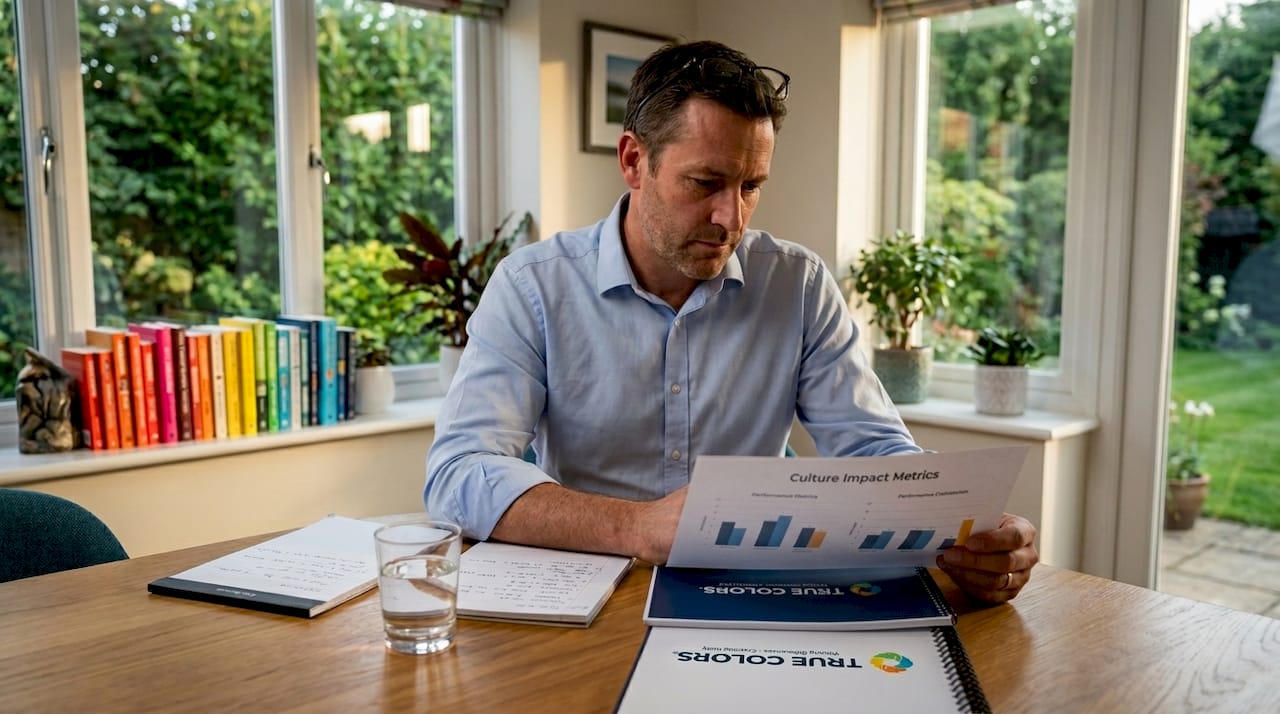
For business leaders and HR professionals, understanding this distinction is the starting point for everything else. You cannot improve what you have not accurately defined. And you cannot define culture by reading your own values statement.
How does leadership shape organizational culture?
Culture is not what is said. It is what is repeated. Leaders shape culture through the signals they send every day: what they prioritize in meetings, what they reward in performance reviews, what they tolerate from high performers, and what they model under pressure. Stated values mean nothing if leadership behavior contradicts them consistently.
The mechanism works through six observable signal types:
-
Priorities — What leaders spend time on signals what the organization values.
-
Rewards — Who gets promoted and recognized defines the real performance standard.
-
Decisions — How trade-offs are made under pressure reveals actual values.
-
Accountability — What leaders hold people responsible for shapes behavioral norms.
-
Attention — What leaders notice and follow up on tells teams what matters.
-
Learning — How leaders respond to failure determines whether teams take risks or hide problems.
Misalignment between espoused values and these six signals is the most common reason culture change efforts fail. An organization can declare a commitment to transparency while simultaneously punishing employees who surface bad news. That contradiction does not go unnoticed. Teams are skilled observers of leadership behavior, and they calibrate their own actions accordingly.
Meaningful culture shifts typically take 18 to 36 months of consistent signal changes before new behaviors become embedded. This timeline surprises most leaders who expect culture to shift within a quarter. The reality is that employees need to see consistent signals across enough cycles before they trust that the change is real.
Pro Tip: Before launching any culture initiative, audit your last 10 significant leadership decisions. Ask whether those decisions reinforced the culture you say you want. The gap between your answer and your stated values is your actual starting point.
What are Edgar Schein’s three layers of organizational culture?
Edgar Schein’s model remains the most widely used framework for diagnosing organizational culture because it accounts for what is visible, what is stated, and what is driving behavior. Understanding all three layers is necessary for any serious culture assessment.
-
Artifacts are the visible, tangible elements of culture: office layout, dress codes, meeting rituals, onboarding processes, and the language people use. They are easy to observe but easy to misread. A company with open-plan offices may claim to value collaboration, even as its meeting culture is entirely top-down.
-
Espoused values are the stated principles, norms, and goals that leadership formally endorses. These appear in mission statements, leadership communications, and HR policies. They represent the culture an organization aspires to, not necessarily the one it practices.
-
Underlying assumptions are the unconscious beliefs that drive behavior. They are rarely articulated because they are taken for granted. According to Schein, underlying assumptions are the hardest to change and the most impactful on real culture. An organization might espouse innovation while holding a deep assumption that failure is career-ending. No amount of “fail fast” messaging will override that assumption.
The practical implication is significant. A valid culture analysis triangulates all three layers rather than relying on values audits alone. Organizations can pass a values audit while holding contradictory deep assumptions that undermine the very behaviors they are trying to build. HR professionals who rely solely on engagement surveys or values assessments are measuring the wrong layer.
| Layer | Description | Example |
|---|---|---|
| Artifacts | Visible symbols and practices | Open-door policy, office layout, meeting frequency |
| Espoused values | Stated principles and norms | “We value transparency and collaboration” |
| Underlying assumptions | Unconscious beliefs driving behavior | “Admitting mistakes leads to punishment” |
What are the main types of organizational culture?
Researchers and practitioners commonly use the Competing Values Framework to classify organizational culture into four types. Each type has distinct characteristics that affect innovation, collaboration, control, and performance. Understanding culture types helps leaders diagnose their current environment and make deliberate choices about where they want to go.
Clan culture prioritizes collaboration, mentorship, and internal cohesion. Organizations with clan cultures feel like families. They tend to have high employee satisfaction and strong retention, but can struggle with accountability and performance differentiation. Many mission-driven nonprofits and early-stage companies operate here.
Adhocracy culture values innovation, experimentation, and risk-taking. These organizations move fast and reward creative thinking. The challenge is that adhocracy cultures can lack the operational discipline needed to scale. Technology startups and R&D-intensive companies often exhibit this type.
Hierarchy culture emphasizes process, consistency, and control. Government agencies, financial institutions, and large manufacturers frequently operate within hierarchy cultures. They excel at reliability and compliance but can suppress initiative and slow adaptation to change.
Market culture is results-oriented and competitive. Performance metrics, market share, and goal achievement drive behavior. These organizations can produce strong short-term results but risk burning out employees if accountability is not balanced with support.
Most organizations are not a pure type. They blend elements of two or more, and the dominant type often varies by department. A company’s sales team may operate as a market culture while its engineering team runs closer to adhocracy. Recognizing these variations helps HR professionals design culture interventions that are specific rather than generic.
Pro Tip: When assessing your culture type, ask frontline managers rather than senior leaders. The culture that frontline employees experience is almost always more revealing than the one executives describe.
How to improve organizational culture: practical strategies
Improving organizational culture requires moving beyond aspiration into observable, measurable behavior change. Culture assessment methods include structured surveys, behavioral interviews, and direct observation of how decisions get made in real time. Each method surfaces different layers of the Schein model.
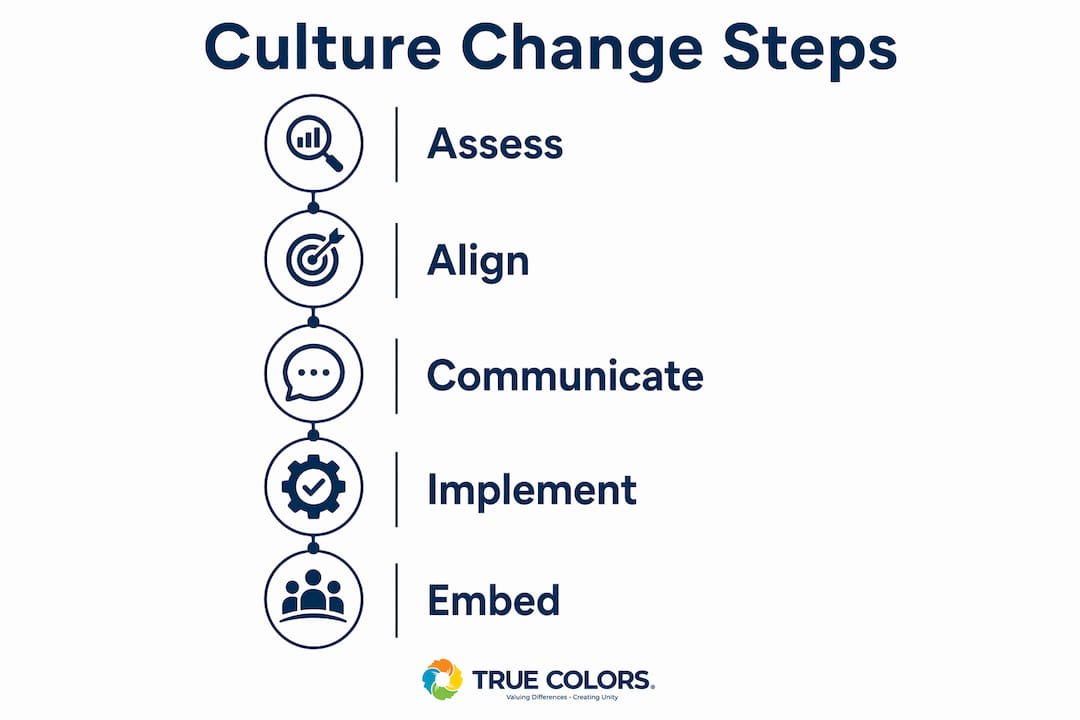
A practical improvement process follows this sequence:
-
Assess the current state. Use a combination of employee surveys, leadership interviews, and observation to map what behaviors are rewarded and what norms are operating. Do not rely on a single data source.
-
Identify the gap. Compare current behaviors and assumptions against the culture you need to support your strategy. Be specific about which behaviors need to increase, decrease, or change.
-
Connect culture to decision systems. Hiring criteria, promotion decisions, performance reviews, and reward structures must reinforce the desired culture. If your culture values learning but your performance review punishes mistakes, the system overrides the intention.
-
Build leadership alignment first. Culture change does not succeed as a grassroots initiative. Senior leaders must model the target behaviors visibly and consistently before expecting the organization to follow.
-
Reinforce over time. Consistent leadership behavior over 18 to 36 months is what converts new signals into internalized norms. Reinforcement mechanisms include recognition programs, team rituals, and regular culture diagnostics.
Psychological safety is a foundational element that many culture improvement efforts overlook. Harvard professor Amy C. Edmondson defines psychological safety as a climate of interpersonal risk-taking where employees can speak candidly, admit mistakes, and propose new ideas without fear of punishment. Without it, even the best-designed culture programs produce surface compliance rather than genuine behavior change.
The most common pitfall in culture improvement is treating it as a communications campaign. Rebranding values, launching culture workshops, or publishing new leadership principles does not change culture. Behavior changes culture. Specifically, leadership behavior, repeated consistently, embedded in systems, and reinforced over time.
Key takeaways
Organizational culture is defined by what leaders consistently do, not what organizations say they value, and changing it requires sustained behavioral alignment across systems and time.
| Point | Details |
|---|---|
| Culture is behavior, not messaging | What leaders reward, tolerate, and model defines culture more than any stated value. |
| Schein’s three layers matter | Artifacts and values are visible; underlying assumptions drive the real culture and are hardest to change. |
| Culture types shape dynamics | Clan, adhocracy, hierarchy, and market cultures each produce distinct team behaviors and performance patterns. |
| Change takes 18 to 36 months | Sustained leadership consistency is required before new behaviors become embedded organizational norms. |
| Systems must reinforce culture | Hiring, promotion, and rewards must align with the desired culture or the system will override the intention. |
Why culture work is the most underestimated leadership responsibility
I have spent years working alongside leaders who are genuinely committed to building better organizations. The pattern I see most often is not a lack of intention. It is a misunderstanding of what culture work requires.
Most leaders treat culture as a communication problem. They update the values, run an offsite, and expect the organization to shift. When it does not, they conclude that culture is too abstract to manage. That conclusion is wrong and costly. Culture is not abstract. It is the sum of observable behaviors that get repeated, rewarded, and reinforced across the organization every day.
What I have consistently found to be true is that the leaders who build the strongest cultures are not the most charismatic or the most vocal about values. They are the most consistent. They make decisions that align with stated values even when it is inconvenient. They hold people accountable in ways that match the culture they claim to want. They treat culture diagnostics as a leadership discipline, not a one-time HR project.
The research on culture-led performance is unambiguous. The organizations that invest in deliberate, sustained culture work outperform those that do not by margins that no operational efficiency program can match. If you are a business leader or HR professional reading this, the question is not whether culture matters. The question is whether you are willing to do the work that culture change requires. That work starts with your own behavior, and it does not stop after the next all-hands meeting.
— Theresa Stairs
How Truecolorsintl helps you build culture that performs
Truecolorsintl works with business leaders and HR professionals who are ready to move beyond culture as a concept and into culture as a practice. Through leadership development programs and culture diagnostics grounded in behavioral science, Truecolorsintl helps organizations identify what is driving or undermining performance, align leadership signals with stated values, and build the reinforcement systems that make culture change stick.
Whether you are diagnosing a culture that has drifted, building alignment after a merger, or developing leaders who model the behaviors your strategy requires, Truecolorsintl provides the tools, training, and ongoing support to make progress measurable. Explore culture and leadership solutions designed for organizations that take performance seriously.
FAQ
What is the organizational culture definition used by researchers?
Organizational culture is the beliefs and expectations shared by members, expressed through common norms, values, and perspectives that govern behavior. Edgar Schein’s model, referenced by StatPearls, describes it across three layers: artifacts, espoused values, and underlying assumptions.
How long does it take to change organizational culture?
Meaningful culture change typically takes 18 to 36 months of consistent leadership signals before new behaviors become embedded norms. Faster timelines are possible in crisis conditions, but sustainable change requires sustained behavioral consistency across hiring, rewards, and accountability systems.
What are the four types of organizational culture?
The four most recognized types are clan, adhocracy, hierarchy, and market culture. Each type produces distinct patterns in collaboration, innovation, control, and performance, and most organizations blend elements of more than one type across different teams or functions.
Why is psychological safety important for organizational culture?
Psychological safety, defined by Harvard professor Amy C. Edmondson as a climate of interpersonal risk-taking, allows employees to speak candidly and admit mistakes without fear. Without it, culture improvement efforts produce compliance rather than genuine behavior change.
How do you measure organizational culture effectively?
Effective culture measurement triangulates three data sources: employee surveys, behavioral interviews, and direct observation of leadership decisions. Relying on values audits alone misses the underlying assumptions that drive actual behavior, producing an inaccurate picture of the real culture.