
Culture initiatives fail when leadership behavior and organizational systems directly contradict the values leaders publicly commit to. This gap, known in organizational development as systemic incongruence, is the single most consistent cause of failed culture change. It is not a communication problem or a training deficit. It is a structural and behavioral misalignment that employees recognize immediately, even when leaders do not. Understanding why leaders fail culture initiatives requires looking past the slogans and examining what the organization rewards, models, and repeats every day.
Why leaders fail culture initiatives: the incongruence problem
Systemic incongruence occurs when an organization communicates new values while keeping legacy reward systems that punish the very behaviors it claims to want. A company declares that collaboration is a core value, then continues to rank employees on individual performance curves. A leadership team promotes psychological safety in all-hands meetings, then penalizes managers who surface bad news. Employees do not read the posters. They read the incentives.
The systemic incentives that govern promotions, bonuses, and recognition often directly contradict stated values such as collaboration and transparency. This is not a coincidence. Most organizations built their reward architecture around a different set of priorities, and culture initiatives rarely touch that architecture. The result is a message that employees learn to distrust.

The effects on trust are measurable. Global employee engagement dropped to 21% in 2024, with $438 billion in lost productivity attributed to low or average leadership effectiveness. That number reflects what happens when employees stop believing that the organization means what it says. Disengagement is not apathy. It is a rational response to repeated incongruence.
Consider what this means practically:
-
A new “speak up” culture initiative launches while the manager who raised concerns last quarter was quietly sidelined.
-
A values refresh emphasizes work-life balance while the highest performers are still those who answer emails at midnight.
-
A diversity initiative is announced while promotion decisions continue to favor the same demographic profiles as before.
Culture is not what is said. It is what is repeated, rewarded, and tolerated.
Each of these scenarios sends a clear signal. The stated culture is aspirational theater. The real culture is what the systems enforce.
How leadership behavior shapes culture every day
Culture is an output of leadership behavior, not an HR initiative. This distinction matters because it shifts accountability from a department to every person with authority in the organization. Training leaders without fixing the systems they inhabit results in regression after the training ends. Behavior reverts because the environment has not changed.
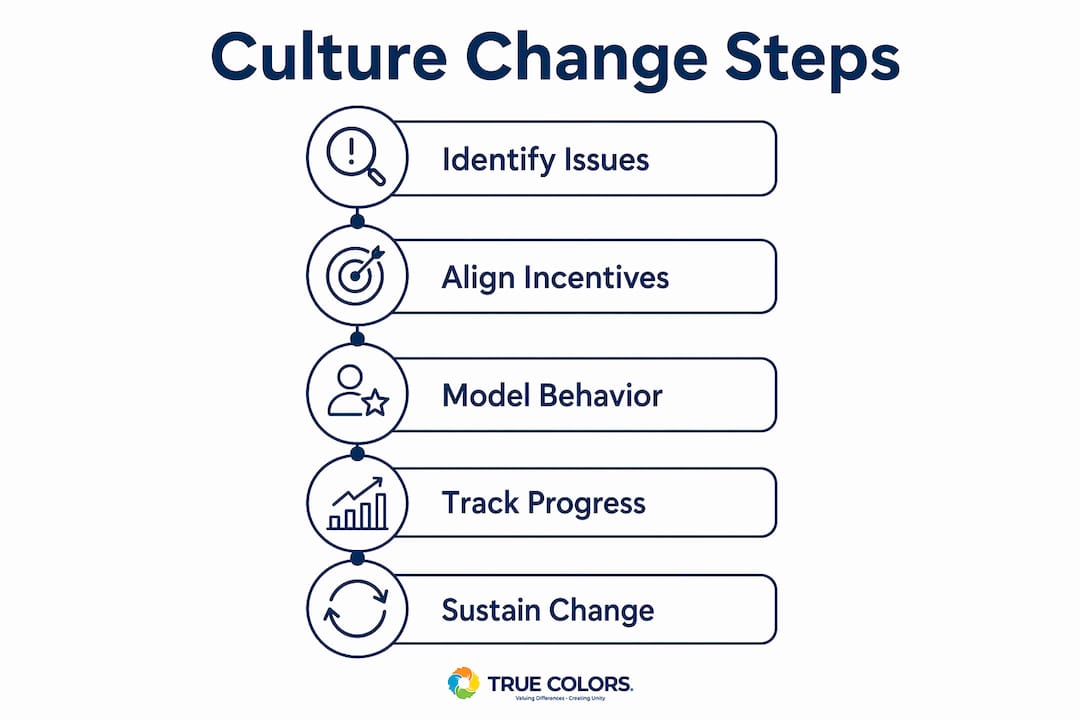
Organizations are more than five times as likely to succeed in culture transformation when leaders consistently model the desired behaviors. That statistic points to a specific mechanism: employees calibrate their own behavior by watching what leaders do under pressure, not what they say in presentations. When a senior leader cuts a corner on a stated value to hit a quarterly number, the message spreads faster than any internal communication campaign.
Middle managers are the most underestimated variable in this equation. They translate executive vision into daily practice through hundreds of small decisions each week: who gets recognized, which conversations get redirected, and what behavior gets tolerated in a team meeting. Culture change that does not reach middle managers does not reach the organization.
Here is a practical sequence for leaders who want to make behavior the foundation of culture change:
-
Identify two or three specific behaviors that visibly demonstrate the desired culture, not values statements, but observable actions.
-
Model those behaviors publicly and consistently, especially in moments of pressure or ambiguity when the default would be to revert.
-
Equip middle managers with the language and authority to reinforce those behaviors in their own teams.
-
Audit the reward systems to confirm they recognize the behaviors you are asking for, not just the outcomes you have always measured.
-
Create feedback loops that surface whether the behaviors are spreading, not just whether people attended the training.
Pro Tip: Identify one leadership behavior you want to see more of across the organization, then track how often you personally demonstrate it in the next 30 days. Leaders who measure their own behavior first build the credibility to ask others to change.
What are the most common pitfalls in culture change?
The three most common pitfalls in culture change are impact theater, misdiagnosis of the real problem, and failure to navigate organizational power structures. Each one can sink an otherwise well-designed initiative.
Impact theater is the practice of running high-visibility culture events, workshops, or campaigns without tracking whether any behavior changes. If initiatives lack tracked variables that correlate with behavior change, employees simply wait them out until they disappear. The annual culture survey, the values posters in the lobby, the one-day offsite with a keynote speaker: these are not culture change. They are culture performance.
Misdiagnosis is equally damaging. Many leaders treat culture as a morale problem when it is a structural one. They commission engagement surveys and respond with perks when the real issues are unclear decision rights, inconsistent accountability, or an operating model that rewards the wrong things. Culture is a symptom, not a condition. Fixing it requires simultaneous alignment across purpose, strategy, operating model, organizational architecture, talent, and leadership.
Navigating organizational power is the third terrain that most culture efforts fail to map. Managers often apply frameworks such as Kotter's or Prosci's without understanding who holds informal authority within the organization. Misreading authority and misalignment with key stakeholders cause initiatives to stall despite strong ideas and genuine intent.
The table below compares what culture initiatives typically look like versus what they need to look like to produce lasting change:
| What most initiatives do | What effective initiatives do |
|---|---|
| Launch with a values campaign | Audit and realign reward systems first |
| Train leaders in isolation | Embed behavior change in daily workflows |
| Measure participation rates | Track observable behavior shifts over time |
| Delegate culture to HR | Assign ownership to the full C-suite |
| Treat rollout as the finish line | Design for ongoing reinforcement and iteration |
Pro Tip: Before launching any culture initiative, map the three or four people in your organization who hold informal authority regardless of title. If they are not aligned with the change, the initiative will stall at the middle layer.
How to treat culture as infrastructure, not a program
The most durable cultural changes happen when leaders stop treating culture as a program to launch and start treating it as infrastructure to build. Culture change programs fail when treated like software deployment: a uniform rollout, a go-live date, and the assumption that adoption will follow automatically. Culture is a complex adaptive system. It changes through local interactions, not top-down mandates.
Reframing culture as infrastructure means making several concrete shifts:
-
Design for implementation as the main event. The rollout plan is not the culture change. The daily decisions, conversations, and reinforcement loops that follow are where culture forms or fails.
-
Empower localized adoption. Different teams will express the same values differently based on their function, context, and leadership. Forcing uniform behavior scripts produces compliance, not commitment.
-
Align incentives with the culture you want. Review promotion criteria, performance metrics, and recognition programs. If they reward behaviors that contradict your stated values, the values lose every time.
-
Distribute decision rights clearly. Ambiguity about who can make which decisions creates the informal power vacuums that undermine culture. Clarity about authority is a cultural statement in itself.
-
Build reinforcement into operations. Culture that is only addressed in dedicated sessions fades. Culture that is woven into team meetings, performance conversations, and onboarding becomes self-sustaining.
Culture ownership belongs to the full C-suite, especially the CEO. When culture is delegated solely to HR or a chief culture officer, other executives disengage, and the initiative loses the organizational weight it needs to survive. The misaligned culture costs that accumulate from this delegation are not just cultural. They show up in retention, productivity, and business performance.
Leaders who want to understand how strategic culture change works in practice will find that the organizations that succeed treat culture as a leadership discipline, not a communications exercise.
Key takeaways
Leaders fail culture initiatives when behavior, systems, and incentives remain misaligned with stated values, making structural change the prerequisite for any lasting cultural shift.
| Point | Details |
|---|---|
| Systemic incongruence is the root cause | Legacy reward systems that contradict stated values destroy employee trust faster than any messaging can rebuild it. |
| Leadership behavior is the mechanism | Organizations are over five times more likely to succeed when leaders consistently model desired behaviors in daily practice. |
| Impact theater wastes resources | Initiatives without tracked behavior variables teach employees to wait out the change rather than adopt it. |
| Middle managers are the multiplier | Culture change that does not reach middle managers never reaches the organization at scale. |
| Culture requires infrastructure, not programs | Lasting change comes from aligning incentives, decision rights, and workflows, not from launching campaigns. |
What I have learned about culture change that most leaders resist hearing
From my experience working with organizations across industries, the hardest truth to deliver is this: most culture initiatives fail not because leaders lack commitment, but because they underestimate how much the existing system is working exactly as designed. The behaviors you see in your organization are the logical output of the incentives, structures, and modeling that have been in place for years. A new values statement does not override that. A workshop does not override that. Only a deliberate, sustained change to what the system rewards and what leaders visibly do will move the needle.
The leaders I have seen succeed at culture change share one habit: they focus on small, specific, observable behaviors rather than broad aspirational values. They do not ask their teams to “be more collaborative.” They ask themselves what collaboration looks like in a Monday morning meeting, and then they model it there, consistently, for months. That specificity is what makes culture change real rather than rhetorical.
The other pattern I have observed is that successful leaders take the time to understand their organization's informal power structure before launching anything. They know who the skeptics are. They know which middle managers will amplify the change and which ones will quietly absorb it without passing it on. They build alignment with those people first, not last. That is not political maneuvering. It is organizational literacy, and it is the difference between an initiative that spreads and one that stalls.
The common failures in corporate training that I see most often come down to one thing: treating the intervention as the solution rather than the starting point. The real work begins after the training room empties.
— Robert Cook
How Truecolorsintl helps leaders build culture that holds

Truecolorsintl works with organizations that are serious about making culture more than a talking point. Through leadership development programs grounded in human behavior, Truecolorsintl helps leaders identify the specific gaps between stated values and daily practice, then build the habits and systems that close them. The methodology connects personal awareness to team alignment to organizational reinforcement, so culture change does not stop when the program ends. If you are ready to move from culture as aspiration to culture as infrastructure, explore Truecolorsintl’s full suite of leadership and culture solutions designed for exactly that work.
FAQ
Why do most culture initiatives fail within the first year?
Most culture initiatives fail because they are treated as programs with a launch date rather than as ongoing behavioral and systemic change. Without aligned incentives and consistent leadership modeling, employees revert to the behaviors the existing system rewards.
What is systemic incongruence in culture change?
Systemic incongruence is the gap between the values an organization communicates and the reward systems, decisions, and behaviors that govern daily work. It is the primary structural reason culture transformation efforts stall.
How does leadership behavior affect culture outcomes?
Leadership behavior is the primary mechanism through which culture forms. Organizations are over five times more likely to succeed in culture change when leaders consistently model desired behaviors, because employees calibrate their own conduct by observing how leaders behave under pressure.
What is impact theater and why does it harm culture efforts?
Impact theater refers to high-visibility culture events or campaigns that generate attention without producing measurable behavior change. When employees see no tracked outcomes tied to these efforts, they learn to wait them out rather than engage.
How should leaders measure progress in culture change?
Leaders should track specific, observable behavior shifts rather than participation rates or survey scores alone. Identifying two or three behaviors that visibly represent the desired culture and measuring their frequency over time produce evidence-based progress rather than activity-based reporting.