
If 70% of strategic transformations fail as culture pushes back, “culture eats strategy” reads less like inspiration and more like instruction. Commonly attributed to Peter Drucker, the phrase points to a central insight: culture is the operating environment of strategy.
Recognizing that reality changes how leaders lead. Some build culture into execution. Others keep revisiting the same priorities, hoping for different results.
Key takeaways
| Point | Details |
|---|---|
| Culture overrides strategy | Even well-designed strategies collapse when daily behaviors and norms contradict them. |
| Leadership modeling is the mechanism | Organizations are 5x more likely to succeed when leaders consistently model the desired behaviors. |
| Culture acts as an operating system | Culture sets invisible defaults that determine what decisions feel natural before logic even enters the room. |
| Barriers are predictable | Resistance, misaligned incentives, and poor middle management translation are the most common culture-related failure points. |
| Alignment requires systems, not slogans | Sustainable culture change depends on reinforced behavior over time, not one-time programs or communication campaigns. |
Why culture eats strategy explained: the core relationship
Before examining why culture wins, it helps to clearly separate the two terms. Strategy is the deliberate plan: the goals, priorities, resource allocation, and roadmap. Culture is something different entirely. It is the collection of shared beliefs, norms, and behaviors that define how people actually work together on any given Tuesday morning. Culture isn't what is said. It is what is repeated.
The impact of culture on strategy is most evident in three areas: decision-making, execution speed, and team behavior. When an organization’s culture rewards caution, a growth strategy requiring bold market moves will stall. When culture normalizes silos, a collaboration-dependent product launch will fragment. High-accountability cultures make quicker, bolder decisions without excessive approval delays, which directly accelerates the speed at which a strategy reaches the market.
Here is where many leaders get caught off guard. Strategy is visible. You can read a strategy deck in thirty minutes. Culture is largely invisible. It lives in the questions people don't ask in meetings, where ideas get laughed at, and in the behaviors that actually get rewarded regardless of what the values plaque on the wall says. When those invisible forces pull against the stated strategy, culture wins. Every time.
Pro Tip: Before launching a new initiative, audit the behaviors your current incentive systems reward. If your strategy requires collaboration but your compensation structure rewards only individual performance, you have already built in a contradiction that will cost you.
The misalignment between rewards and strategy is not theoretical. Incentive systems focused on individual performance directly undermine strategies that depend on cross-functional coordination. Meanwhile, supportive cultures increase engagement and productivity while reducing the bureaucratic drag that slows execution. The relationship is direct: culture either accelerates strategy or absorbs it.
Cultural barriers that derail strategic transformation
Most leaders can articulate what went wrong after a transformation fails. Few can articulate the cultural warning signs that were present six months before the failure. Recognizing those signs early is where the real leverage sits.
Research from 2026 confirms that the leading causes of strategic failure are not weak competitive analysis or poor financial modeling. They are culture problems in disguise. The most common barriers follow a recognizable pattern:
-
Employee resistance to change. When people don't understand why change is happening or don't believe leadership is committed, passive resistance becomes the default. This rarely shows up as open opposition. It shows up as slow adoption, workarounds, and attrition among high performers.
-
Leadership that doesn't model the new behaviors. Leaders who announce a new direction but continue operating in the old way send a louder message than any all-hands meeting. The organization watches what leaders do, not what they say.
-
Misaligned reward structures. When the behaviors required by the strategy are not the behaviors being recognized and rewarded, people logically default to what gets them promoted.
-
Middle management as a broken link. Employee experience of culture comes primarily through immediate managers. When middle managers can't translate the leadership vision into daily team behavior, the transformation stalls exactly where it needs to gain momentum.
-
Fear of failure without psychological safety. Strategies requiring experimentation and iteration die in cultures where mistakes are punished. People stop proposing new ideas and start optimizing for self-protection instead.
“Culture transformation is a leadership system, not an HR project. It requires ongoing behavior modeling, not a one-time initiative or a campaign.”
That framing matters. When organizations treat culture change as a project with a launch date and a completion milestone, they are setting up the next failure. Culture change fails when treated as a project; it only succeeds when it is treated as a sustained leadership commitment embedded in how the organization operates every day.
Culture as an operating system
One of the most clarifying frameworks for understanding cultural influence comes from Dr. Raphael Nagel, who describes culture as an operating system shaping decisions and behavior below conscious awareness. The analogy is worth sitting with. Just as a computer’s operating system determines which applications can run and how they perform, an organization’s culture determines which ideas get traction and which behaviors feel natural versus uncomfortable.

This means culture operates before logic enters the room. When a proposal feels “off” to a team without anyone being able to articulate exactly why, that is culture enforcing its norms. When a leader notices that certain conversations never happen in their organization despite being clearly necessary, that is the operating system filtering them out.
The practical implication for leaders is significant. Confusing cultural architecture with individual behavior causes leaders to misdiagnose systemic issues as personality conflicts. When execution consistently breaks down in the same patterns across different teams, the problem is not the people. It is the system those people are operating within.
| Dimension | Strategy | Culture |
|---|---|---|
| Visibility | High. Documented in plans and presentations. | Low. Lives in behaviors, norms, and unwritten rules. |
| Change speed | Relatively fast. Can shift in weeks with new direction. | Slow. Meaningful change takes months to years. |
| Primary driver | Leadership decisions and resource allocation. | Daily behaviors modeled and reinforced over time. |
| Failure mode | Flawed analysis or poor prioritization. | Invisible defaults that override the plan in practice. |
| Measurement | Milestones, KPIs, financial outcomes. | Behavioral patterns, engagement, decision quality. |
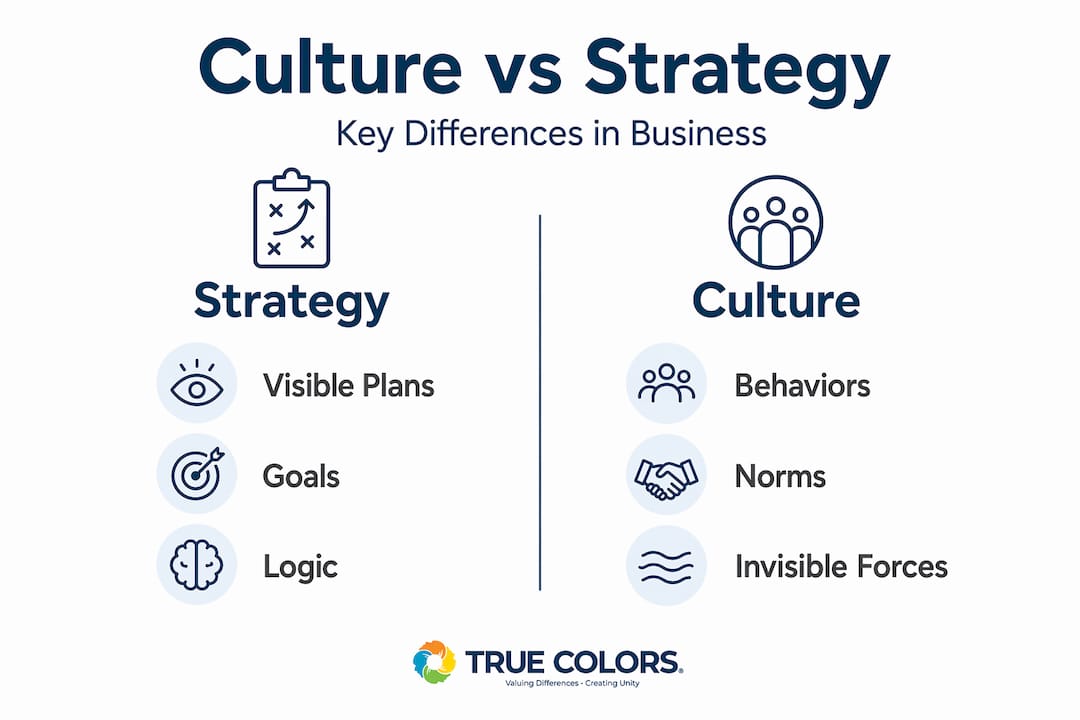
Pro Tip: When diagnosing a culture problem, look for patterns rather than people. If the same breakdown keeps happening across different teams and different leaders, you are looking at a systemic norm, not an individual failure.
Understanding culture in business through this lens reframes the leader’s job. The question shifts from “Do we have the right strategy?” to “Does our operating environment allow this strategy to run?”
Aligning culture and strategy for real execution
Knowing that culture and strategy need to work together is not the same as knowing how to make that happen. The organizations that get this right share several observable practices.
-
Leaders model the required behaviors publicly and consistently. When leaders consistently demonstrate the behaviors they expect from others, organizations are five times more likely to succeed in transformation efforts. What makes the difference is steady, observable behavior that reinforces priorities day after day.
-
Incentives and recognition are realigned to support the strategy. This is a structural decision, not a motivational one. If the strategy requires cross-functional collaboration, the performance review process, bonus structures, and public recognition need to explicitly reward collaborative behavior.
-
OKRs are used to translate cultural expectations into observable goals. Objectives and key results create a direct line between the strategic direction and the daily work of every team, reducing the interpretive gap that cultural defaults tend to fill.
-
Middle managers receive deliberate support and accountability. Since culture is experienced mostly through immediate managers, organizations that invest in developing middle management as cultural stewards significantly reduce the implementation gap.
-
Culture health is measured, not assumed. Organizations use employee experience data to identify where cultural norms support strategy and where they undermine it. This replaces assumption with evidence.
The examples worth paying attention to come from companies that treat cultural alignment as an ongoing leadership discipline rather than a transformation initiative. Microsoft’s shift under Satya Nadella is one of the most-cited cases: the strategy pivot toward cloud and collaboration became possible only after a deliberate cultural shift away from stack ranking and toward a growth mindset. The strategy and the culture moved together. One didn't precede the other.
The same pattern appears at Hindustan Unilever, where culture-led leadership practices enabled consistent strategic execution across a highly distributed workforce. The mechanism in both cases was the same: leadership behavior, reinforced daily, that made the strategy feel natural rather than imposed.
My take on why strategies keep failing
I’ve worked with enough organizations to recognize a pattern that rarely gets named directly. Leaders invest significant time and money in strategy development and almost none in diagnosing whether their culture can carry it. The assumption is that if the plan is good enough, execution will follow. It almost never does.
What I’ve learned is that the most dangerous cultural barrier is the one leaders can't see because they created it. The behaviors senior leaders repeat, the decisions they reward, and the risks they visibly take or avoid become the organization’s operating norms whether that was the intention or not. Culture change doesn't start with a workshop or a values refresh. It starts with a leader deciding to act differently and then doing so repeatedly in public.
The misconception I see most often is that culture is too soft or too slow to be a strategic concern. In my experience, it is the most concrete lever a leader has. You can't directly change what people believe. You can change what they observe, what gets recognized, and what feels safe to propose. Do those three things consistently and the culture shifts. Stop doing them, and it reverts within months.
The 5 ways to transform workplace culture that create lasting culture are grounded in behavior. They are embedded in daily actions, expectations, and follow-through. Leaders often concentrate on vision and messaging, while the real work sits in consistent behavioral reinforcement. That is where the strategy-versus-culture tension is resolved.
— Theresa Stairs
How Truecolorsintl helps leaders close the culture gap

Knowing the relationship between culture and strategy is one thing. Having a practical system to act on it is another. Truecolorsintl works with organizations to make culture tangible, measurable, and connected to how people lead and execute every day. Through leadership development programs and behavioral team training, Truecolorsintl helps leaders identify the specific norms and habits that support or undermine their strategic goals. The approach is grounded in human behavior, and it translates directly into the decisions, conversations, and patterns that shape performance. Explore corporate consulting and coaching solutions designed to align culture with strategy, or visit Truecolorsintl.com to see the full range of programs available for leadership teams and organizations ready to close the gap between strategy and execution.
FAQ
What does “culture eats strategy for breakfast” mean?
The phrase, attributed to Peter Drucker, means that an organization’s cultural norms and behaviors will override even a well-designed strategy if the two are not aligned. Culture determines how people work, which ultimately controls whether any strategy succeeds in practice.
Why do most strategic transformations fail?
Approximately 70% of transformations fail due to cultural issues, including employee resistance and insufficient management support, rather than flaws in the strategy itself.
How does culture affect strategy execution?
Culture shapes decision-making speed, team behavior, and what actions feel natural or risky. When cultural norms contradict strategic goals, people default to familiar behaviors, and the strategy loses momentum regardless of its quality.
What is the leader’s role in cultural alignment with strategy?
Leaders set cultural norms through the behaviors they model repeatedly and publicly. Organizations are five times more likely to succeed in strategic transformation when senior leaders consistently demonstrate the behaviors required by the strategy.
How long does culture change take compared to strategy change?
Strategy can shift in weeks through new directives and resource allocation. Meaningful cultural change typically takes months to years because it requires consistent behavioral reinforcement across leadership levels before new norms become defaults.