The role of CEO in culture is the single most powerful force shaping how an organization thinks, behaves, and performs. Culture is not what a company posts on its website. It is what leaders do when no one is watching, and what gets repeated until it becomes habit. Research from O.C. Tanner, Harvard Business Review, and Fortune confirms that CEOs who treat culture as a core operating responsibility, not a soft-skills afterthought, produce measurably stronger alignment, engagement, and performance across their organizations.
What is the ceo’s role in shaping company culture?
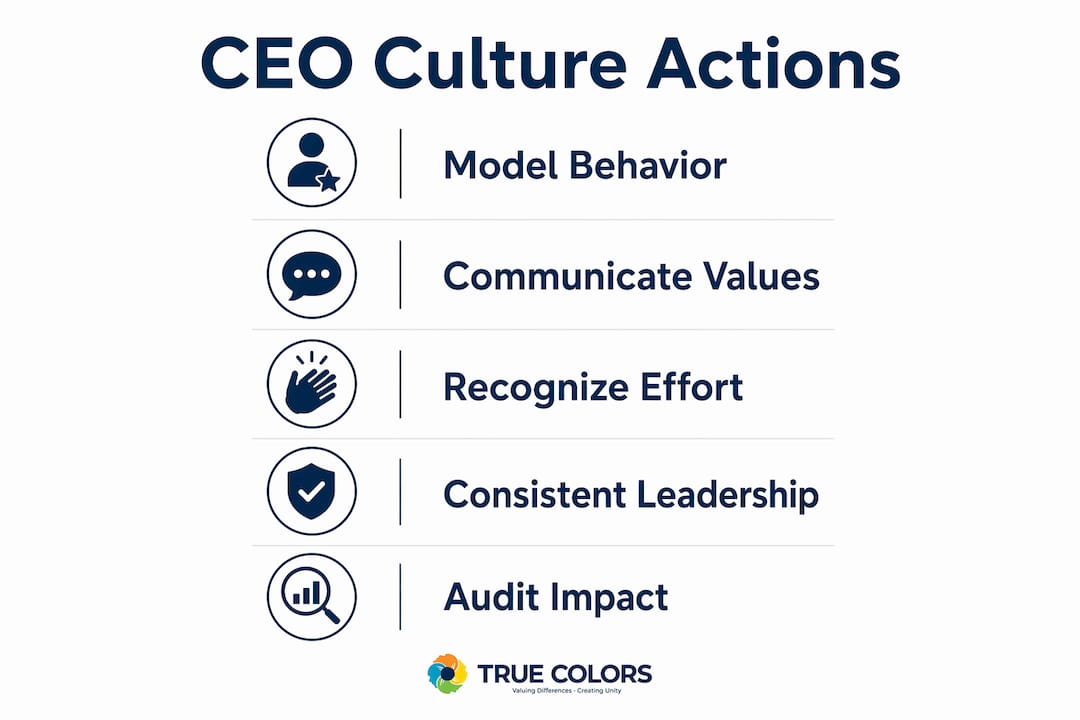
The CEO’s role in shaping company culture is to serve as the organization’s primary behavioral model. Every decision, reaction, and priority signal you send becomes a template that others follow. Leadership embodies and enforces values daily through behaviors like setting tone, hiring teams, and translating purpose into direction. That is not a metaphor. It is a mechanism.
Culture, in organizational development terms, is the accumulated pattern of shared assumptions, values, and behaviors that define how work gets done. The CEO’s influence on company culture operates through what O.C. Tanner describes as a “compound of micro-experiences.” These are the small, repeated interactions that shape how employees perceive their environment, their leaders, and their own contribution.

The importance of CEO in culture becomes clearest when leadership changes. Organizations frequently see culture shift within months of a new CEO taking over, even when strategy stays the same. That speed of change reveals how much culture depends on the person at the top, not the documents on the wall.
How do ceos shape culture through daily leadership behaviors?
CEOs shape culture through consistent, observable actions tied to recurring leadership moments. A values statement means nothing if the CEO’s behavior in a budget meeting contradicts it. The behaviors that carry the most cultural weight are the ones employees see repeated across contexts.
Culture change requires designing for reinforcement through leadership micro-experiences that provide direction, recognition, and personalized purpose. That means the CEO’s cultural leadership role is not a quarterly initiative. It is a daily practice embedded in how you run meetings, give feedback, and respond to setbacks.
Specific CEO leadership behaviors that influence culture include:
-
Setting the hiring standard. Who you bring in signals what you value, regardless of what your culture deck says.
-
Translating purpose into team-level meaning. Employees need to see how their work connects to the organization’s direction, and that translation starts with you.
-
Recognizing the right behaviors publicly. Recognition is a cultural signal. What gets celebrated gets repeated.
-
Providing resources that match stated priorities. If culture is a priority but has no budget or time, employees notice the gap.
-
Holding yourself accountable to the same standards you set for others. Consistency between what you say and what you do is the foundation of credibility.
Immediate leaders translate CEO intent into employee experience. Without their embodiment of values, culture goals become hollow slogans. This means your cultural leadership role extends to developing the managers below you so they carry the same behavioral standards into every team interaction.
Pro Tip: Identify one recurring leadership moment, such as your weekly all-hands or one-on-one check-ins, and use it deliberately to reinforce one specific cultural value. Repetition in a predictable context is how behavior becomes norm.
Why does one high-impact behavior beat a broad culture campaign?
Broad education campaigns rarely produce measurable shifts in company culture. That finding from HBR challenges the instinct many CEOs have to launch organization-wide culture programs. The problem with broad campaigns is that they distribute attention across too many behaviors at once, making it impossible to track progress or sustain momentum.
Culture transformation is fundamentally about behavior, not education. Leaders must own cultural impact through day-to-day actions, not through awareness programs or communication cascades. The more specific the behavior, the more measurable the change.
HBR’s guidance points to selecting a single observable behavior tied to your organization’s operating rhythms, such as how decisions get made in leadership meetings, how coaching conversations are structured, or how accountability is handled in performance reviews. Once that behavior is defined, it can be modeled, tracked, and reinforced.
| Approach | Outcome |
|---|---|
| Broad culture campaign | Raises awareness but rarely changes observable behavior |
| Single high-impact behavior | Creates measurable, trackable shifts in how work gets done |
| Organization-wide training rollout | Builds knowledge without guaranteeing application |
| Behavior embedded in operating rhythms | Reinforces change through repetition in real work contexts |
High-leverage culture change requires CEOs to select one observable behavior in operating rhythms and monitor change rather than relying on awareness efforts. This approach also gives you a governance structure. You can measure whether the behavior is occurring, adjust your own modeling, and hold leaders accountable for the same standard. That is how strategic culture change moves from concept to practice.
How does the ceo’s emotional tone affect organizational performance?
CEOs set the organization’s emotional tone daily, which acts as a performance lever influencing employee feelings and outcomes during meetings and decisions. This is not a soft-skills observation. Emotional tone is an operating variable that shapes how urgency, accountability, and ambition are experienced across the organization.
Tone travels faster than instructions. When you walk into a room anxious, distracted, or dismissive, that signal spreads before you say a word. Employees calibrate their own behavior to match the emotional environment you create. If your tone signals scarcity and fear, you get risk-averse decisions. If it signals confidence and accountability, you get initiative.
The practical implication is that your emotional presence in meetings, one-on-ones, and company-wide communications is not separate from your leadership strategy. It is part of it. Emotional tone becomes policy-by-example, and CEOs must reflect on their presence after difficult moments to maintain a trusted leadership atmosphere. That reflection is not optional. It is how you catch the moments where your tone contradicted your stated values and correct them before they become the norm.
Auditing your emotional presence does not mean performing positivity. It means developing enough self-awareness to recognize when your state is working against your culture goals, and adjusting without losing authenticity. Leaders who understand their own behavioral patterns, including how they show up under pressure, are far more effective at sustaining the culture they intend to build.
Pro Tip: After a high-stakes meeting or difficult decision, take five minutes to assess the emotional signal you sent. Ask: did my tone reinforce the culture I am building, or did it undermine it? That single habit builds the self-awareness that separates reactive leaders from intentional ones.
How much time should ceos invest in culture work?
Anthropic CEO Dario Amodei spends about 40% of his time on company culture, treating it as a strategic priority distinct from operational tasks. That number surprises most executives. It should not. Amodei’s position is that culture, not products, will determine who wins in the AI race. The logic applies well beyond AI companies.
The misconception is that time spent on culture detracts from running the business. The opposite is true. Leadership buy-in at all levels is required for culture investments to pay off. When the CEO is absent from culture work, that absence signals to every leader below that culture is secondary. The cascade effect is predictable: managers deprioritize it, teams feel it, and engagement drops.
CEOs retreating to narrow management duties and avoiding employee and customer engagement reduce their effectiveness in culture leadership. HBR frames this as a real risk for executives who get trapped in meeting cycles and management mechanics. The result is a CEO who is technically busy but culturally invisible.
Practical ways to show up as a culture leader include:
-
Attending team-level meetings without an agenda. Presence without an operational purpose sends a powerful signal about what you value.
-
Engaging directly with employees at all levels. Skip-level conversations reveal cultural gaps that filtered reporting never surfaces.
-
Connecting with customers regularly. External perspective keeps your culture grounded in the reality of what your organization delivers.
-
Modeling the behaviors you expect from your leadership team. You cannot delegate culture. You can only demonstrate it.
The CEO’s effect on employee engagement is most visible when leaders show up consistently and with genuine interest. Employees do not need a perfect leader. They need a present one.
Key takeaways
The CEO’s cultural leadership role is the most direct lever for shaping organizational behavior, employee engagement, and long-term performance.
| Point | Details |
|---|---|
| CEO sets the cultural baseline | Every repeated behavior from the CEO becomes the behavioral standard for the organization. |
| One behavior beats broad campaigns | Selecting a single observable behavior tied to operating rhythms produces measurable culture change. |
| Emotional tone is a performance variable | The CEO’s emotional presence in meetings and decisions directly shapes team alignment and output. |
| Time investment signals priority | CEOs who allocate significant time to culture, such as Dario Amodei at Anthropic, signal its strategic importance. |
| Immediate leaders carry culture forward | Without managers embodying CEO-set values, culture goals remain aspirational. |
What I have learned about CEOs and culture after years in this work
The most common mistake I see CEOs make is treating culture as a communication problem. They write the values, announce the vision, and then wonder why nothing changes. Culture is not what is said. It is what is repeated. And what gets repeated is determined by what you, as the CEO, do.
The executives I have seen build genuinely strong cultures share one habit: they audit their own behavior before they assess anyone else’s. They ask hard questions about whether their presence at a difficult meeting reinforced or undermined accountability. They notice when their emotional state sent a signal they did not intend. That level of self-awareness is not natural for most high-performing leaders. It has to be built deliberately.
The other pattern I notice is that CEOs who struggle with culture are often technically excellent but relationally absent. They are in every operational meeting but missing from the moments that shape how people feel about their work. Fixing that does not require a personality change. It requires a calendar change and a commitment to showing up in different contexts.
If you are serious about your cultural leadership role, start with one behavior, model it visibly, and track whether it spreads. That is not a soft approach. That is how culture initiatives succeed where most fail.
— Theresa Stairs
How Truecolorsintl helps CEOs make culture stick
Culture doesn't change because a CEO decides it should. It changes because the right behaviors get embedded, reinforced, and measured over time. Truecolorsintl works with executive leaders to make that process concrete and repeatable.
Through leadership development programs grounded in behavioral science, Truecolorsintl helps CEOs identify the specific actions that are helping or hindering their culture, strengthen communication across leadership teams, and build the habits that sustain progress. From corporate consulting and coaching to employee experience insights and talent solutions, Truecolorsintl gives you the practical tools to lead culture with the same rigor you bring to operations. If you are ready to move from culture aspiration to culture reality, Truecolorsintl is built for exactly that work.
FAQ
What is the ceo’s primary role in company culture?
The CEO’s primary role is to model the behaviors that define organizational culture through consistent, observable actions. Culture is shaped by what leaders do repeatedly, not by what they announce.
How do CEOs influence employee engagement through culture?
CEOs influence employee engagement by setting the emotional tone, recognizing the right behaviors, and showing up consistently in ways that signal what the organization values. Employees align their effort with what they see leaders prioritize.
Why do broad culture campaigns often fail?
Broad campaigns raise awareness but rarely change observable behavior. HBR research shows that focusing on a single high-impact behavior tied to operating rhythms yields more measurable and lasting culture shifts.
How much time should a CEO spend on culture?
Anthropic CEO Dario Amodei allocates roughly 40% of his time to culture, treating it as a core strategic priority. The right amount varies, but culture work should appear consistently on the CEO’s calendar, not just during annual planning cycles.
What is the biggest mistake CEOs make with culture?
The most common mistake is treating culture as a communication initiative rather than a behavior change effort. Culture is not what is said. It is what is repeated, and that repetition starts with the CEO.