
Measuring organizational culture means systematically evaluating the behaviors, perceptions, and business outcomes that reflect shared values and norms within a workplace. Culture is not what is said. It is what is repeated. Leaders who understand how culture is measured in organizations move beyond gut instinct and start making decisions grounded in real data. Frameworks like the Shingo Insight assessment and CEO-level scorecards from tools such as Happily.ai give leaders a structured path from observation to action. The result is a clearer picture of where culture supports performance and where it quietly works against it.
How culture is measured in organizations: behaviors, sentiment, and outcomes
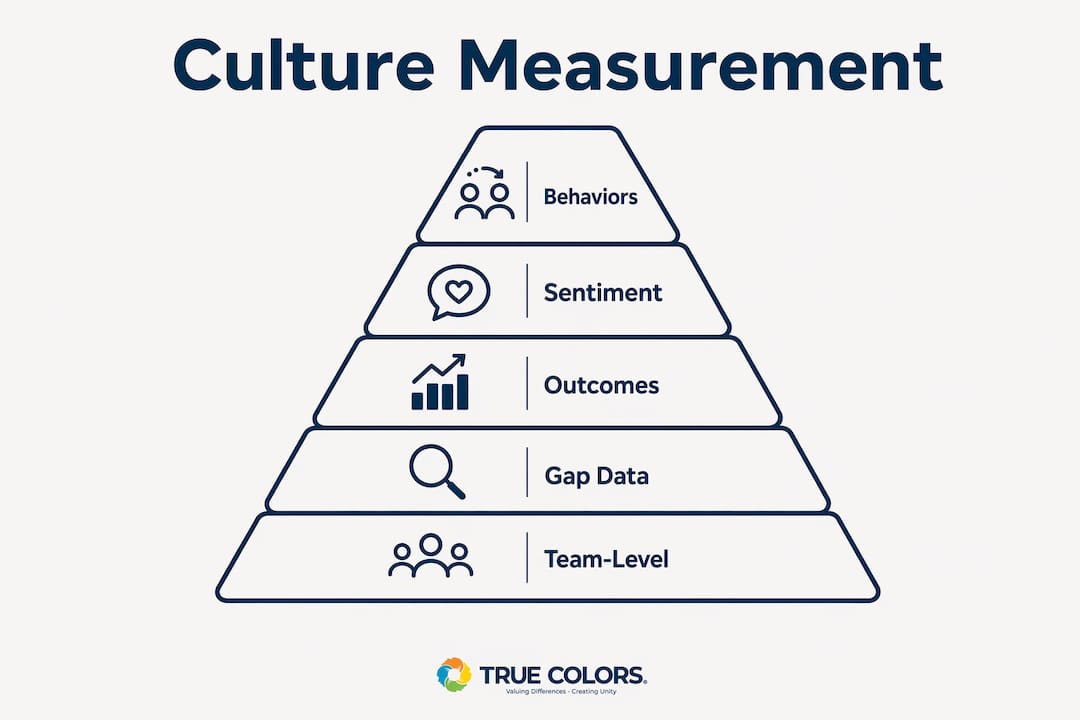
Organizational culture assessment works across three dimensions: behavioral norms, employee sentiment, and outcome data. No single dimension tells the full story. A culture that scores high on engagement surveys but shows poor recognition patterns and rising attrition is not a healthy culture. It is a culture with a measurement gap. Measuring workplace culture requires a multi-pronged approach that mixes numbers with narrative to uncover what drives performance.
Each dimension answers a different question. Behavioral data tells you what people do. Sentiment data tells you how people feel about what is happening. Outcome data tells you what the organization produces as a result. Together, these three layers form the foundation of any credible culture measurement system.
What do behavioral metrics reveal about culture?
Behavioral observation is the most direct form of culture measurement. Culture lives in behavior, not in opinion, which means behavioral evaluations provide more useful data than surveys that only measure whether employees believe in stated values. A team can say it values collaboration and still operate in silos. Behavioral data catches that gap.
Behavioral metrics worth tracking include:
-
Recognition frequency: How often managers and peers formally acknowledge contributions
-
Manager response time: How quickly leaders respond to employee requests or concerns
-
Meeting equity: Whether all voices contribute in team discussions or a few dominate
-
Follow-through rates: Whether commitments made in one-on-ones are kept
-
Escalation patterns: Whether employees raise concerns directly or route around leadership
One critical insight most leaders miss: culture measurement at the company-wide level hides more than it reveals. Team-level reporting exposes pockets of dysfunction or excellence that get averaged away in aggregate scores. A company with a strong overall culture score may have one division where turnover is double the norm and recognition is nearly absent. That division is where the real work is.
Pro Tip: When reviewing behavioral data, compare your highest and lowest performing teams side by side. The gap between them is your most actionable culture signal.

How do employee sentiment surveys contribute to culture measurement?
Sentiment surveys capture how employees perceive their work environment. They complement behavioral data by surfacing psychological safety, trust, and team health in ways that observation alone cannot. The most common formats are pulse surveys, full engagement surveys, and the Employee Net Promoter Score (eNPS).
A well-designed measurement cadence looks like this:
-
Quarterly pulse surveys: Short, 5–10 question surveys focused on current team health, psychological safety, and manager effectiveness
-
Annual engagement surveys: Deeper diagnostics covering alignment, growth, recognition, and belonging
-
eNPS tracking: A single question asking whether employees would recommend the organization as a place to work, tracked over time
-
Behavioral audits: Periodic structured observations or 360-degree feedback cycles tied to specific values
The distinction between aspirational and actual sentiment matters enormously. Many surveys ask employees whether they believe the organization values transparency. That question measures aspiration. A better question asks whether their manager shared the reasoning behind a recent decision that affected their team. That question measures experience.
Combining pulse and deep surveys with behavioral observations and organizational metrics like engagement, turnover, and absenteeism gives leaders a complete view of culture health. Narrative evidence, gathered through open-ended questions or focus groups, adds the context that numbers alone cannot provide.
The Shingo Insight assessment, developed by the Shingo Institute, illustrates what a rigorous survey instrument looks like in practice. The survey covers satisfaction, engagement, and behavior across approximately 75 questions and takes 6–8 weeks to complete, including administration. It is anonymous, web-based, and takes about 15 minutes per respondent. That combination of depth and accessibility makes it a useful baseline tool for organizations beginning a formal culture measurement program.
How does outcome data complete the culture picture?
Outcome data connects culture measurement to business performance. It answers the question leaders care about most: does our culture produce results? The metrics that matter most are those that reflect how well people stay, grow, and contribute over time.
| Outcome Metric | What It Measures | Culture Signal |
|---|---|---|
| Voluntary attrition rate | Who chooses to leave | Alignment, belonging, leadership quality |
| Internal mobility rate | Who moves into new roles | Growth culture, talent investment |
| Absenteeism rate | Unplanned time away | Engagement, psychological safety |
| Productivity per employee | Output relative to headcount | Clarity, accountability, team effectiveness |
| Promotion rate | Who advances | Fairness, development culture |
A CEO-level culture evaluation can be completed within 30 days by combining these outcome metrics with behavioral and sentiment data into a single scorecard. This framework uses three dimensions: Feeling, Focus, and Progress. Feeling captures sentiment. Focus captures behavioral alignment. Progress captures business outcomes. Together, they give leaders a scorecard that is both diagnostic and forward-looking.
Outcome data requires context to be useful. A high attrition rate in a fast-growing company may reflect normal scaling friction rather than a toxic culture. A low absenteeism rate in a high-pressure environment may signal fear rather than engagement. Leaders must interpret outcome data alongside behavioral and sentiment data to avoid drawing the wrong conclusions.
Which culture assessment tools should leaders consider?
Several established instruments exist for formal organizational culture assessment. Each carries trade-offs in cost, depth, and strategic alignment.
| Tool | Focus | Items | Best For |
|---|---|---|---|
| OCI (Organizational Culture Inventory) | Behavioral norms | 96–120 items | Deep behavioral diagnostics |
| OCAI (Organizational Culture Assessment Instrument) | Culture type classification | 24 items | Quick strategic alignment check |
| DOCS (Denison Organizational Culture Survey) | Linkage to business outcomes | 60 items | Performance-focused organizations |
| Shingo Insight | Operational excellence behaviors | ~75 items | Manufacturing and continuous improvement cultures |
No instrument is perfect. Selecting one depends on trade-offs between cost, depth, and how well the instrument aligns with your organization’s strategic priorities. The OCI, for example, measures behavioral norms across 96–120 items and has been used in thousands of organizations. Its depth makes it powerful for identifying specific norm gaps. Its length makes it harder to administer frequently.
The most valuable output of any culture assessment is not a score. Gap data, the discrepancy between current and ideal behaviors, is the most actionable result a culture assessment can produce. A single culture score tells you where you are. Gap data tells you what to change and where to focus first.
Ongoing measurement matters as much as the choice of instrument. Pulse surveys quarterly and deep diagnostics annually, supplemented by rolling behavioral audits, capture evolving culture trends far better than a single annual snapshot. Culture changes slowly. Measurement must be frequent enough to detect movement.
Pro Tip: Before selecting a culture assessment tool, map it against your top three strategic priorities. If the instrument cannot tell you whether your culture supports those priorities, choose a different one.
Aligning your culture measurement approach with business strategy is not optional. It is the difference between data that informs decisions and data that fills a report no one reads.
Key Takeaways
Measuring organizational culture requires combining behavioral observation, employee sentiment data, and outcome metrics at the team level to produce gap data that drives targeted, lasting change.
| Point | Details |
|---|---|
| Behavior over belief | Measure what people do, not just what they say they value. |
| Team-level data matters | Company-wide averages hide the pockets of dysfunction that need attention most. |
| Three dimensions required | Combine behavioral, sentiment, and outcome data for a complete culture picture. |
| Gap data drives change | The distance between current and ideal behaviors is your most useful output. |
| Measure continuously | Quarterly pulse surveys and annual diagnostics together track real culture movement. |
Why I think most culture measurement programs miss the point
Many organizations treat culture measurement as an event. They run an annual engagement survey, share the results in a town hall, and move on. Twelve months later, they run the same survey and wonder why scores have not moved. The problem is not the instrument, it's the interval.
Culture isn't what is said. It's what is repeated. That means culture data must be collected frequently enough to detect changes in behaviors after an intervention. Normalizing metrics by team size and smoothing them over a rolling 9-month window reduces noise from temporary events, such as a difficult quarter or a leadership transition, and reveals whether real progress is happening.
The second mistake I see consistently is treating a culture score as the goal. Leaders celebrate when their engagement score rises two points. But a score is a lagging indicator. It tells you what already happened. Gap data, the distance between where your culture is and where it needs to be, is what tells you what to do next. Culture data should function as a mirror that reveals system gaps, not as a performance grade.
The leaders who get the most from culture measurement are the leaderss who use it to ask harder questions. Not “did our score go up?” but “which teams improved and why?” Not “are employees satisfied?” but “are managers behaving in ways that make satisfaction possible?” That shift in framing is where culture measurement becomes culture change.
— Theresa Stairs
Truecolorsintl supports culture measurement and development
Truecolorsintl helps organizations move from culture data to culture change. The gap between measuring culture and shifting it is where most programs stall. Truecolorsintl closes that gap through a practical system built on human behavior, not just survey scores.
Through leadership development programs and employee experience surveys, Truecolorsintl equips leaders with the tools to identify what is helping or hindering performance, strengthen team dynamics, and build the habits that make culture measurable and sustainable. Whether your organization is establishing a cultural baseline or reinforcing progress after a major change, Truecolorsintl provides the structure and support to sustain momentum. Visit Truecolorsintl to learn how the programs work.
FAQ
What are the three main methods for measuring workplace culture?
The three main methods are behavioral observation, employee sentiment surveys, and outcome data analysis. Together, they provide a complete picture of how culture operates at the team and organizational levels.
How long does a formal organizational culture assessment take?
A structured assessment like Shingo Insight takes 6–8 weeks to complete, including survey administration. A CEO-level scorecard framework can produce an initial culture evaluation within 30 days.
What is the most actionable output of a culture assessment?
Gap data, the discrepancy between current and ideal behaviors, is the most actionable result. It tells leaders exactly where to focus change efforts rather than simply reporting an overall score.
Why should culture be measured at the team level?
Company-wide culture scores mask significant differences between teams. Team-level reporting reveals where culture practices are consistent and where they break down, enabling focused interventions rather than broad, unfocused programs.
How often should organizations measure culture?
Quarterly pulse surveys combined with annual deep diagnostics and rolling behavioral audits provide the most accurate picture of culture over time. Single annual snapshots miss the movement that happens between measurement points.