
Organizational culture is defined as the internal operating system that governs how decisions get made, how people behave, and what gets prioritized when no one is watching. Leaders who turn culture into competitive advantage treat it not as a collection of values on a wall, but as an enforceable decision system aligned with business strategy. The evidence is compelling: organizations in the “Peak Performance” culture state showed a 25% share-price increase in one year and a 47% advantage over peers, according to a Culture Amp study tracking 1,800 organizations globally. That number signals one thing clearly. Culture is no longer a soft asset. It is a measurable driver of financial performance.
What does it mean to turn culture into competitive advantage?
Culture as a competitive advantage means your organization’s shared behaviors, priorities, and decision-making patterns consistently produce outcomes that competitors cannot easily replicate. Harvard Business School Online describes culture as a rulebook that tells people what to prioritize, how to behave, and what to avoid. When that rulebook aligns with your strategy, culture multiplies results. When it does not, it quietly works against them.

The distinction between a cultural asset and a cultural liability comes down to specificity and enforcement. Many organizations have stated values. Far fewer have defined the observable behaviors those values require. The difference matters because employees do not act on abstract ideals. They act on what they see modeled, what gets rewarded, and what gets tolerated.
Culture types linked to competitive positioning include:
-
Peak Performance: High accountability, clear expectations, strong execution. Linked to market value premiums and share-price outperformance.
-
Growth Collaborator: Cross-functional trust, shared learning, and collaborative problem-solving. Linked to innovation and talent retention.
-
Strategic Architect: Long-range thinking, disciplined resource allocation, and structured decision-making. Linked to market positioning and operational consistency.
Each archetype creates a different form of competitive edge. The key is selecting the culture type that fits your strategic context, then building the systems to reinforce it. Culture is not what is said. It is what is repeated.
What prerequisites do leaders need before leveraging culture strategically?
Before culture can function as a strategic asset, leaders need an honest picture of where culture currently stands. That means going beyond engagement surveys and examining the gap between stated values and actual behaviors. Truecolorsintl uses employee experience insights and behavioral diagnostics to help organizations identify exactly where that gap exists, and what it is costing them.
Three foundational prerequisites determine whether a cultural advantage strategy will hold:
| Prerequisite | Why it matters |
|---|---|
| Behavioral definition | Values must be translated into specific, observable actions employees can model daily. |
| Leadership alignment | Senior leaders must visibly and consistently demonstrate the behaviors they expect from others. |
| Measurement infrastructure | Culture must be tracked over time using defined metrics, not just annual sentiment scores. |
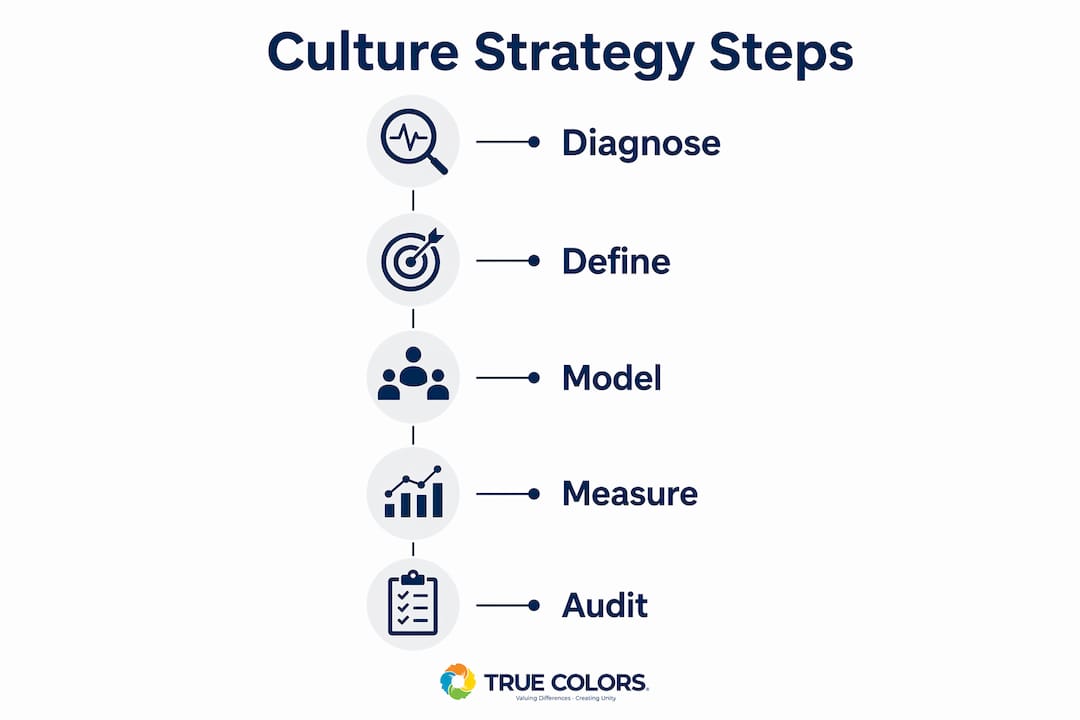
Culture measurement platforms like Culture Amp’s Performance Culture Quadrant now allow organizations to map culture states to financial outcomes, giving CFOs the evidence they need to treat culture as a balance-sheet concern rather than an HR initiative. This shift in framing changes the conversation at the executive level.
SHRM research confirms that a strong culture takes hold when employees know how to respond, believe it is the right way to act, and expect to be recognized for living organizational values. All three conditions must be present. Missing any one of them creates inconsistency, and inconsistency erodes trust faster than any policy can rebuild it.
Pro Tip: Before launching any culture initiative, conduct a culture effectiveness audit to establish a baseline. Without a baseline, you cannot measure progress, and without measurable progress, culture investment loses executive support.
How to turn culture into competitive advantage: step-by-step
Building a cultural advantage strategy requires deliberate, sequenced action. The following steps reflect what BDO research and organizational development practice consistently show works.
-
Define the behaviors your strategy requires. Start with your business goals and work backward. If your strategy depends on speed, what does speed look like as a daily behavior? If it depends on customer trust, what specific actions build or erode that trust? Behavioral specificity is what separates a living culture from a decorative one.
-
Align hiring and onboarding with cultural fit. Culture is reinforced or diluted at the point of entry. Hiring managers who assess behavioral alignment, not just technical skill, protect the culture from within. Onboarding programs that explain the “why” behind cultural expectations accelerate new hire integration and reduce early attrition.
-
Model desired behaviors at every level of leadership. Leadership modeling drives up to 70% improvement in culture quality, according to BDO. This is the highest-leverage action a leader can take. When executives demonstrate the behaviors they expect, those behaviors gain legitimacy across the organization.
-
Build accountability systems that reinforce culture. Accountability is not punishment. It is the consistent application of both positive and corrective consequences that signals what the organization values. Leaders who reward results but ignore how those results were achieved send a message that culture is optional.
-
Connect individual work to organizational goals. Employees who understand how their daily decisions contribute to the company’s direction are more engaged and more aligned. Transparency about strategy and priorities is itself a cultural behavior. Truecolorsintl’s leadership development programs are built around exactly this connection, helping leaders communicate purpose in ways that translate into consistent team behavior.
-
Reinforce culture through ongoing training and communication. Culture does not sustain itself. It requires regular reinforcement through structured programs, team conversations, and leadership check-ins. The organizations that build thriving workplaces treat culture reinforcement as a recurring discipline, not a one-time initiative.
Pro Tip: Map your most critical decision types to the behaviors your culture requires. Then audit whether your reward and accountability systems reinforce those behaviors. Most leaders are surprised by how often they do not.
Common challenges in building a culture-driven competitive advantage
Even well-intentioned culture efforts fail. The most common reason is a gap between what leaders say the culture is and what they reward. SHRM’s 2026 Global Workplace Culture Report identifies culture archetypes such as Growth Collaborator and Strategic Architect as tied to market success, but only when the behaviors that define those archetypes are consistently enforced.
The pitfalls that most frequently undermine cultural advantage strategy include:
-
Tolerating misaligned behavior from high performers. When a top revenue producer is exempt from cultural expectations, the message to the rest of the organization is that culture is negotiable. This single pattern does more damage than any policy failure.
-
Overinvesting in perks instead of behavior change. Free lunches and flexible schedules improve satisfaction temporarily. They do not change how people make decisions under pressure. Real culture change requires behavioral reinforcement, not amenity upgrades.
-
Treating culture as a launch, not a system. Many organizations invest heavily in a culture rollout, then move on. Culture requires continuous leadership engagement and adaptation. It is a system of reinforced decisions, not a campaign.
-
Failing to measure culture over time. Without tracking culture states against business outcomes, leaders cannot identify what is working or where drift is occurring. Measurement is what converts culture from a belief into a managed asset.
92% of business leaders say a healthy culture is essential for success, yet the gap between belief and practice remains wide. Closing that gap is where the competitive advantage lives.
Comparing culture advantage strategies and their business impact
Different culture types produce different competitive outcomes. Understanding which archetype fits your organization’s strategic context is the starting point for building a culture that performs.
| Culture type | Core characteristics | Primary competitive outcome |
|---|---|---|
| Peak Performance | High accountability, clear expectations, execution focus | Share-price outperformance, operational excellence |
| Growth Collaborator | Cross-functional trust, shared learning, open communication | Innovation capacity, talent retention |
| Strategic Architect | Long-range planning, disciplined resource use, structured decisions | Market positioning, consistent delivery |
| Deep Trust / High Expectations | Psychological safety combined with performance standards | Engagement, retention, and productivity gains |
No single culture type is universally superior. A technology startup scaling rapidly benefits from Growth Collaborator traits. A regulated financial institution benefits from Strategic Architect discipline. The organizations that align culture with strategy are the ones that extract the most value from both. The mistake is importing a culture archetype that does not fit the business model, then wondering why it does not produce results.
Culture type selection should be revisited as strategy evolves. A company that grows through acquisition needs different cultural behaviors than one that grows organically. Leaders who treat culture as static miss the opportunity to use it as a dynamic competitive tool.
Key takeaways
Culture becomes a competitive advantage when leaders define specific behaviors, model them consistently, and hold people accountable to them over time.
| Point | Details |
|---|---|
| Culture is a decision system | Define observable behaviors tied to strategy, not just values statements. |
| Financial impact is measurable | Peak Performance culture states produced a 47% market value advantage over peers. |
| Leadership modeling drives quality | Consistent leadership behavior drives up to 70% improvement in culture quality. |
| Measurement sustains progress | Track culture states against business outcomes to identify drift and adjust. |
| Culture type must fit strategy | Select and reinforce the culture archetype that matches your competitive context. |
Why culture leadership is the discipline most organizations underestimate
I have worked with enough leadership teams to recognize a pattern. The organizations that struggle most with culture are not the ones that ignore it. They are the ones that talk about it constantly but measure it rarely. They invest in values workshops and culture decks, then return to rewarding the behaviors that built the old culture. The gap between aspiration and action is where culture dies.
What I have found works is treating culture as a leadership discipline with the same rigor applied to financial planning. That means defining what the culture requires in behavioral terms, auditing whether current systems reinforce those behaviors, and holding leaders accountable for the culture they create through their daily decisions. Marshall Goldsmith, a recognized authority on behavioral change in leadership, has long argued that what gets rewarded gets repeated. That principle is the entire architecture of a culture strategy.
The leaders who get this right are not necessarily the most charismatic or the most visionary. They are the most consistent. They say the same things in the boardroom that they say in the hallway. They address misaligned behavior even when it is uncomfortable. They connect individual performance reviews to cultural expectations, not just financial targets. That consistency is what makes culture a real asset rather than a recurring agenda item.
The opportunity for most organizations is not to build a new culture from scratch. It is to close the gap between the culture they claim and the culture they reinforce. That gap is where competitive advantage is either built or lost.
— Robert Cook
How Truecolorsintl helps leaders make culture a strategic asset
Truecolorsintl works with organizations that are ready to move beyond culture as a concept and into culture as a managed system. Through leadership development and culture-building programs, Truecolorsintl helps leaders define the behaviors their strategy requires, measure where culture currently stands, and build the reinforcement habits that keep progress moving.
The approach combines employee experience diagnostics, behavioral alignment tools, and ongoing leadership training to create culture change that holds. Whether your organization is building a new culture or correcting one that has drifted, Truecolorsintl provides the structure and support to make it stick. Explore corporate consulting solutions to see how the system works in practice.
FAQ
What is culture as a competitive advantage?
Culture as a competitive advantage means your organization’s shared behaviors and decision-making patterns consistently produce outcomes that competitors cannot easily replicate. It functions as a strategic asset when aligned with business goals and enforced through leadership behavior.
How does culture drive business performance?
Organizations in high-performing culture states show measurable financial advantages, including a 47% market value premium over peers, according to Culture Amp research tracking 1,800 organizations. Culture drives performance by shaping how people make decisions, collaborate, and respond to challenges.
What is the first step to building a competitive culture?
The first step is diagnosing the gap between your stated values and the behaviors your organization rewards. Without that baseline, culture investment lacks direction and measurable outcomes.
Why do culture initiatives fail?
Most culture initiatives fail because they focus on messaging rather than behavior change, or because leaders tolerate actions that contradict stated values. Culture is not what is announced. It is what is consistently reinforced through reward and accountability systems.
How do you measure culture as a strategic asset?
Culture measurement requires tracking defined behavioral indicators against business outcomes over time. Tools like Culture Amp’s Performance Culture Quadrant and employee experience surveys provide the data leaders need to connect culture states to financial and operational results.