
Aligning culture with business strategy is the process of designing your organization's norms, behaviors, and systems to directly support your strategic goals. Culture is not a soft backdrop to strategy. Culture acts as an internal rulebook that shapes what employees prioritize, what they tolerate, and how they make decisions when no one is watching. Organizations that treat cultural design with the same rigor as strategy formulation consistently outperform those that treat culture as a byproduct. Harvard Business School, INSEAD, and Truecolorsintl all point to the same conclusion: when culture and strategy pull in opposite directions, strategy loses.
What does it mean to align culture with business strategy?
Culture and strategy do not operate independently. They exist in a constant, bidirectional relationship that either accelerates or stalls execution. Culture doesn't eat strategy for breakfast so much as it digests or rejects it based on fit. That distinction matters enormously for leaders designing change.
There are three ways this relationship plays out in practice:
- Adapting strategy to culture. Leaders recognize that the existing culture has real strengths and design strategic goals that build on those strengths rather than fight them.
- Adapting culture to strategy. Leaders identify that the current culture cannot support the required strategy and deliberately work to shift norms, behaviors, and systems.
- A phased approach. Leaders pursue near-term strategic goals within the existing culture while simultaneously investing in the cultural shifts needed for longer-term objectives.
The third path is the most realistic for most organizations. Culture does not change overnight. Expecting it to do so is one of the most common reasons culture initiatives stall.
Culture also functions as a prioritization engine. It determines which behaviors get rewarded, which get ignored, and which get quietly punished. Culture's true measure lies in promotion patterns, resource allocation decisions, and behavioral tolerances, not in values statements on a wall. Leaders who understand this design culture deliberately. Those who do not leave it to chance.
What prerequisites and tools does culture-strategy alignment require?
Effective culture-strategy integration requires clarity before it requires action. Leaders must reach genuine consensus on two things: what the strategy actually demands and what cultural attributes are required to execute it. Without that consensus, every downstream effort produces mixed signals.
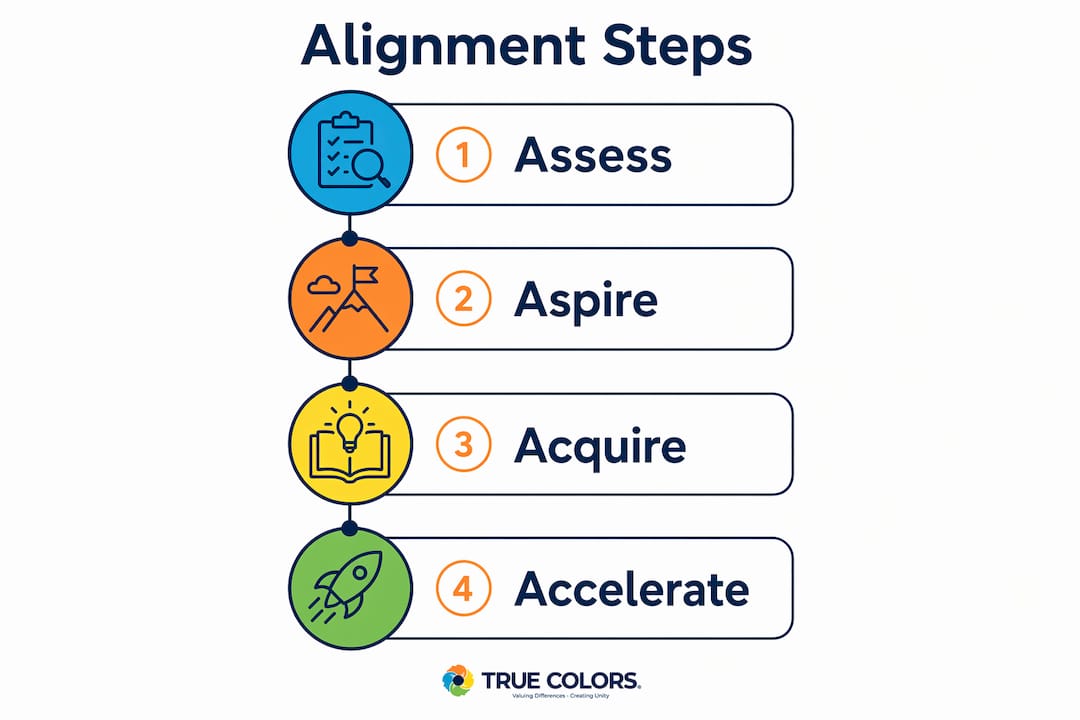
The table below outlines the four-step alignment framework that operationalizes this process in a repeatable way.
| Step | Focus | Key Action |
|---|---|---|
| Assess | Current state | Audit culture against strategic requirements honestly |
| Aspire | Future state | Define 3–5 strategic priorities every employee can recall |
| Acquire | Capability building | Align people, processes, and workflows to those priorities |
| Accelerate | Ongoing execution | Establish rhythmic check-ins and reinforce target behaviors |
Strategy tracking technologies are used by 63% of organizations, but technology only works when the cultural habits supporting it are already in place. A dashboard does not fix a culture that ignores feedback. The tool is only as effective as the behavior system around it.
Culture assessment tools, employee experience surveys, and leadership behavior audits are the practical instruments that surface gaps between stated values and lived reality. Truecolorsintl uses behavior-based frameworks to help organizations identify exactly where culture is helping or hurting performance before any change program begins.
Pro Tip: Before selecting any alignment tool or framework, have your executive team independently write down the top three cultural attributes required to execute your strategy. If the answers differ significantly, that gap is your starting point, not your tool selection.
How to align culture with goals: a step-by-step process
Turning cultural alignment from a concept into a practice requires a clear sequence. The following steps reflect how leading organizations move from diagnosis to sustained execution.
Step 1: Assess current culture honestly
Start by measuring what the culture actually rewards, not what it claims to value. Look at who gets promoted, which projects receive funding, and which behaviors leadership models consistently. This assessment should include input from frontline employees, not just senior leaders. The view from the middle of the organization is often the most accurate.
Step 2: Aspire by translating vision into shared priorities
A practical alignment framework requires 3–5 strategic priorities that every employee can recall without prompting. If your team cannot name the priorities without looking them up, the strategy has not been translated into culture yet. This step requires leaders to make hard choices about what matters most and communicate those choices repeatedly.
Step 3: Acquire by aligning people and processes
Once priorities are clear, align your talent, workflows, and decision rights to support them. This means reviewing hiring criteria, performance management systems, and meeting structures. Meso-level organizational design features such as decision authorities and meeting cadences govern daily habits more than any values statement. Changing these structural levers is where real culture shift happens.

Step 4: Accelerate through reinforcement and rhythmic check-ins
Culture is not what is said. It is what is repeated. Rhythmic check-ins and clear ownership create faster decision-making, fewer bottlenecks, and more predictable execution. Leaders must model the target behaviors visibly and consistently. When senior leaders act in ways that contradict the stated strategy, the culture registers that contradiction immediately and adjusts accordingly.
Executive team alignment on cultural requirements before cascading goals to the broader organization is the single most critical factor in preventing ambiguity and stalled initiatives. Get the senior team aligned first. Then cascade.
Pro Tip: Build a 90-day cultural reinforcement calendar alongside your strategic planning cycle. Identify three specific leadership behaviors that visibly demonstrate each strategic priority, and track them in your next leadership review.
What are the most common culture-strategy misalignment risks?
Misalignment does not usually announce itself. It accumulates quietly through small inconsistencies until execution breaks down. The following patterns are the most common causes:
- Leadership misalignment at the top. When executives hold different views of what the strategy requires culturally, those differences cascade into contradictory signals for every team below them.
- Neglecting structural design levers. Leaders focus on values and communication while ignoring the meeting cadences, decision rights, and approval processes that actually shape daily behavior.
- Cultures that punish what strategy demands. Cultures that punish risk-taking while the strategy demands innovation create a direct contradiction. Employees read the actual reward system, not the stated values.
- Insufficient reinforcement over time. Cultural coherence requires consistent reinforcement and a clear narrative. Organizations that launch culture programs without ongoing reinforcement see initial momentum fade within six months.
- Feedback loops that are absent or ignored. Culture must adapt as strategy evolves. Without structured feedback mechanisms, leaders cannot detect drift until it has already caused damage.
Understanding why culture initiatives fail often comes down to one root cause: leaders treat culture as a communications project rather than a systems design challenge. Changing the narrative without changing the structure produces cynicism, not alignment.
Culture-driven organizations outperform those without culture-strategy alignment on both revenue and value metrics. That performance gap is the cost of misalignment made visible.
Key Takeaways
Sustained culture-strategy alignment requires deliberate design at the structural level, not just values communication, and it must be reinforced continuously by leadership behavior.
| Point | Details |
|---|---|
| Culture is a strategic asset | Culture shapes promotion, resource allocation, and daily decisions more than any values statement. |
| Alignment requires structural change | Adjust decision rights, meeting cadences, and hiring criteria to reinforce strategic priorities. |
| Executive consensus comes first | Senior leaders must agree on required cultural attributes before cascading goals to the organization. |
| Reinforcement sustains alignment | Rhythmic check-ins and visible leadership behavior keep culture and strategy moving together over time. |
| Feedback loops prevent drift | Continuous measurement and adaptation allow culture to evolve alongside a changing strategy. |
What I have learned about making culture-strategy alignment real
By Theresa
After working with organizations across industries on culture and leadership, the pattern I see most often is this: leaders treat culture alignment as a communications project. They write a new set of values, hold an all-hands meeting, and expect behavior to follow. It rarely does.
The organizations that get this right do something different. They treat culture design as central leadership work, not a task delegated to HR or internal communications. The CEO and the executive team debate, disagree, and ultimately reach genuine consensus on what the culture must look like to execute the strategy. That debate is not a detour. It is the work.
What surprises most leaders is how much of culture lives in the structural details they overlook. The agenda of your weekly leadership meeting, who gets invited to key decisions, which projects receive emergency funding when priorities conflict. These are the real cultural signals. Employees watch them far more closely than they read the values on the intranet.
I have also seen organizations that measure culture well but adapt slowly. Continuous measurement with feedback loops is not optional. Strategy evolves. The competitive environment shifts. A culture that was perfectly aligned two years ago may be quietly resisting the new direction today. The leaders who catch that drift early are the ones who build measurement into their operating rhythm, not just their annual engagement survey.
The most honest thing I can tell you is that culture-strategy alignment is never finished. It is a practice, not a project. The organizations that treat it that way are the ones that sustain performance over time.
— Theresa
How Truecolorsintl helps you build alignment that lasts
Culture alignment is not a one-time initiative. It requires practical tools, leadership development, and ongoing reinforcement to produce lasting results. Truecolorsintl works with organizations to make culture measurable and actionable, from assessing current cultural patterns to building the leadership behaviors that drive strategic execution.
Through leadership development programs and corporate consulting solutions, Truecolorsintl helps executive teams reach alignment on cultural requirements, translate strategy into observable behaviors, and build the reinforcement systems that keep progress moving. Whether you are starting a culture assessment or scaling a change initiative, Truecolorsintl provides the frameworks and support to move from intention to execution.
FAQ
What does it mean to align culture with business strategy?
Aligning culture with business strategy means designing your organization's norms, behaviors, and systems to directly support your strategic goals. Culture shapes how employees prioritize decisions and allocate effort, so it must reinforce, not contradict, what the strategy requires.
Why does culture-strategy misalignment happen?
Misalignment most often occurs when leadership teams hold different views of what the strategy requires culturally, or when structural levers like decision rights and meeting cadences are left unchanged while values messaging shifts. Without consistent reinforcement, the gap between stated culture and lived culture widens.
How do you measure cultural alignment with strategy?
Measure alignment by examining promotion patterns, resource allocation decisions, and behavioral tolerances, not just survey scores. Employee experience surveys, leadership behavior audits, and structured feedback loops provide the most accurate picture of where culture and strategy diverge.
What is the first step to align culture with goals?
The first step is an honest assessment of what the current culture actually rewards, based on observable behavior and outcomes. That assessment must precede any aspiration-setting or change program to avoid building on a false baseline.
How long does culture-strategy alignment take?
Culture change is measured in years, not months. Organizations that establish rhythmic check-ins, reinforce target behaviors consistently, and adapt their structural design levers typically see meaningful shifts within 12–24 months, though continuous management is required indefinitely.