
A leadership capability model defines the specific, observable behaviors leaders need at each level of an organization, then connects those behaviors to development, assessment, and succession planning. Its central value is alignment: instead of vague qualities like "strong communicator," it gives HR and executives a shared, measurable language for what good leadership actually looks like. The strongest versions draw on institutional frameworks like the United Nations System Staff College (UNSSC) model and university-built competency guides, alongside practitioner systems built for day-to-day use.
TL;DR:
- Smaller organizations can effectively use lean models with four to six capability categories focused on sensemaking, visioning, relating, and inventing.
- Core leadership capabilities are consistent across frameworks and include strategic thinking, leading people, driving results, collaboration, learning, credibility, and developing culture.
- Building a useful framework requires aligning to strategy, choosing appropriate granularity, and linking capabilities to learning and succession processes.
- Regular reinforcement and embedding capability language into daily operations are more impactful than extensive initial design for sustaining leadership development.
- Adaptive, behavior-focused assessment methods and ongoing review ensure the framework remains relevant and drives authentic leadership behaviors.
Table of Contents
- What Are the Common Types of Leadership Capability Models?
- What Are the Core Leadership Capabilities Every Model Should Include?
- How Do You Build or Adapt a Leadership Capability Framework?
- How Do You Assess Leadership Capability and Set Proficiency Levels?
- How True Colors Applies Capability Models in Practice
- Leadership Capability Models vs. Competency Models: What Is the Difference?
- How Does Organizational Culture Shape Leadership Capabilities?
- What Are the Most Common Pitfalls When Deploying a Leadership Capability Model?
- What Do Real-World Applications of Leadership Capability Models Look Like?
- What the Research Actually Tells HR and L&D Leaders to Do First
- Turn Your Capability Model Into Sustained Leadership Behavior
- Sources
What Are the Common Types of Leadership Capability Models?
Most leadership capability frameworks fall into a handful of recognizable templates, and the differences matter more than they first appear.
The leanest version is the 4-cap model, popularized in updated leadership research from MIT Sloan Executive Education, which groups leadership into sensemaking, visioning, relating, and inventing. It works well for smaller organizations or flatter hierarchies where simplicity beats granularity. From there, models scale up: 5 to 6 capability clusters cover mid-sized organizations needing more nuance without full complexity, and 6 to 8 capability lists are the most common choice for companies balancing depth with usability.
At the top end sit comprehensive competency matrices, often built around 15 or 16 capabilities with full KSAB detail, similar to the structure in the UNSSC's Leadership and Management Competency Framework. Despite the range in size, every credible leadership capability framework shares three components:
- A capability statement naming the behavior domain
- Level descriptors showing how the behavior scales with seniority
- Observable behaviors that make assessment concrete rather than subjective
Choose lean models for smaller teams or early-stage capability work. Choose detailed matrices when role complexity is high, succession stakes are significant, or the organization needs defensible data for promotion decisions.
What Are the Core Leadership Capabilities Every Model Should Include?
Strip away the branding differences between frameworks and a consistent core emerges. These a set of core capabilities show up across UNSSC, university, and practitioner models, each with a one-line definition and observable behaviors reflecting some career stages.
- Strategic thinking. The capacity to connect daily decisions to long-term direction. Entry-level: asks how a task supports team goals. Senior-level: reallocates resources ahead of market shifts, not after them.
- Leading people. Directing and developing others toward shared outcomes. Entry-level: gives clear, timely feedback. Senior-level: builds succession depth two levels down.
- Driving results and execution. Converting plans into delivered outcomes. Entry-level: meets deadlines with quality. Senior-level: removes systemic blockers that limit team throughput.
- Collaboration and influence. Working across functions without formal authority. Entry-level: shares information proactively. Senior-level: builds coalitions across competing priorities.
- Learning and systems thinking. Adapting practice based on new information. Entry-level: incorporates feedback quickly. Senior-level: redesigns processes when the operating environment changes.
- Credibility and ethics. Consistency between what a leader says and does. The MIT Sloan framework treats credibility as the connective tissue that makes every other capability believable to the people being led.
- Developing people and culture. Actively growing others and shaping norms. Entry-level: mentors a peer. Senior-level: institutionalizes practices that outlast their own tenure, a pattern reflected in the University of Minnesota's leadership competency framework.
Notice what none of these require: a leader who is equally strong everywhere. Credible leadership research argues that leaders who know their gaps and build complementary teams outperform those chasing mastery across every capability.
How Do You Build or Adapt a Leadership Capability Framework?
Building a leadership capability framework from scratch, or adapting an existing one, works best as a sequence rather than a single workshop.
Step 1: Align to strategy and map your audience. Identify which roles and levels need capability definitions first, and tie the priority list directly to where the business is headed, not where it has been.
Step 2: Decide granularity and write behavioral statements. Choose between a lean 4 to 6 capability set or a fuller matrix, then draft each capability using active verbs describing what a leader does, not abstract traits they possess.
Step 3: Build KSAB descriptors and proficiency scales. Knowledge, Skills, Attitudes, and Behaviors matrices, the approach the UNSSC uses across its four-level progression, make expectations teachable instead of impressionistic.
Step 4: Map capabilities to learning pathways and succession. Development only sticks when it is timely and contextual; practitioner guidance on capability models recommends pairing each capability with mapped learning content rather than generic course catalogs. Our own guidance on building a leadership development curriculum walks through that sequencing in more depth.
Governance: assign a clear owner (usually L&D or HR leadership), set an annual strategic review, and track adoption metrics from day one.
- Owner: named HR/L&D lead with executive sponsorship
- Review cadence: at minimum annually, tied to strategic planning cycles
- Success metric: percentage of roles with documented capability expectations
Pro Tip: Sequence capability rollout the way the UNSSC structures its own framework: self-leadership first, team leadership second, organizational leadership last. Skipping straight to system-level capabilities before leaders have mastered self-awareness is one of the most common reasons capability language never sticks.
How Do You Assess Leadership Capability and Set Proficiency Levels?
Assessment is where most capability models either prove their worth or quietly fail. The toolkit that works in practice combines several methods rather than relying on one instrument.
- 360-degree feedback for triangulated perception across peers, direct reports, and managers
- Structured behavioral interviews anchored to the capability's observable indicators
- KSAB checklists scored against defined proficiency levels
- Direct observation during high-stakes moments (crisis response, change announcements)
- Pulse surveys that track perceived leadership behavior over time
A workable proficiency scale runs from functional (meets baseline expectations) to proficient (consistently strong, models the behavior for others) to transformative (shapes how the capability shows up organization-wide). Calibration matters here: behavior-first capability statements reduce rating ambiguity and speed up agreement across raters who might otherwise interpret "strategic thinking" very differently.
Once assessment data exists, convert it deliberately. Gaps become individual development plans, coaching assignments, or stretch roles, not vague feedback conversations. Feed the same data into succession planning so readiness decisions rest on evidence rather than tenure.
Track impact through a small set of KPIs: measurable behavior change on repeat assessments, role readiness scores ahead of promotion cycles, retention among high-potential leaders, and downstream performance metrics for the teams those leaders run.
How True Colors Applies Capability Models in Practice
Frameworks fail the moment they stop describing behavior and start describing intention. Truecolorsintl's Connected Leadership approach treats capability language as something leaders practice, not something they memorize, translating each statement into specific behavior-based interventions that show up in real interactions.
That looks like embedding capability language directly into onboarding conversations, performance check-ins, and employee experience surveys that measure whether behaviors are actually landing with teams. A leadership statement left in a slide deck changes nothing; one referenced in weekly team meetings and one-on-ones becomes a working compass, a pattern SmartBrief's coverage of leadership statements also points to.
Three tips from applying this work with organizations directly:
- Sequence for early wins: pick one or two capabilities with visible, fast payoff before rolling out the full model.
- Engage stakeholders before launch, not after, so managers feel ownership rather than compliance pressure.
- Build reinforcement into existing rhythms (meetings, reviews) rather than creating a separate capability-tracking process nobody sustains.
Leadership Capability Models vs. Competency Models: What Is the Difference?
The two terms get used interchangeably, and that confusion causes real design problems. A competency model typically catalogs the knowledge, skills, and traits needed to perform a job well, often role-specific and heavily tied to technical or functional requirements. A leadership capability model, by contrast, focuses specifically on the behaviors leaders use to influence people, decisions, and outcomes, regardless of technical function.
The practical distinction shows up in how each gets used. Competency models drive hiring criteria and job descriptions. Leadership capability models drive development conversations, succession readiness, and culture work, because they describe how someone leads, not just what they know. A finance director and a sales director might have entirely different competency models but share the same leadership capability expectations around driving results or developing people.
Some organizations try to merge the two into a single sprawling document, and that is usually where models collapse under their own weight. Keeping leadership capabilities distinct, even while referencing role-specific competencies elsewhere, keeps the framework usable for its actual purpose: developing how people lead, not just confirming they can do the job.
How Does Organizational Culture Shape Leadership Capabilities?
A capability model built without accounting for existing culture will describe leadership behaviors that never take root. Culture determines which capabilities get rewarded in practice, regardless of what the official framework says.
An organization that quietly punishes dissent will struggle to develop the collaboration and influence capability no matter how well it is defined on paper, because the informal incentives run in the opposite direction. Culture also shapes which capabilities feel urgent. A company scaling rapidly may need to prioritize driving results and systems thinking, while one recovering from a trust breakdown needs credibility and ethics front and center.

This is precisely why capability models cannot be copied wholesale from another organization's playbook. The UNSSC and CISL frameworks provide structure and rigor, but the specific emphasis, and the behaviors leaders are actually held accountable for, has to reflect what the organization's culture currently rewards and what it needs to reward instead. Ignoring that gap is how well-designed frameworks get adopted on paper and ignored in practice.
What Are the Most Common Pitfalls When Deploying a Leadership Capability Model?
Most leadership capability models do not fail because the content is wrong. They fail in the mechanics of rollout and reinforcement.
The most common failure is treating the model as a static document rather than something leaders actively use. A capability framework distributed once during a training session and never referenced again becomes shelf-ware within a quarter. The fix is straightforward but requires discipline: reference the capability language in onboarding, performance conversations, and team meetings on a recurring basis.
A second pitfall is building the model at the wrong level of granularity for the organization's size, either too detailed for a lean team to realistically use or too vague for a large, complex organization to assess consistently, which leaders can avoid by understanding stakeholder alignment and securing buy-in. A third is skipping calibration, where different managers interpret the same capability statement in wildly different ways, undermining trust in any resulting assessment data.
The fourth, and most damaging long term, is failing to review the framework as the business changes. The CISL's 2025 leadership research specifically recommends treating capability frameworks as living documents, revisited periodically rather than locked in place. A model built for a five-year-old strategy rarely fits the organization it is describing today.
What Do Real-World Applications of Leadership Capability Models Look Like?
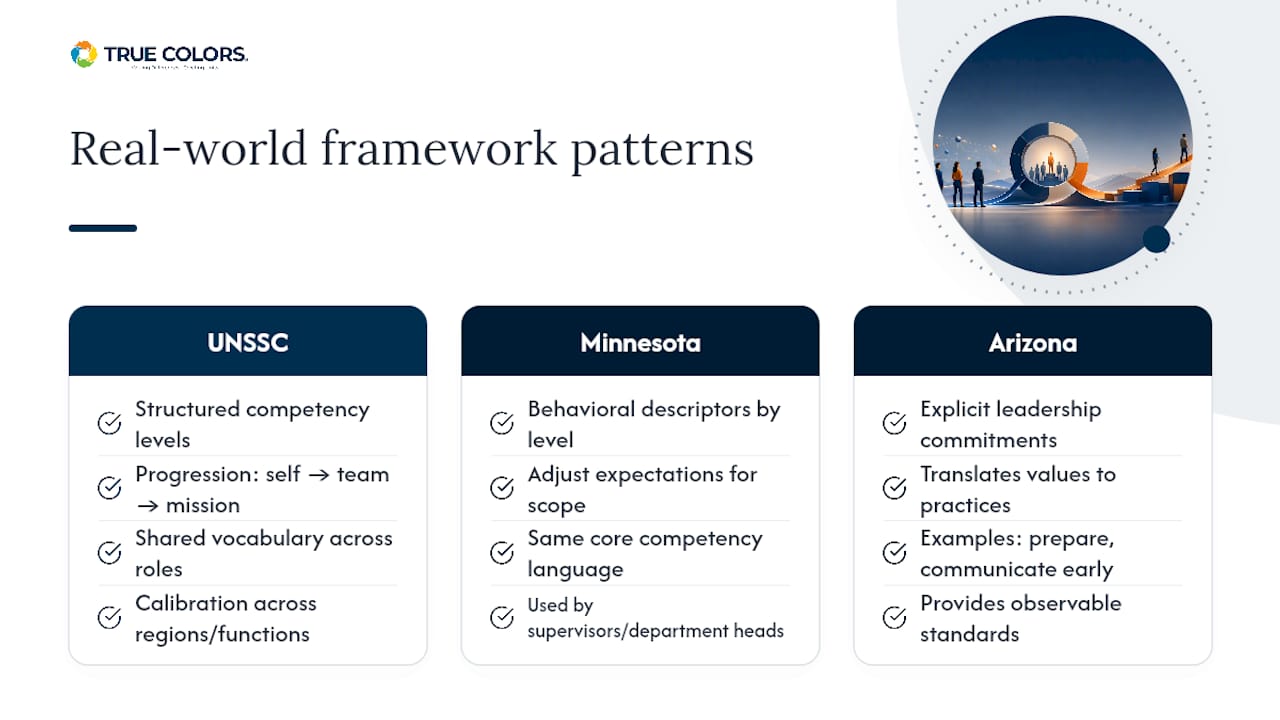
Institutional frameworks are not theoretical exercises. The UNSSC's competency framework structures expectations across four development levels, from individual contributor through organization-wide influence, giving international staff a shared vocabulary for readiness regardless of function or region. That level progression, self, then team, then mission, gives large, distributed organizations a way to calibrate expectations consistently across very different roles.
University systems apply the same logic at a different scale. The University of Minnesota's leadership competency framework ties specific behavioral descriptors to organizational levels, letting supervisors and department heads use the same core competency language while adjusting expectations for scope and seniority. The University of Arizona takes a related approach through explicit leadership commitments, translating abstract values into concrete practices like leading with preparation and communicating early, giving campus leaders observable standards rather than aspirational statements.
The common thread across these examples: none of them treat the framework as finished on delivery. Each ties capability language to a specific organizational rhythm, whether that is an annual review cycle, a supervisor training program, or an onboarding sequence, which is what separates a capability model that gets used from one that gets filed away.
What the Research Actually Tells HR and L&D Leaders to Do First
Most organizations over-invest in framework design and under-invest in reinforcement. That is the uncomfortable finding sitting underneath every institutional model reviewed here: UNSSC, CISL, and university frameworks all converge on rigorous, well-structured capability language, yet the practitioner evidence consistently points to embedding and repetition as the actual point of failure.
The conventional advice tells HR teams to spend months perfecting the capability list before rollout. That instinct is backwards. A lean, imperfect model referenced weekly in real conversations outperforms a comprehensive matrix that sits in a shared drive. Sequence matters more than completeness, and the UNSSC's own self-team-mission progression backs that up: capability development is a developmental arc, not a flat checklist to master simultaneously.
If you take one thing from the research, prioritize reinforcement infrastructure before you finalize every capability descriptor. Build the review cadence, assign the owner, and identify where the language will live in daily operations. A capability model earns credibility through repetition, not through the elegance of its first draft.
— Theresa
Turn Your Capability Model Into Sustained Leadership Behavior
A well-designed leadership capability model still needs a system to keep it alive, and that is where most internal efforts stall out after the initial rollout. Truecolorsintl's Connected Leadership Program is built specifically to close that gap: it converts capability language into ongoing behavior-based coaching, workshops, and reinforcement mechanisms, rather than a one-time training event your organization has to sustain alone.

This fits naturally for organizations that already have a capability framework on paper but have watched it lose momentum after the initial launch, and for those just starting to build one who want a system designed to keep working past year one. True Colors approaches culture as a behavior system: moving people from personal awareness their own style to aligned action, stronger leadership habits, and communication that holds up under pressure, then reinforcing it over time so progress does not quietly erode. If your leadership capability model needs a partner to operationalize it and keep it living, request a consultation through the Connected Leadership Program to see how the approach maps to your organization's current stage.
Sources
- Leadership capabilities for the 21st century | CISL (2025)
- UNSSC Leadership and Management Competency Framework (2026)
- Updated leadership framework | MIT Sloan Executive Education
- The Leadership Competency Framework | University of Minnesota Office of Human Resources