The best personality workshop activities do three things: they help each person name how they work, they let colleagues see those differences in a live work situation, and they end with a specific behavior someone will change. This guide gives you six activities with setup, timing and debrief questions, then shows how to turn one good session into habits that last.
TL;DR
- Choose activities that move people from self-awareness to observable action: self-reflection, then comparison across styles, then a real work case.
- Frame every session as a starting point for reflection, never as an evaluation or a label. Make sharing voluntary.
- A 45 to 90 minute session works for most teams. Split groups above roughly two dozen people, and give remote teams smaller breakout rooms.
- The debrief is where the value is. Close with one behavior per person and a follow-up date.
- Insight fades without reinforcement, so plan the next touchpoint before the workshop starts.
Table of Contents
- What makes a personality workshop activity worth running
- Set the ground rules before any activity
- Six personality workshop activities, with setup and debrief
- How to run the debrief
- Adapting activities to group size and remote teams
- Making it last: from workshop to habit
- Perspective: awareness is the start, not the outcome
- Bring this into your organization
- FAQ
- Sources
What makes a personality workshop activity worth running
Most teams have sat through a personality session that was pleasant and forgettable. People learned their color, letter or number, laughed about it, and went back to work unchanged. The activity was not the problem. The design was.
A useful activity has four features:
- A personal starting point. Each participant reflects on their own preferences before they hear anyone else's.
- A shared language. The group uses the same simple vocabulary for styles, so a comment like "I need the big picture first" lands without a lecture.
- A real case. The group applies the styles to a current work situation, not a hypothetical one.
- A commitment. Every person leaves with one observable action and a date for follow-up.
Culture is not what is said. It is what is repeated. An activity earns its place when it changes what people repeat on Monday morning.
Set the ground rules before any activity
Personality material touches identity, so the first five minutes decide whether people open up. Three framing points protect psychological safety:
- The purpose is self-awareness and team awareness, not evaluation. Say plainly that results will not be used for hiring, promotion or performance ratings.
- The model is a starting point. Present the results as a prompt for reflection, not a definitive description of anyone.
- Participation is voluntary. Nobody has to announce their result. People can share a strength or a preference without sharing a label.
This framing is also well supported by the research. A peer-reviewed study of 18 HRD professionals found that type-based tests can lack predictive validity and discriminant validity, partly because of their forced-choice formats. That is a good reason to use personality tools for what they do well, building awareness and a shared vocabulary for conversation, and not for selection decisions or fixed judgments about people. Used this way, a behavior-based assessment gives a team a common reference point and does not put anyone in a box.
Six personality workshop activities, with setup and debrief
1. Four corners: self-type, huddle, cross-table case (45 minutes)
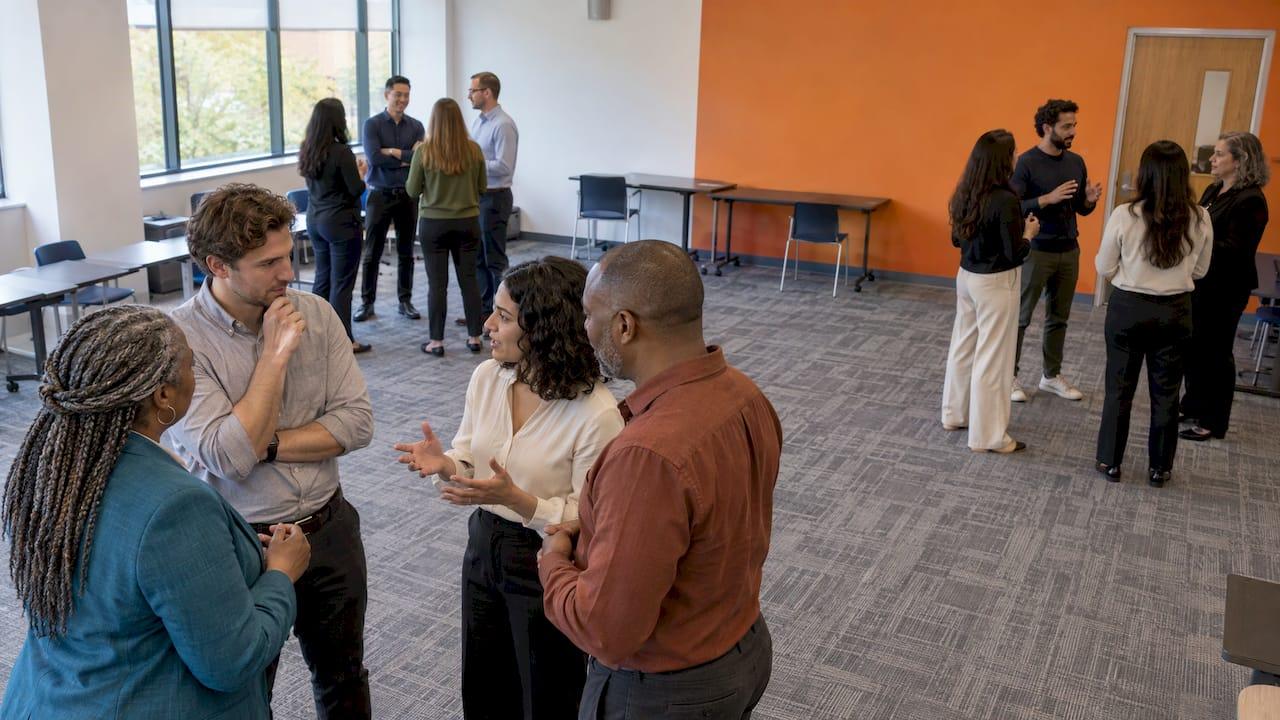
This is the most reliable format we know for a first session because it moves a group from reflection to action in one sitting. It suits 6 to 24 people.

Setup: a room with four usable corners, one sign per style, one blank card per person, and tables of four to six people for the final round. Above 24 people, run two identical halves or add a second facilitator.
Flow:
- Self-type (about 8 minutes). Participants read short descriptions of all four styles, silently choose the one that fits them best, and walk to that corner. Silence matters: it keeps people from choosing the style their friends chose.
- Same-style huddle (about 10 minutes). Each corner answers three prompts: one strength we lean on, one blind spot others keep noticing, and one thing other styles misread about us.
- Cross-table case (about 15 minutes). Re-mix the room so each table holds every style. Present a real, current work situation, such as a delayed project or a decision stuck in review. Each person reads it from their own style's point of view, then the table agrees on one next move, with an owner and a date.
- Plenary debrief (about 12 minutes). Use the questions in the debrief section below.
The cross-table case is the heart of the activity. Self-awareness stays abstract until someone sees their own style misread, or sees a colleague's style solve a problem they were stuck on.
2. Opposite-style interviews (30 minutes)
Pair each person with the colleague whose style differs most from theirs. In pairs, each person answers a short set of prompts: my natural strengths, my favorite part of the work, what helps me do my best work, and what drains me. The listener's only job is to ask one follow-up question.
Then each pair reports back one thing they learned that surprised them. This works well with a mixed group because it builds a relationship across styles, not just a concept. It is also an excellent follow-up for teams who have already taken an assessment and know their results.
3. Preference line-up (30 to 40 minutes)
Before the meeting, participants complete an assessment. In the room, mark a line on the floor for each preference pair your model uses, with the ends labeled. Participants stand where their results place them, or where they naturally fall if they disagree with the result. That second option is important: it invites people to question the instrument.
After each line, the facilitator asks the group to look around:
- Where does the team cluster, and where is it evenly spread?
- How does this preference show up in meetings, deadlines or feedback?
- What does the team gain from a cluster, and what might it overlook?
The line-up makes team composition visible in under a minute per dimension. A team that discovers it is heavily weighted toward one end often recognizes its own recurring blind spot.
4. Team tension mapping (60 minutes)
This activity is for teams that already feel friction. It follows the pattern described by researchers at MIT Sloan Management Review: after team members complete a Big Five assessment, facilitated discussions let participants connect their collective traits to team tensions, whether latent or overt, and defuse them. For newly formed teams, the same exercise can speed up cohesion.
A practical version:
- Display the team's combined profile, anonymized if the group prefers.
- Ask each person to write one recurring friction in the team on a card, without names.
- Cluster the cards on a wall.
- For each cluster, ask: which style differences could explain this pattern?
- Agree on one working agreement per cluster, for example "decisions that need input are sent 24 hours ahead".
The discipline here is to talk about patterns and styles, never about individuals. If a conversation drifts toward a person, the facilitator redirects to the pattern.
5. Communication translation drill (45 minutes)
Give each table a single message, such as "The launch is moving two weeks." Ask each person to rewrite it the way they would want to receive it, then the way a colleague of a different style would want to receive it. Compare versions.
People discover quickly that one person wants the reason and the risk, another wants the new date and the action list, another wants to know how it affects the people involved, and another wants the whole picture and a chance to react. This is a low-stakes way to practice a skill leaders use daily. For more on this theme, see our piece on how personality affects workplace communication.

6. Team agreements workshop (60 to 90 minutes)
Use this one after an earlier session, when the team has a common vocabulary. Starting from the team's style mix, the group writes four or five agreements about how it will work: how decisions are made, how disagreement is raised, how meetings run, how recognition is given, and how requests are made.
Keep each agreement observable. "We communicate respectfully" cannot be seen. "We send the agenda 24 hours ahead and name the decision needed" can. Each agreement gets an owner and a review date.
How to run the debrief
The debrief turns an enjoyable activity into a lasting one. A good set of questions for the final 10 to 15 minutes:
- What surprised you, as opposed to what confirmed what you already believed?
- What is one thing people of your style are often misread as?
- Where did the live case change once you looked at it from another style?
- Which style is missing from this team's decisions, and what does that cost us?
- What is one behavior you will do differently before the end of the week?
- When will we meet again to check on it?
The last two questions matter most. Without a named behavior and a follow-up date, the session is an event, not a change.
Adapting activities to group size and remote teams
| Situation | What to change |
|---|---|
| Small team of 6 to 10 | Run the full sequence in one session. Pair interviews and team agreements fit well here. |
| 11 to 24 people | Use four corners with mixed tables of four to six. Add one co-facilitator for the cross-table round. |
| Above 24 people | Split into two identical halves or add a second facilitator. Run the plenary debrief with representatives from each table. |
| Remote or hybrid | Replace corners with breakout rooms by style, keep rooms to four to six people, and use a shared board for the live case. Ask for cameras optional and chat welcome. |
| Cross-functional or leadership team | Spend more time on tension mapping and team agreements, less on introductions. |
For remote groups, shorten each segment slightly and give people a minute of silent writing before every discussion, since talking over each other on video drowns out quieter participants. In hybrid rooms, give the remote participants the first word so they do not become observers.
Making it last: from workshop to habit
A single workshop raises awareness. A habit needs repetition, and leaders can build it into ordinary work without adding many meetings:
- Name the behavior, not the trait. "I will send the context before asking for a decision" is trackable. "I will be more open" is not.
- Put the language into existing meetings. Start a weekly check-in with one question: whose style is missing from this decision?
- Schedule a 30-minute follow-up within two to four weeks. Ask each person what they tried, what happened and what they will adjust.
- Have leaders go first. When a senior leader says "my style tends to rush to a decision, so please slow me down," the team learns the language is safe to use.
- Connect it to onboarding. New hires who learn the team's shared vocabulary in their first weeks join the culture, not just the department.
- Measure what changes. A pulse survey on communication, trust and role clarity before and after gives leaders evidence about what is shifting. Our employee experience survey is built for this.
For a wider view of workshop formats, our guides on types of team collaboration workshops and team effectiveness workshops and measurement go deeper on planning, and how personality assessments for teams are applied in daily work shows what reinforcement looks like in practice.
Perspective: awareness is the start, not the outcome
We see the same pattern in organizations of every size. Leaders invest in an assessment or a team day, people enjoy it, and six weeks later the language has disappeared. The activity was fine. Nothing carried it forward.
That is why we treat personal awareness as the first step in a system, not a product in itself. People first understand how they think, communicate and make decisions. Then they learn to recognize those differences in others. Then the team practices new behavior on real work, and leaders reinforce it until it becomes what the organization repeats.
The activities in this guide are built to move in that order: self, others, real case, commitment, follow-up. When a shared language is in place, a hard conversation about a missed deadline or a clash between two departments becomes easier to start, because people can talk about how they work without making it personal.
Our approach is designed for that long arc. We pair behavior-based assessments with team training and continued reinforcement, so the insight from a single workshop becomes a working habit for the whole organization.
Theresa
Bring this into your organization
If you are a CHRO, L&D director or executive planning a culture or leadership initiative, we can help you move past a one-off session. Our team training programs, including communication, team building and conflict navigation, give groups a shared language and a structure for applying it to real work. We also offer an employee experience survey to show where culture is helping or hurting performance.
Explore our team training programs or learn how our corporate consulting solutions can be tailored to your organization.
If you would like to see how personality styles play out day to day first, our guide to personality styles at work is a good next read.
FAQ
How long should a personality workshop activity take?
Most single activities run 30 to 45 minutes, and a full introductory session of self-reflection, comparison and a real case fits in about 45 to 90 minutes. Allow at least 10 minutes for the debrief, because that is where the commitments are made. Team agreements and tension mapping deserve a full hour.
Which activity works best for a team in conflict?
Team tension mapping is the best fit, because it links style differences to specific, recurring friction without blaming individuals. Pair it with a team agreements session afterward so the discussion produces observable working rules. For deeper, ongoing friction, a structured conflict navigation training gives the team practical steps.
Can we run these activities with remote or hybrid teams?
Yes. Use breakout rooms of four to six people in place of room corners, a shared digital board for the live case, and silent writing before discussions. In hybrid rooms, invite remote participants to speak first so they stay fully involved.
Should we use personality results in hiring or promotion decisions?
No. Keep workshop results for development, communication and team awareness. Research on type-based tests notes limits in their predictive validity, and telling participants up front that results are never used for evaluation is what makes honest conversation possible.
How do we make the learning stick after the workshop?
End with one observable behavior per person and a scheduled follow-up within a few weeks. Use the shared vocabulary in regular meetings, have leaders model it first, and measure change with a pulse survey. Reinforcement over time is what turns awareness into culture.
Sources
- A New Way to Address Troubled Team Dynamics, MIT Sloan Management Review
- "This is not a test": How do human resource development professionals use personality testing, Human Resource Development Quarterly