
A leadership development program (LDP) is a structured, multi-month initiative that prepares high-potential employees for senior leadership roles through a deliberate combination of learning, mentoring, stretch assignments, and executive exposure. Unlike a one-day workshop or a single training course, an LDP is a sustained investment in building the leadership pipeline your organization will depend on. Research confirms that programs designed this way produce measurably stronger leaders than episodic training events. For HR professionals and business leaders, understanding what separates a well-designed LDP from a costly underperformer is the difference between a thriving leadership bench and a recurring talent gap.
What is a leadership development program and how is it structured?
A leadership development program is defined as a formal, organization-sponsored initiative that builds strategic, interpersonal, and enterprise-level capabilities in selected employees over an extended period. The industry term used by practitioners and researchers is “leadership development program” (LDP), which refers specifically to a multi-component system rather than any single course or seminar. Yale School of Management describes fast-track rotational programs with mentorship and formal training as the defining model for LDPs across industries.
Most programs run for 12 to 24 months, reflecting the time required to produce genuine behavior change rather than surface-level awareness. That duration is not arbitrary. It aligns with how adults internalize new leadership behaviors: through repeated practice, feedback, and application across different contexts.

Core components found in most LDPs
The structure of a well-designed program typically includes several interconnected elements working together:
-
Rotational assignments: Participants move through different business units or functions to build a cross-functional perspective and test their adaptability.
-
Formal training modules: Structured learning sessions covering topics such as strategic thinking, communication, conflict resolution, and organizational dynamics.
-
Mentorship and coaching: One-on-one relationships with senior leaders or external coaches who provide guidance, challenge assumptions, and model leadership behavior.
-
Stretch assignments: Real projects with meaningful stakes that require participants to apply new skills outside their comfort zone.
-
Cohort learning: Peer groups that create a shared language, mutual accountability, and a network that often outlasts the program itself.
Pro Tip: Design your cohort groups deliberately. Mixing participants from different functions and levels creates richer peer learning and prevents the echo-chamber effect that weakens single-department cohorts.
The table below compares common LDP formats to help you match program design to organizational context.
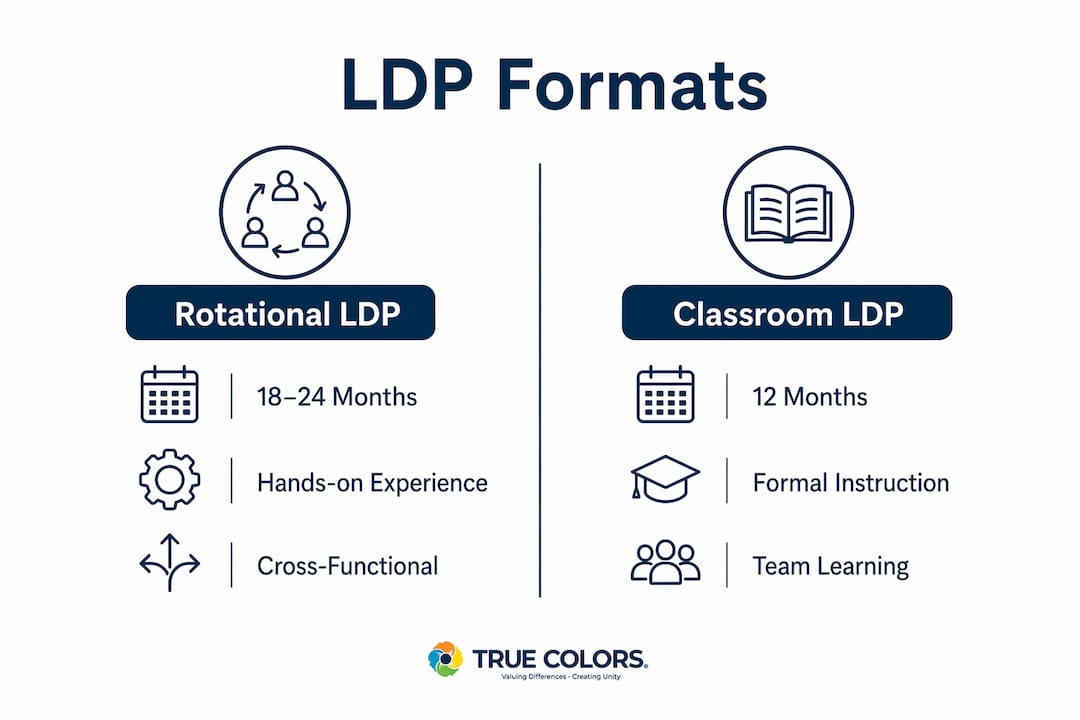
| Format | Typical duration | Primary mechanism | Best suited for |
|---|---|---|---|
| Rotational LDP | 18–24 months | Cross-functional job rotations | Large enterprises with multiple business units |
| Cohort-based LDP | 12–18 months | Peer learning and structured curriculum | Mid-size organizations building a shared leadership culture |
| Executive sponsorship program | 12 months | Senior leader mentorship and exposure | High-potential individual contributors |
| Blended learning LDP | 12–24 months | Online modules plus in-person intensives | Geographically distributed organizations |
What does research say about effective program design?
Program design quality is a stronger predictor of leadership development success than production values or program cost. This finding from research synthesis on LDP outcomes reframes how organizations should allocate their development budgets. Spending more on a polished program with generic content produces weaker results than investing in a leaner program built on rigorous design principles.
The most cited meta-analysis on leadership training examined 335 samples and found that programs incorporating needs analysis, feedback, practice, and spaced sessions produced a job transfer effect size of approximately δ = .82. That is a large effect by any standard in organizational research, and it signals that the right design features reliably move the needle on real-world leadership behavior.
Leadership development is effectively behavior change engineering that requires participants to apply learnings on the job, receive feedback, and revisit behaviors repeatedly to prevent skill decay.” — GOV.UK Rapid Evidence Review.
Several design features consistently separate high-impact programs from low-impact programs:
-
Upfront needs analysis: Identifying specific leadership gaps before designing content prevents the generic-program trap and ensures relevance to participants’ actual roles.
-
Multiple delivery methods: Combining formal instruction with on-the-job application, peer discussion, and coaching produces deeper learning than any single method alone.
-
Practice with feedback: Interactive workshops with targeted behavioral practice outperform demonstration-only or virtual-only formats.
-
Spaced learning: A meta-analytic review found that distributed practice over weeks and months produces a learning retention advantage of d = 0.54 compared to compressed, intensive formats. Spacing content across a program’s timeline is not a scheduling convenience. It is a learning science requirement.
-
Face-to-face components: On-site delivery with real-time feedback remains more effective than fully virtual programs for developing interpersonal and strategic leadership behaviors.
Pro Tip: Before purchasing any off-the-shelf leadership curriculum, map it against your organization’s specific leadership competency gaps. If the curriculum does not address those gaps directly, it will not transfer to the job regardless of how well it is produced.
How do leadership development programs differ from leadership training?
Leadership development and leadership training are related but not interchangeable. Leadership training refers to episodic events: a two-day workshop on giving feedback, a seminar on executive presence, or an online course on change management. These events build awareness and introduce concepts, but they rarely produce sustained behavior change on their own.
A leadership development program, by contrast, is a sustained behavior-change system that integrates training events into a longer arc of application, reflection, and reinforcement. The distinction matters because organizations that treat development as a series of training events consistently underinvest in the transfer mechanisms that make learning stick.
Management training adds a third category worth clarifying. The differences between these three approaches follow a clear progression:
-
Management training focuses on operational skills: delegation, performance management, scheduling, and process execution. It targets people who manage work and tasks.
-
Leadership training focuses on specific interpersonal or strategic skills delivered in a defined session. It targets individuals who need to build discrete capabilities.
-
Leadership development programs focus on enterprise-level capabilities: strategic thinking, organizational influence, culture building, and leading through ambiguity. They target high-potential employees and prepare them for senior roles over an extended period.
The practical implication for HR professionals is that these three approaches serve different populations and different organizational needs. Conflating them leads to misaligned program design, wasted budget, and frustrated participants who receive the wrong development for their stage and role.
How can organizations implement and sustain effective LDPs?
Implementing a leadership development program that produces lasting results requires more than selecting a curriculum and scheduling sessions. The organizations that see the strongest return on their development investment follow a disciplined sequence from diagnosis through reinforcement.
Start with a rigorous needs analysis
Skipping needs analysis is the most common and most costly mistake in LDP design. Without a clear picture of current leadership gaps, programs default to generic content that participants cannot connect to their real challenges. A needs analysis should examine current leadership competency data, business strategy requirements, and the specific contexts in which your future leaders will operate.
Build in practice, feedback, and reinforcement
The program architecture should create repeated cycles of learning, application, and feedback rather than front-loading content and hoping it transfers. Specific on-the-job assignments tied to each learning module provide participants with a structured way to practice new behaviors under real-world conditions. Scheduled check-ins, peer coaching, and manager debriefs create the feedback loops that prevent skill decay between sessions.
Use cohorts and mentoring to build shared standards
Cohort-based approaches create social environments in which participants hold one another accountable, share observations from their application assignments, and build a common leadership language across the organization. Mentoring relationships with senior leaders add organizational context that no classroom can replicate. Both mechanisms extend the program’s influence beyond formal sessions.
Plan for post-program reinforcement
The formal program is not the finish line. Organizations that treat program completion as the end of development see rapid skill decay within months. Effective programs build a reinforcement plan into the design from the start, including follow-up coaching, alumni networks, and stretch assignments that continue after graduation.
-
Assign post-program sponsors who check in on behavioral application at 30, 60, and 90 days.
-
Create alumni cohort touchpoints to sustain the peer network and shared accountability.
-
Connect program graduates to visible leadership opportunities that reinforce new behaviors in high-stakes contexts.
-
Use employee experience data to track whether changes in leadership behavior are registering at the team level over time.
Key takeaways
Effective leadership development programs succeed because they combine rigorous needs analysis, spaced practice with feedback, cohort learning, and sustained post-program reinforcement within a 12 to 24-month design.
| Point | Details |
|---|---|
| Definition matters | An LDP is a multi-month behavior change system, not a series of training events. |
| Design drives outcomes | Needs analysis, practice, and spaced learning predict transfer more than program cost or production quality. |
| Training vs. development | Management training targets operational skills; LDPs build strategic and enterprise-level leadership capabilities. |
| Cohorts accelerate learning | Peer cohorts create shared language, mutual accountability, and reinforcement that extends beyond formal sessions. |
| Reinforcement is non-negotiable | Post-program coaching, alumni networks, and stretch assignments prevent skill decay and sustain behavior change. |
What I’ve learned about where leadership programs break down
After working with organizations across industries on leadership development and culture change, I see the pattern most often is not a lack of investment. It is a lack of design discipline. Organizations spend real money on well-produced programs and then wonder why leadership behavior does not change. The answer is almost always the same: the program skipped the needs analysis, compressed the learning into a few intensive days, and had no reinforcement plan after the final session.
Research on why leadership development programs fail consistently points to the same structural gaps. What strikes me is how preventable they are. A thorough needs analysis takes time, but it is far less expensive than redesigning a program after it fails to produce results.
I have also seen organizations underestimate the power of cohort learning. When participants go through a program together, they build a shared vocabulary for leadership behavior that persists long after the program ends. That shared language is one of the most undervalued outputs of a well-designed LDP. It makes culture change visible and measurable in a way that individual training never can.
The organizations that get the most from their leadership development investment treat it as a system, not an event. They connect program design to business strategy, build in feedback loops, and plan for reinforcement from day one. That is not a complicated formula. It is just a disciplined one.
— Robert Cook
How Truecolorsintl supports leadership development that sticks
Organizations that want leadership development to produce real, observable behavior change need more than a curriculum. They need a system that connects individual awareness to team performance and organizational culture. Truecolorsintl builds that system.

Through leadership development and culture-building programs, Truecolorsintl helps organizations design and implement LDPs grounded in behavioral science and practical application. The Connected Leadership Program provides a structured framework for developing leaders through coaching, mentoring, and experiential learning that transfers directly to the job. For organizations ready to move from awareness to aligned action, Truecolorsintl offers the tools, frameworks, and corporate consulting solutions to make leadership development a sustained organizational capability rather than a one-time initiative.
FAQ
What is a leadership development program in simple terms?
A leadership development program is a structured, multi-month initiative that prepares high-potential employees for senior leadership roles through learning, mentoring, stretch assignments, and exposure to executives. It differs from a single training course by integrating practice, feedback, and reinforcement over an extended period.
How long does a typical leadership development program last?
Most leadership development programs run 12 to 24 months. This duration reflects the time required to produce genuine behavior change through spaced learning, repeated practice, and on-the-job application rather than surface-level awareness from a short course.
What are the most important design features of an effective LDP?
Research identifies needs analysis, practice with feedback, spaced learning sessions, and face-to-face delivery as the strongest predictors of leadership training transfer to the job. Programs that include all four features consistently outperform those that rely on content delivery alone.
How does a leadership development program differ from management training?
Management training targets operational skills such as delegation and performance management. A leadership development program builds strategic, interpersonal, and enterprise-level capabilities in employees, preparing them for senior roles over a sustained period.
Why do so many leadership development programs fail to produce results?
The most common causes are skipping the upfront needs analysis, compressing learning into intensive short events without spaced reinforcement, and failing to plan for post-program application and follow-up. Programs that treat development as a one-time event rather than a sustained system consistently underdeliver on behavior change.