
Executive team cohesion is the degree to which a senior leadership group is aligned around shared goals (task cohesion) and mutually committed to one another's success (social cohesion), producing faster decisions, clearer strategy execution, and stronger organizational resilience. Before you read further, three things you can do right now:
- Run a two-question cohesion check in your next meeting: Ask each executive to rate, on a 1–5 scale, how clearly they understand their own decision-making authority and how confident they are that peers will follow through on cross-functional commitments.
- Set one explicit meeting norm today: Name it, write it down, and hold the first violation accountable within the same meeting. Norms only exist if they are enforced.
- Assign a 30-day diagnostic owner: One person, accountable for gathering baseline behavioral data (meeting participation, decision follow-through rates, escalation lag times) before the next leadership offsite.
Research from Grossman et al.'s 2022 meta-analysis of 195 studies and more than 12,000 participants confirms that task-focused, behavioral measures of cohesion predict team performance more reliably than social or attitudinal measures alone. Harvard Business School practitioner guidance reinforces this: cohesive executive teams require explicit behavioral norms and ongoing investment from the CEO, not just goodwill. Truecolorsintl's behavior-based system is built around exactly this principle, moving organizations from individual awareness to aligned, observable action.
Table of Contents
- What is executive team cohesion, and what are its two core dimensions?
- Why does executive team cohesion affect business performance?
- How do you recognize and measure cohesion in your leadership team?
- Why do executive teams lose cohesion?
- What practical interventions build executive team cohesion?
- What timeline and resources should you plan for?
- How do you diagnose and fix cohesion problems in one week?
- How does Truecolorsintl's behavior-based system build executive team cohesion?
- How do leadership styles shape executive team cohesion?
- How does organizational culture affect executive team cohesion?
- How do you maintain cohesion during organizational change or crisis?
- Key Takeaways
- The behavioral foundation that most executive teams skip
- Truecolorsintl helps executive teams move from awareness to aligned action
- Useful sources for further reading
What is executive team cohesion, and what are its two core dimensions?
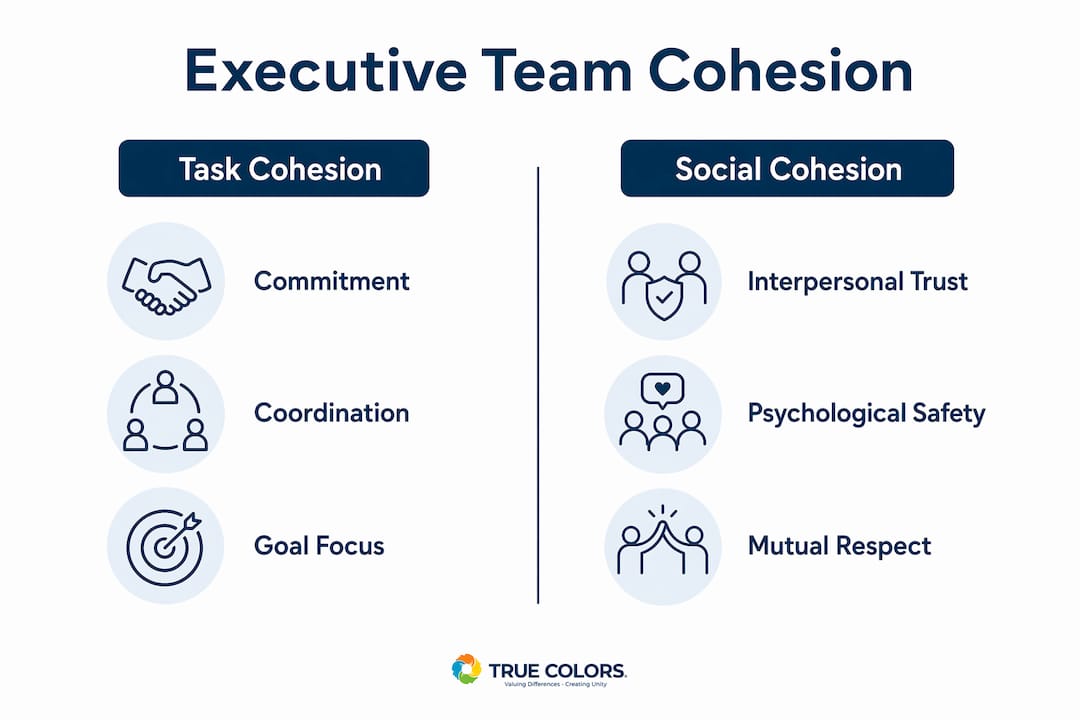
Leadership team cohesion is not a single feeling of camaraderie. It has two distinct, measurable dimensions that operate differently and predict different outcomes.
Task cohesion is the shared commitment to the team's goals and the coordinated behaviors that support them: joint ownership of strategy, clear decision rights, mutual accountability for cross-functional deliverables, and consistent follow-through. When task cohesion is high, executives do not just agree on priorities in a meeting; they act on them between meetings without needing to be reminded.
Social cohesion is the quality of interpersonal relationships: mutual liking, psychological safety, and the willingness to raise uncomfortable truths without fear of retaliation. It matters, but it is not sufficient on its own. A team can be personally close and still fail to execute because roles are ambiguous or decision protocols are absent.
| Dimension | What it looks like in practice | Primary performance driver? |
|---|---|---|
| Task cohesion | Joint goal ownership, clear decision rights, consistent follow-through | Yes — strongest predictor |
| Social cohesion | Psychological safety, candid dissent, mutual support | Enabling condition |
| Group pride | Shared identity, pride in team membership | Tertiary, context-dependent |
The Grossman et al. meta-analysis found that proximal, task-focused behavioral measures correlate more strongly with performance than distal social or attitudinal measures. That finding has a direct implication for how you invest your time: fix the behavioral infrastructure first.
A cohesion measurement note: Measure both individual perceptions and team-level aggregates. A single executive's low score on psychological safety may reflect a personal dynamic; a team-level pattern signals a structural problem. Multilevel measurement gives you the resolution to tell the difference.
Why does executive team cohesion affect business performance?
The business case for cohesion is not abstract. It shows up in the metrics executives are already tracking.
When task cohesion is high, decisions move faster because authority is clear and executives do not relitigate settled questions. Strategy milestones land on time because cross-functional dependencies are honored. Employee engagement holds steadier because the signals coming from the top team are consistent rather than contradictory. And when the organization faces a crisis, a cohesive leadership team can absorb ambiguity and maintain direction rather than fracturing along functional lines.

There is also a less obvious benefit. Research on boundary-spanning activity shows that executive teams with high cohesion convert external networks, outside directorships, and stakeholder relationships into firm-level advantage. Low-cohesion teams face the opposite risk: individual executives use those same external ties to advance personal agendas, creating misalignment that erodes the strategy from the outside in.
The risks of weak cohesion are equally concrete:
- Fragmented agendas: Functional leaders optimize for their own units, and cross-functional initiatives stall or require constant CEO arbitration.
- Managerial opportunism: Executives with strong external networks but low team loyalty can redirect resources or attention in ways that benefit their function at the expense of the whole.
- Slower execution: Without clear decision rights and follow-through norms, every cross-functional decision requires a meeting to schedule a meeting.
- Eroded stakeholder confidence: Boards, investors, and employees read inconsistency at the top as a signal of strategic uncertainty.
Concrete metrics to watch: 90-day strategy milestone completion rates, time-to-decision on cross-functional issues, employee engagement drift across quarters, and the average lag between an issue being identified and being escalated to the right decision-maker.
How do you recognize and measure cohesion in your leadership team?
Cohesion is observable. You do not need a lengthy survey to get a first read; you need the right questions and the discipline to track behavioral signals over time.
Sample survey items (referent-shift phrasing for team-level aggregation):
- "Our team has a clear, shared understanding of our top three strategic priorities." (Task)
- "Members of our team follow through on commitments made in leadership meetings." (Task/behavioral)
- "On our team, it is safe to raise a concern that contradicts the majority view." (Social/psychological safety)
- "Our team members actively support one another's success across functions." (Social)
Collect responses individually, then aggregate to a team mean. A gap between the highest and lowest individual scores on any item is itself a signal worth investigating.
Behavioral metrics that matter:
| Indicator | What it signals | Recommended first action |
|---|---|---|
| Meeting participation parity | Whether all voices are heard or a few dominate | Rotate facilitation; use structured turn-taking |
| Decision follow-through rate | Whether commitments made in meetings are honored | Add a standing agenda item: "commitments from last meeting" |
| Cross-functional dependency completion | Whether handoffs between functions happen on time | Map dependencies; assign named owners |
| Frequency of candid dissent | Whether psychological safety is real or performative | Normalize dissent explicitly; thank the person who raises it |
| Escalation lag time | Whether problems surface early or fester | Set a clear escalation norm for cross-functional blockers |
A one-meeting diagnostic checklist:
- Did every executive speak at least once on a substantive agenda item?
- Was there at least one instance of genuine disagreement, openly expressed?
- Were commitments from the previous meeting reviewed and accounted for?
- Did the team make at least one clear decision with a named owner and deadline?
If you answer "no" to two or more of these, you have a behavioral cohesion gap that warrants immediate attention. The Salas et al. measurement review recommends blending behavioral indicators with attitudinal items and analyzing at the team level for the most actionable insights.
Why do executive teams lose cohesion?
Cohesion rarely collapses all at once. It erodes through patterns that are easy to rationalize in the moment and hard to reverse once they become norms. The True Colors blog on leadership team warning signs identifies several of these patterns in detail.
-
Unclear role expectations. When executives are uncertain about where their authority ends and a peer's begins, they either over-reach or under-contribute. Red flag: recurring debates about who owns a decision. Pro tip: Publish a one-page decision rights map before the next leadership meeting and ask each executive to mark where they see ambiguity.
-
Competing functional agendas (silos). Each leader optimizes for their own unit's metrics, and cross-functional commitments become secondary. Red flag: cross-functional projects consistently miss milestones while functional projects hit them. Pro tip: Add one shared cross-functional metric to every executive's performance scorecard.
-
Low psychological safety. Executives self-censor in meetings and raise concerns in hallway conversations instead. Red flag: unanimous agreement in meetings followed by private dissent. Pro tip: At the close of each meeting, ask one open question: "What did we not say today that we should have?"
-
Too-rare or unfocused meetings. Without regular, structured time together, the team operates as a collection of functional heads rather than a leadership unit. Red flag: the only time the full team meets is for the monthly business review. Pro tip: Add a 30-minute weekly "team health" touchpoint with no operational agenda, focused only on cross-functional dependencies and blockers.
-
Rapid turnover. Every new executive resets the team's relational and task-cohesion baseline. Red flag: onboarding is treated as an individual process rather than a team integration process. Pro tip: Assign a peer sponsor for every new executive and run a structured team formation session within the first 60 days.
-
Asymmetric boundary-spanning. Some executives have rich external networks; others do not. Without cohesion, those networks serve the individual rather than the firm. Red flag: external relationships are not shared or debriefed with the team. Pro tip: Create a standing agenda item for executives to share one external insight or relationship opportunity per month.
What practical interventions build executive team cohesion?
The most reliable path to stronger cohesion starts with behavioral, task-oriented changes. Meeting design and decision protocols produce observable gains within weeks. Social and relational work, while valuable, builds on that behavioral foundation rather than replacing it. This sequencing is supported by the Grossman et al. meta-analysis and by Bridgespan's Executive Team Effectiveness Toolkit, which identifies role clarity, meeting design, and behavioral norms as the highest-leverage levers.
30-day: Diagnose and stabilize
- Run the one-meeting diagnostic checklist from the Signs & Metrics section.
- Publish a decision rights map and resolve the top three ambiguities.
- Establish two explicit meeting norms (e.g., "commitments are reviewed at the start of every meeting" and "dissent is named and welcomed, not managed offline").
- Assign a metrics owner to track behavioral indicators monthly.
90-day: Align and clarify
- Conduct one-on-one alignment check-ins between the CEO and each executive: 30 minutes, focused on role clarity, cross-functional dependencies, and one thing the executive needs from the team to succeed.
- Run a facilitated session to align the team on the top three strategic priorities and the behavioral commitments each function is making to support them.
- Introduce behavioral intelligence practices that help executives understand how their own behavioral styles affect team dynamics.
- Review the first month of behavioral metrics and adjust norms accordingly.
180-day: Reinforce and measure
- Administer a full cohesion survey (task and social dimensions, team-level aggregation) and compare to the 30-day baseline.
- Embed cohesion metrics into the leadership team's quarterly review cadence.
- Design one offsite experience that combines strategic work with structured relational investment (not a social retreat, but a working session with deliberate trust-building built in).
- Assess whether the team needs external facilitation for deeper structural issues.
Pro Tip: When designing meeting agendas, separate "decision items" from "discussion items" in writing, before the meeting. Assign a decision owner to every decision item. This single protocol reduces meeting time spent relitigating settled questions and forces the clarity that psychological safety alone cannot create.
What timeline and resources should you plan for?
Cohesion work does not follow a linear schedule, but you can set realistic expectations by phase.
Short-term wins (1–3 months): Behavioral norm changes, decision rights clarification, and meeting redesign produce visible results quickly. Executives notice fewer redundant conversations and faster resolution of cross-functional blockers. These changes require primarily executive sponsor time and a metrics owner, not significant budget.
Medium-term structural changes (3–9 months): Role clarity work, facilitated alignment sessions, and the introduction of shared metrics require more investment. Typical U.S. cost bands for this phase:
- Diagnostic plus light coaching: roughly $15,000–$40,000 for a structured assessment and a series of executive coaching sessions.
- Facilitated offsite (one to two days): roughly $25,000–$75,000 depending on facilitator experience and group size.
- Enterprise program (full 6–12 month engagement): $100,000–$300,000+ for organizations seeking systemic culture change with reinforcement systems.
These are illustrative ranges, not quotes. Actual investment depends on team size, scope, and the depth of structural issues.
Long-term culture shifts (9–18 months and beyond): Sustaining cohesion requires embedding behavioral norms into performance management, onboarding, and leadership development systems. This phase typically involves HR and organizational development support alongside ongoing measurement. Cascading cohesion across multiple leadership levels is the work of this phase.
How do you diagnose and fix cohesion problems in one week?
When cohesion has visibly broken down, you need triage before strategy. These steps can be completed in five business days.
- Day 1 — Ask the diagnostic questions in your next meeting. Use the four-item checklist from the Signs & Metrics section. Note which items fail.
- Day 2 — Identify the primary driver. Is the breakdown task-related (unclear roles, missed commitments) or social (psychological safety, interpersonal conflict)? The answer determines the fix.
- Day 3 — Address the most visible symptom directly. If commitments are being missed, add the "commitments from last meeting" agenda item immediately. If dissent is absent, open the next meeting with a structured round-robin on the team's biggest current risk.
- Day 4 — Have one direct conversation. The CEO or team leader should speak privately with the executive whose behavior is most visibly undermining cohesion. Name the specific behavior, not the person's character. Use a script: "In our last three meetings, I've noticed [specific behavior]. That's creating [specific impact]. I'd like to understand what's driving it and agree on a different approach."
- Day 5 — Communicate one norm change to the full team. Name it explicitly. Explain why it exists. Commit to holding it. Culture is not what is said. It's what is repeated.
For teams where tension has become interpersonal, a practical tension-resolution framework can help leaders move from conflict to clarity without requiring a full offsite.
How does Truecolorsintl's behavior-based system build executive team cohesion?
Truecolorsintl approaches executive team cohesion as a behavioral challenge, not a personality puzzle. The system moves organizations through three connected phases: diagnostic clarity, targeted intervention, and sustained reinforcement.
The engagement typically includes:
- Behavioral diagnostic: A structured assessment that surfaces how each executive's behavioral style affects team dynamics, decision-making, and communication patterns.
- Facilitated team session: A working session that translates diagnostic findings into specific behavioral commitments, meeting norm changes, and role clarity agreements.
- Leader coaching: One-on-one coaching that helps individual executives understand their own patterns and adapt them to the team's needs.
- Meeting redesign: Practical restructuring of agenda formats, decision protocols, and participation norms based on the diagnostic findings.
- Reinforcement systems: Employee experience surveys, leader follow-up tools, and ongoing measurement cadences that keep progress visible and accountable.
The 30/90/180-day plan outlined earlier maps directly to this engagement structure. The 30-day phase aligns with the diagnostic and initial facilitation. The 90-day phase aligns with coaching and meeting redesign. The 180-day phase aligns with reinforcement and measurement.
When to engage an external partner rather than doing this internally: when the team has a structural conflict that the CEO is part of, when two or more previous internal attempts have not held, or when the organization is entering a significant change (merger, restructuring, CEO transition) that will reset team dynamics entirely. Building high-performance culture for executives requires both internal commitment and, at certain inflection points, external perspective.
How do leadership styles shape executive team cohesion?
The CEO's leadership style sets the behavioral ceiling for the entire team. A leader who models candid dissent, explicit accountability, and genuine curiosity about peer perspectives creates the conditions for task and social cohesion to develop. A leader who rewards consensus and penalizes disagreement, even subtly, will produce a team that performs well in meetings and fragments between them.
Directive styles can accelerate decision-making but suppress the psychological safety that social cohesion requires. Collaborative styles build relational trust but can slow decisions if clarity about authority is absent. The most effective executive teams tend to have leaders who are directive about process (clear norms, explicit decision rights) and collaborative about content (genuinely open to challenge on strategic questions).
Leadership style also affects how cohesion is maintained during personnel changes. When a new executive joins, the existing team's cohesion norms either absorb or reject the newcomer's style. Leaders who are explicit about behavioral expectations during onboarding integrate new members faster and protect the team's existing cohesion baseline.
How does organizational culture affect executive team cohesion?
Organizational culture and executive team cohesion are mutually reinforcing. A culture that values transparency, accountability, and collective ownership makes it easier for executive teams to build and sustain cohesion. A culture built on political capital, information hoarding, or individual heroics actively works against it.
The relationship runs in both directions. Executive teams that are cohesive tend to produce clearer, more consistent cultural signals for the rest of the organization. Teams that are fragmented produce contradictory signals, and employees learn quickly to navigate the political landscape rather than the stated values.
Culture change at the organizational level almost always requires cohesion at the executive level first. You cannot cascade a behavioral norm that the leadership team itself does not practice. This is why Truecolorsintl's approach begins with the executive team before expanding to broader organizational layers. The four pillars of team cohesion — shared vision, transparent communication, mutual trust, and collective commitment — are as much cultural artifacts as they are team behaviors. When the executive team embodies them, the organization has a model to follow.
How do you maintain cohesion during organizational change or crisis?
Change and crisis are the stress tests of executive team cohesion. The teams that hold together are not the ones with the strongest personal relationships; they are the ones with the clearest behavioral agreements and the most practiced communication norms.
During a merger, restructuring, or leadership transition, three things tend to break down first: role clarity (who owns what in the new structure), decision authority (who can commit the organization to what), and information flow (who knows what and when). Addressing all three explicitly, before the change is fully underway, is the single most protective action a leadership team can take.
Specific practices that sustain cohesion through disruption:
- Increase meeting frequency temporarily. During the first 60–90 days of a major change, add a weekly 30-minute check-in focused exclusively on cross-functional blockers and emerging role ambiguities.
- Restate behavioral norms explicitly. Do not assume that norms established before the change still hold. Name them again in the first post-change leadership meeting.
- Protect psychological safety actively. Change creates anxiety, and anxiety suppresses candor. Leaders who explicitly invite dissent and acknowledge uncertainty model the behavior that keeps information flowing accurately.
- Measure cohesion more frequently. A monthly behavioral pulse (three to five survey items, team-level aggregation) during a change period gives leaders early warning before a cohesion gap becomes a performance gap.
The trust-building practices that sustain social cohesion in stable times become the foundation for resilience in unstable ones. Teams that have invested in relational capital before a crisis have more to draw on when the pressure is highest.
Key Takeaways
Executive team cohesion is built through consistent behavioral practice, not through goodwill alone, and task-focused interventions produce the fastest, most measurable gains.
| Point | Details |
|---|---|
| Task cohesion drives performance | Behavioral, task-focused measures predict team performance more reliably than social or attitudinal measures alone. |
| Measure behavior, not just sentiment | Track meeting participation, decision follow-through, and escalation lag times alongside survey scores. |
| Start with norms and role clarity | The fastest cohesion gains come from explicit meeting norms and a published decision rights map, not from offsites. |
| Change and crisis require proactive maintenance | Restate norms, increase meeting frequency, and run monthly behavioral pulse checks during any major organizational transition. |
| Truecolorsintl accelerates the process | Truecolorsintl's behavior-based diagnostics, facilitation, and reinforcement systems give executive teams a structured path from awareness to sustained, measurable cohesion. |
The behavioral foundation that most executive teams skip
The conventional wisdom on executive team cohesion tends to land in one of two places: either "you need a trust-building retreat" or "you need a better strategy process." Both miss the point. Cohesion is not a feeling you generate at an offsite, and it is not a byproduct of a cleaner org chart. It is a set of repeated behaviors that either exist in your meeting rooms and email threads or they do not.
What most leadership teams underestimate is how much of their cohesion problem is actually a clarity problem. Executives who do not know exactly where their authority ends and a peer's begins will protect their turf. Executives who have never had an explicit conversation about how the team makes decisions will default to the loudest voice or the highest title. These are not character flaws; they are structural gaps that produce predictable, fixable behaviors.
The research is unambiguous on this point. Task-focused, behavioral interventions outperform social and attitudinal ones in predicting team performance. That means the most valuable thing a CEO can do for executive team cohesion is not to schedule a ropes course. It is to sit down with the team and answer three questions: What are we collectively accountable for? Who owns which decisions? And what behavior do we commit to when we disagree? Those answers, written down and enforced, are the foundation everything else builds on.
Truecolorsintl helps executive teams move from awareness to aligned action
Executive teams that recognize a cohesion gap often know what is wrong. The harder part is building the behavioral infrastructure to fix it and keep it fixed. Truecolorsintl works with leadership teams at exactly that inflection point, offering structured diagnostics that surface the specific behavioral patterns holding the team back, facilitated sessions that translate findings into concrete commitments, and reinforcement systems that keep progress visible over time.

For teams with a clear but fixable gap, the right entry point is typically a behavioral diagnostic paired with a facilitated offsite, giving the team a shared language and a set of explicit behavioral agreements to carry back into daily operations. For teams seeking a longer-term reinforcement system, the Connected Leadership Program provides a structured, multi-month framework that builds cohesion at the executive level and cascades it across the organization. For enterprise teams needing a broader culture change engagement, Truecolorsintl's corporate consulting services cover the full scope from diagnostic through sustained reinforcement.
The next step is a conversation. Reach out to Truecolorsintl to discuss which entry point fits your team's current situation and timeline.
Useful sources for further reading
- The team cohesion–performance relationship: A meta-analysis (Grossman et al., 2022) — The most current large-scale meta-analysis on cohesion and performance; essential reading for leaders who want the research basis for prioritizing task-focused interventions.
- Measuring Team Cohesion (Salas, Grossman, Hughes, Coultas) — A methodological review that explains how to design cohesion surveys, aggregate to team-level scores, and blend behavioral and attitudinal items for maximum predictive value.
- The effects of cohesion on top management team boundary spanning (SAGE Journals) — Research on how cohesion moderates the relationship between executive external networks and firm performance; useful for leaders managing executives with significant external roles.
- What makes a leadership team effective? (Harvard Business School Working Knowledge) — Practitioner-facing guidance from HBS on the structural and behavioral conditions that distinguish effective leadership teams.
- Executive Team Effectiveness Toolkit (Bridgespan) — A practical toolkit synthesizing the highest-leverage levers for executive team performance, including role clarity, meeting design, and behavioral norms.
- 9 signs your leadership team lacks cohesion (Truecolorsintl) — A practitioner-focused diagnostic guide identifying observable warning signs and early interventions for leadership teams showing cohesion gaps.