
A high-performance culture is defined as the shared behaviors, norms, and systems that consistently produce superior results across an organization. When executives commit to building a high-performance culture, they create conditions where execution accelerates, talent stays longer, and teams generate better ideas. High-performance work systems (HPWS) significantly improve employee performance when organizational support and engagement are present. Culture is not what is said. It is what is repeated, and the executives who understand that distinction build organizations that outperform their peers year after year.
The standard industry term for this discipline is organizational culture development, and it sits at the intersection of leadership behavior, HR system design, and employee engagement. Truecolorsintl works with organizations to make culture actionable by identifying what is helping or hurting performance and building the habits that sustain progress. Culture as a strategic asset requires the CEO to own it, model it actively, and integrate it into core business decisions. Without that ownership at the top, every culture initiative becomes a program rather than a practice.
What are the core components of a high-performance culture?
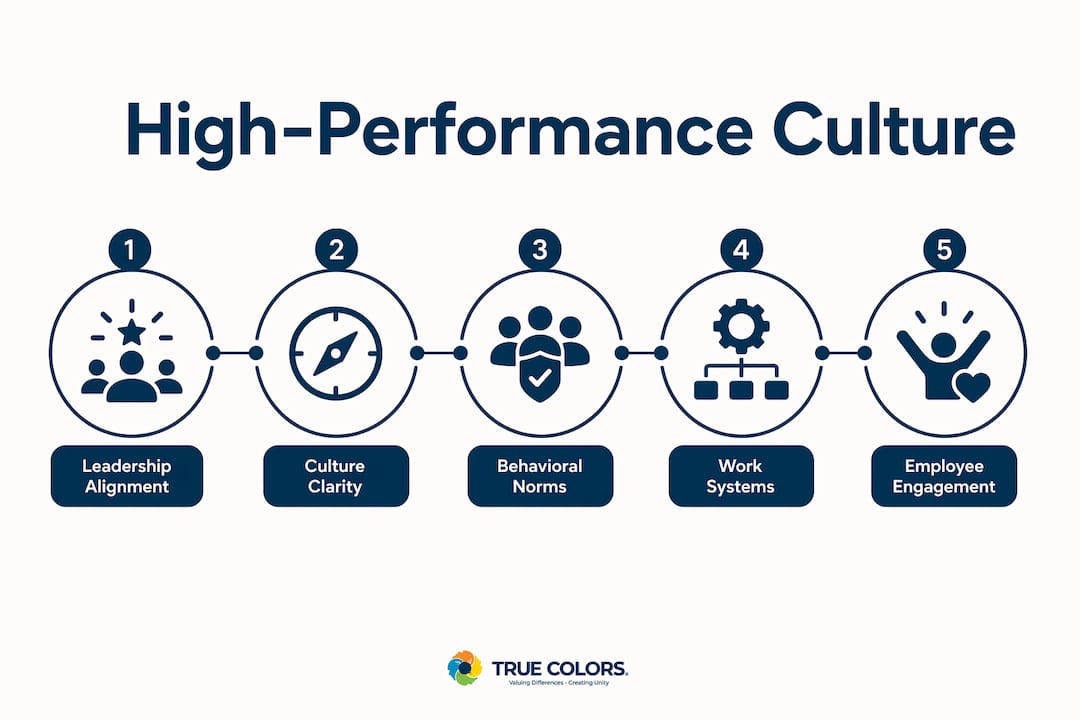
A high-performance culture rests on three interconnected foundations: leadership alignment, culture clarity, and integrated HR systems. Remove any one of them and the structure weakens. Executives who try to build performance culture through values posters and annual surveys miss the point entirely.

Defining behaviors, not just values
Core values only work when they are translated into observable behaviors tied to business strategy. "Integrity" means nothing without a specific description of what integrity looks like in a Monday morning meeting or a difficult client conversation. Leaders must define expected behaviors at every level and then model them consistently. The gap between stated values and actual leadership behavior is where most culture efforts fail.
Integrating high-performance work systems
HPWS are structured HR practices that align three factors: employee ability, motivation, and opportunity. They include rigorous selection, ongoing skill development, performance-linked rewards, and meaningful participation in decisions. HPWS positively impacts performance when employees feel engaged and supported by the organization. That finding matters because it confirms that systems alone are not enough. Psychological safety and organizational support must accompany the structural elements.
| Culture component | Leadership role | System requirement |
|---|---|---|
| Behavioral norms | Model and reinforce daily | Defined competency frameworks |
| Employee engagement | Create conditions for belonging | Pulse surveys and feedback loops |
| Performance accountability | Set clear expectations | Goal-setting and review cadence |
| Knowledge sharing | Reward collaboration openly | Cross-functional team structures |
| Psychological safety | Protect dissent and candor | Manager training and norms |
Pro Tip: Map your current leadership behaviors against your stated values before launching any culture program. The gaps you find will tell you more than any employee survey.
How can executives develop high-performing leaders to sustain culture?
Executive development is distinct from management training. Building executive capacity focuses on navigating ambiguity and inspiring innovation, not on managing tasks and timelines. Organizations that confuse the two produce capable managers but not leaders who can carry culture forward under pressure.
The most effective executive development programs share four practices:
-
Stretch assignments with real accountability. Effective stretch assignments carry cross-functional scope, genuine business stakes, and a designated sponsor who stays actively involved. A stretch assignment without accountability is just extra work. The pressure of real consequences is what builds leadership judgment.
-
Active sponsorship, not passive mentorship. Sponsors advocate for leaders in rooms they are not in. They create visibility, open doors, and provide honest feedback on performance. Mentorship offers guidance. Sponsorship creates opportunity. High-performance cultures need both, but sponsorship drives faster development.
-
Cohort-based peer learning. When executives learn alongside peers from different functions, they build a shared leadership language. That shared language reduces friction when teams need to align quickly across departments. Cohort learning also surfaces assumptions that siloed development never challenges.
-
Structured reflection and after-action reviews. Embedding reflection into development programs prevents leaders from repeating the same mistakes under new circumstances. After-action reviews tied to live business problems create learning that sticks because it connects directly to outcomes the leader already cares about.
Measuring program success requires output metrics, not satisfaction scores. Promotion rates, retention, and succession coverage give a clearer picture of pipeline health than post-training surveys. If your leadership development program cannot show movement in those numbers, it is not building the culture you need.
Pro Tip: Assign each high-potential leader a senior executive sponsor before the stretch assignment begins. Define the sponsor's role in writing so accountability is mutual, not assumed.
Which high-performance workplace practices drive innovation and engagement?
Knowledge sharing is the most underrated driver of organizational innovation. HPWS that prioritize knowledge sharing produce measurable increases in employee innovation initiatives. That finding, drawn from structural equation modeling across 380 professionals, shows that the mechanism is not just motivation. It is the flow of information across teams that enables people to act on new ideas.
Motivation-enhancing and opportunity-enhancing HR practices work together to create the conditions for sustained performance. Motivation-enhancing practices include performance-linked pay, recognition programs, and clear career pathways. Opportunity-enhancing practices include participation in decisions, cross-functional project access, and visible pathways to senior roles. Neither category works well in isolation.
Culture is not a program you launch. It is a pattern of behavior you reinforce. The organizations that sustain high performance are the ones that make knowledge sharing, recognition, and participation a daily habit, not a quarterly initiative.
Key HPWS practices that build engagement and drive innovation include:
- Cross-functional knowledge networks that connect subject matter experts across business units
- Performance-linked recognition tied to specific behaviors, not just outcomes
- Employee participation in decisions that affect their work directly
- Skill development investments that signal long-term commitment to the individual
- Transparent goal alignment so every team member sees how their work connects to organizational priorities
Balancing performance pressure with grit matters here. HPWS can increase psychological stress when employees perceive pressure as a threat rather than a challenge. Leaders who build grit in their teams, by framing difficult goals as growth opportunities rather than survival tests, convert that pressure into energy. The difference between a team that thrives under pressure and one that burns out is almost always the framing the leader provides.
What challenges arise when building a high-performance culture?
The most common failure in culture building is the gap between what leaders say and what they do. Behavior always wins. When executives declare psychological safety as a value but punish candor in meetings, employees read the behavior, not the poster. Ongoing culture measurement with behavioral indicators and pulse surveys tied to cultural priorities is the only way to catch that gap before it becomes a credibility problem.
Several specific challenges appear repeatedly across organizations attempting culture transformation:
- Threat appraisal under HPWS pressure. When performance systems feel punitive, employees experience stress that degrades the very performance the system was designed to improve. Leaders must actively reframe high standards as development opportunities.
- Neglecting the manager layer. Culture lives or dies at the team level. Senior executives set direction, but frontline managers deliver the daily experience. Organizations that invest only in C-suite development leave the most influential culture carriers undertrained.
- Treating culture as a passion project. When culture ownership sits with one enthusiastic executive rather than the full leadership team, it stalls the moment that executive changes roles. Broad ownership and clear accountability frameworks prevent this.
- Measuring inputs instead of outcomes. Training hours and program completion rates do not measure culture. Behavioral change, retention, and team performance metrics do.
Pro Tip: Run a quarterly behavioral audit. Ask each business unit leader to name three specific behaviors their team demonstrated this quarter that reflect the organization's stated values. Vague answers reveal the real state of culture adoption.
Truecolorsintl helps organizations identify the specific behaviors that are helping or hurting performance, then builds reinforcement systems that keep progress visible. The employee experience survey tools Truecolorsintl provides give leaders the behavioral data they need to move from diagnosis to action.
Key Takeaways
Building a high-performance culture requires executives to align leadership behavior, HR systems, and employee engagement into a single, reinforced system rather than treating each as a separate initiative.
| Point | Details |
|---|---|
| Behavior over messaging | Culture is defined by what leaders repeat, not what they declare in values statements. |
| HPWS requires support | High-performance work systems only improve performance when organizational support and engagement accompany them. |
| Executive development is distinct | Building executive capacity focuses on ambiguity and inspiration, not task management. |
| Knowledge sharing drives innovation | HPWS that prioritize knowledge sharing produce measurable increases in employee innovation. |
| Measure behavioral outcomes | Promotion rates, retention, and succession coverage reveal pipeline health better than satisfaction scores. |
Why culture and leadership development must be built together
Most organizations treat culture and leadership development as parallel tracks. That is the mistake I see most often, and it is expensive. Culture without leadership development produces good intentions that fade when pressure arrives. Leadership development without culture produces capable individuals who operate in different directions.
The executives I have seen build genuinely high-performing organizations share one habit: they treat culture as a live business problem, not a background condition. They connect every leadership development investment, every stretch assignment, every cohort learning experience, directly to a current strategic challenge. That connection is what makes development stick and culture real.
Sponsorship is consistently underused. Most organizations have mentorship programs. Far fewer have structured sponsorship frameworks where senior leaders actively advocate for high-potential talent in resource and succession conversations. The consulting and coaching programs that work best are the ones that build sponsorship into the architecture, not as an add-on.
Structured reflection is the other underused tool. After-action reviews feel like overhead until you watch a leadership team catch a pattern they had been repeating for two years. That moment of recognition, when it is connected to a real business outcome, changes behavior faster than any training module.
The organizations that sustain high performance measure relentlessly and honestly. They use culture performance data to hold leaders accountable, not just to report progress. If your measurement system only produces good news, it is not measuring the right things.
— Theresa
How Truecolorsintl supports executive culture and leadership programs
Truecolorsintl works with C-suite leaders and HR teams to make culture more than a stated priority.

Through leadership development programs built around real behavioral change, Truecolorsintl helps executive teams align around shared norms, identify what is slowing performance, and build the reinforcement habits that keep culture moving forward. The corporate consulting solutions include cohort-based learning, culture diagnostics, and employee engagement tools designed for organizations that need measurable results, not just better conversations. If you are ready to connect leadership development directly to culture outcomes, Truecolorsintl provides the system to do it.
FAQ
What is a high-performance culture in an organization?
A high-performance culture is a set of shared behaviors, norms, and systems that consistently produce superior organizational results. It requires leadership alignment, clear behavioral expectations, and HR systems that support ability, motivation, and opportunity.
How do HPWS improve employee performance?
HPWS improve performance by aligning selection, development, rewards, and participation practices to engage employees and build organizational support. The effect is strongest when employees feel psychologically safe and organizationally supported.
What is the difference between executive development and management training?
Executive development builds the capacity to navigate ambiguity and inspire innovation across an organization. Management training focuses on task execution and operational oversight. High-performance cultures require investment in both, but executive development drives culture transformation at scale.
How should executives measure culture effectiveness?
Behavioral indicators and pulse surveys tied to cultural priorities provide more useful data than annual engagement scores. Output metrics like promotion rates, retention, and succession coverage reveal whether culture is producing the leadership pipeline the organization needs.
Why does knowledge sharing matter for organizational innovation?
Knowledge sharing mediates the relationship between HPWS and employee innovation initiatives. When information flows freely across teams, employees have the context and connections needed to generate and act on new ideas.