
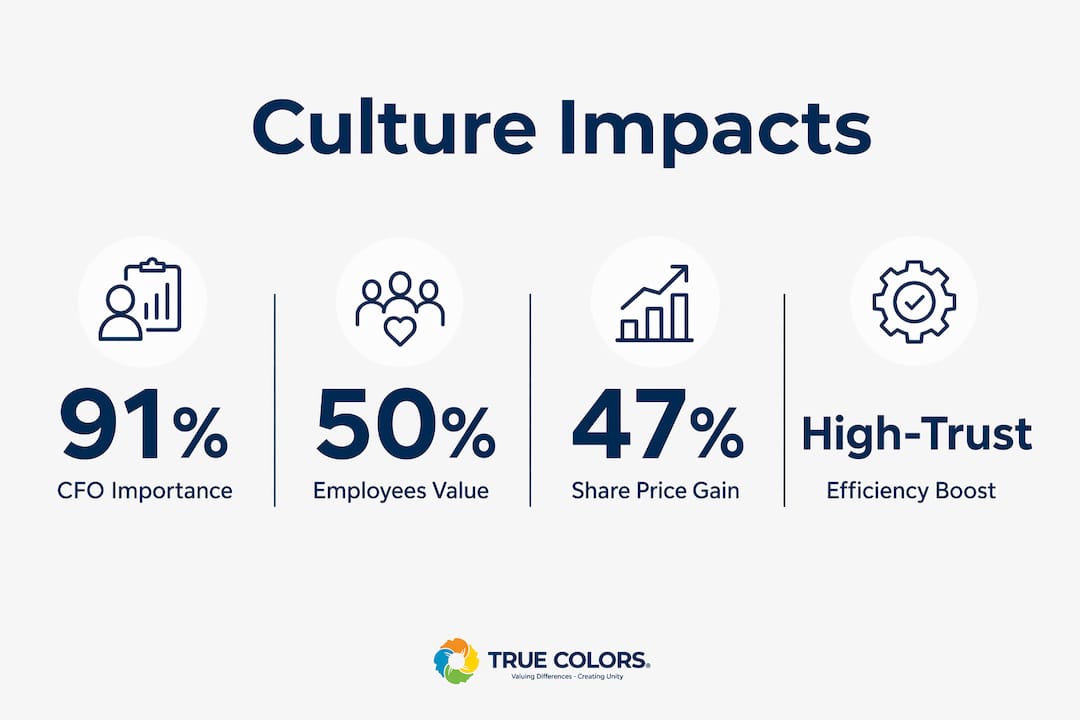
Corporate culture is the invisible operating system that determines how employees prioritize, behave, and make decisions when no one is watching. Understanding why culture drives business performance is not a philosophical exercise. It is a financial and operational imperative. Research from Culture Amp shows that organizations integrating culture and performance achieve a 47% share price advantage over those treating them separately. Culture is not what is said. It is what is repeated, rewarded, and tolerated every day.
Why culture drives business performance: the operating system no one sees
Culture, in organizational development, is defined as the shared values, norms, and behaviors that govern how work gets done. The term “organizational culture” is the recognized industry standard for this concept. Leaders often use “company culture” informally, but both refer to the same underlying system of collective behavior that shapes every business outcome.
Culture governs execution at every level. When a team faces a difficult tradeoff between speed and quality, culture determines which way they lean without a manager in the room. When an employee considers raising a risk, culture determines whether they speak up or stay quiet. These micro-decisions, multiplied across thousands of interactions, produce the aggregate results that show up in financial statements.

91% of CFOs rate corporate culture as important or very important to firm success. That consensus from finance leaders signals that culture has moved well beyond HR territory. It now sits at the center of how organizations create and protect value.
How does culture tangibly affect employee engagement and business outcomes?
Organizational culture shapes engagement by setting the conditions under which people choose to give their best effort. Engagement is not a mood. It is a behavioral state where employees invest discretionary energy because they believe their work matters and their environment is fair.
Strong cultures produce measurable retention advantages. Poor cultures trigger turnover intent in over half of dissatisfied employees, according to SHRM’s 2026 Global Workplace Culture Report. Turnover is expensive in both direct costs, such as recruiting and onboarding, and indirect costs, such as lost institutional knowledge and reduced team cohesion.
The engagement-culture connection works through several specific mechanisms:
-
Shared values reduce ambiguity. When employees understand what the organization stands for, they spend less energy navigating uncertainty and more energy executing.
-
Psychological safety drives innovation. Teams that feel safe to challenge ideas generate more solutions and catch more problems early.
-
Recognition aligned with values reinforces behavior. When leaders consistently reward the right actions, employees repeat those actions.
-
Alignment between stated and lived culture builds trust. When leaders model the behaviors they ask of others, credibility increases and engagement follows.
About 50% of employees rank culture as more critical than strategy or operating models. That finding reflects a lived reality: employees experience culture directly, and it shapes their daily motivation more than any strategic plan.
Pro Tip: Measure culture’s impact on engagement by tracking two metrics side by side: your employee net promoter score and your voluntary turnover rate by department. Gaps between departments often reveal where culture is inconsistent, not where individuals are failing.
In what ways does culture influence strategic alignment and operational efficiency?
Culture acts as the organization’s operating system for strategy execution. A well-designed strategy fails when the culture beneath it pulls in a different direction. Leaders who align culture with business strategy consistently outperform those who treat the two as separate workstreams.
The efficiency gains from a high-trust culture are concrete and measurable. High-trust cultures reduce decision-cycle time by up to 40%, enabling faster time-to-market by removing unnecessary bureaucracy and blame-avoidance behaviors. That 40% reduction translates directly into competitive speed, which is one of the most valuable assets in fast-moving markets.
| Dimension | Traditional control model | Culture-driven self-regulation |
|---|---|---|
| Decision-making | Requires managerial approval at each step | Teams act within shared principles without escalation |
| Accountability | Enforced through rules and penalties | Maintained through peer norms and shared values |
| Speed | Slowed by approval chains | Accelerated by distributed judgment |
| Innovation | Constrained by fear of rule violations | Encouraged by psychological safety |
| Scalability | Requires more managers as teams grow | Scales through internalized norms |
Effective cultural management relies on normative social control rather than rigid rules, fostering self-regulation aligned with broad guiding principles. This approach reduces the overhead of compliance management and frees leaders to focus on growth rather than enforcement.
Leadership behavior is the primary mechanism for embedding cultural alignment. What leaders prioritize in meetings, how they respond to failure, and who they promote all send louder signals than any values statement on a wall.
Pro Tip: Run a simple alignment audit: list your top five strategic priorities, then ask your team which behaviors the organization rewards. Where the lists diverge, culture is working against strategy.
What are the measurable financial impacts of investing in corporate culture?
Culture’s financial impact is no longer a matter of debate. The data is specific and consistent across multiple research streams. Organizations integrating culture and performance achieve a 47% share price advantage, with sustained 36% growth at the two-year mark. That is not a marginal difference. It is a structural advantage that compounds over time.
Culture also functions as a risk management tool. A high-trust culture reduces a company’s cost of capital by enabling greater transparency and faster risk surfacing. Investors and lenders price trust into their terms, even when they do not name it explicitly.
| Research finding | Source | Business implication |
|---|---|---|
| 47% share price advantage for culture-performance integration | Culture Amp, 2026 | Culture is a direct driver of market valuation |
| 36% sustained growth at two years | Culture Amp, 2026 | Culture’s financial impact compounds over time |
| 91% of CFOs rate culture as critical | Berkeley CMR, 2026 | Finance leaders treat culture as a core business variable |
| High-trust cultures cut decision cycles by up to 40% | Corporate Finance Institute, 2026 | Operational speed is a measurable cultural output |
| Over 50% of dissatisfied employees report turnover intent | SHRM, 2026 | Poor culture creates direct, quantifiable cost exposure |
Organizations with strong, growth-oriented cultures are significantly more likely to meet financial targets and foster innovation. The connection between culture and innovation is particularly important: cultures that reward experimentation and tolerate calculated failure generate more new ideas and bring them to market faster.
Culture is also visible externally, influencing how clients, investors, and partners perceive the organization. That external perception affects high-stakes business opportunities in ways that do not show up in internal surveys but do show up in deal flow and partnership quality.
How can leaders actively build a high-performance culture?
Building a high-performance organizational culture requires deliberate design, not passive hope. Culture is built through leadership behaviors, hiring decisions, promotion patterns, and reward systems. Perks and slogans do not create culture. Consistent, observable actions do.
Leaders who want to build a culture that supports business performance should work through these steps in sequence:
-
Define the behaviors that serve your strategy. Start with your business model and identify the specific behaviors that make it work. A culture built for rapid iteration looks different from one built for precision and compliance.
-
Audit what you currently reward. Map your promotion and recognition decisions from the past 12 months. The pattern reveals your real culture, not your intended one.
-
Align hiring criteria with cultural behaviors. Talent acquisition should screen for behavioral fit alongside technical skill. Every hire either reinforces or dilutes the culture.
-
Model the behaviors you expect. Leaders who hold others accountable for behaviors they do not practice themselves create cynicism, not culture.
-
Measure culture with the same rigor as financial performance. Use structured tools to track cultural health over time. Truecolorsintl’s employee experience surveys give leaders quantitative data on where culture is strong and where it is eroding.
-
Reinforce continuously, not episodically. Culture fades without repetition. Build cultural reinforcement into team rituals, performance reviews, and leadership conversations.
Culture must align with the organization’s life cycle stage and operating environment. A startup culture built on speed and experimentation may need to evolve as the organization scales. Leaders who fail to adapt their culture to their growth stage often find that the behaviors that drove early success become liabilities at scale.
Culture functions as the organization’s operating system and must be managed with the same rigor applied to financial systems. That means regular measurement, clear ownership, and structured intervention when gaps appear. Truecolorsintl provides a practical framework for improving workplace culture by connecting behavioral awareness to team-level and organizational-level change.
Key Takeaways
Culture is a measurable, manageable business asset that directly determines engagement, operational speed, and financial performance when leaders treat it with the same discipline they apply to strategy and finance.
| Point | Details |
|---|---|
| Culture is a financial asset | Organizations integrating culture and performance achieve a 47% share price advantage over those that do not. |
| Engagement follows culture | Poor cultures trigger turnover intent in over half of dissatisfied employees, creating direct cost exposure. |
| Trust accelerates operations | High-trust cultures reduce decision-cycle time by up to 40%, producing measurable competitive speed. |
| Leaders build culture through behavior | Hiring, promotion, and reward patterns define real culture more than any stated values. |
| Measurement is non-negotiable | Culture must be tracked with structured tools and reviewed with the same frequency as financial metrics. |
Culture is not a soft skill. It is a management discipline.
I have worked with enough leadership teams to know the most common mistake they make with culture: they treat it as a communications problem. They write better values statements, run an all-hands meeting, and call it done. Then they wonder why nothing changes.
Culture is not what is announced. It's what is tolerated and rewarded, day after day. The real culture of any organization is visible in three places: who gets promoted, what behaviors go unchallenged, and how leaders behave under pressure. Everything else is aspiration.
The gap between espoused culture and lived culture is where performance leaks. I have seen organizations with genuinely strong values on paper where the actual day-to-day experience was one of fear, political maneuvering, and blame. That gap does not close with better messaging. It closes when leaders change their own behavior first and hold that standard consistently.
What I find most underappreciated is culture’s reach beyond HR. Culture affects your cost of capital, your deal flow, your ability to attract talent in a competitive market, and your speed to execute strategy. Finance leaders are catching up to this reality. The 91% of CFOs who rate culture as critical are not being sentimental. They are recognizing that culture is a risk variable they can manage or ignore at their peril.
The leaders who get this right treat culture as a discipline with metrics, owners, and review cycles. They use tools that give them real behavioral data, not just sentiment scores. And they understand that culture change is slow, nonlinear, and worth every bit of the effort.
— Theresa Stairs
How Truecolorsintl helps leaders build cultures that perform
Culture change requires more than good intentions. It requires a system that connects individual behavior to team dynamics and organizational outcomes.
Truecolorsintl gives leaders that system. Through Connected Leadership Training, leaders develop the self-awareness and behavioral consistency needed to model and reinforce the culture they want to build. The Employee Experience Survey provides structured data on where culture is working and where it is creating friction. And corporate consulting solutions help organizations move from diagnosis to sustained behavior change. If you are ready to treat culture as the performance driver it is, Truecolorsintl is built for exactly that work.
FAQ
What is organizational culture in business?
Organizational culture is the shared set of values, norms, and behaviors that govern how employees make decisions and interact. It is the invisible system that determines execution quality, engagement levels, and innovation capacity.
Why does culture matter more than strategy?
Culture determines whether strategy gets executed. A strong strategy built on a misaligned culture will fail during implementation because employees default to cultural norms when formal direction is absent.
How does culture affect financial performance?
Organizations that integrate culture and performance achieve a 47% share price advantage over those that do not, and high-trust cultures reduce the cost of capital by enabling faster risk transparency.
How can leaders measure organizational culture?
Leaders can measure culture through structured employee experience surveys, behavioral audits of promotion and reward decisions, and tracking operational metrics like decision-cycle time and voluntary turnover by team.
What is the biggest mistake leaders make with culture?
The most common mistake is treating culture as a communications initiative rather than a behavioral management discipline. Culture changes when leaders change what they reward, tolerate, and model, not when they update their values statements.