
Talent segmentation is the strategic process of categorizing employees or candidates into distinct groups based on shared characteristics such as performance, potential, role criticality, or career stage, so HR investment goes where it produces the highest return. Rather than treating the workforce as a uniform population, segmentation reveals where targeted action changes outcomes.
Three immediate benefits make the case quickly:
- Recruitment prioritization: Focus sourcing and offer velocity on roles and candidate pools that carry the most strategic weight.
- Retention targeting: Identify flight-risk employees in high-value segments before they leave, not after.
- Succession clarity: Surface future leaders and critical specialists early enough to develop them deliberately.
If you are ready to move from concept to execution, the step-by-step implementation section below gives you an 8–12 week pilot framework you can start this week.
Table of Contents
- Why talent segmentation shifts HR from support function to strategic partner
- Common frameworks and models: which one fits your situation
- Key dimensions to segment on and the data you need
- How to implement talent segmentation: a step-by-step process
- Data, metrics, and systems that power segmentation
- Concrete segment examples and the actions each one calls for
- Common pitfalls and how to avoid them
- Turning segmentation into action: a True Colors practical approach
- Templates, downloads, and next steps to launch your pilot
- Key takeaways
- Why segmentation without behavior is just a spreadsheet
- Truecolorsintl's talent segmentation support
- Useful sources for further reading
Why talent segmentation shifts HR from support function to strategic partner
Most HR teams already collect performance data, run engagement surveys, and track turnover. The gap is not data. It is the decision logic that connects data to differentiated action. Talent segmentation fills that gap by repositioning HR as a decision-science function, one that identifies the pivotal talent pools where human capital investment changes strategic outcomes.

Consider resource allocation. Without segmentation, development budgets spread thinly across all employees, and recruiting urgency gets driven by headcount pressure rather than strategic value. With segmentation, leaders can direct accelerated career programs, retention bonuses, and executive visibility to the groups where those investments compound. Research on firms that segment talent and tailor the employee value proposition to distinct populations has found measurable business returns, including higher shareholder returns compared to organizations that apply uniform talent practices.
The use cases extend well beyond retention. In recruitment, segmentation lets talent acquisition teams build differentiated pipelines for critical roles versus standard roles, adjusting sourcing channels, interview depth, and offer timelines accordingly. In succession planning, it creates a structured view of who is ready now, who needs 12–18 months of development, and who requires a longer runway. In talent acquisition and development alignment, segmentation is the connective tissue that keeps hiring decisions consistent with workforce planning goals.
A concrete illustration: a mid-size technology company segments its engineering workforce into three groups: senior engineers in scarce specializations, high-potential mid-level engineers, and early-career hires. By concentrating retention packages and internal mobility programs on the first group and structured mentoring on the second, the company reduces voluntary attrition in its most critical segment while accelerating the development pipeline that feeds it.
Common frameworks and models: which one fits your situation
No single segmentation model works for every organization. The right choice depends on your objective, data maturity, and organizational scale.
The 9-box talent matrix
The nine-box grid places employees in one of nine cells using two axes: current performance and future potential. It remains the most widely used tool for talent review and succession planning because it is visually intuitive and easy to calibrate in a group setting. A manager calibration session using the 9-box typically takes two to three hours and produces a shared view of who is ready for advancement, who needs development support, and who may be misaligned with their current role.
The 9-box works best when the objective is succession planning or leadership pipeline review. Its limitation is that it captures a point-in-time snapshot, so organizations that rely on it exclusively risk making decisions based on stale assessments.
Strategic segmentation and pivotal talent pools
For workforce planning, the more powerful frame is strategic segmentation: identifying the roles and talent pools where performance variance most directly affects business outcomes. This approach, grounded in the talentship decision-science paradigm, asks a different question than the 9-box. Instead of "who is our best performer?" it asks "where does talent quality change our strategy?" A customer success manager at a SaaS company may be more pivotal than a senior analyst, depending on the growth model.
Persona-based segmentation
Persona-based models borrow from marketing: they group employees by shared motivations, communication preferences, and career aspirations rather than performance metrics alone. This approach is particularly useful for designing targeted engagement communications, onboarding experiences, and development programs. It pairs naturally with behavioral assessment tools and is the model most directly supported by True Colors' behavior-based frameworks.
Choosing a model
| Objective | Best-fit model | Data required | Complexity |
|---|---|---|---|
| Succession planning | 9-box talent matrix | Performance ratings, potential assessments | Low to medium |
| Workforce planning | Strategic / pivotal talent pools | Role criticality, business impact data | Medium to high |
| Engagement and development | Persona-based segmentation | Behavioral data, engagement surveys | Medium |
| Recruitment prioritization | Role-criticality segmentation | ATS data, hiring velocity, offer acceptance | Low to medium |
Key dimensions to segment on and the data you need
Effective segmentation frameworks combine multiple dimensions rather than relying on a single metric. Using only performance ratings, for example, misses the employees who are performing adequately today but carry high flight risk or exceptional future potential.
The dimensions most commonly used in practice map to distinct data sources:
| Dimension | What it measures | Primary data source |
|---|---|---|
| Performance | Current output quality and consistency | HRIS performance ratings, manager reviews |
| Potential | Capacity for growth and increased responsibility | Potential assessments, 9-box calibration |
| Role criticality | Strategic impact of the role on business outcomes | Workforce planning analysis, job architecture |
| Skills scarcity | Difficulty of replacing the skill in the external market | Labor market data, ATS sourcing metrics |
| Lifecycle stage | Tenure, career phase, and onboarding status | HRIS tenure data, onboarding completion |
| Engagement | Discretionary effort and organizational commitment | Employee engagement surveys, pulse tools |
| Flight risk | Probability of voluntary departure | Predictive analytics, manager signals, tenure patterns |
| Geographic or operational constraints | Location, shift, or deployment requirements | HRIS location data, scheduling systems |
Common segmentation dimensions used in practice include performance trends, potential assessments, role criticality, skills scarcity, lifecycle stage, and flight-risk scoring. Combining three to four of these dimensions produces segments that are specific enough to act on without becoming so granular that programs become unmanageable.
Privacy and ethics guardrails matter here. Segmentation should never rely on protected characteristics such as age, race, gender, or disability status. Document the decision rules behind each dimension, involve your legal and EEO teams early, and build in a baseline of universal development access for all employees regardless of segment. Differentiated investment is the goal; a visible two-tier culture is the risk to avoid.
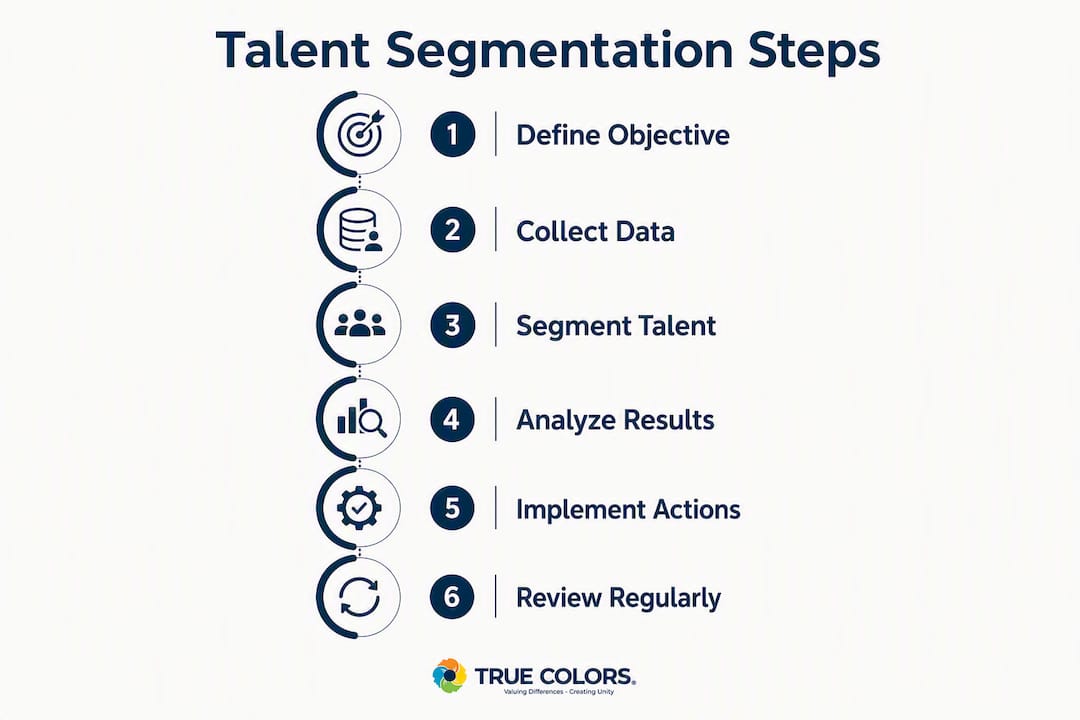
How to implement talent segmentation: a step-by-step process
A well-scoped pilot produces results in 8–12 weeks. The steps below are sequential, but expect to revisit earlier stages as you learn.
-
Define your objective. Decide whether the pilot is focused on succession planning, retention risk, recruitment prioritization, or development investment. One clear objective keeps the scope manageable and the success metrics obvious.
-
Choose your model and dimensions. Select the framework that fits your objective (see the model table above). Pick three to four segmentation dimensions you already have data for. Starting with dimensions that require new data collection adds six to eight weeks of lead time.
-
Audit your data. Inventory what exists in your HRIS, ATS, LMS, and engagement survey platform. Identify gaps, assess data quality, and flag any fields that require legal review before use.
-
Create your segments. Define four to six segments with clear, written criteria. Each segment should have a name, a one-sentence definition, the dimensions that determine membership, and an estimated population size. Fewer segments are almost always better at the start.
-
Design differentiated interventions. For each segment, specify two to three concrete HR actions: a development program, a retention lever, a sourcing strategy, or a mobility pathway. Segmentation without tailored action is merely labeling; the interventions are where the value is created.
-
Run a calibration session. Bring together a small group of managers and HR business partners to review segment assignments, challenge edge cases, and build shared understanding of the criteria. This step reduces inconsistency and builds manager buy-in.
-
Pilot with one business unit. Limit the initial rollout to one team or function. This contains the risk, speeds up learning, and gives you a comparison group for measuring impact.
-
Measure outcomes. Track the KPIs you defined in step one. Useful metrics include time-to-hire for prioritized segments, 90-day retention rates, internal mobility rates, and engagement delta between segments. Set a baseline before the pilot begins.
-
Review and iterate. Schedule a formal review at week 12. Adjust segment definitions, refine interventions, and document what changed and why. Segmentation is a living process, not a one-time classification exercise.
MVP pilot template: One business unit, one primary objective, three to four dimensions, four to six segments, one calibration session, one measurement dashboard. Timeline: two weeks for data audit, two weeks for segment design, two weeks for calibration, six weeks of intervention, two weeks for review.
Data, metrics, and systems that power segmentation
Segmentation is only as reliable as the data behind it. Most organizations already have the core systems; the challenge is connecting them.

HRIS (such as Workday, SAP SuccessFactors, or BambooHR) holds the workforce attributes that anchor most segments: tenure, role, location, performance ratings, and compensation history. It is the system of record for segment membership.
ATS (such as Greenhouse, Lever, or iCIMS) provides candidate-pool data for recruitment-focused segmentation. Sourcing channel, time-to-fill, offer acceptance rate, and pipeline conversion by role type are all signals that help prioritize where to concentrate recruiting effort. Connecting hiring trends to segmentation strategy is increasingly a competitive differentiator.
LMS (such as Cornerstone, Docebo, or LinkedIn Learning) surfaces development signals: completion rates, skill certifications, and learning velocity. These data points help identify high-potential employees who are actively investing in growth.
People analytics platforms (such as Visier or Workday Prism) combine datasets across systems and enable the cross-dimensional analysis that single-system reporting cannot produce.
Metrics to capture and why:
- Performance trend (not just current rating): reveals trajectory, not just snapshot
- Potential indicators: manager assessments, stretch assignment outcomes, 360 feedback
- Skill rarity: external labor market data from sources like LinkedIn Talent Insights or the Bureau of Labor Statistics
- Retention risk: tenure patterns, engagement scores, compensation competitiveness
- Hiring pipeline velocity: time-to-fill and offer acceptance by segment
Pro Tip: Version your segment definitions. Every time you update criteria or reassign employees, log the change, the date, and the rationale. This creates an audit trail that protects against bias claims and helps you understand what is actually driving segment movement over time.
Governance matters as much as technology. Assign a named owner for each segment, set a quarterly review cadence, and build a feedback loop so managers can flag misclassifications without bureaucratic friction.
Concrete segment examples and the actions each one calls for
Segments only earn their keep when they drive specific decisions. The table below maps six common archetypes to their top three recommended actions.
| Segment | Definition | Top 3 recommended actions |
|---|---|---|
| Future leaders | High performance, high potential; succession-ready within 12–24 months | Executive sponsorship, stretch assignments, accelerated promotion pathway |
| Critical specialists | Rare technical skills, high role criticality, hard to replace externally | Retention package, knowledge-transfer plan, internal community of practice |
| High-performing short-tenure hires | Strong output but less than 18 months in role; flight risk window | Structured onboarding reinforcement, early career conversation, manager check-in cadence |
| Engaged mid-career contributors | Solid performance, moderate potential, high engagement | Lateral mobility options, skills development investment, recognition programs |
| Contingent high-skill contractors | Project-critical skills, no permanent employment relationship | Conversion pathway assessment, preferred vendor relationship, alumni network |
| Early-career high-potential | Below average current performance due to tenure, high assessed potential | Mentoring program, accelerated learning track, frequent feedback loops |
Consider a hypothetical mid-size professional services firm that applies this framework to its critical specialists segment. By identifying 22 employees whose skills are both scarce in the external market and central to client delivery, the firm builds a targeted retention program: a retention bonus tied to a 24-month commitment, a knowledge-transfer initiative that reduces single-point-of-failure risk, and a dedicated internal community of practice. The result is a measurable reduction in voluntary attrition within that segment and a documented succession plan for each role, reducing the firm's exposure to a talent gap that previously had no mitigation strategy.
Common pitfalls and how to avoid them
Most segmentation programs fail not because the model was wrong, but because the implementation overlooked predictable traps.
-
Oversegmenting into too many micro-groups. A common trap is creating too many segments that become impossible to manage with differentiated programs. Keep the initial set to four to six segments. Add complexity only when the simpler model has proven its value.
-
Labeling without action. Classifying employees into segments and then delivering the same programs to everyone destroys credibility. Each segment must have at least two distinct interventions that differ from what other segments receive.
-
Creating a visible two-tier culture. When employees learn they are in a lower-priority segment, morale damage follows. Segmentation should differentiate investment, not basic treatment. Communicate clearly that all employees have access to foundational development; the differentiation is in the acceleration and depth of investment.
-
Relying on single-point-in-time data. A performance rating from one review cycle is not a reliable basis for long-term classification. Build in quarterly reviews and allow segment movement in both directions.
-
Skipping manager calibration. Segment assignments made by HR alone, without manager input, produce classifications that managers do not trust and will not act on. Calibration sessions are not optional.
-
Ignoring the feedback loop. Employees and managers who see errors in segment assignments and have no way to flag them will disengage from the process entirely. Build a simple, low-friction correction mechanism.
Operational controls: Set a formal review cadence (quarterly at minimum), run annual manager calibration sessions, and maintain a written communications plan that explains the purpose and boundaries of segmentation to employees.
US legal and ethical checklist: Use only non-sensitive, job-relevant indicators; document all decision rules in writing; involve legal and EEO counsel before finalizing criteria; and confirm that segment-based actions comply with applicable federal and state employment laws. This is general guidance, not legal advice. Confirm current requirements with qualified employment counsel.
Turning segmentation into action: a True Colors practical approach
Segments tell you who needs what. Behavior-based systems tell you how to reach them. That distinction is where most segmentation programs stall. The classification work gets done, the interventions get designed on paper, and then execution falls flat because the programs do not account for how different people actually receive feedback, respond to coaching, or build new habits.
True Colors' behavior-based framework addresses this directly. By mapping each segment to observable behavioral patterns, HR leaders can design interventions that match the way people in that segment are wired to engage. A future leaders segment, for example, benefits from a structured leadership development program that builds self-awareness alongside strategic capability. The Connected Leadership Program is designed for exactly this: it moves participants from personal awareness to aligned leadership behavior, with reinforcement built into the cadence rather than treated as an afterthought.
Practical checklist for behavior-based segmentation interventions:
- Map each segment to its primary behavioral and motivational profile using assessment data
- Design the intervention sequence: awareness workshop, applied practice, manager coaching, reinforcement check-in
- Set a reinforcement cadence (monthly touchpoints for high-priority segments, quarterly for others)
- Measure culture and talent KPIs together: engagement delta, internal fill rate, time-to-proficiency for newly promoted employees
For the critical specialists segment, the Employee Experience Survey provides the diagnostic data needed to understand what is driving engagement or disengagement in that group before designing retention interventions. Combining survey data with performance and skills data gives a fuller picture than either source alone.
A short example: an organization identifies its engaged mid-career contributors as a segment at risk of stagnation. Using True Colors' behavioral assessment, HR discovers that a significant portion of this group has a strong preference for collaborative work and visible recognition. The intervention shifts from a generic skills training program to a peer-learning cohort with structured recognition built in. Engagement scores in the segment improve, and internal mobility applications from the group increase.
Templates, downloads, and next steps to launch your pilot
You do not need a sophisticated people analytics platform to start. A well-structured spreadsheet and a clear process will carry you through the first pilot.
Suggested templates and what each should include:
- Pilot brief: Objective, scope (one business unit), timeline, stakeholder roles, success metrics, and a one-paragraph description of each segment.
- Segment definition sheet: Segment name, one-sentence definition, inclusion criteria (dimensions and thresholds), estimated population, and assigned HR owner.
- Measurement dashboard: Baseline and target for each KPI, data source, measurement frequency, and owner.
- Manager calibration rubric: Definitions for each performance and potential level, calibration process steps, and a decision tree for edge cases.
Quick DIY segmentation spreadsheet: In a single afternoon, you can build a working tool in Excel or Google Sheets. Create one tab per segment. Columns should include employee ID (not name, for privacy), role, department, dimension scores (performance, potential, flight risk), segment assignment, assigned intervention, and last review date. Add a summary tab that counts population by segment and tracks intervention completion. This is your MVP dashboard.
Next-steps checklist for an 8–12 week pilot:
- Week 1–2: Run a data inventory. Identify what you have in HRIS, ATS, and engagement survey tools.
- Week 2–3: Define your objective and select three to four dimensions.
- Week 3–4: Draft four to six segment definitions and review with one HR business partner.
- Week 4–5: Run a manager calibration session with the pilot business unit.
- Week 5–6: Assign employees to segments and design two to three interventions per segment.
- Week 6–11: Execute interventions and track KPIs weekly.
- Week 12: Conduct a formal review, document learnings, and decide whether to expand.
For a more structured starting point, the talent development program checklist from Truecolorsintl provides a ready-made framework you can adapt for your pilot brief.
Key takeaways
Talent segmentation produces measurable results only when classification leads directly to differentiated, behavior-informed action for each group.
| Point | Details |
|---|---|
| Start with a clear objective | Define whether the pilot targets succession, retention, recruitment, or development before choosing a model. |
| Keep segments to four to six | Fewer, well-defined segments are more manageable and more likely to drive consistent action across managers. |
| Combine multiple dimensions | Performance alone is insufficient; add potential, role criticality, and flight risk for segments that hold up over time. |
| Differentiate investment, not basic treatment | All employees retain access to foundational development; segmentation accelerates and deepens investment where ROI is highest. |
| Truecolorsintl connects segments to behavior | True Colors' behavior-based programs translate segment classifications into targeted interventions with built-in reinforcement. |
Why segmentation without behavior is just a spreadsheet
The organizations that get the most from talent segmentation are not the ones with the most sophisticated models. They are the ones that connect classification to consistent, observable behavior change.
That is the gap most HR leaders underestimate. A well-designed 9-box calibration session produces a clear picture of who sits where. But the picture does not change anything on its own. What changes outcomes is what happens next: the coaching conversation a manager has with a future leader, the development program a critical specialist is enrolled in, the recognition a mid-career contributor receives that keeps them from quietly disengaging. Those moments are behavioral, not analytical.
The conventional wisdom in talent management tends to overweight the segmentation design and underweight the reinforcement architecture. Organizations spend months refining their segment criteria and then launch a single workshop per segment and call it done. Culture is not what is said. It is what is repeated. The same principle applies to talent development: a one-time intervention rarely moves the needle. A reinforced cadence does.
Working with mid-to-large organizations across industries, Truecolorsintl has seen this pattern consistently. The segmentation framework matters, but the behavior-based reinforcement system is what makes it durable. That is why the most effective implementations pair a clear segmentation model with a structured program that builds habits, not just awareness.
Truecolorsintl's talent segmentation support
Designing a segmentation framework is one thing. Turning it into a program that actually changes how leaders develop, how teams communicate, and how the organization retains its most critical people is another challenge entirely.

Truecolorsintl works with mid-to-large organizations to move from segment design to behavior-based action. The Connected Leadership Program maps directly to future leader and critical specialist segments, building the leadership behaviors that accelerate readiness and reduce attrition. The Employee Experience Survey provides the diagnostic data that grounds segment definitions in real engagement signals rather than assumptions. And Truecolorsintl's talent acquisition consulting helps organizations align their hiring pipelines with the segment priorities their workforce planning reveals.
The next step is a scoping conversation. Reach out to Truecolorsintl to discuss your pilot objectives, identify which segments are most urgent for your organization, and map the behavior-based interventions that will move the metrics you care about.
Useful sources for further reading
The following sources support further study on talent segmentation strategy, frameworks, and implementation.
- Talent segments | NSW Public Service Commission — Government practitioner framework with definitions and segment criteria; useful for grounding your own segment design.
- APS Talent Segmentation Process | Australian Public Service Commission — Step-by-step toolkit for public-sector segmentation; contains process templates adaptable to US organizations.
- Talentship, talent segmentation, and sustainability | Human Resource Management — Foundational academic paper on the decision-science paradigm behind strategic segmentation.
- What talent wants: the journey to talent segmentation | Journal of Business Strategy — Research linking segmented EVP design to measurable business returns.
- 9 Box Grid: A Practitioner's Guide | AIHR — Practical guide to designing and running 9-box calibration sessions; includes facilitation tips.
- Building a Talent Segmentation Strategy | HRM Guide — Practitioner-oriented guide covering segment design, persona models, and governance; contains step-by-step frameworks.
- What does Talent Segmentation mean? | Qureos — Concise glossary entry with practical notes on dimensions and common pitfalls.
- Understanding Talent Segmentation in Modern HR Strategy | Intoo — US-focused overview connecting segmentation to workforce planning and talent management practices.
- Strategic talent segmentation model | Queensland Government — PDF framework document with a strategic segmentation model and visual schematic; useful as a template reference.
- Talent lifecycle management for HR leaders | Truecolorsintl — Connects segmentation to lifecycle-oriented programs and reinforcement planning.