
Collaboration skills must be trained because, left to chance, they rarely develop reliably — and the gap between assumed and actual teamwork behaviors directly affects performance, safety, and retention. Meta-analytic evidence shows teamwork training produces moderate-to-large improvements in both teamwork behaviors and measurable team performance. In healthcare, structured programs like TeamSTEPPS and communication tools like SBAR have been linked to reductions in adverse clinical outcomes. The evidence is consistent enough that leaders should act now rather than wait for a crisis to surface the gap.
Three signals that tell you training is overdue:
- Employees spend significant time collaborating yet most receive little or no formal development on how to do it well
- Teamwork failures show up as missed handoffs, duplicated work, or decisions made without the right people in the room
- Teams default to "divide and conquer" rather than integrating their work
Your immediate next step: identify one cross-functional or safety-critical team, run a brief needs assessment this week, and design a four-week pilot around two or three specific teamwork behaviors.
Key Takeaways
Collaboration skills require deliberate training because they do not develop reliably on their own, and the behavioral gaps they leave behind carry measurable costs in performance, safety, and retention.
| Point | Details |
|---|---|
| Training produces real gains | Meta-analyses show moderate-to-large effects on teamwork and performance when programs target multiple dimensions. |
| Method choice matters | Simulation and blended multi-dimension programs outperform didactic-only training on behavioral transfer. |
| Prioritize high-stakes teams | Safety-critical functions and newly formed teams show the strongest return on collaboration training investment. |
| Measure before and after | Set behavioral KPIs (brief frequency, SBAR use, error rates) before the pilot starts to produce defensible ROI data. |
| Truecolorsintl accelerates the cycle | Corporate consulting, leadership programs, and employee surveys provide the design, reinforcement, and measurement infrastructure a pilot needs. |
Table of Contents
- Why collaboration skills don't emerge on their own
- What the research actually shows about teamwork training
- Which training methods produce durable behavior change
- How to design a collaboration training program HR can run
- Which teams should you prioritize for training investment
- How to measure training impact and connect it to business outcomes
- Common obstacles and how to move past them
- A perspective on what training collaboration skills actually requires
- What Truecolorsintl offers leaders ready to act
- Sources
Why collaboration skills don't emerge on their own
The assumption that smart, motivated people will naturally collaborate well is one of the most costly beliefs in organizational life. Collaborative problem-solving skills require explicit instruction, practice, and feedback — they are unlikely to develop reliably through informal group work alone.
Four behavioral dimensions define effective teamwork, and each one must be trained:
- Preparation: shared mental models, pre-task briefs, and goal alignment before work begins
- Execution: real-time communication, closed-loop confirmation, and coordination during the task
- Reflection: structured after-action reviews that convert experience into learning
- Maintenance: interpersonal behaviors that sustain trust, manage conflict, and keep psychological safety intact
When organizations skip training, teams default to dividing tasks and working in parallel. That pattern feels efficient but breaks down at integration points — handoffs, decisions, and escalations — where structural supports like shared norms and clear roles are absent. Hierarchy silences dissent. Unclear goals produce rework. Missed handoffs become near-misses or client failures.
Pro Tip: Before designing any training, observe one team meeting and one handoff moment. The failure modes you see there — not a generic competency model — should drive your learning objectives.
What the research actually shows about teamwork training
The empirical case for training collaboration skills is strong, and the moderators matter as much as the headline effect.
A meta-analysis by Salas and colleagues found consistent, moderate positive effects of team training on cognitive, affective, process, and performance outcomes — with effectiveness moderated by training content, team stability, and team size.
Healthcare and aviation provide the clearest sector precedents. Aviation's Crew Resource Management training established that human factors — not technical skill gaps — cause most errors. Healthcare adopted that logic through TeamSTEPPS and SBAR, a structured communication protocol that reduces information loss during clinical handoffs. The VA's Medical Team Training program was associated with reduced surgical mortality across participating facilities.
| Training approach | Primary outcome | Effect strength |
|---|---|---|
| Didactic only | Knowledge gain | Small |
| Interactive workshop | Shared mental models, attitudes | Moderate |
| Simulation | Behavioral transfer in high-stakes tasks | Moderate to large |
| Multi-dimension blended | Teamwork behaviors + performance | Largest |
A PLOS One systematic review confirms that targeting multiple teamwork dimensions in a single program produces larger effects than single-dimension or didactic-only designs. New teams tend to show stronger teamwork gains from training; intact teams often show stronger performance gains — a distinction that should shape how you sequence investment.
Which training methods produce durable behavior change
Method selection is where most programs either earn their investment or waste it.
- Classroom/didactic instruction builds conceptual knowledge quickly but rarely transfers to behavior on its own. Use it to establish shared vocabulary and frameworks, not as a standalone intervention.
- Interactive workshops — role-plays, case discussions, structured skill practice — build shared mental models and shift attitudes. They work well for communication norms, feedback skills, and conflict navigation.
- Simulation places teams in realistic, high-stakes scenarios with immediate debrief. It produces the strongest behavioral transfer for safety-critical or high-complexity tasks. The PLOS One meta-analysis specifically supports simulation for multi-dimensional teamwork interventions.
- In-situ briefs and debriefs embed learning into daily workflows. A five-minute pre-task brief and a ten-minute after-action review, practiced consistently, build the reflection and preparation habits that workshops introduce.
Psychological safety and emotional intelligence are not soft add-ons — they are structural prerequisites for any of these methods to work. Teams that fear judgment do not practice new behaviors in workshops or apply them under pressure.
Pro Tip: Pair every workshop module with a two-week in-situ practice window. Assign one manager checkpoint to confirm the behavior is appearing in real work, not just in training rooms.
How to design a collaboration training program HR can run
A defensible program follows a clear sequence. Skip steps and you get a one-day event that produces no lasting change.
- Run a needs assessment. Survey team members on psychological safety, handoff clarity, and meeting effectiveness. Observe one team in action. Identify the two or three behaviors with the largest gap between current and required performance.
- Set behavioral learning objectives. Objectives should name observable actions: "Team members use SBAR format in all shift handoffs" or "Teams run a pre-task brief before every cross-functional project kickoff."
- Choose a blended method mix. For a 12-week pilot: weeks one through four cover a two-day workshop on communication, coordination, and conflict norms; weeks five through eight introduce simulation or structured role-plays tied to real scenarios; weeks nine through twelve shift to in-situ briefs, debriefs, and manager coaching checkpoints.
- Build reinforcement into the calendar. Schedule manager coaching conversations at weeks four, eight, and twelve. Assign micro-practices — one brief, one debrief, one feedback exchange per week — as team habits, not optional extras.
- Evaluate vendor or partner readiness using these criteria:
- Can they cite effect sizes from published research, not just client testimonials?
- Do they target multiple teamwork dimensions or deliver a single-topic workshop?
- Do they offer a measurement plan with behavioral KPIs?
- Can they customize for your organizational culture and team context?
Which teams should you prioritize for training investment
Budget and time are finite. Prioritize where the cost of poor collaboration is highest and where training is most likely to produce visible results.
- Safety-critical functions: operating rooms, manufacturing lines, emergency response, and any team where a coordination failure causes harm or regulatory exposure
- Cross-functional teams with complex handoffs: product development, client delivery, and supply chain teams where work moves across boundaries daily
- Newly formed teams: research supports stronger teamwork gains in new teams, making onboarding the highest-leverage moment to establish collaboration norms
- High-turnover teams: frequent membership change erodes shared norms; periodic refresher training maintains baseline behaviors
- Teams with visible conflict or performance stagnation: these are often maintenance-dimension failures — interpersonal dynamics that training can address before they become attrition drivers
Pro Tip: Use a simple two-axis matrix: rate each candidate team on "cost of collaboration failure" (high to low) and "readiness to change" (high to low). Start with high-cost, high-readiness teams. They produce the fastest visible wins and build organizational appetite for broader investment.
How to measure training impact and connect it to business outcomes
Measurement is what separates a defensible training investment from a line item that gets cut in the next budget cycle.
Behavioral KPIs are the leading indicators:
- Frequency of pre-task briefs (tracked by managers weekly)
- SBAR use rates in handoff documentation
- After-action review completion rates
- Observed closed-loop communication in team meetings
Attitudinal KPIs capture the climate shift: psychological safety scores, teamwork climate ratings from an employee experience survey, and peer feedback on communication quality.
Business KPIs are the lagging outcomes: error rates, cycle time, rework volume, retention, and Net Promoter Score where applicable.
| Metric type | Example measure | Collection method |
|---|---|---|
| Behavioral | Pre-task brief frequency | Manager observation log |
| Attitudinal | Psychological safety score | Pre/post survey |
| Business | Handoff error rate | Incident tracking system |
A pre/post design with a control group — even an informal one comparing two similar teams — gives you the clearest signal. Expect behavioral change to appear within four to six weeks of consistent practice; business KPI movement typically lags by one quarter. Use skills-tracking tools to monitor competency development across the team over time.
Common obstacles and how to move past them
The barriers to collaboration training are predictable. So are the fixes.
- "Collaboration is a soft skill": counter this by leading with the meta-analytic effect sizes and the VA surgical mortality data. Hard outcomes from hard evidence change the conversation.
- Manager modeling gaps: training participants without training their managers produces backsliding within weeks. Include managers as participants, not sponsors.
- No practice windows: if teams cannot practice new behaviors between sessions, the training evaporates. Embed micro-practices — one brief, one debrief — into existing team rituals rather than adding new meetings.
- Measurement gaps: without pre-training baseline data, you cannot demonstrate ROI. Run a short survey and one observation session before the program starts.
Structural fixes that sustain gains:
- Tie two or three collaboration behaviors to performance review criteria so managers have a reason to reinforce them
- Integrate teamwork norms into onboarding so new hires arrive with the same behavioral expectations as tenured team members
- Align rewards and recognition with collaborative outcomes, not just individual output
- Use conflict navigation frameworks to give managers a repeatable tool for the interpersonal maintenance dimension
A perspective on what training collaboration skills actually requires
The research on why collaboration skills need training is clear. What the research cannot fully capture is how organizations consistently underestimate the behavioral specificity required to make training stick.
Most programs teach communication principles. Fewer teach the precise moment — the handoff, the pre-brief, the after-action review — where a specific behavior either happens or doesn't. Culture is not what is said in a workshop. It's what is repeated in the hallway the following Monday.
The organizations that see durable gains from collaboration training share one pattern: they treat the manager as the unit of change, not the individual employee. When managers run pre-task briefs, ask for after-action reviews, and name specific behaviors in performance conversations, the training transfers. When managers are absent from the process, it doesn't.
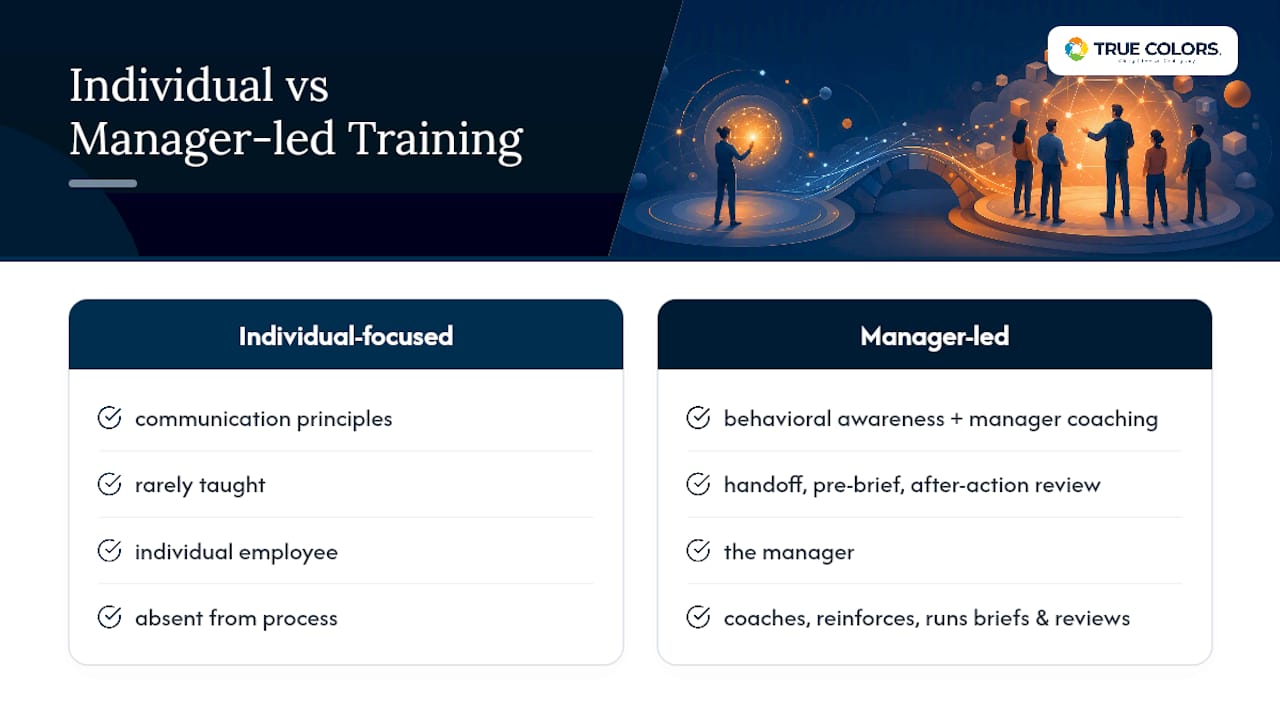
Truecolorsintl's approach — pairing behavioral awareness with manager coaching checkpoints and reinforcement cycles — reflects exactly this pattern. The Connected Leadership Program is built on the premise that leader behavior is the primary driver of team behavior, and that awareness without consistent practice produces no lasting change. Leaders who want to improve collaboration should start by examining their own behavioral consistency before designing any team-level intervention.
What Truecolorsintl offers leaders ready to act

Truecolorsintl gives organizations a practical path from diagnosis to sustained behavior change — without the guesswork of building a program from scratch. The corporate consulting team designs collaboration training programs grounded in the same behavioral science the meta-analyses support: multi-dimensional, blended, and reinforced through manager coaching rather than left to decay after a single workshop.
The employee experience survey provides the pre/post measurement infrastructure your pilot needs to produce defensible ROI data. The Connected Leadership Program develops the manager behaviors that make team-level training stick. Together, these offerings cover the full cycle: diagnose, train, reinforce, measure.
To start, request a discovery conversation with the Truecolorsintl consulting team. They will review your priority teams, identify the highest-leverage behavioral gaps, and outline a pilot design you can present to leadership within two weeks.
Sources
The evidence and frameworks referenced throughout this article draw from the following sources. Each is worth reviewing before designing or commissioning a program.
- Team training meta-analysis (PMC)
- Does team training improve team performance? A meta-analysis - Eduardo Salas et al.
- Teamwork training (AHRQ PSNet primer)
- Collaborative problem solvers are made not born – here’s what you need to know
- Collaboration Is a Key Skill. So Why Aren’t We Teaching It? (MIT Sloan)
- Collaboration, the Critical Skill We're Rarely Taught (Reworked)
- Positivepsychology