
Organizational culture is the collective set of behaviors, values, and norms that define how work gets done, and it persists well beyond any leadership transition. This is why culture outlasts leadership transitions: it lives in systems, habits, and people rather than in a single person’s authority. When a CEO departs, or a new VP steps in, the organization’s operating rhythm does not reset. The shared expectations, communication patterns, and accountability structures remain. Understanding this distinction is what separates leaders who build lasting organizations from those who build loyal followings.
Why culture outlasts leadership transitions: the core mechanism
Organizational culture functions as the operating system of a company. Individual leaders are applications running on top of it. When a leader leaves, the operating system keeps running. Culture persists because it is encoded in the daily behaviors of employees, the rituals teams repeat, and the stories organizations tell about themselves. No single person owns it, which is precisely what makes it durable.
Leaders shape culture as its primary architects through the behaviors they model and the standards they reinforce. That shaping, done consistently over time, transfers ownership from the leader to the organization itself. The culture then operates independently of who holds the title.

How culture gets embedded in systems and processes
Culture does not survive transitions by accident. It survives because it is built into the formal structures that govern daily work. Embedding shared values into onboarding programs, performance evaluations, and communication channels creates cultural anchors that hold steady regardless of who leads.
Specific mechanisms that embed culture include:
-
Onboarding programs that teach new employees not just job tasks, but behavioral expectations and team norms
-
Performance evaluations that assess how work gets done, not just what gets done
-
Decision-making frameworks that reflect organizational values rather than individual manager preferences
-
Recognition systems that reward behaviors aligned with cultural priorities
-
Communication rituals such as all-hands meetings, team retrospectives, and feedback cycles that reinforce shared language
The table below shows how each system reinforces culture independently of leadership:
| Organizational system | Cultural function |
|---|---|
| Onboarding | Transmits values and behavioral norms to new employees |
| Performance management | Holds employees accountable to cultural standards |
| Hiring and selection | Filters for culture alignment before employment begins |
| Recognition programs | Signals which behaviors the organization truly values |
| Internal communication | Maintains shared language and consistent expectations |
Pro Tip: Audit your onboarding program once a year. Ask whether it teaches your culture explicitly or leaves new employees to absorb it by observation. Explicit transmission reduces cultural drift during leadership changes.
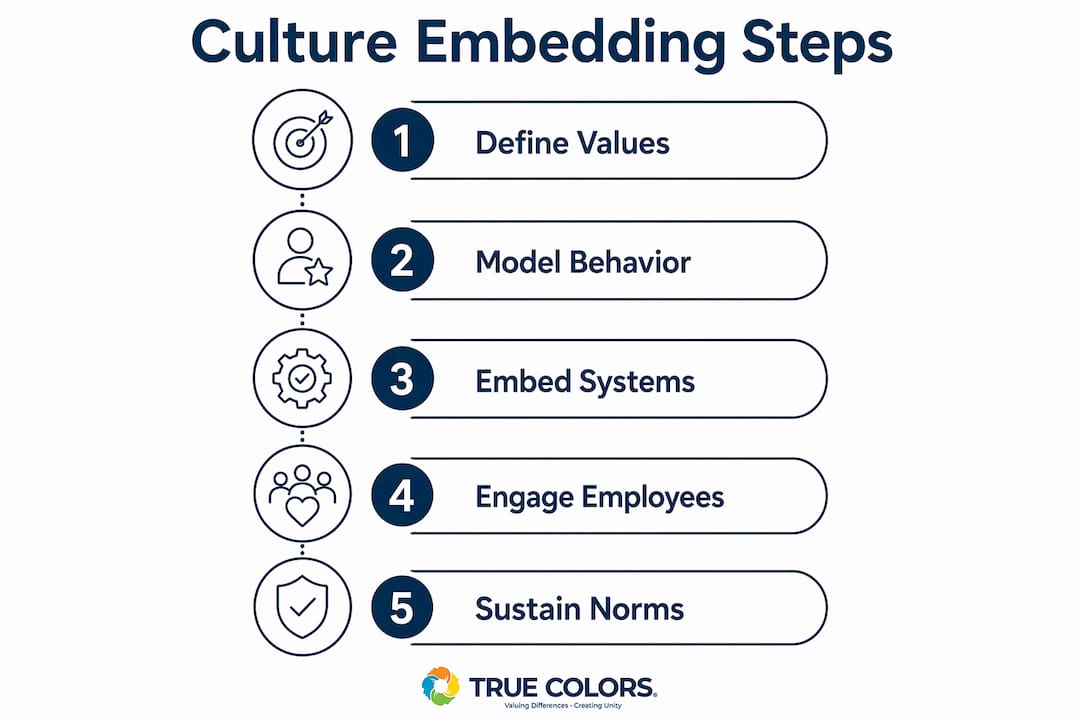
When processes carry the culture, a new leader inherits a functioning system rather than a blank slate. That continuity protects the organization from the disruption that leadership turnover would otherwise cause.
Do engaged employees sustain culture through leadership change?
Yes. High employee engagement creates a sense of ownership that transforms employees from passive participants into active stewards of culture. Engaged employees uphold core principles independent of who leads because they have internalized the values as their own.
This matters most during leadership transitions, when uncertainty is highest. Employees who feel connected to the organization’s purpose do not wait for a new leader to tell them how to behave. They continue operating according to the norms they have practiced and believe in. That behavioral continuity is what prevents cultural drift during the gap between leaders.
The consequences of low engagement are measurable. Over 50% of employees who rate their organizational culture poorly are actively looking for new jobs. That statistic reveals a direct line between culture perception and retention risk, and the risk intensifies during leadership transitions when employees are already evaluating their future with the organization.
Engaged employees also serve as informal culture carriers in specific ways:
-
They model expected behaviors for newer colleagues
-
They push back when decisions conflict with stated values
-
They maintain team cohesion during periods of leadership uncertainty
-
They communicate cultural expectations to incoming leaders
Organizations that invest in the employee experience before a leadership transition occurs are far better positioned to maintain cultural continuity than those that treat engagement as a reactive measure.
Culture vs. leadership style: which guides behavior during transitions?
Leadership styles are personal. Culture is institutional. A new leader may prefer a more directive approach, where the previous leader was collaborative. That stylistic shift creates friction, but it does not erase culture if the culture is strong. Strong organizational culture mitigates the disruptive effects of leadership changes by maintaining consistent behavioral expectations and norms throughout the transition.
The comparison below clarifies what each element controls:
| Factor | Leadership style | Organizational culture |
|---|---|---|
| Source | Individual leader’s personality and preferences | Collective behaviors and shared values |
| Durability | Changes with each new leader | Persists across multiple leadership cycles |
| Scope | Influences direct reports primarily | Shapes the entire organization |
| Accountability | Dependent on the leader’s enforcement | Distributed across teams and systems |
| Transition risk | High. Disruption is likely when a leader changes | Low. Continuity is maintained through systems |
Culture defines what is acceptable, what is rewarded, and what is not tolerated. Those standards do not disappear when a leader does. They remain visible in how teams handle conflict, how decisions get made, and how people treat each other. A new leader who ignores those existing norms will face resistance. A new leader who aligns with them accelerates their own effectiveness.
Pro Tip: When onboarding a new senior leader, give them a structured cultural orientation. Share the stories, rituals, and norms that define the organization. This is not ceremonial. It is how you protect the culture you have built.
Practical strategies to build a culture that survives leadership changes
Building cultural resilience requires deliberate action before a transition occurs. These strategies create the conditions for continuity:
-
Model cultural behaviors at every level of leadership. Culture is not what is said. It is what is repeated. When managers at all levels consistently demonstrate the same behaviors, those behaviors become the norm rather than the exception.
-
Embed culture into talent acquisition. Culture-aligned hiring and socialization processes promote continuity regardless of leadership changes. Hiring for values fit, not just skills, ensures that the people entering the organization reinforce rather than dilute the culture.
-
Involve employees in defining cultural expectations. When employees co-create the norms they are expected to follow, they take ownership of upholding them. That ownership does not transfer away when a leader leaves.
-
Plan for culture continuity in succession management. Succession planning typically focuses on skills and experience. Adding a cultural alignment assessment to that process ensures incoming leaders understand and can operate within the existing culture. Truecolorsintl’s leadership development programs are built around exactly this kind of behavioral alignment.
-
Communicate transparently during transitions. Silence during leadership changes creates anxiety and speculation. Regular, honest communication about what is changing and what is not reinforces cultural stability and builds trust.
-
Reinforce culture through recognition. Publicly recognizing behaviors that reflect organizational values sends a clear signal about what the organization stands for. That signal does not depend on any single leader to deliver it.
Common pitfalls that threaten cultural continuity
The most common threat to cultural continuity is a leader-centric culture. When one person’s personality becomes the culture, the organization has no operating system of its own. Every leadership transition becomes a crisis.
Other pitfalls that create fragile cultures include:
-
Inconsistent accountability. Fluctuating expectations tied to individual leader preferences create confusion and erode trust. Employees learn to adapt to whoever is in charge rather than to a consistent standard.
-
Ignoring employee voice. When employees feel their input does not matter, engagement drops. Disengaged employees do not protect culture during transitions. They leave or disengage further.
-
Mixed messages between stated and lived values. If the organization says it values collaboration but rewards individual competition, employees follow the reward, not the statement.
-
Neglecting culture during the transition itself. Leadership transitions are the moments when culture is most at risk. Organizations that treat the transition as purely a structural event miss the opportunity to actively reinforce cultural norms.
Culture-leadership misalignment is not just a morale problem. It is a retention and performance problem with real costs that compound over time.
Key Takeaways
Culture outlasts leadership transitions because it is embedded in organizational systems, employee behaviors, and shared norms that no single leader owns or controls.
| Point | Details |
|---|---|
| Culture lives in systems | Onboarding, evaluations, and recognition programs carry culture independently of individual leaders. |
| Engaged employees protect culture | Employees who own the culture maintain behavioral continuity during leadership gaps. |
| Strong culture buffers disruption | Organizations with clear norms experience less instability when leadership changes occur. |
| Pitfalls are predictable | Leader-centric cultures and inconsistent accountability are the primary threats to cultural continuity. |
| Succession planning must include culture | Assessing cultural alignment in leadership candidates protects the organization’s operating norms. |
Culture is an operating responsibility, not a leadership personality
I have worked with organizations that genuinely believed their culture was strong, only to watch it fracture within six months of a leadership change. In almost every case, the culture had been carried by one person rather than built into the organization’s systems and people. When that person left, so did the culture.
The shift in thinking that changes everything is this: culture is not a leadership personality. It is an operating model. Consistent leadership behavior repeated over time builds culture as a durable organizational asset, not a reflection of whoever currently holds the top title. That distinction is the difference between a culture that survives and one that has to be rebuilt from scratch every few years.
What I have also observed is that leaders who treat culture as a living responsibility rather than a fixed asset are far more effective at navigating transitions. They document norms. They develop other leaders to model the same behaviors. They create feedback loops that tell them when the culture is drifting. They treat culture-building as ongoing work, not a one-time initiative.
The organizations that get this right do not just survive leadership transitions. They use them as opportunities to reaffirm and sometimes sharpen their culture. That is not idealism. It is what disciplined stewardship looks like in practice.
— Theresa
How Truecolorsintl supports culture that outlasts any leadership change
Organizations that want their culture to survive leadership transitions need more than good intentions. They need practical systems that make culture visible, measurable, and repeatable.
Truecolorsintl helps leaders and teams do exactly that. Through leadership development programs built around observable behavior and alignment, Truecolorsintl gives organizations the tools to embed culture into how people work together. The corporate consulting solutions address culture alignment at the team and organizational level, supporting leaders through transitions with structure rather than guesswork. Whether you are preparing for a leadership change or recovering from one, Truecolorsintl provides the reinforcement needed to keep culture moving forward.
FAQ
Why does culture outlast leadership transitions?
Culture outlasts leadership transitions because it is embedded in organizational systems, employee behaviors, and shared norms rather than in any individual leader. When those systems are strong, the culture continues operating regardless of who holds the leadership role.
What happens to culture when a new leader arrives?
A new leader inherits the existing culture and either reinforces or disrupts it through their behavior. Strong cultures buffer the disruption by maintaining consistent behavioral expectations that the new leader must align with to be effective.
How does employee engagement protect culture during transitions?
Engaged employees act as culture stewards, modeling expected behaviors and maintaining team norms during leadership gaps. Organizations with low engagement face a higher risk of turnover during transitions, since over 50% of employees in poor-culture environments are already looking for new jobs.
What is the biggest threat to cultural continuity during leadership change?
The biggest threat is a leader-centric culture where one person’s personality substitutes for institutional norms. When that leader leaves, the organization has no shared operating standard to fall back on.
How can leaders prepare their organization’s culture for a leadership transition?
Leaders should embed culture into formal systems such as hiring, onboarding, and performance management, involve employees in defining cultural expectations, and incorporate cultural alignment into succession planning. Truecolorsintl’s talent acquisition tools support culture-aligned hiring as part of that preparation.