
Behavioral interview questions ask you to describe a real past situation to prove how you actually behaved and what you learned from it. This guide gives you a themed question bank covering ten competencies, a full breakdown of the STAR framework, ten model answers you can adapt, and a story bank system that prepares you for nearly any prompt an interviewer throws at you.
TL;DR:
- Use concise, specific stories that highlight tangible results, especially quantifiable ones, to demonstrate impact and learning.
- Focus on owner-ship and concrete actions in the STAR framework to show accountability and decision-making, avoiding vague or passive language.
- Tailor your examples to the role by emphasizing relevant competencies like leadership, problem-solving, or teamwork, and adapt vocabulary accordingly.
- Prepare multiple versatile stories mapped to different themes, and practice them aloud to ensure natural delivery within the ideal 90-120 second window.
- When caught off guard, pause briefly to choose the closest story and frame it appropriately, instead of inventing or rushing a disjointed answer.
Table of Contents
- What Are Behavioral Interview Questions?
- Why Interviewers Rely on Behavioral Interview Questions
- The Complete Behavioral Interview Question Bank by Theme
- How to Structure Your Answer With the STAR Framework
- Ten Model STAR Answers You Can Adapt
- Building a Story Bank That Covers Nearly Any Prompt
- Common Mistakes and How to Fix Them Fast
- How True Colors Views Behavioral Storytelling and Team Fit
- What to Ask the Interviewer When It's Your Turn
- Tailoring Your Answers to Different Industries and Roles
- Handling Behavioral Questions That Catch You Off Guard
- How Expectations Shift by Experience Level
- A Personal Note on Practice and Learning From Mistakes
- When Interview Skills Aren't Enough: Fixing the Hiring Process Itself
- Sources
What Are Behavioral Interview Questions?
Behavioral interview questions ask you to recall a specific past event rather than speculate about a hypothetical one. You will recognize them instantly by their opening phrasing: "Tell me about a time…", "Give me an example of…", "Describe a situation where…", "Walk me through a time you…" Each one is fishing for evidence, not opinion.
Interviewers use these questions to test soft skills that are hard to verify any other way, and they typically cluster around five competencies:
- Teamwork — how you collaborate, share credit, and handle interdependence
- Leadership — how you influence others without or with formal authority
- Communication — how you translate complexity, deliver bad news, or resolve misunderstandings
- Problem-solving — how you diagnose issues and choose between imperfect options
- Adaptability — how you respond when plans, priorities, or people change without warning
The distinction between behavioral and situational questions trips up a lot of candidates. A situational question asks "What would you do if a teammate missed a deadline?" A behavioral question asks "Tell me about a time a teammate missed a deadline and how you handled it." The first invites a theory. The second demands a memory, which is exactly why behavioral interview questions are considered a stronger predictor of how someone will actually perform. Technical questions sit in a different category entirely. They test whether you know something; behavioral questions test what you did with what you know.
Why Interviewers Rely on Behavioral Interview Questions
Interviewers ask about your past because your past is the best evidence they have for your future. The logic is simple: a candidate who navigated a messy cross-team conflict last year is more likely to navigate the next one than a candidate who has only ever described how they would handle it in theory.
Most interviewers, whether they say so or not, are scoring your answer across four dimensions:
- Ownership — did you use "I" language, or did you hide inside a team's collective decision?
- Self-awareness — do you understand your own role in what went wrong or right?
- Impact — did the situation actually change because of your action?
- Decision quality — did you weigh trade-offs sensibly given the information you had at the time?
Interviewers evaluate answers along specificity, structure, ownership, and result, and a common scoring penalty is an answer that skips the Result entirely. That is the quiet killer of an otherwise strong story. You can describe a brilliant Action and still lose points if you never state what changed because of it.
This is also why quantifiable outcomes matter so much more than most candidates assume. "We improved the process" tells an interviewer nothing they can compare across candidates. "We cut onboarding time from three weeks to eight days" gives them a number to weigh against every other answer they hear that day. Learning matters too. A story that ends with a lesson applied later shows the interviewer you don't just survive situations, you extract value from them.
The Complete Behavioral Interview Question Bank by Theme
Practicing every possible prompt is a losing strategy. The smarter approach is to know the ten themes interviewers pull from, recognize what each one is really testing, and pick the three or four themes most relevant to the role you're chasing.
1. Teamwork
Teamwork questions probe whether you elevate a group's output or just complete your own slice of it.
- "Tell me about a time you had to work closely with someone whose working style was very different from yours." Tests flexibility and interpersonal patience.
- "Describe a project where your contribution was small but the team's success depended on it." Tests whether you value shared outcomes over individual credit.
- "Give an example of a time you had to rely on a teammate you didn't fully trust." Tests judgment and diplomacy.
- "Tell me about a time you disagreed with a team decision but had to support it anyway." Tests commitment versus ego.
2. Conflict
Conflict prompts reveal whether tension makes you defensive or constructive.
- "Describe a disagreement you had with a coworker and how you resolved it." Tests de-escalation skill.
- "Tell me about a time you had to deliver critical feedback to a peer." Tests directness balanced with tact.
- "Give an example of a conflict you couldn't fully resolve. What did you do?" Tests maturity under unresolved tension.
3. Leadership
Leadership questions matter at every level, not just for people managers, because influence without authority is its own skill.
- "Tell me about a time you led a project without formal authority over the people involved." Tests informal influence.
- "Describe a time you had to motivate a team through a difficult stretch." Tests morale management.
- "Give an example of a decision you made that was unpopular with your team." Tests conviction under pushback.
- "Tell me about a time you delegated something you probably should have kept for yourself, or vice versa." Tests self-awareness about control.
4. Problem-Solving
These prompts test how you think when the "right" answer isn't obvious.
- "Describe a complex problem you solved with limited information." Tests judgment under uncertainty.
- "Tell me about a time you had to choose between two imperfect solutions." Tests trade-off reasoning.
- "Give an example of a time your first solution didn't work. What did you do next?" Tests persistence and iteration.
5. Communication
Communication prompts test clarity under pressure, not just eloquence.
- "Tell me about a time you had to explain something technical to a non-technical audience." Tests translation skill.
- "Describe a time you had to deliver bad news to a client or stakeholder." Tests composure and transparency.
- "Give an example of a misunderstanding that caused a problem. How did you fix it?" Tests accountability in communication breakdowns.
6. Adaptability and Resilience
These questions test what happens when your plan collapses mid-execution.
- "Tell me about a time priorities shifted suddenly and you had to adjust." Tests flexibility.
- "Describe a time you had to learn something new quickly to keep a project moving." Tests speed of learning.
- "Give an example of a setback that forced you to change your approach entirely." Tests resilience.
7. Time Management and Prioritization
These prompts reveal how you make trade-offs when everything feels urgent.
- "Tell me about a time you had to juggle multiple deadlines at once." Tests triage skill.
- "Describe how you decided what to deprioritize when your workload became unmanageable." Tests judgment under volume.
- "Give an example of a time you missed a deadline. What happened?" Tests accountability, not just planning.
8. Failure and Growth
Failure questions are less about the mistake and more about what you built afterward.
- "Tell me about a time you failed at something important." Tests honesty and self-reflection.
- "Describe a mistake you made that affected someone else. How did you handle it?" Tests ownership under consequence.
- "Give an example of feedback that was hard to hear but ultimately useful." Tests coachability.
9. Customer Focus
Even in non-customer-facing roles, this theme surfaces to test whether you think beyond your own task list.
- "Tell me about a time you went out of your way for a customer or client." Tests service orientation.
- "Describe a time a customer's needs conflicted with an internal deadline." Tests prioritization under competing interests.
10. Initiative
Initiative questions separate people who wait for instructions from people who spot gaps and fill them.
- "Tell me about a time you identified a problem no one had asked you to solve." Tests proactivity.
- "Describe a time you took on responsibility outside your job description." Tests ownership beyond title.
If you're early in your career, weight your practice toward teamwork, adaptability, and failure and growth, since those come up in nearly every entry-level loop. If you're targeting a management or senior role, leadership, conflict, and time management carry more weight, because interviewers are testing how you'll operate when you're the one setting direction for others.
How to Structure Your Answer With the STAR Framework
The STAR framework, Situation, Task, Action, Result, remains the industry-standard method for organizing a behavioral answer, and it works because it forces you to include exactly what an interviewer is scoring for, in the order they expect to hear it.
Situation sets the scene in one or two sentences. State the context, the stakes, and who else was involved. Skip company history and unrelated backstory. If it takes you thirty seconds to set the scene, you're already losing your listener.
Task names your specific responsibility inside that situation. This is where you separate what was assigned to you from what the team was doing collectively. One sentence is usually enough.
Action is the meat of the answer and deserves roughly half your total time. Describe the specific steps you took, using "I" rather than "we" wherever the action was actually yours. This is also where interviewers listen for decision quality: did you weigh options, or did you just react?
Result closes the loop with what changed, ideally with a number attached. "Customer complaints dropped by half" lands harder than "customers were happier." If you genuinely don't have a hard metric, use a comparative outcome, like a timeline shortened or a recurring problem that stopped recurring.
Timing matters more than most candidates realize. Guidance from interview coaches puts the ideal answer length at 90 to 120 seconds. Anything under 60 seconds usually means you skipped the Action detail interviewers actually want. Anything over 150 seconds risks losing the interviewer's attention entirely, and it often signals you're including Situation detail that doesn't earn its place.
If you're running long, cut here first:
- Trim the Situation to one sentence, no more
- Remove any names, dates, or internal jargon that don't affect the story's logic
- Cut secondary actions and keep only the one or two that mattered most
- State the Result as a single clear sentence, not a paragraph of qualifiers
Language choices matter as much as structure. Stick to first-person ownership language throughout the Action, since "I proposed," "I decided," and "I adjusted" all signal accountability that "we" quietly dilutes. Avoid passive constructions like "a decision was made" that hide who actually made it.
Pro Tip: Build one story that can answer at least three different prompts by changing only the framing sentence you use to introduce it. A story about redesigning a broken handoff process between two teams can answer a teamwork question, a problem-solving question, and an initiative question, depending on which angle you lead with.
Ten Model STAR Answers You Can Adapt
These are complete answers built from common prompts. Each one is written to be a template, not a script. Swap the specifics for your own experience and the structure still holds.
-
Teamwork. Situation: A cross-functional launch stalled because engineering and marketing were working from different timelines. Task: I was the project coordinator responsible for keeping both sides aligned. Action: I built a shared timeline document and set a standing fifteen-minute sync every Monday so blockers surfaced early instead of at deadline. Result: We launched on schedule after two previous launches had slipped by over a week each.
-
Conflict. Situation: A senior colleague repeatedly overrode my recommendations in client meetings without discussing them with me first. Task: I needed to address it without damaging the working relationship. Action: I asked for a private conversation, framed it around the client's experience rather than my ego, and proposed we align beforehand on messaging. Result: We never had another public disagreement in front of a client again.
-
Leadership. Situation: A team I wasn't managing was missing every internal deadline on a shared deliverable. Task: As the person depending on their output, I needed to unblock the situation without overstepping. Action: I met with their lead, offered to take on the scheduling and status tracking they didn't have bandwidth for, and set clear weekly checkpoints. Result: The team hit its next three deadlines in a row.
-
Problem-solving. Situation: A recurring data error was corrupting weekly reports and no one could trace the source. Task: I was asked to investigate. Action: I built a validation script that flagged the exact step where the error entered, rather than guessing at fixes. Result: We identified a formatting mismatch in an upstream system and eliminated the error within a week.
-
Communication. Situation: A client was upset about a delay and threatening to escalate. Task: I owned the client relationship. Action: I called them directly instead of emailing, acknowledged the miss plainly, and gave a specific revised date with a built-in buffer. Result: The client stayed, and later became a reference account.
-
Adaptability. Situation: A key vendor dropped out two weeks before a major event. Task: I had to find a replacement fast. Action: I reached out to three backup contacts the same day, negotiated a rush rate with one, and revised the run-of-show to fit their capacity. Result: The event happened on schedule with no visible disruption to attendees.
-
Time management. Situation: I had three deliverables due the same week with overlapping stakeholders. Task: I needed to sequence the work without missing any deadline. Action: I mapped each task's true dependency chain, flagged the one with the least flexibility to my manager, and negotiated a two-day extension on the least urgent item. Result: All three landed on time, and the extension was never even needed.
-
Failure and growth. Situation: I underestimated the scope of a project and gave a launch date that turned out to be unrealistic. Task: I had to own the miss with my manager and the client. Action: I told my manager immediately rather than waiting, proposed a revised date with contingency built in, and built a scoping checklist so I would never estimate off a gut feeling again. Result: The next four projects I scoped landed within 10% of their original estimate.
-
Customer focus. Situation: A customer's contract renewal was at risk because a promised feature had slipped. Task: I managed the account. Action: I set up a call with product to get a firm revised timeline, then delivered that timeline to the customer with a small concession to offset the delay. Result: The customer renewed for two years instead of one.
-
Initiative. Situation: I noticed new hires were asking the same onboarding questions repeatedly, eating into senior staff time. Task: No one had asked me to fix it. Action: I built a self-serve onboarding guide covering the ten most common questions and shared it with the next hiring cohort. Result: Manager time spent on onboarding questions dropped noticeably within the first month.
Notice the failure story doesn't apologize or dwell. It names the mistake plainly, states what was done immediately after, and ends with a concrete process change. That structure, ownership followed by a corrective habit, reads as far more credible than a story that claims nothing ever went wrong.
Building a Story Bank That Covers Nearly Any Prompt
You don't need fifty stories memorized. A small story bank of six to eight versatile examples, each mapped to multiple themes, covers the majority of behavioral prompts you'll encounter in any given interview loop.
Pick a moderate number of stories from experiences with real complexity, meaning there was a decision to make, a stake involved, and a measurable outcome. Avoid stories where the outcome was purely lucky or where your role was too minor to describe convincingly in first person.
Once you have your stories, run a mapping exercise. For each one, list three or four themes it could plausibly answer. A story about fixing a broken handoff between two departments might map to teamwork, problem-solving, and initiative all at once. Write that mapping down. It saves you from freezing when an interviewer asks a prompt you didn't specifically prepare for.
A practical practice routine looks like this:
- Time yourself out loud for each story, targeting the 90 to 120 second window
- Record yourself once and listen back, most people are shocked by how much filler language creeps in
- Run at least one mock interview with a peer who asks follow-up questions, since real interviews rarely stop at your first answer
- Iterate the Result line specifically, since that's the part most candidates leave vague on the first pass
The preparation habits that separate strong candidates from average ones are almost always about repetition, not raw talent. Practicing a story aloud five times exposes weak spots that reading it silently never will.
Common Mistakes and How to Fix Them Fast
Most weak behavioral answers fail for one of five predictable reasons, and each has a quick fix.
- Too much context. If your Situation runs longer than two sentences, cut it. Interviewers care about your Action, not your company's org chart.
- Vague actions. "I worked on improving communication" tells the interviewer nothing. Name the specific step: the document you built, the meeting you scheduled, the conversation you initiated.
- Missing results. If you can't state what changed, your story isn't finished yet. Go back and find the number, even an approximate one.
- Blame-heavy stories. A story where the failure was someone else's fault reads as a lack of self-awareness, even when it's technically true. Reframe around your own response instead.
- Overly scripted delivery. Memorized answers sound stiff and fall apart under follow-up questions. Know your key beats, not your exact sentences.
Pro Tip: Run this sixty-second check before you walk into any interview: does each story have a clear "I" action, a number in the Result, and an ending that isn't "and it worked out fine"? If any of those three is missing, fix it before you sit down, not during the answer.
How True Colors Views Behavioral Storytelling and Team Fit
A STAR answer that only proves you can hit a deadline misses half the point. The strongest candidates use their Action section to reveal how they actually work with people, not just what they accomplished alone.
Highlight your communication rhythms explicitly. Did you check in daily or weekly? Did you loop in a skeptical stakeholder early rather than surprising them later? Small habits like these tell an interviewer more about your fit than the outcome itself does. Behavioral intelligence in leadership research points to exactly this: teams perform better when individuals understand and adjust to how their collaborators operate, not just what tasks need finishing.
A useful exercise before any interview: for each of your six to eight core stories, write one sentence naming the specific habit that made the outcome possible. Not "I communicated well," but "I sent a two-line status update every Friday so no one was surprised on Monday." That level of specificity is what separates a forgettable answer from one an interviewer remembers an hour later.
If your story involves resolving tension with a colleague, lean into the how, not just the resolution. Practical guidance on handling difficult workplace conversations is worth reviewing before any interview heavy on conflict-themed prompts, since the framing you use to describe a hard conversation often matters as much as how it ended.
What to Ask the Interviewer When It's Your Turn
The questions you ask at the end of a behavioral interview are still part of the evaluation, whether the interviewer says so or not. A generic "What's the company culture like?" wastes the moment. Sharper questions signal that you were actually listening.
Ask about how the team handles the exact competencies you were just questioned on. If the interview leaned heavily on conflict and communication prompts, ask something like: "Can you walk me through how disagreements between this team and others typically get resolved?" That question does double duty. It gives you real information and shows the interviewer you connect dots.
Other strong options worth having ready:
- "What does a strong first ninety days look like for someone in this role?"
- "How does this team typically handle shifting priorities mid-project?"
- "What's an example of a recent decision this team made that required trade-offs?"
- "How is success in this role measured beyond the job description?"
Avoid questions you could have answered by reading the company website, and avoid asking about compensation or time off in this specific window unless the interviewer opens that door first. Save those for a recruiter conversation or a later stage. The goal here is to leave the interviewer with one more piece of evidence that you think in the same structured, specific way your STAR answers just demonstrated.
Tailoring Your Answers to Different Industries and Roles
The STAR structure never changes, but what counts as a strong Result absolutely does depending on the field you're interviewing in.
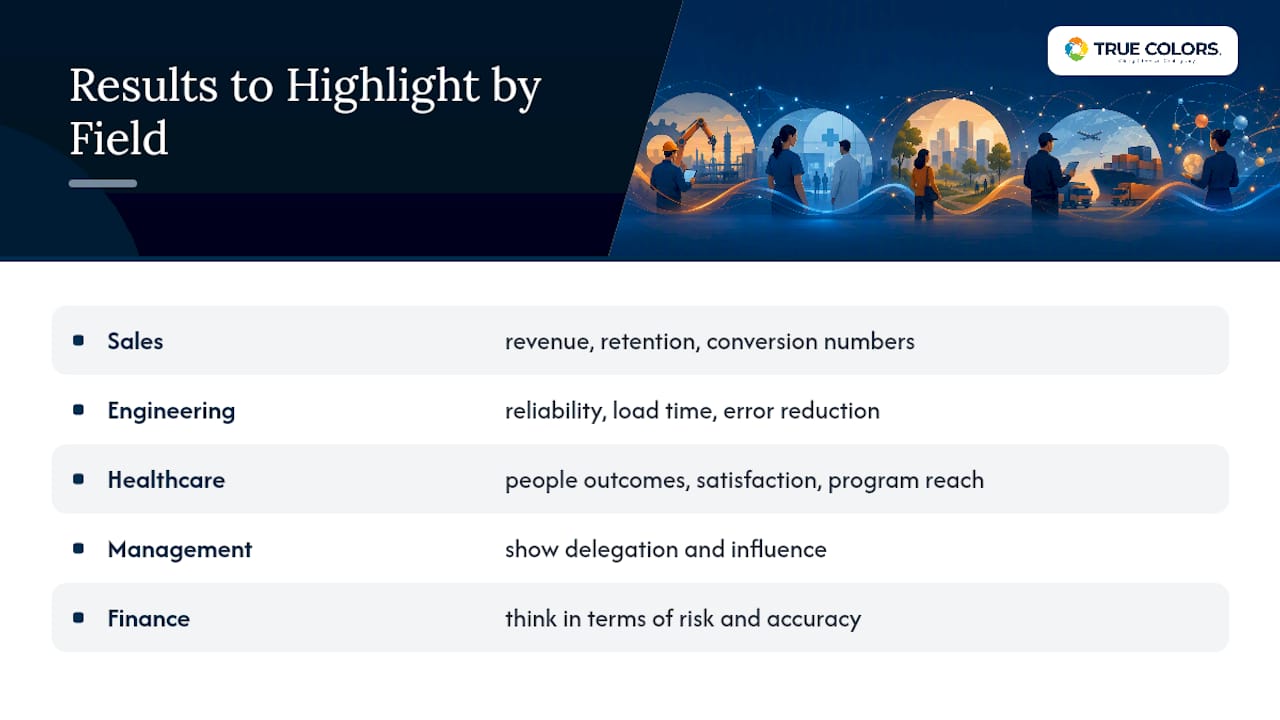
In sales and client-facing roles, lean on revenue, retention, or conversion numbers wherever you have them. A vague "the client was happy" carries far less weight than "the account renewed at a higher tier." In engineering and technical roles, results tied to system reliability, load time, or error reduction land better than soft descriptions of collaboration, even in teamwork-themed prompts. In healthcare, education, or nonprofit settings, outcomes tied to people, patient satisfaction, student progress, program reach, often matter more than pure efficiency metrics, and interviewers in these fields tend to weight empathy and judgment heavily in the Action section.
For management and leadership-track roles, interviewers expect your Action section to show delegation and influence, not just individual execution. A senior candidate who describes doing all the work personally, even successfully, often reads as someone who hasn't learned to lead through others yet.
One adjustment candidates miss: match your vocabulary to the field without overcorrecting. A finance interviewer doesn't need you to use finance jargon to prove fit, but they do want to see you think in terms of risk, accuracy, and stakes. A creative role interviewer wants evidence of original thinking inside your Action, not just process compliance. Read the job posting's language closely before your interview and notice which competencies it repeats. That repetition is usually a direct hint at which of your six to eight stories to lead with.
Handling Behavioral Questions That Catch You Off Guard
Every candidate eventually hits a prompt that doesn't map cleanly to any story they prepared. The instinct to panic is normal. The fix is a short mental process, not a scramble.
First, don't answer instantly. A brief pause, even three or four seconds, to think through which of your stories comes closest is far better than launching into a rambling answer that goes nowhere. Interviewers read a short pause as thoughtfulness, not weakness.
Second, if the question genuinely seems unrelated to the role, like "Tell me about a time you disagreed with a rule you thought was unfair," recognize it's probably testing judgment or integrity rather than a specific job skill. Pick your closest available story and reframe the opening sentence to match the angle being asked about, rather than searching for a brand-new memory on the spot.
Third, if you truly don't have a relevant example, say so honestly rather than inventing one under pressure. A calm "I haven't encountered that exact situation, but here's a related one" followed by your closest match reads as far more credible than a story that sounds fabricated because it probably is.
Finally, if you don't understand the question itself, ask for clarification. "Just to make sure I answer the right thing, are you asking about a time I led a team, or a time I influenced a decision without formal authority?" This single move prevents you from spending ninety seconds answering the wrong question entirely.
How Expectations Shift by Experience Level
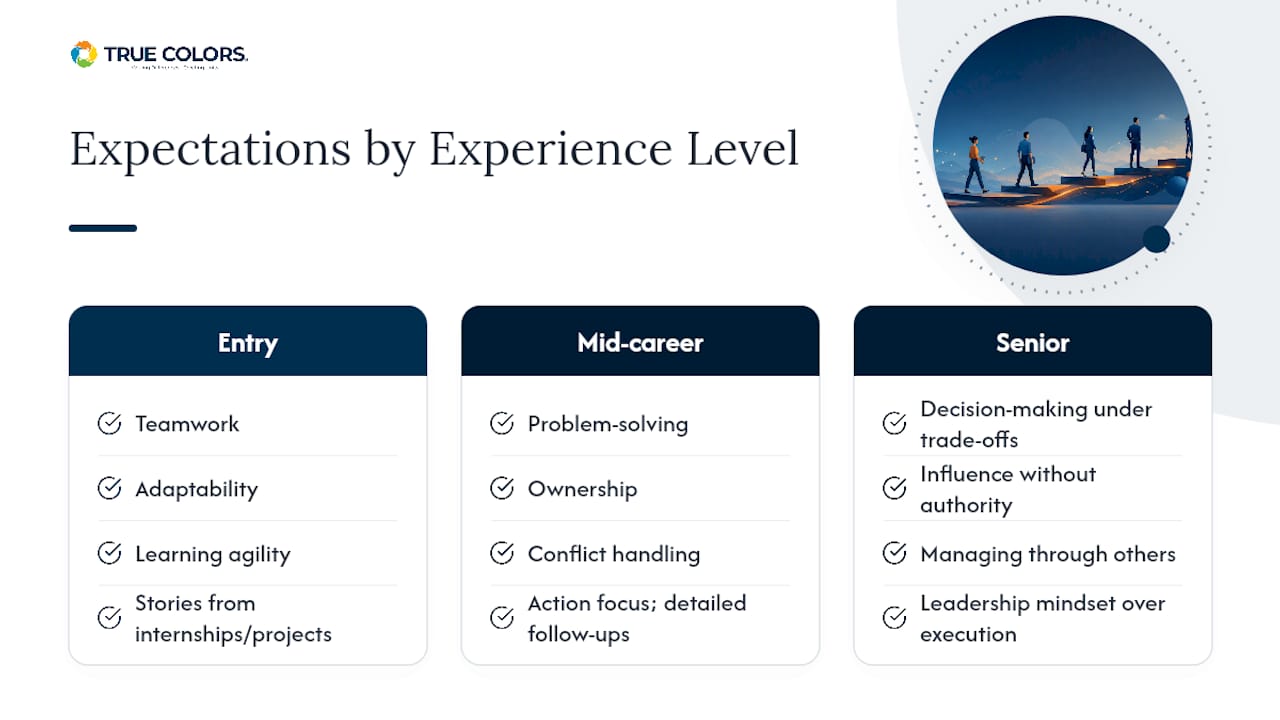
The competencies behavioral interviews test shift meaningfully as you move from entry-level to senior positions, and knowing the shift helps you weight your preparation correctly.
At the entry level, interviewers focus heavily on teamwork, adaptability, and learning agility, since you likely don't have a long track record of independent decisions yet. Stories from internships, group projects, or even extracurricular commitments are entirely fair game here, and interviewers expect that. What they're really testing is whether you can reflect honestly on experience, any experience, not whether that experience happened inside a Fortune 500 office.
At the mid-career level, expect a shift toward problem-solving, ownership, and conflict handling. You're now expected to have navigated ambiguity without constant oversight, and interviewers will probe harder on the Action section, often with follow-up questions like "What would you have done differently?"
At the senior and leadership level, the questions lean heavily toward decision-making under trade-offs, influencing without authority, and managing through other people rather than doing the work yourself. A senior candidate who answers a leadership question with a story about personal execution rather than team enablement often signals they haven't fully made the leap into a leadership mindset yet, even if the individual result was strong.
A Personal Note on Practice and Learning From Mistakes
The best interview stories I've reviewed rarely came from someone's proudest moment. They came from a moment that went sideways and got fixed. Candidates who reframe a real stumble into a clear "here's what I changed afterward" almost always land better than candidates trying to perform perfection.
Practice out loud, not just in your head. Record yourself once, even if it feels awkward. You'll hear filler words and vague Action lines you'd never notice otherwise. Build your six to eight stories deliberately, map them to themes, and rehearse them enough that the structure feels natural rather than recited. That preparation is what lets your actual personality come through instead of a script.
— Theresa
When Interview Skills Aren't Enough: Fixing the Hiring Process Itself
Sharpening your own STAR answers only solves half the equation. If you're on the hiring side, structured behavioral interviewing only works when interviewers are asking the right questions consistently and scoring them against the same criteria.

There are resources available for hiring managers and L&D leaders who want their teams asking behavioral interview questions consistently across every interviewer, not just the ones who happen to be naturally good at it. This involves competency frameworks tied to organizational culture, interview templates built around observable behavior rather than gut feel, and calibration sessions so two interviewers scoring the same candidate land on the same conclusion. This is the deeper piece of the culture change work: hiring decisions that reflect a consistent, agreed-upon standard instead of whoever ran the loop that day.
If persistent conflict-handling or communication gaps keep surfacing in your interview debriefs, that's often a signal worth investigating further with a coaching resource like MMDC ALCHEMY's workplace conversation coaching. But if the real gap is in how your organization interviews and hires for these traits in the first place, explore True Colors' talent acquisition services to see how a behavior-based framework fits your hiring process.
Sources
- Behavioral interview questions - Indeed
- Behavioral interview questions - Coursera
- Top 50 Behavioral Interview Questions With STAR Answers (2026) | TechScreen