
Design a behavior-based training program by mapping high-impact decision moments to precise target behaviors, then engineering instructional events, reinforcement, and governance so those behaviors become the default in daily work. Culture is not what is said. It's what is repeated.
**Start here — five things your program must include: **
- A discovery phase that surfaces the decision moments where behavior actually matters
- A behavior map linking each target behavior to a business metric and a learning objective
- Instructional design grounded in empirically supported principles (not just content delivery)
- A pilot with a defined measurement plan before any organization-wide rollout
- A sustainment system that embeds behaviors in hiring, performance reviews, and manager routines
Immediate next steps:
- Brief your CHRO and one business sponsor on the decision-moment framing this week.
- Assign an L&D design owner and a measurement owner before discovery begins.
- Pull existing engagement, attrition, and performance data to establish a baseline.
- Nominate one business unit (50–200 people) as the pilot group.
- Schedule a 90-minute discovery session with frontline managers in that unit.
Key Takeaways
A behavior-based training program produces durable change only when target behaviors are tied to real decision moments, reinforced by managers, and embedded in the systems that govern daily work.
| Point | Details |
|---|---|
| Map decision moments first | Identify the three to five moments where the target behavior most visibly succeeds or fails before designing any content. |
| Apply empirical principles | Use the 15 instructional principles grouped by stage: encoding principles early, transfer and habit principles late. |
| Measure at all four levels | Track participation, learning, behavioral adoption, and business outcomes — adoption data appears in weeks 6–12, KPI shifts take a full quarter or more. |
| Sustain through systems | Align hiring, onboarding, performance reviews, and manager scorecards to the target behaviors so the environment reinforces what training started. |
| Truecolorsintl as your partner | Truecolorsintl's 30/60/90-day discovery-to-pilot engagement delivers a behavior map, measurement baseline, and pilot data before enterprise rollout. |
Table of Contents
- Why behavior-based programs outperform one-off workshops
- Essential components every behavior-based program needs
- Which instructional principles actually transfer behavior to the job
- How to choose delivery methods that match your target behaviors
- How to measure behavior transfer and business impact
- A pragmatic roadmap from discovery to sustained change
- Systems that make learned behaviors stick
- How Truecolorsintl operationalizes behavior-based training
- What actually drives durable behavior change
- True Colors can help you get started
- Sources
Why behavior-based programs outperform one-off workshops
The science of workplace instruction draws a critical distinction most L&D teams miss: an instructional event is what the organization runs (a workshop, a module, a coaching session). A learning event is what happens inside the learner — encoding, retrieval, application. Programs fail when they optimize for the first and ignore the second. Effective behavioral training strategies close that gap by designing instructional events that reliably trigger learning events.
Three foundational elements determine whether that happens: the learner (their prior knowledge, motivation, and context), the instructional principles applied (evidence-backed techniques that improve encoding and transfer), and the delivery method (how and when the content reaches the learner).
Durable culture change requires orchestrating multiple managerial levers together: hiring criteria, peer feedback norms, information-sharing practices, and performance signals. A single training event, no matter how well designed, cannot move those levers alone.
Pro Tip: Before designing a single module, identify the three to five decision moments where the target behavior most visibly succeeds or fails — a hiring debrief, a performance conversation, a team meeting. Those moments are where your instructional design must land.
Essential components every behavior-based program needs
Behavior mapping
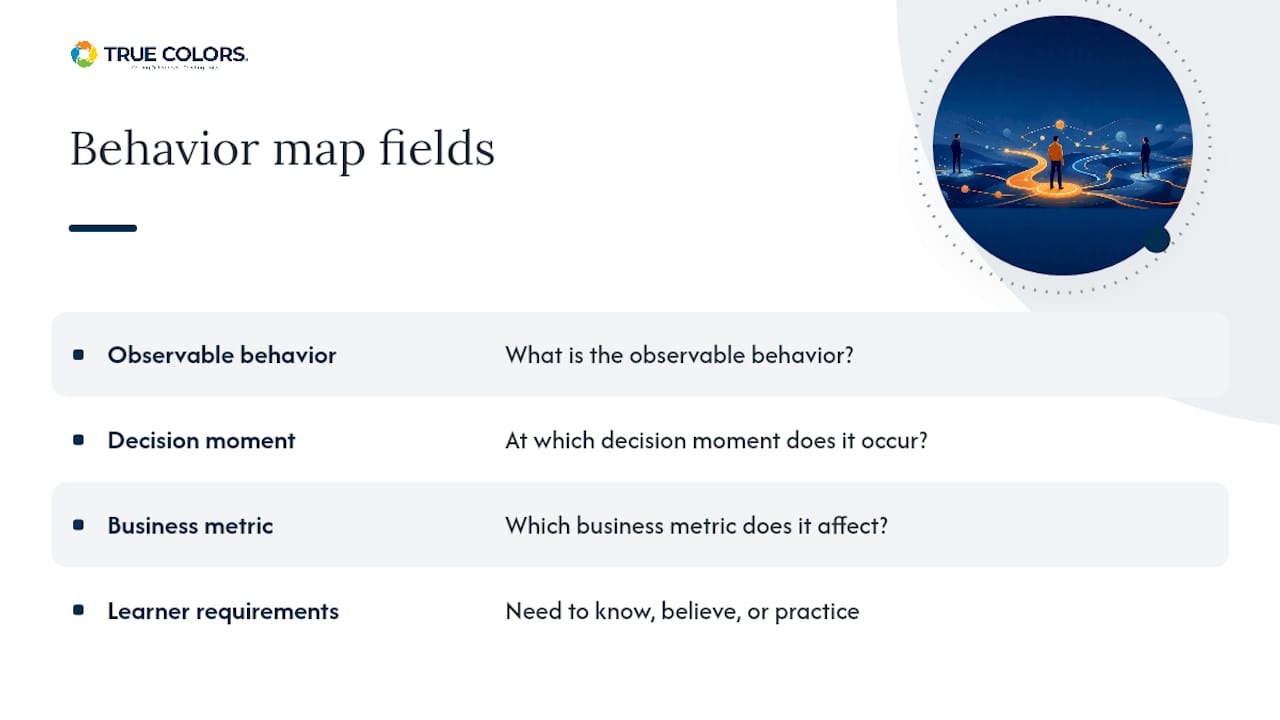
Each row in your behavior map should answer four questions: What is the observable behavior? At which decision moment does it occur? Which business metric does it affect? What does a learner need to know, believe, or practice to perform it consistently? That four-field structure keeps design teams honest — if you cannot complete a row, the behavior is not yet defined precisely enough to train.
Learner analysis and segmentation
Who performs this behavior, how often, and in what context? A senior leader making quarterly talent decisions needs different scaffolding than a frontline manager running weekly one-on-ones. Segment by role, frequency, and stakes before assigning delivery methods.
Roles and artifacts
| Role | Primary Accountability |
|---|---|
| Design owner (L&D) | Behavior map, learning objectives, facilitator guides |
| Business sponsor | Scope approval, executive alignment, resource access |
| Manager coaches | Reinforcing behaviors between sessions, completing playbooks |
| Facilitators | Delivering instructional events, capturing real-time feedback |
| Measurement owner | Baseline data, pilot metrics, transfer reporting |
Required artifacts: behavior map, measurement plan, facilitator guides, manager playbooks, and a reinforcement schedule with specific calendar triggers.
Pro Tip: Build the manager playbook before the facilitator guide. Managers who cannot explain the target behavior in their own words will not reinforce it after training ends.
Which instructional principles actually transfer behavior to the job
The science of workplace instruction catalogs 15 empirically supported principles. Grouped into four clusters, they give L&D teams a practical design kit.
Encoding and retrieval
- Retrieval practice — Test recall rather than re-expose content; use brief quizzes or scenario prompts at the start of each session.
- Spaced repetition — Distribute practice across days and weeks rather than massing it in a single event.
- Interleaving — Mix different behavior scenarios within a session rather than blocking identical ones together.
- Worked examples — Show a fully modeled behavior before asking learners to attempt it independently.
Practice structure
- Variability — Practice the behavior across multiple contexts so learners generalize, not just repeat.
- Scaffolding — Provide structured support early, then reduce it as competence builds.
- Distributed practice — Schedule micro-practice embedded in the work calendar, not only in formal sessions.
- Error-based learning — Let learners encounter and analyze realistic mistakes; errors processed consciously improve future decisions.
Feedback and error
- Feedback specificity — Tie feedback to the observable behavior, not to personality or effort.
- Adaptive guidance — Adjust the difficulty and support level based on each learner's demonstrated performance.
- Goal-setting — Assign specific, proximal behavioral goals before each practice event.
Contextualization and transfer
- Behavioral modeling — Demonstrate the target behavior in a realistic decision context before practice.
- Contextual transfer — Practice in conditions that closely match the actual work environment.
- Cognitive load management — Limit new information per session; reducing cognitive load increases the likelihood of on-the-job application.
- Habit triggers — Attach the target behavior to an existing routine or environmental cue so it fires automatically over time.
Pro Tip: For onboarding programs, lead with worked examples and scaffolding. For leadership stretch assignments, prioritize variability, error-based learning, and feedback specificity — the stakes are higher and the decision contexts are less predictable.
Pro Tip: Combining more than four principles in a single session creates cognitive overload. Pick the cluster that matches the learning stage: encoding principles early, transfer principles late.
How to choose delivery methods that match your target behaviors
Behaviorally designed training tied to real decision contexts — not generic scenarios — increased short-listing and hiring of underrepresented applicants in a large-scale field experiment. The mechanism is straightforward: when practice happens at the moment of decision, transfer is immediate rather than aspirational.
- Behavioral modeling — Best for interpersonal behaviors (feedback conversations, inclusive hiring decisions). Show the behavior, then have learners practice it in a role-play that mirrors an actual decision moment.
- Simulation — Best for high-stakes, low-frequency decisions (performance improvement conversations, crisis communication). High fidelity, high cost; reserve for behaviors where a real mistake carries significant organizational risk.
- Coaching — Best for leadership habit formation. One-on-one coaching between sessions sustains momentum and surfaces barriers generic training cannot anticipate.
- Microlearning with on-the-job practice — Best for high-frequency, moderate-stakes behaviors. A two-minute prompt delivered before a recurring meeting is more effective than a 60-minute module delivered once.
- Adaptive guidance — Best for large, heterogeneous populations. Adjusts content difficulty and pacing based on demonstrated performance, reducing wasted seat time.
The Siemens leadership transformation embedded behavioral interventions directly in leaders' daily workflows — using nudges, contextual reinforcement, and peer accountability — to sustain change across 20,000+ leaders. That scale is only achievable when delivery is woven into existing routines rather than added on top of them.
How to measure behavior transfer and business impact
Measurement works in four levels: participation (did they attend?), learning (can they demonstrate the behavior in a controlled setting?), behavioral adoption (are they doing it on the job?), and business outcomes (is it moving the metric?).
| Metric | Level | Collection Method |
|---|---|---|
| Session completion rate | Participation | LMS data |
| Behavioral demonstration score | Learning | Facilitator rubric |
| Behavioral adoption rate | Transfer | Manager observation |
| Decision-quality score | Transfer | Calibration audits, hiring data |
| Retention / attrition delta | Business outcome | HRIS comparison |
| Business KPI linked to behavior | Business outcome | Operational dashboard |
Pilot evaluation checklist:
- Collect baseline data on the target metric before the pilot begins.
- Identify a comparison group (a similar unit not yet in the program).
- Run short-cycle feedback loops every two to three weeks during the pilot.
- Distinguish statistical significance from practical significance — a small effect on a high-stakes behavior (a promotion decision, a hiring debrief) may still justify full rollout.
- Set executive expectations: leading indicators (behavioral adoption) appear in weeks 6–12; lagging indicators (business KPIs) typically require a full quarter or more.
Common corporate training program failures trace directly to skipping the baseline measurement step, which makes it impossible to demonstrate impact later.
A pragmatic roadmap from discovery to sustained change
- Discovery (weeks 1–4): Interview managers and leaders; map decision moments; audit existing culture and performance data; define target behaviors and success metrics.
- Design sprints (weeks 5–10): Build the behavior map, learning objectives, facilitator guides, and manager playbooks; select delivery methods; schedule the reinforcement calendar.
- Pilot (weeks 11–20): Run the program with the nominated group; collect behavioral adoption data; run short-cycle feedback loops; adjust before scaling.
- Scale (months 6–12): Roll out to additional business units with facilitator certification and manager enablement in place.
- Sustain (ongoing): Embed behaviors in hiring criteria, onboarding, performance reviews, and recognition systems; review data quarterly; refresh content when adoption plateaus.
Common pitfalls and how to avoid them:
- One-off workshops with no reinforcement: Schedule manager check-ins and micro-practice before the first session runs.
- Generic scenarios disconnected from real decisions: Map every practice scenario to an actual decision moment in the learner's role.
- Missing manager enablement: Managers who have not been briefed on the target behaviors cannot coach them. Train managers first.
- No measurement owner: Assign this role before discovery begins, not after the pilot ends.
Pro Tip: A 90-day pilot with 50–100 participants gives you enough signal to make a confident scale decision without overcommitting resources. Smaller pilots produce inconclusive data; larger ones are hard to adjust mid-course.
Systems that make learned behaviors stick
Learned behaviors revert when the surrounding environment still rewards the old ones. Leadership development works best when behaviors are integrated into organizational systems rather than delivered only as training.
Sustainment levers to activate:
- Align hiring criteria to the target behaviors so new hires model them from day one. Culture onboarding is one of the highest-leverage moments for embedding behavioral norms.
- Add behavioral indicators to performance review templates and manager scorecards.
- Build peer accountability rituals — brief, recurring check-ins where teams name one behavior they practiced and one they struggled with.
- Use automated nudges (calendar prompts, pre-meeting reminders) to trigger the target behavior at the decision moment.
- Share behavioral adoption data with leaders monthly so progress is visible and the behavior stays on the agenda.
Sustainment governance checklist:
- Assign a sustainment owner (typically the HRBP or L&D lead for the business unit).
- Set a quarterly review cadence to assess adoption data and refresh content.
- Define the data signals that trigger a program refresh: adoption rate drops below a threshold, attrition rises, or a new business priority shifts the target behavior.
How Truecolorsintl operationalizes behavior-based training
Truecolorsintl moves organizations from personal awareness to aligned action through a structured sequence: behavior mapping, manager enablement, measurement, and sustainment. The framework starts with a diagnostic — surfacing the specific decision moments where leadership behavior is inconsistent — and then builds instructional events around those moments rather than around generic competency models.

A representative engagement looks like this: a mid-size professional services firm identified inconsistent feedback behavior as the root cause of low trust scores and rising attrition. Truecolorsintl mapped the behavior to three decision moments (weekly one-on-ones, quarterly reviews, and project debriefs), designed behavioral modeling sessions for managers, and embedded a reinforcement schedule in the existing meeting cadence. Behavioral adoption data was collected at weeks 6 and 12; the sustainment system aligned the behavior to the next performance review cycle.
Engagement signals that indicate it is time to call Truecolorsintl: inconsistent manager behavior across teams, low trust or engagement scores, poor hiring outcomes despite strong candidate pools, or a culture initiative that launched well but lost momentum after 90 days.
Pro Tip: Start with one behavior, one decision moment, and one business unit. Proving the model at small scale builds the executive confidence needed to fund the full program.
What actually drives durable behavior change
Most programs invest heavily in content and almost nothing in context. The research is consistent: behavior change requires the environment to change alongside the learner. A well-designed module that lands in an organization where managers never reinforce the behavior, hiring still rewards the old one, and performance reviews ignore it entirely will not produce lasting results.
The organizations that get this right treat the behavior-based program design process as an organizational design exercise, not a curriculum project. They ask: what does the system need to do differently so the trained behavior becomes the obvious choice? That question, asked early and answered honestly, separates programs that stick from programs that fade.
True Colors can help you get started

Truecolorsintl offers a structured discovery-to-pilot engagement designed for HR directors and L&D leaders who need to show measurable results before committing to enterprise-wide rollout. The starter engagement runs across 30, 60, and 90 days: discovery and behavior mapping in the first 30 days, instructional design and manager enablement in days 31–60, and a live pilot with measurement in days 61–90.
At the end of 90 days, you have a behavior map, a measurement baseline, a facilitator guide, and pilot data — everything needed to make a confident scale decision. Explore the Connected Leadership Program or visit True Colors International to schedule a discovery conversation.
Sources
- Making Organizational Culture Great: Moving beyond popular beliefs | California Management Review
- The Science of Workplace Instruction (Annual Review of Organizational Psychology and Organizational Behavior)
- Behaviorally designed training leads to more diverse hiring | Science
- Siemens leadership transformation case study | Vivaldi Group
- Using Behavioral Science To Maximize The Impact Of L&D - eLearning Industry