
A frontline manager training program is defined as a structured, phased plan that builds leadership behaviors through practice, coaching, and continuous feedback embedded in daily work. These managers sit at the most consequential layer of any organization. They shape the daily experience of every employee on their team, yet frontline leaders receive less skills-based training than senior leaders despite their outsized impact on engagement and retention. To develop frontline manager training program outcomes that stick, organizations need more than a workshop. They need a system.
What are the foundational phases of a frontline manager training program?
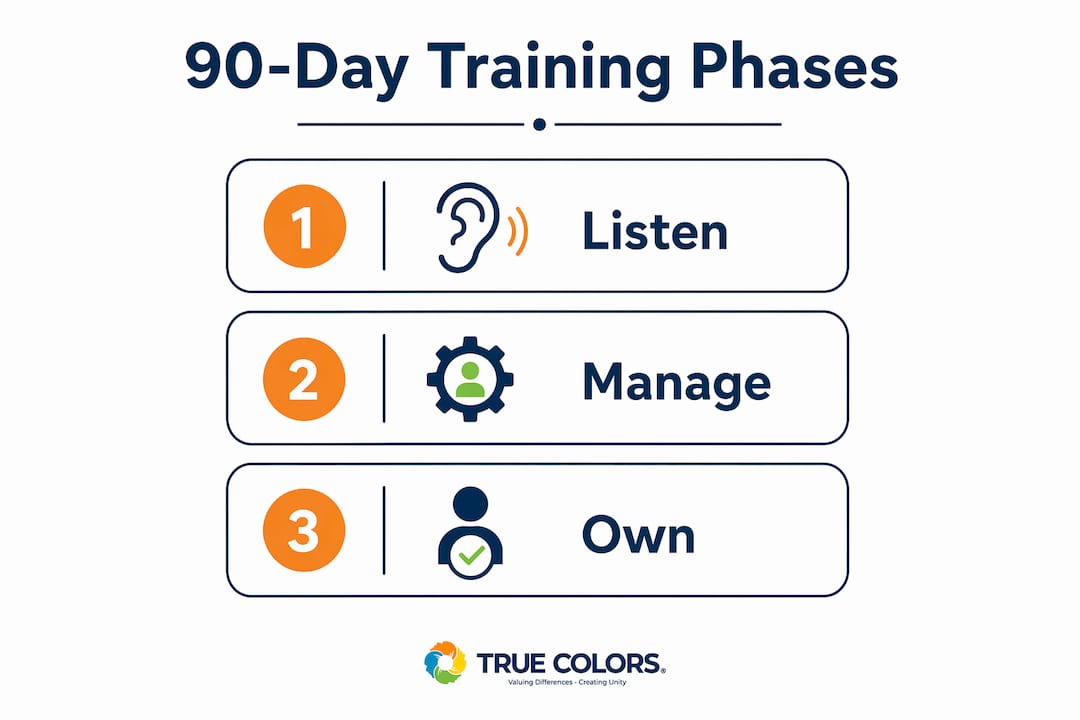
The most effective structure for frontline leadership development is a 90-day phased plan split into three 30-day sprints. Each sprint builds on the last, moving managers from observation to active management to full ownership of their role. This sequencing matters because trust and competence cannot be rushed. Skipping phases produces managers who know the theory but cannot execute under pressure.
The table below maps each phase to its core focus and the behaviors managers should practice.
| Phase | Focus | Key behaviors |
|---|---|---|
| Days 1–30: Listen | Observation and relationship-building | Conduct 1:1s, map team dynamics, ask before directing |
| Days 31–60: Manage | Active skill application | Deliver feedback, delegate tasks, run structured check-ins |
| Days 61–90: Own | Independent leadership | Make decisions, hold accountability, coach direct reports |
One of the most overlooked elements in this phase structure is the identity shift. Successful programs explicitly define decision boundaries and help managers navigate the transition from individual contributor to team leader. Without that clarity, new managers default to doing the work themselves instead of leading others to do it. That single failure pattern accounts for a large share of early management breakdowns.
Pro Tip: Build a “decision rights” document into the Day 1–30 onboarding materials. It tells new managers exactly which decisions they own, which they escalate, and which they share. This one tool reduces confusion and builds confidence faster than any workshop module.
How to design curriculum that addresses real frontline challenges
Curriculum design is where most training programs for managers go wrong. Organizations fill the schedule with abstract topics like “leadership styles” or “communication theory” and wonder why behavior does not change. The fix is to build curriculum around real situations managers face every week.

Practicing actual scenarios with coaching increases both confidence and skill retention far more than content-heavy instruction. That means designing modules around situations like a performance conversation with a resistant employee, a delegation breakdown, or a team conflict that needs resolution before the next shift. The situation-behavior-impact (SBI) framework gives managers a repeatable structure for delivering feedback without damaging the relationship.
A well-designed curriculum for frontline leadership development covers these core areas:
-
Feedback delivery: Using SBI to give specific, behavior-focused feedback in real time
-
Difficult conversations: Scripts and practice for performance discussions, boundary-setting, and conflict resolution
-
Delegation: Matching tasks to team member capability and following up without micromanaging
-
Coaching conversations: Asking questions that build problem-solving capacity rather than giving answers
-
Decision-making: Knowing when to act, when to escalate, and when to involve the team
Pro Tip: Customize at least one scenario per module using your organization’s actual language, policies, and team context. Generic case studies teach generic skills. Managers learn faster when the situation feels like Tuesday morning on their floor.
Truecolorsintl builds leadership development curriculum that connects behavior frameworks to the real culture of an organization, not a hypothetical one. That connection is what makes learning transfer from the training room to the team floor.
What delivery methods effectively support frontline manager training?
The 70-20-10 model is the clearest guide for how leadership growth happens: 70% through on-the-job challenges, 20% through coaching and peer learning, and 10% through formal training. That ratio tells you something direct. If your program is mostly classroom time, it is built backward.
Effective manager training strategies distribute learning across multiple delivery formats. The table below compares the most common methods and their best use cases.
| Delivery method | Best use case | Frequency |
|---|---|---|
| Live workshops | Skill introduction, role-play practice | Monthly or quarterly |
| Microlearning modules | Reinforcement of specific behaviors | Weekly, embedded in workflow |
| 1:1 coaching sessions | Personalized feedback and goal-setting | Bi-weekly |
| Peer coaching groups | Accountability and shared problem-solving | Monthly |
| On-the-job assignments | Real-world skill application | Ongoing |
Embedding microlearning into workflow tools like Slack or Microsoft Teams makes leadership development continuous without disrupting daily operations. A two-minute reflection prompt after a difficult conversation, or a short video on delegation sent before a team meeting, keeps skills active between formal sessions. Platforms like Leaderly are built specifically to deliver this kind of workflow-integrated leadership practice.
Peer coaching groups deserve more attention than most programs give them. Groups of 4–6 managers meeting regularly to discuss real cases build both confidence and problem-solving capacity. These groups create the accountability that a single training event never can. Managers stop feeling isolated in their challenges and start learning from each other’s experience.
How to sustain and measure frontline manager training impact
One-time training workshops do not produce lasting behavior change. Sustained impact requires embedding short, routine practices into the daily rhythm of management work. Start-of-shift huddles, micro check-ins, and structured feedback loops are not add-ons. They are the training.
Measurement is where many organizations stall. They track completion rates and satisfaction scores, then wonder why team performance has not shifted. The metrics that indicate program success are behavioral and relational. Tracking coaching behaviors, team retention rates, and direct report feedback gives you a real picture of whether managers are leading differently.
Build your measurement system around these indicators:
-
Coaching frequency: Are managers holding regular 1:1s and following through on commitments?
-
Team retention: Is turnover decreasing among teams led by program participants?
-
Direct report feedback: Do employees report feeling heard, supported, and clear on expectations?
-
Decision quality: Are managers escalating less and resolving more at their level?
-
Peer group participation: Are managers showing up to accountability sessions and applying what they discuss?
Truecolorsintl’s employee experience survey tools give HR leaders a structured way to capture direct report feedback and connect it to leadership behavior patterns over time.
Pro Tip: Set a 90-day review cadence for your program metrics. Review what is working, what is not, and adjust one element at a time. Changing too many variables at once makes it impossible to know what drove the improvement.
Building peer coaching networks into the program structure creates the accountability layer that keeps behavior change alive after formal training ends. Culture is not what is said. It is what is repeated. The managers who repeat the right behaviors consistently are the ones whose teams perform.
Key Takeaways
The most effective frontline manager training program combines a phased 90-day structure, behavior-focused curriculum, blended delivery methods, and ongoing coaching to produce lasting leadership change.
| Point | Details |
|---|---|
| Use a phased 90-day structure | Sequence listening, managing, and owning phases to build skills progressively. |
| Design curriculum around real scenarios | Use SBI feedback, delegation, and difficult conversation practice over abstract theory. |
| Apply the 70-20-10 model | Allocate 70% on-the-job practice, 20% coaching, and 10% formal instruction. |
| Embed microlearning in daily workflows | Deliver short, relevant content through tools managers already use every day. |
| Measure behavioral outcomes | Track coaching frequency, team retention, and direct report feedback, not just completion rates. |
What I’ve learned about why most frontline training fails
After working with organizations across industries, the pattern is consistent. Companies invest in a two-day leadership workshop, managers leave energized, and within three weeks the old behaviors are back. The problem is not the content. The problem is that the training was treated as an event instead of a discipline.
The programs that change how frontline managers lead share one quality: they make leadership behaviors part of the daily job, not a separate activity. A manager who practices a coaching conversation every week gets better at coaching. A manager who attends one workshop on coaching and then returns to a culture that does not reinforce it does not. The environment wins every time.
What I find most underestimated is the identity piece. New managers often feel caught between their old peer group and their new authority. They avoid difficult conversations because they do not want to damage relationships. They over-explain decisions because they are not confident in their own judgment. A program that addresses this identity shift directly, through coaching and peer support, produces managers who lead with clarity instead of anxiety.
The organizations that get this right treat frontline leadership development as a culture priority, not a training line item. They build systems that reinforce the right behaviors every day, and they measure what matters. That is the difference between a program that looks good on paper and one that changes how teams perform.
— Robert Cook
Truecolorsintl’s approach to frontline leadership development
Truecolorsintl helps organizations build the systems that make leadership behavior change real and repeatable.

The Connected Leadership program blends behavioral frameworks, coaching tools, and ongoing reinforcement to develop frontline managers who lead with consistency and confidence. Rather than delivering a one-time training event, Truecolorsintl works with HR leaders and organizational teams to embed leadership habits into daily workflows. The result is a program that builds culture from the ground up, one manager at a time. If you are ready to move from training events to lasting leadership change, True Colors International offers the structure and support to get there.
FAQ
What is a frontline manager training program?
A frontline manager training program is a structured plan that develops leadership behaviors in managers who directly supervise frontline employees. Effective programs use phased learning, coaching, and real-work practice rather than one-time workshops.
How long should a frontline manager training program last?
A 90-day phased structure is the standard for building foundational leadership behaviors. The three phases cover listening and observation, active management skills, and independent leadership ownership.
What does the 70-20-10 model mean for manager training?
The 70-20-10 model allocates 70% of learning to on-the-job experience, 20% to coaching and peer learning, and 10% to formal instruction. This ratio means most manager development should happen through practice and feedback, not classroom time.
How do you measure the success of a frontline manager training program?
Measure coaching frequency, team retention rates, and direct report feedback rather than course completion rates alone. These behavioral and relational metrics show whether managers are leading differently.
Why do most manager training programs fail to produce lasting change?
One-time workshops fail because they treat leadership as content to absorb rather than behavior to practice. Programs that embed coaching and reinforcement into daily workflows produce lasting change.