
Competency-based hiring evaluates candidates on observable behaviors tied to job success, not on degrees or years of experience. Done well, it predicts on-the-job performance and reduces early turnover because you're scoring what someone actually does, not what their résumé claims. Structured, competency-based interviews produce more consistent evaluations than unstructured ones, according to a journal review of competency-based hiring practices, and employers who move to skills-first hiring report improvements in time-to-hire and retention.
Start here, today:
- Run a job analysis for the role. Sit down with the hiring manager and two or three top performers and list what someone actually does in the first 90 days.
- Pick 4 to 6 competencies, not 12. Mix organizational must-haves (like collaboration) with role-specific skills (like data modeling or conflict resolution).
Key Takeaways
Competency-based hiring works because it scores observable, job-relevant behavior instead of proxies like degrees or years of experience, and it holds up only when job analysis, calibrated scoring, and onboarding stay connected.
| Point | Details |
|---|---|
| Start with job analysis | Map Day-One tasks with SMEs before writing a single competency. |
| Limit to 4 to 6 competencies | Blend organizational and role-specific behaviors, and make each one observable. |
| Use anchored, multi-tool scoring | Combine work samples, structured interviews, and SJTs with written rating anchors. |
| Train and calibrate raters continuously | Run calibration sessions before every hiring cycle to catch scoring drift. |
| Connect hiring to culture systems | Truecolorsintl links competency frameworks to leadership development and employee experience tracking so the behaviors you hire for keep getting reinforced. |
Table of Contents
- What Competency-Based Hiring Is and Why It Matters
- How to Implement Competency-Based Hiring Step by Step
- Sample Competencies, Behavioral Indicators, and Interview Prompts
- Common Mistakes and How to Avoid Them
- Measuring Success: KPIs, Governance, and Continuous Improvement
- How True Colors International Helps Organizations Adopt Competency-Based Hiring
- Legal and Ethical Considerations in Competency-Based Hiring
- Training for Interviewers and HR Staff on Competency-Based Methods
- Integrating Competency-Based Hiring With Talent Management
- Handling Unconscious Bias in Competency Assessments
- The Case Against Treating This as a One-Time Project
- Bring Competency-Based Hiring Into Your Culture Work With Truecolorsintl
- Sources
What Competency-Based Hiring Is and Why It Matters
Traditional hiring leans on proxies: a bachelor's degree, five years in a similar title, a polished resume. Competency-based hiring skips the proxy and tests the behavior directly. A candidate for a customer-success role doesn't just say they're "great with people." They walk you through a real de-escalation, and you score how they actually handled it.
The payoff shows up in three places:
- Predictability. You're measuring the behavior the job requires, not a credential that correlates loosely with it.
- Retention. Skills-first employers report measurable gains in retention and time-to-hire after adopting the approach.
- Fairness and reach. Dropping degree gatekeeping opens the pool to candidates who built the skill outside a traditional pipeline, which is why the U.S. Department of Labor's skills-based hiring framework and federal competency guidance from the Office of Personnel Management both push agencies and employers toward it.
Practitioners often describe the real win as removing gut-feeling bias: when interviewers score against a rubric in the moment, personal impressions carry less weight than the evidence in front of them.
How to Implement Competency-Based Hiring Step by Step
Building this from scratch feels like a lot until you break it into five moves.
-
Do the job analysis first. Pull in the hiring manager and two or three subject-matter experts who already do the job. Map the tasks a new hire needs to handle in week one, month one, and month three. The OPM's competency-assessment framework treats this multi-stakeholder step as the anchor for everything downstream. Skip it, and every competency you write later is a guess.
-
Define 4 to 6 competencies, and make them granular. "Leadership" is not a competency; it's a category. "Delegates tasks with clear success criteria and follows up without micromanaging" is a competency you can score. Blend organizational competencies (communication, adaptability) with role-specific ones (SQL fluency, negotiation under pressure).
-
Design assessments that map to each competency. Prefer work samples, job simulations, structured interviews, and situational judgment tests (SJTs) over unstructured conversation. If a competency is "handles conflicting priorities," build a timed scenario, not a hypothetical question. Every assessment tool should trace back to a specific competency on your list, not float free as a generic "culture fit" check.
-
Score with anchored rating scales and weight them. A 1 to 5 scale with a written behavioral anchor at each point (what a "2" looks like versus a "4") turns subjective impressions into comparable data. Use a multiple-hurdle structure for high-volume roles, so weak candidates exit early, and document every score. That documentation is what makes the process defensible if a decision is ever challenged.
-
Train and calibrate raters, every time. Interviewers who never practiced against the rubric will drift back to gut feel within a few interviews. Mandatory calibration sessions, where two raters score the same recorded interview and compare notes, catch that drift before it becomes a pattern.
-
Carry the same competencies into onboarding. Whatever gaps the assessment surfaced become the first 90 days' development plan. A candidate strong on technical skill but thin on stakeholder communication should have that named on day one, not discovered in a six-month review.
Pro Tip: Write your scoring anchors before you post the job, not after the first interview. Retrofitting a rubric to match a candidate you already like is the fastest way to undo everything competency-based hiring is supposed to fix.
Sample Competencies, Behavioral Indicators, and Interview Prompts
Copy-ready templates save you from staring at a blank scorecard. Each competency below pairs an observable behavior with a STAR-style prompt (Situation, Task, Action, Result) you can use immediately.
- Collaboration: Shares credit and surfaces disagreement early rather than after a decision ships.
- Problem solving: Breaks an ambiguous problem into testable steps before proposing a fix.
- Communication: Adjusts explanation depth based on the listener's role and familiarity with the topic.
- Adaptability: Changes plan mid-project when new information invalidates the original approach.
- Accountability: Names their own mistake before being asked, then describes the correction.
- Conflict resolution: De-escalates disagreement by identifying the root cause and facilitating compromise.
| Competency | Example behavior | Sample interview question |
|---|---|---|
| Collaboration | Flags a disagreement in a team meeting instead of letting it fester | "Tell me about a time you disagreed with a teammate's approach. What did you do?" |
| Problem solving | Splits a vague request into testable hypotheses | "Walk me through a problem you had to define before you could solve it." |
| Accountability | Owns an error publicly and proposes the fix | "Describe a mistake you made that affected your team. What happened next?" |
| Conflict resolution | Identifies the root cause before proposing a compromise | "Tell me about a conflict you helped resolve between two colleagues." |
Score each answer on a 1 to 3 anchor: a "1" describes the behavior in the abstract, a "2" gives one concrete example, a "3" gives a specific example with a measurable outcome.
Common Mistakes and How to Avoid Them
Most competency-based hiring rollouts don't fail because the concept is wrong. They fail in execution.
- Vague competencies. "Leadership" and "strategic thinking" mean nothing on a scorecard. Rewrite them as observable behaviors, the same way you would for the templates above.
- Single-assessment reliance. One great interview doesn't prove a competency. Triangulate with a work sample or SJT before you decide.
- Skipped rater training. Without calibration, two interviewers scoring the same answer will land on different numbers, and neither can defend their score later.
- Legacy degree requirements sitting alongside new competencies. A job posting that still says "bachelor's degree required" while claiming to be skills-first sends a mixed signal to candidates and undercuts the whole approach, a contradiction SHRM's skills-based hiring guidance flags directly.
- Unvalidated personality tests relabeled "culture fit." If the instrument hasn't been validated for the role, it's a liability, not a competency check.
Measuring Success: KPIs, Governance, and Continuous Improvement
You can't tell if competency-based hiring is working without a baseline and a review schedule.
Track these:
- Time-to-hire, compared against your prior degree-first process.
- Quality-of-hire, measured as manager rating at the 6 and 12-month mark.
- First-year retention, the clearest signal that the competencies you tested actually predicted fit.
- Candidate experience, since a longer, more structured process can feel heavier to applicants if not managed well.
- Diversity metrics, tracked across the funnel, not just at offer stage.
- Inter-rater reliability, the degree to which two interviewers score the same candidate similarly.
Set a quarterly pilot review for any new competency framework and an annual validity check against actual performance data. Employers adopting skills-first methods report measurable gains in retention and hiring speed, but that only holds if you keep auditing for scoring drift and adjusting competency definitions as the role evolves. A framework you never revisit slowly turns back into gut feel with extra paperwork.
How True Colors International Helps Organizations Adopt Competency-Based Hiring
Competency-based hiring only sticks when it connects to how people actually behave on the job, not just how they interview. Truecolorsintl builds that connection by translating competency definitions into hiring and onboarding practices grounded in observable behavior, the same discipline behind our broader culture alignment work.
Our relevant support includes:
- Talent-acquisition consulting to design role-specific competency frameworks.
- Upskilling programs that train hiring teams and interviewers on structured scoring and calibration.
- Employee experience surveys that check whether new hires are living the competencies you screened for.
- Validated assessment design that ties scoring rubrics to the behaviors your culture actually rewards.
Pro Tip: A competency framework built in isolation from your culture work rarely survives contact with real hiring managers. Align the two from the start.
Legal and Ethical Considerations in Competency-Based Hiring
Competency-based hiring reduces certain legal risks, but it doesn't eliminate them, and a poorly built framework can create new ones.
The biggest exposure is unvalidated assessments. If a work sample or SJT hasn't been checked for job-relatedness, and it disproportionately screens out a protected group, you're carrying the same liability as an old-fashioned, credential-based process that did the same thing. This is why the OPM's assessment framework insists on documenting how each assessment maps to a job-analysis finding. That documentation is your defense if a rejected candidate ever challenges the process.
Consistency matters just as much as validity. Every candidate for a given role needs the same competencies, the same assessments, and the same scoring rubric. The moment one candidate gets a bonus question or a skipped work sample because "we already know they're good," you've created a disparate-treatment problem, no matter how well-intentioned the shortcut was.
Watch language, too. "Culture fit" without a behavioral definition behind it tends to function as a proxy for sameness, screening out candidates who don't look or sound like the current team. Replace it with named, observable behaviors, the same granularity that makes a competency scoreable in the first place.
Finally, retain your scoring records. If a competency framework is ever audited or challenged, the rubric, the interviewer notes, and the calibration records are what prove the decision was made on job-related criteria, not on a hunch.
Training for Interviewers and HR Staff on Competency-Based Methods

A rubric is only as good as the person using it. Interviewers who haven't practiced against behavioral anchors will drift toward familiar instinct within a handful of interviews, scoring candidates they "click with" higher regardless of what the transcript actually shows.
Effective training covers three things. First, how to ask a STAR-style question without leading the candidate toward the answer you want. Second, how to score against a written anchor instead of a gut reaction, using practice transcripts scored independently and then compared as a group. Third, how to recognize and set aside the specific biases that creep into competency scoring, like favoring candidates who communicate the way the interviewer does.
Calibration sessions should happen before a hiring cycle starts and periodically during high-volume periods. Two or more interviewers score the same recorded or written response independently, then compare and discuss any gap larger than one point on the scale. Consistent gaps point to a rubric that needs clearer anchors, not just a rater who needs more coaching.
New interviewers shouldn't run a live competency-based interview solo until they've shadowed at least one calibration session and scored a handful of practice cases within an acceptable range of an experienced rater. Skipping this step is how organizations end up with a "structured" process that produces the same inconsistent results as the unstructured one it replaced.
Integrating Competency-Based Hiring With Talent Management

Hiring is the entry point, not the whole system. If the competencies you assess for at the interview stage disappear the moment someone accepts the offer, you've built a filter, not a strategy.
The stronger move is to carry the same competency language through performance reviews, promotion criteria, and leadership development. A candidate hired for strong "conflict resolution" behavior should see that same competency show up in their first performance conversation, not a generic new set of terms invented by a different team. That consistency is what lets a hiring framework compound into an actual talent strategy instead of resetting every time someone changes roles.
This is also where succession planning benefits. If your competency model already defines what strong performance looks like at the individual-contributor level, extending it upward to define what "ready for management" looks like is a natural next step, not a separate project. The same anchored, behavioral logic applies at every level.
Retention tracking should tie back to the same competencies, too. If people hired for high scores on adaptability are leaving within a year, that's a signal to check whether the assessment was measuring the right thing, or whether onboarding and management practices are undermining a strength you correctly identified at hiring. Competency-based hiring works best as one connected system with performance management and retention strategy, not as an isolated recruiting tactic.
Handling Unconscious Bias in Competency Assessments
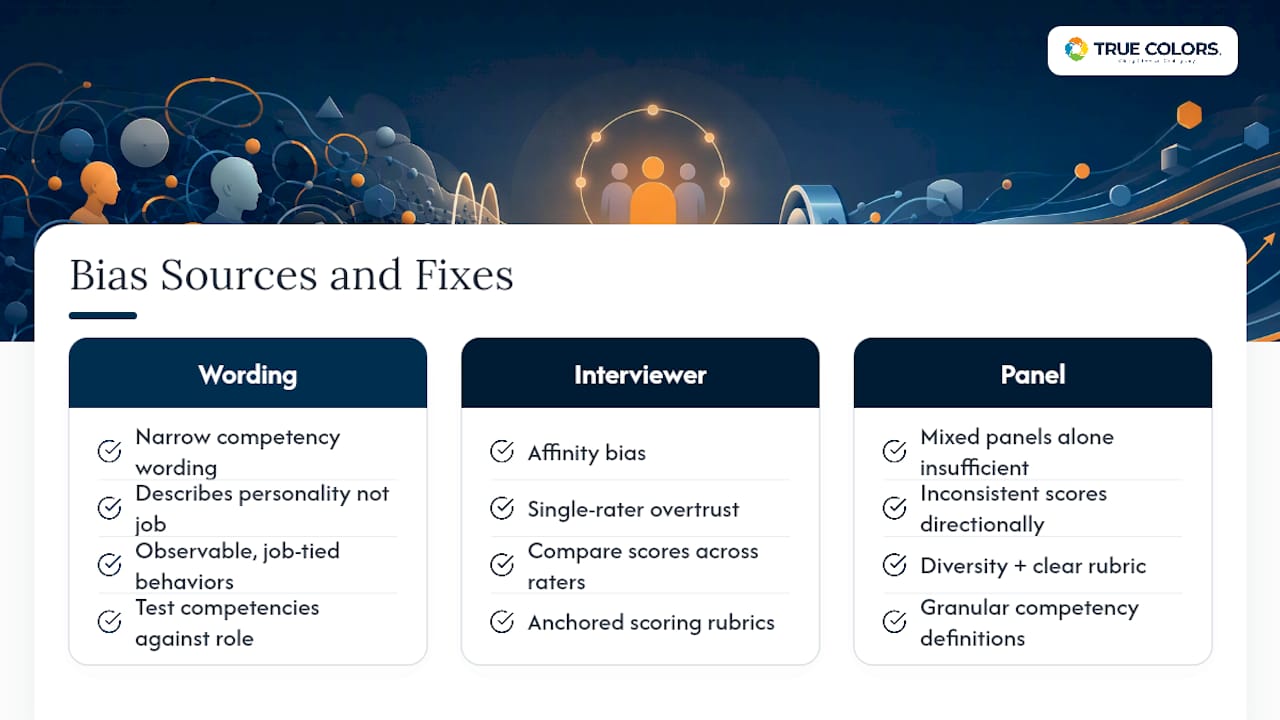
Structure reduces bias. It does not remove it.
Even a well-designed rubric can carry bias if the competencies themselves were written with one kind of candidate in mind. "Executive presence," for example, often ends up describing a narrow communication style rather than an actual predictor of job performance. Test every competency against a simple question: does this describe a behavior tied to the job, or does it describe a personality type that happens to be common among people already in the role?
Interviewer-level bias shows up differently. Affinity bias, where a rater unconsciously scores someone higher because they share a background or communication style, survives structured interviews unless calibration actively catches it. This is why comparing scores across raters matters more than trusting any single interviewer's judgment, however experienced.
Panel diversity helps, but it's not a substitute for training. A mixed panel using an unclear rubric will still produce inconsistent, biased scores; they'll just be inconsistent in more directions. The fix is the same either way: granular, observable competency definitions, anchored scoring, and calibration sessions that flag when one rater's scores consistently run high or low compared to the group.
Track scoring patterns by candidate demographic over time, not to hit a quota, but to catch a rubric or a rater quietly reintroducing the exact bias competency-based hiring was built to remove.
The Case Against Treating This as a One-Time Project
Most organizations that try competency-based hiring treat it as a launch event: build the rubric, train the panel, ship it, move on. That's the single biggest gap between what the research supports and how it actually gets implemented. A framework built once and never audited drifts back toward gut-feel scoring within a year or two, just with better paperwork attached.
The conventional advice oversells the interview redesign and undersells the job analysis. Teams spend weeks perfecting STAR questions and rating scales, then skip the multi-stakeholder job analysis that OPM's framework treats as foundational, because it's slower and requires pulling subject-matter experts away from their actual work. That shortcut is where most frameworks go wrong before the first interview is even scheduled.
If you're prioritizing one thing, prioritize the job analysis and the calibration cadence. The scorecards and question templates are the easy part. What separates organizations that see real retention gains from ones that just have a nicer-looking interview process is whether anyone checks, quarterly, whether the competencies still predict what they're supposed to predict.
— Theresa
Bring Competency-Based Hiring Into Your Culture Work With Truecolorsintl
Building a competency framework is one project. Making sure it actually reflects how your organization works, and that new hires land into a culture that reinforces what you just assessed for, is a different problem entirely. That's the gap Truecolorsintl closes: we don't hand you a generic interview template and walk away. We build competency frameworks rooted in your organization's actual behavior patterns, then train your hiring managers and leaders to score consistently and reinforce those same behaviors after the offer is signed.

If you're a C-suite executive, HR director, or learning and development leader trying to move from personal awareness of what "good" looks like to an aligned, organization-wide hiring practice, this is where True Colors fits. Our talent solutions and culture consulting start with the same job analysis and behavioral mapping this article outlined, then extend it through leadership development and employee experience tracking, so the competencies you hire for are the same ones your culture actually reinforces. Reach out to scope a pilot for one role or one department, and see what a behavior-rooted competency framework looks like inside your own organization.
Sources
- Designing a Competency-Based Assessment Strategy (OPM)
- Skills-Based Hiring Starter Kit (U.S. Department of Labor)
- Behavioral & competency-based interviewing (University of Washington HR)