
HR should own a business-driven manager coaching program that pairs trained coaches with explicit governance, measurable KPIs, and a pilot-to-scale path. That is the core recommendation. The SHRM coaching toolkit is direct: programs without formal guardrails — defined frequency, coaching agreements, confidentiality boundaries, and goal-tracking — are neither measurable nor defensible to leadership. True Colors International's behavior-based framework adds a layer most programs miss: connecting personal awareness to observable behavior change and organizational alignment, so coaching outcomes show up in culture, not just in session notes.
Three actions to take before anything else:
- Define scope and success metrics. Decide who is eligible, what business problem coaching solves, and how you will measure progress before you recruit a single coach.
- Choose your delivery model. Determine whether internal coaches, external coaches, or a blended approach fits your budget, confidentiality requirements, and scale targets.
- Schedule a 90-day pilot kickoff. Identify a business sponsor, draft an executive one-pager, and set a go/no-go decision gate at day 90.
The program needs two sponsors: HR owns design and governance; a senior business leader owns the mandate. Without both, coaching stays a perk. With both, it becomes a talent lever.
Pro Tip: Frame the program to your CFO as cost avoidance, not a training expense. Replacing a manager typically incurs a significant cost relative to annual salary. Coaching that improves retention pays for itself faster than most L&D investments.
Table of Contents
- How do you define the purpose and scope of a manager coaching program?
- How do you build the business case and set program governance?
- Should you use internal, external, or blended coaching delivery?
- How do you select, train, and credential your coaches?
- What does a good coach–manager matching process look like?
- How do you design the program's operating model and cadence?
- How do you measure coaching program impact and prove ROI?
- What does a realistic coaching program budget look like?
- What legal and HR policy items does a coaching program require?
- What does a 30/60/90 pilot timeline look like?
- How does True Colors' framework connect coaching to culture?
- Key Takeaways
- The gap between "coaching program" and a coaching culture
- True Colors International supports your manager coaching program
- Useful sources for further reading
How do you define the purpose and scope of a manager coaching program?
Clarity of purpose is what separates programs that scale from programs that quietly fade. Before recruiting coaches or building intake forms, HR needs a one-sentence answer to: What business problem does this program solve?
Common program purposes and when each fits:
- New manager onboarding coaching: Supports managers in their first 90–180 days. Reduces early derailment and accelerates time-to-effectiveness. Best when promotion rates are high or onboarding gaps are visible in engagement data.
- Frontline manager upskilling: Addresses specific skill gaps — feedback delivery, goal setting, difficult conversations — identified through 360 assessments or engagement surveys. Pairs well with cohort-based delivery.
- Succession readiness: Prepares high-potential managers for senior roles. Typically longer engagements (6–9 months) with a stretch assignment component.
- Performance coaching: Supports managers whose teams show persistent engagement or productivity gaps. Requires careful positioning as development, not discipline.
- Diversity, equity, and inclusion support: Builds inclusive leadership behaviors in managers who may have strong technical skills but limited experience leading diverse teams.
Eligibility and enrollment models
Four enrollment models are common, each with real trade-offs:
| Model | Best for | Trade-off |
|---|---|---|
| Open enrollment | Culture of development, broad access | Hard to manage demand; dilutes focus |
| Nomination by manager | Succession and high-potential programs | Perceived favoritism if criteria are unclear |
| Role-based cohorts | New manager onboarding, consistent skill gaps | Less personalized; cohort size matters |
| Succession-targeted invitation | Senior pipeline readiness | Narrow reach; requires mature talent data |
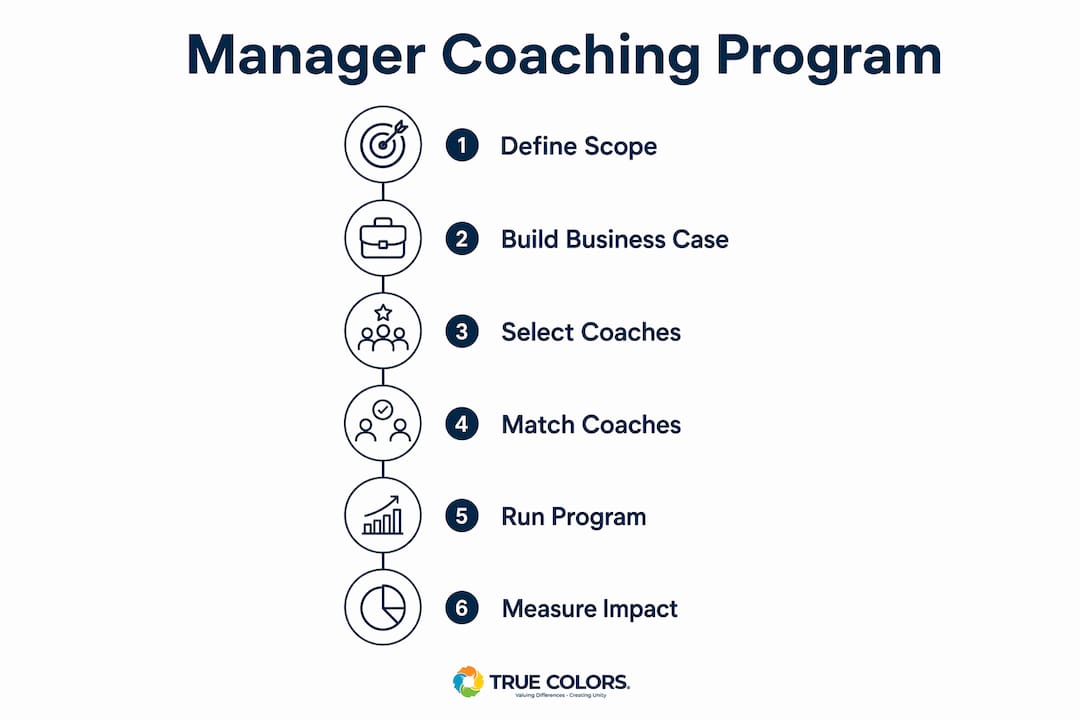
Concrete success criteria HR can adapt include meaningful improvements in manager effectiveness scores, reductions in voluntary turnover on coached managers' teams within a year, or a significant proportion of coached managers rated "promotion-ready" within a reasonable period after program completion. The threshold matters less than the fact that you set one before the program launches.
Pro Tip: Write coaching objectives in the same behavioral language your performance review system uses. When a manager's coaching goal reads like a performance competency, leaders can see the connection — and that visibility protects your budget.
How do you build the business case and set program governance?

The business case for a manager coaching program lives or dies on the metrics executives already track. Retention cost, promotion velocity, and team productivity are the three levers most CFOs and business sponsors respond to. HR's job is to connect coaching investment to movement on those levers.
A simple ROI framework to track:
- Coaching cost: Coach fees or FTE time, platform costs, training and credentialing, and administration hours.
- Retention lift estimate: Number of managers retained who would otherwise have left, multiplied by estimated replacement cost.
- Promotion velocity: Time from manager role to senior manager role for coached vs. non-coached populations.
- Productivity proxy: Team engagement scores, output metrics, or customer satisfaction scores for teams led by coached managers.
Administrative rigor drives executive buy-in — a dedicated budget line and documented processes are markers of program maturity, not bureaucracy.
Stakeholder governance matrix
| Role | Responsibility | Reporting cadence |
|---|---|---|
| HR program owner | Design, coach QA, data, iteration | Monthly to CHRO |
| Business sponsor | Mandate, participation, escalation | Quarterly to CEO/COO |
| CFO / Finance | Budget approval, ROI review | Quarterly |
| Coaches (internal or external) | Session delivery, notes, flagging | Per engagement |
| Participants (managers) | Attendance, goal progress, feedback | Per session |
The executive one-pager should include: program objective, target population and eligibility criteria, pilot timeline (30/60/90 days), expected outcomes with measurable thresholds, governance structure, and the specific ask — budget amount and named sponsor. Keep it to one page. Executives who have to read three pages to find the ask will not fund the program.
Communicate value using the language of cost avoidance and readiness. "This program is projected to reduce manager turnover by X%, saving an estimated $Y in replacement costs" lands differently than "this program develops leadership skills." The role of HR in leadership development is increasingly strategic — and the business case is where that strategy becomes visible.
Should you use internal, external, or blended coaching delivery?
The delivery model decision shapes budget, confidentiality, and scalability more than any other design choice. There is no universally correct answer, but there is a right answer for your organization's current state.

Internal coaches bring organizational context, lower per-engagement cost, and scalability. They understand the culture, the politics, and the performance language. The trade-off: managers may not speak as freely with someone who shares their reporting chain or attends the same leadership meetings. Senior leaders often prefer external coaches precisely because confidentiality feels more credible with someone outside the organization.
External coaches offer independence, specialist expertise, and a confidentiality boundary that is easier to enforce. They cost more per engagement and require more onboarding to understand your culture and talent context. For senior or high-stakes engagements, that investment is usually justified.
Blended models pair an external coach for senior or sensitive engagements with trained internal coaches for broader frontline programs. This is the most common model in mature enterprise programs — it balances cost with quality and confidentiality with scale.
Decision checklist
Before choosing a model, answer these questions:
- What is the seniority level of the primary coachee population? (Senior leaders: lean external. Frontline managers: lean internal or blended.)
- How sensitive are the coaching topics? (Performance gaps, succession concerns, or interpersonal conflict: lean external.)
- What is the per-engagement budget? (External coaching typically runs higher per session than internal FTE time allocation.)
- Do you have qualified internal coaches available, or would you need to train and certify them?
- What is your target scale? (Hundreds of managers: internal or platform-supported blended. Dozens: external is manageable.)
True Colors International's consulting model supports blended delivery — behavior-based assessments and coach training can be embedded into an enterprise program so internal coaches have a consistent framework and external coaches align to the same behavioral language.
Pro Tip: If you are starting with internal coaches, protect their time explicitly. A coach who is also managing a full HR portfolio will deprioritize coaching when deadlines hit. Allocate a defined percentage of their role to coaching — and hold to it.
How do you select, train, and credential your coaches?
Coach quality is the single variable that determines whether participants trust the program. Credentials matter, but they are not sufficient on their own. Business experience and facilitation skills matter as much as a coaching certification — a coach who cannot connect a behavioral insight to a business outcome will lose a manager's attention by session three.
Coach selection criteria
Look for candidates who demonstrate:
- Credibility with the manager population (prior management experience or deep business exposure)
- Active listening and powerful questioning skills, not just advice-giving
- Comfort with ambiguity and confidentiality discipline
- Familiarity with performance management language and talent processes
- A coaching credential from a recognized body such as the International Coaching Federation (ICF) or equivalent
Coach training outline
A practical internal coach training program covers five areas in sequence:
- Foundation coaching skills: Active listening, powerful questions, goal-setting frameworks, and session structure.
- Behavioral coaching: How to use assessment data (such as True Colors profiles) to surface patterns and create awareness without diagnosing.
- Ethics and confidentiality: What can and cannot be shared with HR, how to handle disclosures, and when to escalate.
- Measurement basics: How to use intake and exit data, how to document session themes without breaching confidentiality, and how to contribute to program-level reporting.
- Calibration sessions: Practice coaching with peer feedback, observed sessions, and debrief with a senior coach or supervisor.
Ongoing quality assurance should include quarterly peer communities of practice, annual recertification or continuing education hours, and a lightweight audit — reviewing anonymized session documentation against program goals — at least once per program cycle. The SHRM People Manager Qualification (PMQ) is a credible credential HR can reference when building internal coach selection criteria, particularly for coaches who will work with frontline managers on communication, performance management, and team leadership.
Pro Tip: Schedule a calibration session at the midpoint of every cohort — not just at the start. Coaches drift. A 60-minute group debrief where coaches share anonymized themes and challenge each other's assumptions keeps quality consistent across a large program.
What does a good coach–manager matching process look like?
Matching is where programs earn or lose participant trust before the first session begins. A poor match — whether based on availability alone or a misread of goals — can end a coaching relationship in two sessions. A structured process prevents that.
Step-by-step matching flow
- Intake: Manager completes a short intake form covering coaching goals, preferred communication style, topics they want to explore, and any constraints (scheduling, language, seniority preference).
- Preferences and goals review: HR or program coordinator reviews intake data and identifies two or three coaches whose background, style, and availability align with the manager's stated goals.
- Shortlist and introduction: Manager receives brief bios or profiles of shortlisted coaches. A 20-minute intro call with each is strongly recommended before a match is confirmed.
- Intro session: A single exploratory session (not counted as a formal coaching session) where coach and manager assess fit.
- Match confirmation: Manager confirms or requests a different coach. HR documents the match and initiates the coaching agreement.
Coaching agreement minimum fields
Every coaching engagement should be governed by a written agreement that covers:
- Stated coaching goals and behavioral objectives
- Session frequency and total duration (e.g., bi-weekly sessions over 6 months)
- Confidentiality boundaries: what the coach will and will not share with HR
- Permissible disclosures: aggregate themes, participation status, and safety concerns
- Data use: how session notes are stored, who can access them, and retention period
- Exit criteria: what constitutes successful completion or early termination
- Conflict-of-interest declaration: coach and manager both sign
Conflict-of-interest guidance deserves its own attention. An internal coach should decline a match when they share a reporting relationship with the manager, have a prior personal relationship that could compromise objectivity, or have a direct stake in the manager's performance outcomes. If a conflict emerges mid-engagement, the protocol should be documented: pause sessions, notify the program coordinator, and reassign within two weeks.
A structured intake and exit process makes it possible to collect baseline and follow-up data that demonstrate impact — which means the matching form is also your first measurement instrument. Keep it short (10–12 questions), but make every question count.
How do you design the program's operating model and cadence?
The operating model is what keeps a coaching program running when the initial enthusiasm fades. Without clear enrollment flows, scheduling rules, and documentation ownership, programs become inconsistent — and inconsistency is what kills participation rates.
Format comparison
| Format | Best for | Typical cadence | Scalability |
|---|---|---|---|
| One-on-one coaching | Senior managers, sensitive topics, succession | Bi-weekly, 45 min | Low (coach-limited) |
| Cohort plus coaching | Frontline upskilling, new manager onboarding | Monthly group + bi-weekly 1:1 | Medium |
| Peer coaching | Broad culture reinforcement, cost-constrained programs | Weekly pairs, 30 min | High |
| Digital/micro-coaching | Skill reinforcement between sessions, scale programs | On-demand or weekly prompts | Very high |
Executive coaching engagements commonly run 6–9 months; performance-focused coaching typically runs 3–6 months; short skill coaching can be under a month. Match the format and duration to the program purpose, not to what is easiest to administer.
Administrative playbook
- Enrollment: Use a defined enrollment window (e.g., quarterly) with a clear application or nomination process. Avoid rolling enrollment in the first year — it creates administrative chaos.
- Scheduling: Coaches own their calendars; managers book within a defined window. A shared scheduling tool prevents the back-and-forth that erodes participation.
- Documentation: Coaches submit a brief session summary (themes only, no content) within 48 hours. HR owns the aggregate data; coaches own the session notes.
- Confidentiality process: Establish a clear protocol for what happens if a coach hears something that requires HR action. Document it, train coaches on it, and include it in the coaching agreement.
Coaching platforms can automate matching, track session activity, and report program health more easily than manual spreadsheets — particularly once a program exceeds 20–30 active engagements. For smaller pilots, a well-structured spreadsheet and calendar tool are sufficient. True Colors' tools integrate with enterprise programs by providing behavioral assessment data that coaches can use as a shared language across sessions, reducing the time spent on self-discovery and accelerating the work of behavior change.
A sample cadence calendar for a 6-month engagement: intake and goal-setting in week one, bi-weekly sessions through month four, a midpoint check-in survey at month three, a final summary session in month six, and a 90-day post-engagement follow-up survey. Coaching should be timed to intersect with talent cycles — schedule midpoint reviews to precede performance calibration, and final summaries to inform succession planning conversations.
How do you measure coaching program impact and prove ROI?
Measurement is where most programs fail — not because the data does not exist, but because HR did not build the measurement architecture before the program launched. Combining quantitative KPIs with qualitative case narratives and midpoint surveys is the most credible way to show behavior change and business impact to executives.
Core KPIs by category
- Engagement: Participation rate, session completion rate, dropout rate, and coach utilization.
- Behavior change: Pre/post 360 scores on targeted competencies, manager self-assessment shifts, and direct report feedback on observable behavior.
- Talent outcomes: Promotion rate of coached managers vs. non-coached peers, voluntary turnover on coached managers' teams, and succession readiness ratings.
- Business signals: Team engagement scores, customer satisfaction or NPS for teams led by coached managers, and productivity metrics where available.
- Coach utilization: Sessions delivered per coach, coach satisfaction ratings, and coach retention in the program.
Measurement timeline
| Milestone | Timing | Owner | Data collected |
|---|---|---|---|
| Intake baseline | Week 1 | HR | Goals, 360 baseline, self-assessment |
| Midpoint check-in | Month 3 | HR + coach | Progress survey, session themes |
| Post-engagement | Month 6 | HR | 360 follow-up, goal attainment |
| 90-day follow-up | Month 9 | HR | Retention, promotion, team data |
| Annual program review | Month 12 | HR + sponsor | Full KPI set, ROI narrative |
To attribute outcomes to coaching rather than to other variables, use a matched-cohort approach: compare coached managers to a similar group of non-coached managers on the same KPIs. A true control group is rarely feasible in organizational settings, but a matched cohort with similar tenure, role level, and team size is a credible alternative that finance and business sponsors will accept.
Pro Tip: Pair every quantitative KPI report with one structured case narrative — a short, anonymized story of a manager whose behavior shifted and what changed on their team as a result. Executives remember stories. The numbers give them permission to believe the story.
What does a realistic coaching program budget look like?
Budget planning is where good program design meets organizational reality. The goal is not to minimize cost — it is to allocate cost in a way that is defensible, trackable, and tied to outcomes.
Common budget line items
- Coach fees: External coaches typically charge per session or per engagement. Internal coach time should be costed as a percentage of FTE salary to make the investment visible.
- Platform fees: Coaching management platforms vary widely in cost depending on features and user count.
- HR administration: Program coordinator time for enrollment, matching, documentation, and reporting.
- Training and credentialing: Initial coach training, ongoing supervision, and recertification costs.
- Assessment tools: Behavioral assessments (such as True Colors profiles) used at intake and midpoint.
- Evaluation costs: Survey tools, 360 administration, and data analysis time.
Funding models
| Model | How it works | Best for |
|---|---|---|
| Central HR budget | HR owns the full cost | Programs with strong CHRO sponsorship |
| Business-unit cost-share | Each BU funds its participants | Decentralized organizations |
| L&D line | Funded from the learning budget | Programs positioned as skill development |
| Leadership development pool | Dedicated fund for high-potential programs | Succession-focused programs |
Outsourcing decisions should be driven by four criteria: sensitivity of the coaching topics (external vendor for senior or high-stakes work), speed to scale (a vendor can deploy faster than training internal coaches), expertise required (specialist coaching skills HR does not have internally), and HR capacity (if the team cannot absorb the administrative load, outsource the administration). Vendor contracts should specify session minimums, coach credential requirements, data ownership and deletion rights, confidentiality obligations, and a defined reporting cadence with agreed KPIs.
What legal and HR policy items does a coaching program require?
Coaching programs touch employment law in ways that are easy to overlook. The most common mistake is treating coaching as an informal conversation — which means no documentation, no agreements, and no protection for the organization or the participant.
Legal checklist
- Confidentiality clauses: Every coaching agreement must define what is confidential, what can be shared with HR, and under what circumstances disclosure is required (safety concerns, legal obligations).
- Data ownership and retention: Who owns session notes? How long are they retained? Who can request access? These questions need written answers before the program launches.
- Permissible disclosures: HR should receive participation status and aggregate themes — not session content. Define this in writing and train coaches on the boundary.
- Vendor data protections: External vendors must sign a data processing agreement that covers subprocessor rules, deletion rights, and breach notification obligations.
- ADA and Title VII compliance: Coaching eligibility criteria must not discriminate on the basis of protected characteristics. The Americans with Disabilities Act and Title VII of the Civil Rights Act apply to development programs as they do to any other employment practice.
Policy clause examples
The following items belong in every coaching agreement:
- "The coach will not share session content with HR, the participant's manager, or any other party without the participant's written consent, except where disclosure is required by law or where the coach has a reasonable belief that the participant or another person is at risk of harm."
- "Participation status (enrolled, active, completed) may be reported to HR in aggregate program reports."
- "Session notes are the property of the coach and will be destroyed within 12 months of engagement close unless the participant requests otherwise."
- "Outcome data (goal attainment ratings, 360 scores) will be reported to HR in anonymized form only, unless the participant consents to individual attribution."
One practical employment law note: coaching must be positioned as a development opportunity, not a disciplinary tool. Using coaching as a performance improvement plan substitute creates legal exposure and destroys participant trust. If a manager is in a formal performance process, coaching is a separate, voluntary track — never a condition of continued employment.
What does a 30/60/90 pilot timeline look like?
A 90-day pilot gives HR enough time to test the matching process, run initial sessions, collect early data, and make a go/no-go decision before committing to full-scale rollout.
Pilot timeline
| Phase | Days | Objectives | Owner | Decision gate |
|---|---|---|---|---|
| Design and launch | 1–30 | Finalize scope, recruit coaches, build agreements, enroll first cohort | HR program owner | Cohort enrolled; agreements signed |
| Early delivery | 30–60 | First sessions delivered, intake data collected, early feedback gathered | Coaches + HR | Participation rate above threshold; no major issues |
| Midpoint and review | 60–90 | Midpoint surveys, stakeholder debrief, go/no-go assessment | HR + sponsor | KPI movement visible; sponsor confirms scale |
Templates HR needs for the pilot
- Intake form: 10–12 questions covering coaching goals, behavioral preferences, scheduling constraints, and baseline self-assessment. Doubles as the first measurement instrument.
- Coaching agreement: One-page document covering goals, frequency, confidentiality, permissible disclosures, data use, and exit criteria. Both parties sign.
- Session agenda template: Opening check-in (5 min), goal review (10 min), core coaching conversation (30–35 min), commitments and next steps (10 min). Adapted from Google's People Management Essentials emphasis on practical, goal-anchored conversations.
- Midpoint survey: 8–10 questions for both manager and coach covering progress toward goals, session quality, and any barriers to engagement.
- Final report template: Summary of goal attainment, behavioral shifts observed, recommended next steps, and anonymized themes for program reporting.
- Pilot go/no-go checklist: Participation rate above 75%, at least one measurable KPI showing early movement, positive stakeholder feedback from sponsor and participants, and confirmed resourcing to scale.
Meeting agenda prompts for the pilot closeout: What worked in the matching process? Where did coaches need more support? What did participants say about confidentiality? What does the data show about early behavior change? What would need to change to serve 3x the number of participants?
How does True Colors' framework connect coaching to culture?
Most manager coaching programs treat coaching as an isolated intervention. True Colors International's approach is different: it connects personal awareness to behavior adoption to organizational alignment, so coaching outcomes reinforce culture rather than existing alongside it.
The framework moves in three stages:
- Assessment (awareness): Managers complete a True Colors behavioral profile that surfaces their natural communication style, decision-making tendencies, and interpersonal patterns. This gives coaches and managers a shared, non-judgmental language for the work ahead.
- Coaching (behavior adoption): Coaches use the profile data to accelerate self-awareness and focus sessions on observable behavior change — not abstract reflection. Goals are written in behavioral terms that connect to performance review language and team outcomes.
- Reinforcement (organizational alignment): Coaching outcomes feed into talent processes — succession planning, promotion readiness ratings, and team development plans. Culture is not what is said. It is what is repeated. Reinforcement activities keep the behavior change visible and consistent after the coaching engagement ends.
Program governance checklist HR can adopt
- Assign a named HR program owner with dedicated time (not a collateral duty)
- Establish a coach QA process: calibration sessions, peer review, and annual recertification
- Set a measurement cadence: intake baseline, midpoint check-in, post-engagement follow-up, and annual program review
- Document coach credentialing requirements and verify them before deployment
- Integrate coaching outcomes with succession planning and performance calibration cycles
- Report program health to the business sponsor quarterly, using both KPI data and case narratives
Coaching outcomes feed talent pipelines most effectively when HR treats the final coaching summary as an input to the succession planning conversation — not a separate document filed in a coaching folder. A manager who has demonstrably improved their feedback delivery and team engagement scores is a different succession candidate than one who has not. The talent development program checklist HR uses for broader programs should include coaching completion and goal attainment as data points in readiness assessments.
Pro Tip: Ask coaches to submit a one-paragraph anonymized "behavior shift" note at the end of each engagement — not a full report, just one observable change and one business outcome it influenced. These notes become the raw material for your executive ROI narrative.
Key Takeaways
A well-governed, HR-led manager coaching program requires clear scope, trained coaches, written agreements, measurable KPIs, and a deliberate pilot-to-scale path to deliver consistent leadership development outcomes.
| Point | Details |
|---|---|
| HR owns design and governance | HR sets scope, coach QA, measurement, and reporting — a business sponsor owns the mandate. |
| Coach quality determines trust | Select coaches with business credibility and coaching skills; credential them through recognized bodies like the ICF or SHRM PMQ. |
| Written agreements protect everyone | Every engagement needs a signed agreement covering goals, confidentiality, permissible disclosures, and exit criteria. |
| Measure before, during, and after | Intake baselines, midpoint surveys, and post-engagement 360s are the minimum measurement architecture. |
| Truecolorsintl links coaching to culture | True Colors' behavior-based framework connects assessment to coaching to reinforcement, so outcomes show up in culture and talent pipelines, not just in session notes. |
The gap between "coaching program" and a coaching culture
There is a version of this conversation that HR has been having for years — and it usually ends the same way. A program gets launched, a few managers participate, someone puts together a slide deck with satisfaction scores, and then the next budget cycle arrives and the program quietly shrinks. The problem is not the coaching. The problem is that the program was never connected to anything the business actually cared about.
The conventional wisdom says: get coaches, match them to managers, and measure satisfaction. That is not wrong, but it is incomplete. Satisfaction is not a business outcome. A manager who says the coaching was "very helpful" and then returns to the same behaviors is not a program success. The measure that matters is whether the manager's team is performing differently six months after the engagement ends.
What most guides underemphasize is the reinforcement layer. Coaching creates awareness. Reinforcement creates habit. Without a deliberate plan to keep new behaviors visible — through peer accountability, manager check-ins, and integration with performance processes — the behavior change fades within 90 days. That is not a coaching failure. It is a program design failure.
The other thing HR leaders consistently underestimate is the administrative discipline required. Documenting session frequency, maintaining intake and exit forms, and enforcing confidentiality rules are not bureaucratic overhead. They are what make the program defensible when a CFO asks for evidence that the investment worked. A program that cannot produce clean participation data and a coherent KPI narrative will not survive the next budget review, regardless of how good the coaching was.
Build the governance first. The coaching will follow.
True Colors International supports your manager coaching program
Building a manager coaching program from scratch is one of the more complex design challenges HR faces — not because the concepts are difficult, but because the execution requires alignment across coaching quality, governance, measurement, and culture reinforcement simultaneously.

Truecolorsintl brings a behavior-based framework that does the work most programs skip: connecting individual coaching to observable behavior change and then anchoring that change in the organization's culture and talent processes. The Connected Leadership Program provides cohort-based leadership development that pairs naturally with one-on-one coaching pilots, giving HR a structured curriculum alongside personalized coaching. For organizations ready to build or scale a manager coaching program, Truecolorsintl's corporate consulting services cover pilot design, coach training, behavioral assessments, and governance support — with measurable outcomes built into the engagement from day one.
The next step is a conversation about your program's scope, your current coaching capacity, and where the gaps are. Contact Truecolorsintl to schedule a pilot design discussion and get a clear picture of what a governed, behavior-based manager coaching program looks like for your organization.
Useful sources for further reading
- SHRM: Build a Business-Driven Coaching Culture: The most comprehensive U.S.-focused toolkit for HR leaders designing coaching programs — includes templates, governance guidance, and program design checklists.
- SHRM People Manager Qualification (PMQ): A credentialing program HR can reference when setting internal coach selection criteria, particularly for frontline manager coaching programs.
- International Coaching Federation (ICF): The primary credentialing body for professional coaches in the U.S. — use ICF credential levels (ACC, PCC, MCC) as a baseline when vetting external coaches.
- Google People Management Essentials: A practical, free resource covering goal setting, feedback, and coaching behaviors that managers can apply immediately — useful for session agenda design and manager pre-work.
- EEOC: Americans with Disabilities Act and Title VII: Primary legal sources for ensuring coaching program eligibility criteria comply with federal anti-discrimination law.
- Center for Creative Leadership (CCL): Research-backed resources on leadership coaching, 360 assessment design, and manager development — particularly useful for measurement frameworks and coach training benchmarks.
- Truecolorsintl: Talent Development Program Checklist: A practical checklist HR can adapt for pilot readiness, program governance, and integration with talent processes.