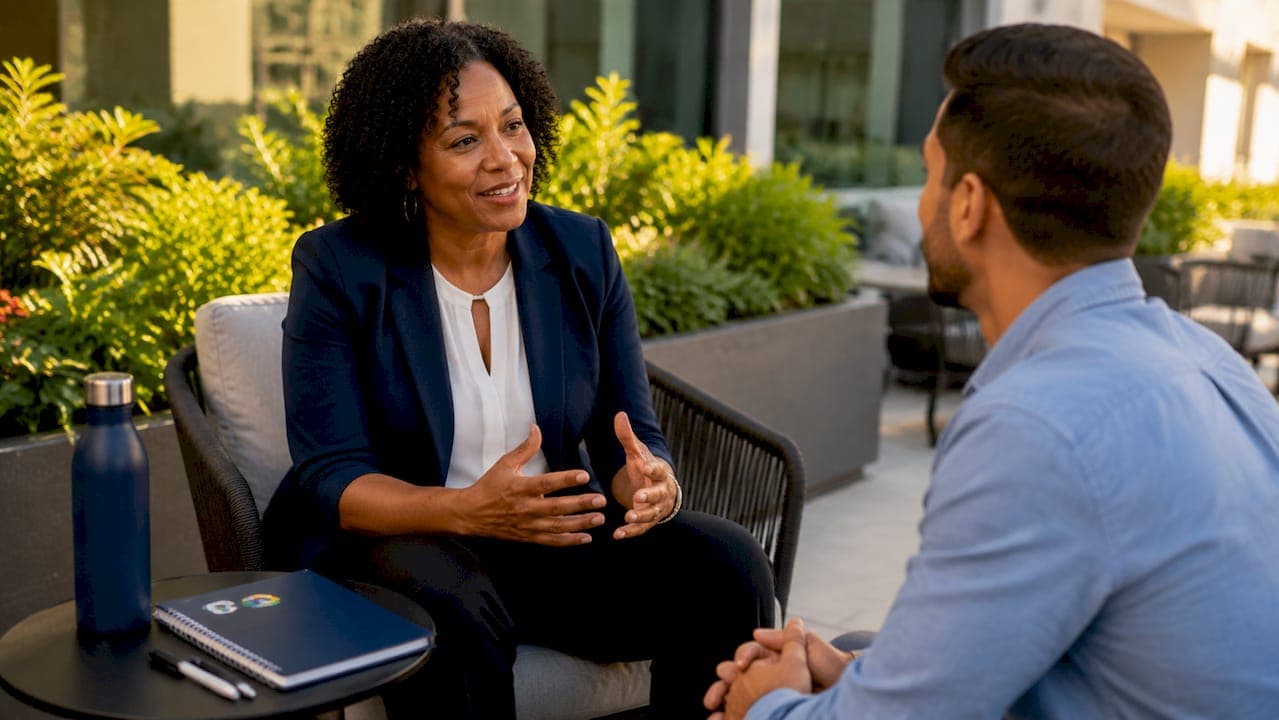
The role of manager as coach is defined as a leadership approach where managers build team capability through active listening, powerful questioning, and supportive dialogue rather than directing tasks. This is not a soft skill. Coaching is an essential business competency that shifts organizational culture from compliance to commitment. Gallup research shows that teaching managers coaching techniques increases team performance by 20% to 28%. That number reflects something deeper than productivity gains. It signals that how managers lead matters as much as what they manage. The industry term for this practice is "manager as coach," and it sits at the intersection of leadership development and organizational behavior change.
What coaching skills must managers master in their role as coaches?
The five foundational coaching competencies for managers are active listening, powerful questioning, developmental feedback, accountability without micromanagement, and knowing when to coach versus when to direct. These are not abstract ideals. Each one maps to a specific behavior that changes how teams experience leadership.
Active listening means giving full attention without preparing your next response. Managers who listen at this level pick up on what employees are not saying, which is often where the real problem lives.
Powerful questioning opens thinking rather than closing it. Questions like "What options haven't you considered yet?" or "What would success look like for you?" push employees to solve problems themselves rather than waiting for answers.
Developmental feedback focuses on growth, not correction. It names specific behaviors, explains their impact, and invites the employee into a conversation about what to do differently.

Accountability without micromanagement means setting clear expectations and following through on commitments made during coaching conversations. Balancing accountability and autonomy is critical. When managers follow through consistently, trust compounds over time.
Knowing when to coach versus when to direct is the competency most managers underestimate. A safety issue or a hard deadline requires direction. A skill gap or a confidence problem requires coaching. Misreading the situation wastes time and erodes credibility.
Pro Tip: Keep a simple log of your conversations for one week. Mark each one as "coaching" or "directing." Most managers are surprised to find they direct far more often than they realize.
How does the managerial mindset need to shift to embrace coaching?
The biggest barrier to effective coaching is not skill. It is identity. Most managers earned their roles by being excellent individual contributors. They solved problems fast, delivered results, and built expertise. Coaching asks them to do the opposite: to hold back, ask questions, and let employees struggle productively.
Kevin Rockmann of George Mason University describes this as shifting from "performer" to "balcony." The balcony view means stepping back from the action to see the full picture and help others navigate it. Managers who stay on the floor, solving every problem themselves, create dependency rather than capability.
Managers who resist providing immediate solutions foster productive struggle that builds team autonomy. The discomfort employees feel when working through a challenge is not a problem to fix. It is the mechanism of growth.
Psychological safety is the foundation this mindset shift requires. Employees will not take risks, admit uncertainty, or ask for help unless they trust that doing so is safe. Managers build that safety through consistency, not through declarations. They build it by responding calmly to mistakes, by asking rather than telling, and by keeping their word.
The dual-role paradox adds another layer of complexity. Managers hold formal authority over the people they coach. That power dynamic does not disappear during a coaching conversation. Acknowledging it openly, and distinguishing clearly between coaching conversations and performance conversations, protects the trust that coaching depends on.
Pro Tip: Before your next one-on-one, write down one question you genuinely do not know the answer to. Ask it. The act of not knowing something in front of your team is one of the fastest ways to build psychological safety.
How can managers integrate coaching into daily leadership?
Coaching does not require a separate calendar. It lives inside the work managers already do. The key is learning to recognize coaching opportunities within routine interactions and treating them differently than operational check-ins.
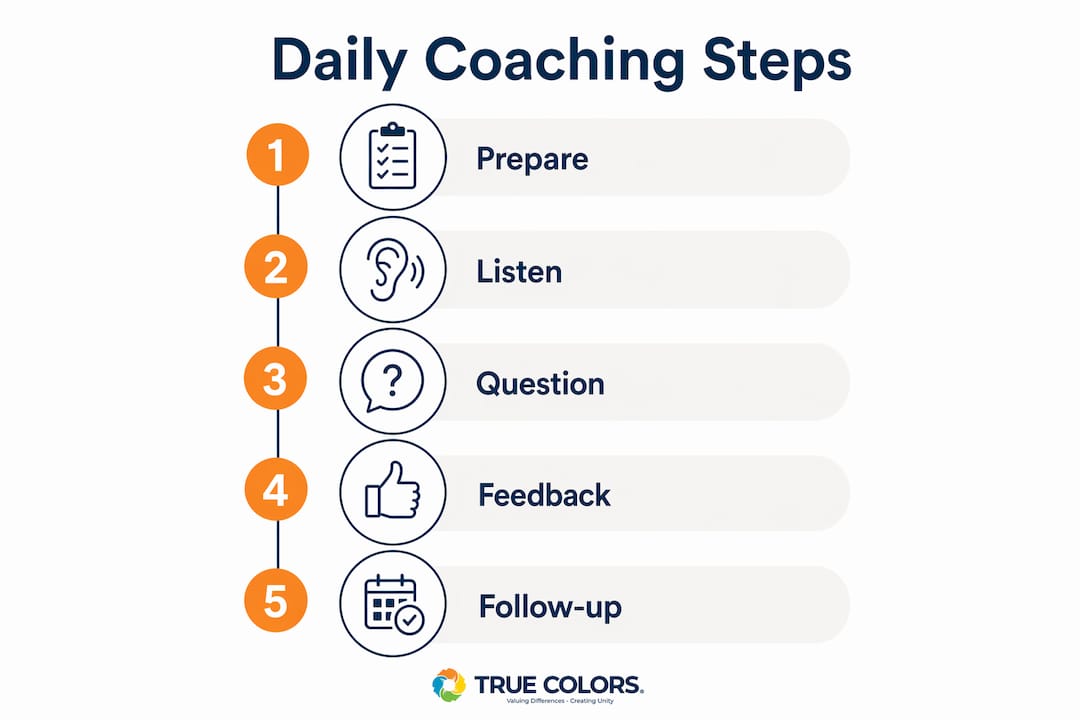
Managers need to set aside dedicated time for coaching to prevent it from being deprioritized when operational pressure rises. A weekly 30-minute one-on-one structured around the employee's development, not the manager's task list, is a practical starting point. That single habit changes the relationship between manager and team member over time.
Delegation is one of the most underused coaching tools available. When a manager assigns a project and then asks "How are you planning to approach this?" instead of explaining the approach, they turn a routine handoff into a capability-building conversation. The employee owns the thinking. The manager owns the support.
Here is a practical framework for integrating coaching into the week:
- Start one-on-ones with an open question. "What's on your mind?" or "What do you need to work through today?" shifts the agenda from operational to developmental.
- Separate coaching conversations from managing conversations. When you need to address performance, say so clearly. When you are coaching, say that too. The distinction protects trust.
- Use delegation as a coaching moment. Assign stretch tasks with a follow-up question, not a follow-up instruction.
- Debrief after projects. Ask "What worked? What would you do differently?" before offering your own assessment.
- Follow through on every commitment made in a coaching conversation. Broken promises in coaching conversations damage trust faster than in any other context.
| Coaching behavior | What it replaces | The result |
|---|---|---|
| Asking "What options do you see?" | Providing the answer directly | Employee builds problem-solving confidence |
| Delegating with a follow-up question | Delegating with detailed instructions | Employee develops ownership and judgment |
| Scheduling dedicated development time | Treating one-on-ones as status updates | Relationship shifts from transactional to developmental |
| Naming the conversation type (coaching vs. managing) | Blending feedback and coaching | Psychological safety increases |
Building team confidence and competence through these daily habits is not a program. It is a practice. The managers who do it well are not the ones who attended a workshop. They are the ones who kept practicing after the workshop ended.
Why do organizational and generational factors make coaching more critical now?
The workforce has changed in ways that make directive management less effective than it once was. Younger employees expect managers to invest in their development through coaching, and when that expectation goes unmet, they leave. Turnover is expensive. Replacing a single employee typically costs a significant portion of their annual salary, and that cost does not account for lost institutional knowledge or team disruption.
Teams led by coaching managers demonstrate higher engagement, greater adaptability, and lower turnover than those led by directive managers. That finding holds across industries and team sizes. The mechanism is straightforward: when employees feel developed rather than managed, they invest more of themselves in their work.
Hybrid and distributed work environments amplify this effect. When managers cannot observe their teams directly, they must rely on trust and capability rather than oversight. Coaching builds both. A team that has been coached to solve problems independently performs better when the manager is not in the room, which is increasingly the norm.
Several organizational factors make coaching a structural necessity:
- Cultural alignment: Coaching conversations surface misalignment between individual goals and organizational direction before it becomes a retention problem.
- Adaptability: Employees who have been coached to think through problems adapt faster when conditions change.
- Employee experience: Rapport and trust built through coaching reduce conflict and make difficult conversations easier to have when they are needed.
- Leadership pipeline: Managers who coach develop the next generation of leaders from within, reducing hiring costs and preserving culture.
Coaching builds trust that makes difficult conversations easier and more effective. That is not a secondary benefit. In organizations navigating change, that trust is the difference between a team that holds together and one that fragments.
Key Takeaways
Managers who adopt a coaching role build teams that perform better, adapt faster, and stay longer because coaching shifts the foundation of leadership from authority to capability.
| Point | Details |
|---|---|
| Coaching drives measurable performance | Gallup research links manager coaching techniques to a 20%–28% increase in team performance. |
| Five competencies define the coaching manager | Active listening, powerful questioning, developmental feedback, accountability, and knowing when to direct are the core skills. |
| Mindset shift precedes skill development | Managers must move from problem solver to facilitator before coaching techniques become effective. |
| Daily integration beats occasional workshops | Skills learned in workshops deteriorate without reinforcement; coaching must be embedded in routine leadership behaviors. |
| Coaching is a retention tool | Younger employees expect developmental investment, and teams with coaching managers show lower turnover. |
The identity shift no one warns managers about
What I have observed consistently is that the hardest part of becoming a coaching manager is not learning the techniques. The techniques are teachable. The hard part is letting go of the identity that got you promoted.
Most managers became managers because they were the best at something. They had answers. They moved fast. They fixed things. Coaching asks you to slow down, ask questions you already know the answer to, and watch someone else struggle through a problem you could solve in five minutes. That feels inefficient. It feels like you are not doing your job. That feeling is wrong, but it is real, and it does not go away quickly.
What I have seen in teams where managers made this shift is striking. The manager becomes less busy, not more. Employees stop bringing every problem upstairs. Decision-making moves closer to the work. The manager's job changes from firefighting to building, and that is a better job by almost every measure.
Skills learned in coaching workshops deteriorate rapidly without reinforcement. That finding should change how organizations invest in coaching development. A two-day workshop followed by nothing is not a coaching program. It is a good intention with a short shelf life. Sustained coaching culture requires ongoing support, peer accountability, and leadership that models the behavior from the top.
The managers I have seen succeed at this did not do it alone. They had access to frameworks that helped them understand their own behavior patterns and those of their team members. Truecolorsintl's approach to behavior-based leadership development gives managers exactly that kind of practical foundation. It connects self-awareness to observable leadership behavior, which is where coaching actually happens.
— Theresa
How Truecolorsintl supports managers in building a coaching culture
Developing coaching skills requires more than good intentions. It requires a system that connects self-awareness to leadership behavior and keeps that connection alive over time.

Truecolorsintl works with organizations to make that system real. Through corporate consulting and coaching programs, Truecolorsintl helps managers understand their own behavioral tendencies, recognize those of their team members, and build the habits that make coaching a consistent practice rather than an occasional effort. The Connected Leadership program gives managers a structured path from awareness to application, with reinforcement built in. If your organization is ready to move from telling to developing, Truecolorsintl's leadership programs offer a practical starting point grounded in real behavior change.
FAQ
What is the role of manager as coach?
The role of manager as coach is defined as a leadership approach where managers build employee capability through active listening, powerful questioning, and developmental feedback rather than directing tasks. This approach improves team performance, engagement, and retention.
How is coaching different from managing?
Coaching focuses on developing an employee's thinking and capability, while managing focuses on directing tasks and ensuring operational outcomes. Effective managers distinguish between the two and use each at the right moment.
What are the most important coaching skills for managers?
The five core coaching skills for managers are active listening, powerful questioning, developmental feedback, accountability without micromanagement, and knowing when to coach versus when to direct.
Why does coaching improve employee retention?
Younger employees expect managers to invest in their development, and teams led by coaching managers show higher engagement and lower turnover than those led by directive managers. When employees feel developed, they stay.
How can managers find time to coach without neglecting operations?
Managers can integrate coaching into existing routines by restructuring one-on-ones around employee development, using delegation as a coaching opportunity, and scheduling dedicated coaching time that does not compete with operational meetings.